
AI Automation Jobs in 2026: Roles, Salaries, and How to Break In
Every week the headlines tell you AI is coming for your job. The same week, your LinkedIn feed fills with AI automation roles paying six figures. If you're a marketer, an ops manager, or an analyst who can feel parts of your own workflow getting automated, you're probably asking the quiet question nobody says out loud in standups: do I get replaced, or do I become the person who runs the automation? The boom in ai automation jobs is real, and the answer to that question is more in your hands than the doom-scrolling suggests.
Two numbers sit in direct opposition here. The IMF estimates that around 60% of jobs in advanced economies are exposed to AI — but roughly half of those exposed roles are likely to be augmented, not eliminated. Meanwhile, AI generated roughly 5 million new positions globally in 2025, according to ElectroIQ AI Job Creation Statistics. Exposure is not extinction.
This piece breaks down the actual roles emerging in 2026, what they pay with real salary bands, and the realistic path in. No hype. No doom. Just the map.

Table of Contents
- Which Jobs AI Automation Is Creating vs. Eliminating in 2026
- The 7 Core AI Automation Roles Worth Targeting
- What These Roles Actually Pay — 2026 Salary Ranges
- The Skills That Separate Hireable Candidates From Hopefuls
- How to Break In Without a CS Degree
- Where AI Automation Jobs Are Heading by 2028
- Your 30-Day AI Automation Job-Entry Plan
- Frequently Asked Questions
Which Jobs AI Automation Is Creating vs. Eliminating in 2026
Reframe the fear precisely. It is not "jobs disappearing." It is task displacement and role reshaping. AI absorbs tasks. Humans get pushed up the stack toward orchestration and judgment. The work that survives is the work that decides what gets automated, supervises it in production, and fixes it when it breaks.
The IMF's exposure split is the anchor data point. Around 60% of advanced-economy jobs are exposed to AI, with roughly half of those exposed roles likely to be augmented and roughly half facing substitution risk. "Exposed" does not mean "eliminated." It means the task mix inside the job is changing. That distinction is the whole game.
The World Economic Forum's Future of Jobs 2025 coverage reinforces it. Employers expect substantial restructuring of roles rather than one-for-one elimination, plus a major "skills reset" toward analytical, creative, and technology skills. Restructuring creates new seats. Someone has to fill them.
And there's hard field evidence that AI deployment builds higher-leverage operator roles instead of pure headcount cuts. A Brookings-published call-center study found that generative AI assistance produced a 14% productivity increase per hour worked, with the largest gains going to less-experienced workers. That is the signature of augmentation, not replacement: the tool makes the human worth more.
| Tasks AI Now Absorbs | Roles Growing Because of It |
|---|---|
| Manual data entry & enrichment | AI automation specialists / orchestrators |
| First-draft content & copy | AI content & SEO operators |
| Support ticket triage & routing | Conversational AI / chatbot designers |
| Basic reporting & dashboards | AIOps managers |
| Repetitive QA & data validation | Human-in-the-loop reviewers |
The two columns are causally linked, not coincidentally adjacent. Every automated workflow on the left needs someone on the right to build it, wire its triggers, supervise its output, and own the result. When AI drafts first-copy at scale, businesses run automated content pipelines that draft while you sleep — and those pipelines need an operator who configures and governs them. When ticket routing gets automated, someone designs the conversation trees and reviews the transcripts. The displacement of the task manufactures the role.
Don't hand-wave the counterweight, though. MIT's Daron Acemoglu warns there is no automatic guarantee that AI creates enough new tasks to offset what it automates. Much current investment goes to what he calls "so-so automation" — replacing routine work without producing high-quality new roles. The takeaway is not "everything's fine." It's that the safe roles cluster on the augmentation side, and you have agency in which side you land on. You don't wait to find out. You position.
The safest job in 2026 isn't the one AI can't touch — it's the one that decides what AI touches next.
The 7 Core AI Automation Roles Worth Targeting
These are the seven roles where demand is concentrating. For each, here's a one-line definition, what the day-to-day actually looks like, and the real entry difficulty.
AI Automation Specialist — Builds no-code and low-code workflows in Zapier, Make, and n8n that chain apps, APIs, and AI models into end-to-end automations. Day-to-day, you map a manual process, wire triggers and actions, then test the edge cases that break it. The Zapier "agents" pattern — chaining tools plus AI without writing code — is exactly this role's core skill. Entry difficulty: Medium-Low. This is the most accessible technical-adjacent path in the list.
Prompt / AI Workflow Engineer — Designs the instructions and multi-step prompt chains that make AI outputs reliable inside a workflow. The job is writing, testing, and versioning prompts; reducing hallucination; and building reusable templates that other people's automations depend on. It's less about clever wording and more about engineering for consistency. Entry difficulty: Medium.
AI Operations (AIOps) Manager — Owns AI systems in production: monitoring, incident response, performance audits. This role maps almost one-to-one onto the NIST AI Risk Management Framework functions of MAP, MEASURE, MANAGE, and GOVERN. In practice that means continuous monitoring, rollback procedures, and bias checks on live systems. Entry difficulty: High.
Conversational AI / Chatbot Designer — Designs dialogue flows, intents, and fallback handling for support and sales bots. The day-to-day is mapping conversation trees, reviewing real transcripts, and tuning responses so the bot stops failing on the queries customers actually send. Entry difficulty: Medium.
AI Content & SEO Operator — Runs automated content production pipelines: keyword research, drafting, fact-checking, publishing. You configure the pipeline, review output quality against a bar, and manage publishing cadence. The skill that matters is judgment — knowing what good looks like and where the automation needs a human gate. The SEO copywriting software these operators run handles the heavy lifting; the operator owns the standard. Entry difficulty: Low-Medium.
Machine Learning Ops (MLOps) Engineer — The most technical role here. You deploy, scale, and maintain ML models in production: CI/CD for models, data pipelines, monitoring infrastructure. This one requires real coding, not configuration. Entry difficulty: High.
Human-in-the-Loop QA / AI Reviewer — Reviews and corrects AI outputs, flags errors, and enforces quality and compliance gates. This role has a direct regulatory tailwind: the EU AI Act classifies workplace AI systems as high-risk and mandates human oversight, which means organizations legally need people in this seat. Entry difficulty: Low — the lowest barrier on this list.

What These Roles Actually Pay — 2026 Salary Ranges
Anchor everything on the overall AI talent benchmark. The median advertised AI salary in Q1 2025 was $156,998, up 0.8% quarter-over-quarter, according to vendor analysis from Veritone. That's the broad AI-roles median across functions. Many automation-heavy titles sit below this median at entry and converge toward or above it at senior levels as outcome-ownership grows.
A note on the table before you read it: only two rows carry hard, sourced salary numbers — AI Automation Specialist and Prompt / AI Workflow Engineer. The rest of the roles have no dedicated published band in the research, so those cells read "No published band." The Remote-Friendly and Barrier-to-Entry columns are author-assessed editorial classifications derived from role descriptions, not sourced metrics. Treat them as informed orientation, not measured data.
| Role | Entry | Mid | Senior |
|---|---|---|---|
| AI Automation Specialist | $80K–$110K | $115K–$150K | $160K+ |
| Prompt / AI Workflow Engineer | ~$95K | ~$126K | $270K+ |
| AIOps Manager | No published band | — | — |
| Conversational AI Designer | No published band | — | — |
| AI Content & SEO Operator | No published band | — | — |
| MLOps Engineer | No published band | — | — |
| Human-in-the-Loop QA | No published band | — | — |
| Role | Remote-Friendly? | Barrier to Entry |
|---|---|---|
| AI Automation Specialist | High | Medium-Low |
| Prompt / AI Workflow Engineer | High | Medium |
| AIOps Manager | Medium | High |
| Conversational AI Designer | High | Medium |
| AI Content & SEO Operator | High | Low-Medium |
| MLOps Engineer | Medium | High |
| Human-in-the-Loop QA | High | Low |
The hard numbers come from two sources. Vendor guide RefonteLearning reports AI Automation Engineer bands of $80K–$110K entry, $115K–$150K mid, and $160K+ senior — a clean proxy for the Specialist role. For prompt engineers, RefonteLearning reports total compensation spanning roughly $95K to $270K+ depending on seniority, domain, and employer. Coursera's salary guide adds a useful mid-point: around $126,000 per year at 4–6 years of experience.
Three things drive the spread. First, technical depth — MLOps and deep engineering roles that require real code command the top of the market. Second, industry and outcome ownership — the more directly your work moves revenue or cuts cost, the more you earn, regardless of title. Third, location and remote flexibility — automation work that lives entirely in cloud tools opens you to a wider, often higher-paying market.
For career switchers, two roles offer the best return on effort: AI Automation Specialist and Human-in-the-Loop QA. Both have a lower barrier, real entry paths, and fast time-to-first-role. The Specialist even has published bands you can target. The macro caveat from the IMF matters here, though: gains may concentrate among high-skilled workers and capital owners unless workers reskill into complementary roles. So pick a role with a real upward ladder, not just an open door. The door gets you in. The ladder keeps you earning.
You don't get paid for knowing the tool — you get paid for owning the outcome the tool produces.
The Skills That Separate Hireable Candidates From Hopefuls
Here's the underrated argument, stated plainly: domain knowledge plus automation beats pure technical skill. The evidence backs it. That Brookings call-center study found AI's biggest productivity gains — the 14% average lift — went to less-experienced workers who gained leverage from the tool. The differentiator wasn't raw coding ability. It was process understanding and the judgment to apply the tool well. WEF's "Great Skills Reset" points the same direction: employers prioritize analytical thinking, creative thinking, and AI skills alongside resilience and flexibility.
The skills split into two clusters.
Technical foundations:
- Workflow tool fluency — Zapier, Make, n8n. You need to wire a multi-step automation end to end without getting stuck. This is the table-stakes technical skill, and it's learnable in weeks, not years.
- APIs & webhooks basics — Understand triggers, payloads, and authentication well enough to connect tools that don't natively integrate. You don't need to build APIs. You need to consume them.
- Prompt design — Write reliable, testable, versioned prompts that reduce error rates. Treat prompts like code: they get tested, versioned, and improved, not written once and forgotten.
- Data literacy — Read metrics, validate outputs, and spot when an automation drifts off-spec. An automation that silently fails is worse than no automation, and you're the early-warning system.
Judgment skills:
- Process mapping — Decomposing a messy human workflow into clean automatable steps. This is the single most transferable skill in the entire field. Master it and you can walk into any vertical.
- ROI thinking — Quantifying hours saved or revenue generated, then framing the automation in business terms. Nobody approves an automation because it's clever. They approve it because it saves $40K a year.
- Error-handling mindset — Designing for failure: fallbacks, human review gates, graceful degradation. This aligns directly with the NIST AI RMF emphasis on continuous monitoring and human oversight.
- Domain expertise — Knowing which workflows in a given vertical are actually worth automating. The technologist who doesn't understand the business automates the wrong thing efficiently. You won't.

How to Break In Without a CS Degree
The spine of this path is one sentence: a portfolio of working automations beats certifications. A certificate proves you sat through a course. A working automation with a measured outcome proves you can do the job. Hiring managers know the difference. Here's the sequence.
1. Pick a vertical you already understand. E-commerce ops, real estate, agency marketing, customer support — whatever you actually know. You bring domain knowledge the pure technologist lacks, which means you already know which workflows are painful enough to be worth automating. That's your edge. Don't surrender it by starting from scratch in an unfamiliar industry.
2. Automate one real workflow. Choose something genuinely painful and repetitive — lead enrichment, weekly report generation, ticket routing. One real automation that solves an actual problem beats ten tutorials you followed along with. Real problems have edge cases, and handling edge cases is the skill.
3. Build it with free or cheap tools. Zapier, Make, and n8n all have free tiers. You need zero budget to produce proof. The constraint is your time and attention, not money, which removes the most common excuse for not starting.
4. Measure the outcome. Capture the baseline against the result: hours saved per week, leads processed, response time cut. This is the productivity-lift framing that turns a hobby project into a hireable case study. A number is the difference between "I built a thing" and "I saved 6 hours a week."
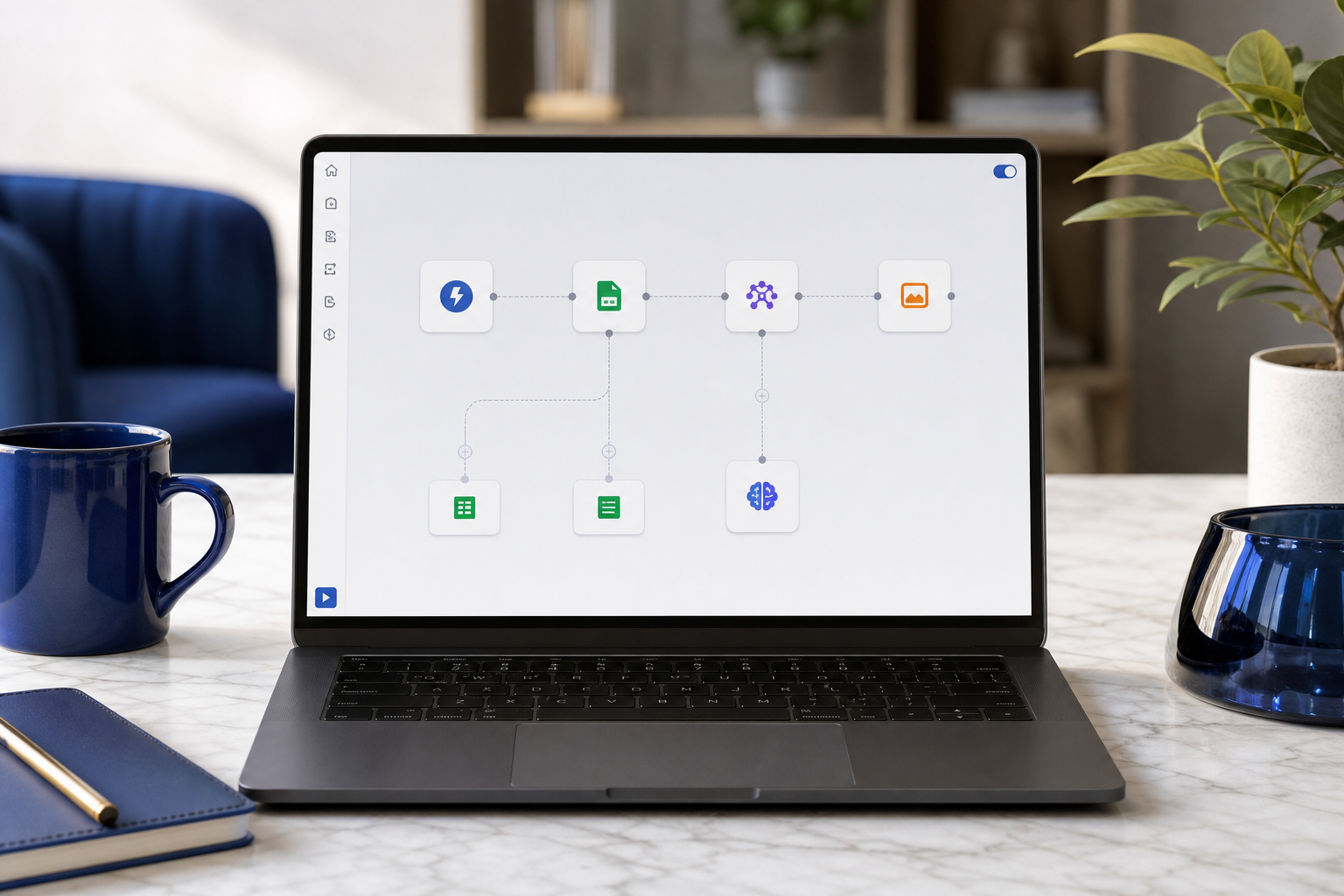
5. Document it as a portfolio case study. Problem → Tool → Outcome → Hours saved. One page with a screenshot of the workflow canvas. That's it. The discipline of writing it down also forces you to articulate the business value, which is exactly what you'll do in the interview.
6. Position yourself where these roles hire. Map your case study to a specific target role from the roles section. Post in no-code and automation communities. Apply on the right job boards. Or skip the queue entirely and pitch it as freelance to a business in your vertical, or propose the role internally to your current employer. The case study works the same in all three channels.
Where AI Automation Jobs Are Heading by 2028 — Betting on Durable Skills
Forward-looking, but grounded. Three shifts are already underway, and each one tells you where to place your skill bets.
Agentic AI raises the orchestration ceiling. As AI agents chain steps autonomously — calling tools, making decisions, executing multi-step tasks without a human pressing go at each stage — the human job moves further up the stack. You stop building each individual step and start designing, supervising, and governing whole agent systems. This expands orchestration roles rather than collapsing them. The Zapier agents pattern is the live example: a non-developer assembles tools, APIs, and AI models into a system that runs itself, and the operator's job becomes deciding what the system should do and catching it when it does something it shouldn't. That's a more valuable job than wiring step three of seven.
Tool consolidation and churn. Point tools will merge, rebrand, and get acquired repeatedly between now and 2028. If you bet your career on mastering one platform's exact interface, you're betting on a tool that may not exist in its current form in three years. The durable bet is process thinking and outcome ownership — the skills that transfer across whichever platform wins the consolidation wars. Learn Zapier, but learn it as one expression of a transferable skill, not as the skill itself. The person who understands why an automation is structured a certain way rebuilds it in any tool. The person who only memorized the clicks starts over every time.
The rise of the automation generalist inside small businesses. This is the live, non-theoretical proof that automation creates jobs. Small businesses increasingly run automated pipelines themselves — marketing, SEO content, customer support — rather than outsourcing to agencies on retainer. A bootstrapped founder connects a tool, and an automated content pipeline researches keywords, drafts articles, and publishes daily. But that pipeline doesn't run unattended forever. Someone has to own it: set the standard, review the edge cases, decide the cadence, and fix it when output quality drifts. That someone is an operator, and the operator role didn't exist before the automation did. When a local business hires an SEO company or brings the function in-house, they're increasingly hiring for pipeline ownership, not manual production. The automation created the seat.
Balance this with macro honesty. WEF's research points to restructuring rather than wholesale elimination, which supports the optimistic read — but restructuring still displaces people who don't move with it. And Acemoglu's caution stands: augmentation is not automatic. It depends on how firms actually deploy AI. A company that buys automation purely to cut headcount produces no new high-quality roles. A company that uses it to push its people up the stack produces plenty. You can't control which kind of company you end up in, but you can control whether your skill set makes you the obvious person to keep when the restructuring happens.
There's also a regulatory tailwind worth naming. The EU AI Act classifies workplace AI as high-risk and mandates human oversight, documentation, and transparency. That's not just compliance overhead — it structurally creates demand for AIOps managers, compliance specialists, and human-in-the-loop reviewers. Regulation is, in effect, legislating certain automation jobs into existence. When the law requires a human in the loop, a human gets hired for the loop.
Pull all three shifts together and the strategic conclusion is clean. The tools will reset. The platforms will churn. The regulations will tighten. Through all of it, the person who can walk into a messy workflow, map it into automatable steps, attach a number to the outcome, and govern the system that runs it stays employable. Skill in any single tool is a depreciating asset. Process thinking compounds.
The tools will change three times before 2028. The person who maps the process survives every reset.
Your 30-Day AI Automation Job-Entry Plan
Here's a week-by-week briefing you can start Monday. It operationalizes the break-in steps and the roles section — so map back to those rather than re-reading them.
Week 1 — Choose + Audit. Pick the vertical you know best. Audit one painful, repetitive workflow inside it. Record the baseline in hard terms: how long it takes, how often it runs, and what errors cost when it goes wrong. The baseline is what makes your eventual result credible. Skip it and you have a project with no proof.
Week 2 — Build + Measure. Build the automation in a free no-code tool — Zapier, Make, or n8n. Don't over-engineer it; solve the one workflow you audited. Then capture the result against your Week 1 baseline: hours saved, throughput gained, error reduction. The measurement is the whole point. An automation without a measured outcome is a demo. An automation with one is evidence.
Week 3 — Document + Map. Write the case study using the template below. Then map it to a specific target role from the roles section. AI Automation Specialist, AI Content & SEO Operator, and Human-in-the-Loop QA are the fastest entries, so aim there unless your background points elsewhere. The mapping turns a generic project into a targeted application asset.
Week 4 — Apply / Pitch / Propose. Run three channels in parallel. Apply to matching roles on the right boards. Pitch the case study as freelance to a business in your vertical. And propose the role internally to your current employer — often the easiest entry, because they already trust you and you already know their workflows. One case study, three shots on goal.
Automation Case Study Template
Problem: [The manual workflow and what it cost — hours/week, errors, delays]
Tool: [Zapier / Make / n8n + any AI model used]
Build: [Trigger → steps → output, in one or two sentences]
Outcome: [Hours saved per week / leads processed / response time cut — with numbers]
The durable-skills thesis, one last time: the person holding a working automation plus a measured outcome walks into the interview having already done the job. Everyone else is describing what they'd theoretically do. You're showing what you already did. That gap is the entire game.
Frequently Asked Questions
Do I need to learn to code for AI automation jobs?
No — not for most of them. The automation specialist and operator roles run on no-code tools like Zapier, Make, and n8n, plus prompt design. Coding is only essential for MLOps and deep engineering roles. For everyone else, the break-in path holds: a portfolio of working no-code automations with measured outcomes beats a stack of certifications. Build something real, attach a number to it, and you've cleared the bar that matters most to hiring managers.
Are AI automation jobs safe from being automated themselves?
The orchestration and judgment layers are the most durable parts of the field. Agentic AI raises the ceiling on what systems can do autonomously, but those systems still need humans to design them, govern them, and fix them when they break. There's also a structural reason these roles persist: the EU AI Act mandates human oversight for high-risk workplace AI. When the law requires a human in the loop, the loop role doesn't get automated away.
What's the difference between an AI Automation Specialist and an MLOps Engineer?
A Specialist wires existing tools and models into business workflows using no-code platforms — a lower barrier and an entry band of roughly $80K–$110K per RefonteLearning. An MLOps Engineer deploys and maintains machine learning models in production with real code, data pipelines, and CI/CD infrastructure, which carries a high barrier and demands genuine engineering skill. For benchmark context, the broad AI-roles median sat near $157K in Q1 2025, with the most technical roles clustering at the top.
Can I get an AI automation job remotely or from outside the US?
Yes. Most automation roles are highly remote-friendly because the work lives entirely in cloud tools — you build, monitor, and govern from anywhere with a connection. And the demand isn't US-only. The IMF's exposure data spans advanced and emerging markets, with around 40% of global employment exposed to AI. Where workflows are exposed, augmentation and operator roles follow. That makes the opportunity genuinely global, not confined to a few coastal tech hubs.