
how to automate seo content: How to Automate Your SEO Content Workflow From Start to Finish
Most people who blog for their business know the late-night ritual: a blank document, a half-remembered keyword idea, an hour lost to formatting, and a post that finally goes live at midnight — then silence, because one article a month rarely moves rankings. Learning how to automate SEO content changes that rhythm entirely. Instead of you personally shepherding every step from research to publish, a connected system handles the repetitive work daily while you keep control of strategy, quality, and brand voice.
This guide breaks down what an automated SEO content workflow actually looks like, which stages benefit most from automation, where a human still has to stay in charge to satisfy Google's quality expectations, and how a platform like AymarTech stitches the whole cycle together — research, writing, internal linking, images, and publishing — without asking you to babysit a stack of separate tools.
Table of contents
- What automating your SEO content workflow really means
- The seven stages of an SEO content workflow
- Where automation works and where humans stay in charge
- Building an automated SEO engine with AymarTech
- Measuring, iterating, and scaling your content program
- Frequently asked questions
What automating your SEO content workflow really means
Automation is not the same as a single AI writer spitting out drafts. Content workflow automation means using tools to handle the repetitive tasks across the full lifecycle of a piece of SEO content — from topic ideation and keyword research through writing, optimization, publishing, and reporting. The point is to remove manual handoffs between disconnected tools, which is where most teams lose time and introduce errors.
An SEO automation platform, more broadly, is software that uses AI and automation to perform SEO tasks that would otherwise be done by hand: drafting outlines and meta descriptions, generating content, and monitoring technical health such as broken links, schema, and title tags. The distinction that matters for your workflow is coverage. A drafting tool automates one step. A workflow platform aims to connect research, planning, drafting, optimization, publishing, and performance monitoring into one path.
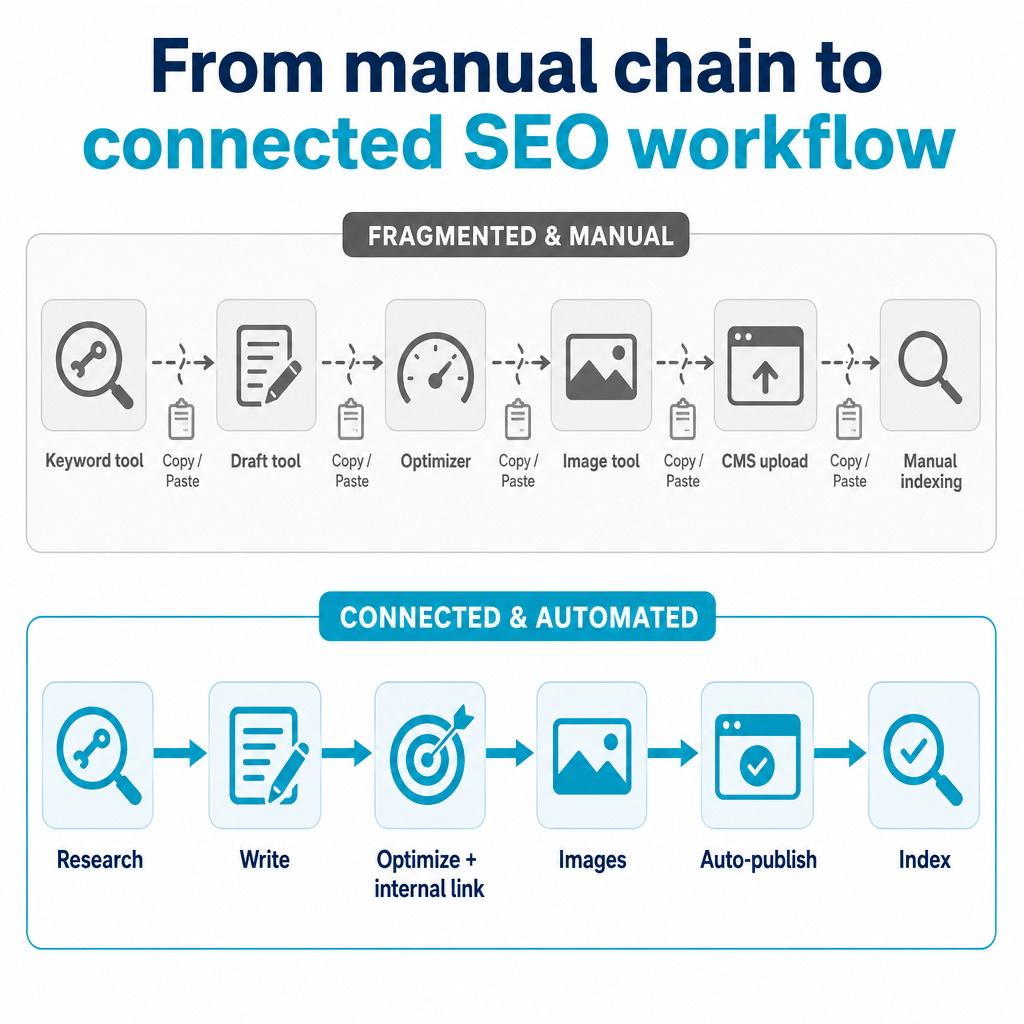
That difference is the whole game when you are deciding how to automate SEO content at scale. If your "automation" still requires you to copy a draft out of one app, paste it into an optimizer, download an image from somewhere else, format it in your CMS, and manually request indexing, you have not automated the workflow — you have just added a text generator to a manual chain. Real automation compresses those handoffs so the output of one stage feeds directly into the next.
Automation versus a pile of point solutions
Non-integrated workflows tend to chain separate products: one for keyword discovery, one for briefs, one for writing, one for on-page scoring, one for image creation, and yet another for scheduling. Each tool is fine on its own, but the seams between them are where latency, cost, and inconsistency creep in. Every export and re-import is a chance for tone to drift, for a keyword to get dropped, or for a formatting quirk to break your template.
The practical test for any buyer is simple: does the platform genuinely cover research, drafting, optimization, internal linking, images, publishing, and indexing — or will you still be duct-taping extra tools around it? The fewer manual bridges you have to build and maintain, the closer you are to a workflow that actually runs on its own.
The seven stages of an SEO content workflow
A mature end-to-end SEO workflow can be broken into distinct stages, and each one presents a different automation opportunity. Mapping your process against these stages tells you exactly where you are still doing manual work that a system could carry.
1. Demand mapping and keyword discovery. This is where you identify what your audience is searching for and which terms are worth targeting. AI-driven keyword research can surface candidate topics and assign priority far faster than manual spreadsheet work.
2. Clustering and topic architecture. Individual keywords are grouped into topic clusters so your content builds authority around themes rather than scattering across random posts. Automated categorization by topic cluster and priority keeps the structure coherent as volume grows.
3. Brief generation and editorial governance. Before writing, a brief sets the angle, target keyword, and structure. This is also where quality standards and brand rules should be enforced so every draft starts from the same baseline.
4. Constrained content creation. The actual drafting. "Constrained" is the operative word — the writing should follow the brief, hit the target keyword naturally, and stay inside your brand voice rather than producing generic filler.
5. On-page optimization and schema. Titles, meta descriptions, headings, and internal linking are aligned to the target query. Real-time optimization at this stage is one of the highest-value things to automate because it is repetitive and rule-based.
6. Publishing and internal distribution. The finished post is pushed to your CMS and connected to related pages through internal links. Native publishing to platforms like WordPress removes the manual upload step entirely.
7. External distribution and monitoring. After publishing, you track rankings, traffic, and technical issues, then feed what you learn back into stage one. Automated performance monitoring catches ranking shifts and broken links without someone checking manually.
Which stages give back the most time
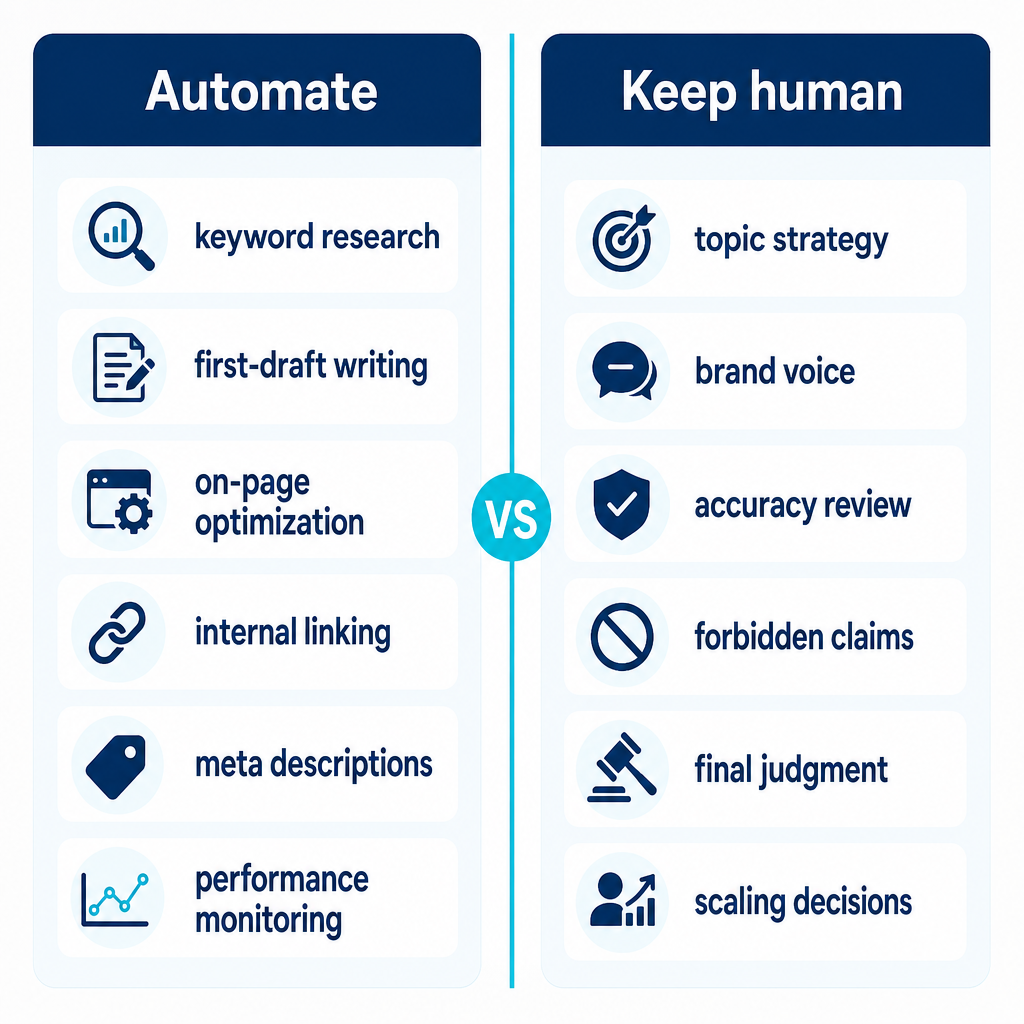
The stages that reward automation most are the repetitive, high-frequency ones: keyword research, first-draft generation, on-page updates, and reporting. These are also the tasks that a workflow guide will consistently flag as safe to hand to tools because they follow clear patterns. Strategy and final judgment sit at the other end of the spectrum, which is exactly why the next section matters.
If you want to see how tooling maps to these stages in practice, our roundup of the best AI tools for content writing in 2026 breaks down where individual tools fit versus what a connected platform handles on its own.
Where automation works and where humans stay in charge
The temptation with any automated system is to assume that once it runs, you can stop paying attention. That assumption is where automated content programs get into trouble. Google permits AI-generated content in Search, but only when it meets the same standards as anything else — useful, original, non-spammy content that helps people rather than existing purely to manipulate rankings. According to Google's guidance on generative AI content, automatically generated content becomes a problem precisely when its only purpose is to game the algorithm.
That framing is the guardrail for every automation decision. Automation is a production method, not a loophole. The distinction Google draws is about intent and quality, not about whether a human or a model typed the words.
What automation should own
Tools and AI reliably handle the repetitive execution layer: keyword research, first-draft generation, on-page updates, meta descriptions, internal linking suggestions, and performance reporting. These tasks are pattern-based, high-volume, and low-judgment, which makes them ideal candidates to run continuously. Automating them frees your attention for the decisions that actually differentiate your brand.
What humans must keep
Strategy, judgment, and brand voice belong to people. That means deciding which topics fit your business, defining the tone and the claims you will and won't make, and reviewing output for accuracy. Guidance attributed to Google's Gary Illyes reinforces the point: AI-generated content should receive editorial oversight to ensure correctness and accuracy. In practice, that oversight can happen before publishing during a pilot, or through ongoing spot-checks once you trust the system's baseline quality.
A sensible way to codify this is to write your standards down before you automate anything — target topics, tone, forbidden claims, and any regulated language specific to your industry. Best-practice advice on SEO content automation consistently recommends starting with a workflow audit, documenting brand guidelines and quality standards, piloting on a single content type, choosing a tool compatible with your stack, and scaling gradually rather than flipping everything to autopilot on day one.
The indexing reality check
One place automation claims deserve careful reading is indexing. It is tempting to assume that a "Google API" can push any new blog post straight into the index on demand. The official Google Indexing API documentation is explicit that the Indexing API is designed for job postings and livestreaming video pages, and Google recommends using it only for those page types. Third-party SEO coverage echoes the same limitation.
For ordinary blog content, the compliant path to getting indexed is the standard one: crawlable internal links, an XML sitemap, and Search Console's request-indexing tools. So when any platform describes automated indexing for standard articles, the honest interpretation is that it is helping content get discovered and crawled through supported mechanisms — not buying privileged placement. Treat fast discovery as a workflow convenience, not a ranking guarantee.
Building an automated SEO engine with AymarTech
This is where the abstract workflow becomes something you can actually switch on. AymarTech is positioned as an AI-powered SEO platform that researches, writes, fact-checks, and publishes original blog content to your website on autopilot — built for businesses that want organic traffic and AI visibility without hiring writers or juggling multiple SEO tools. Rather than automating one stage, it aims to cover the full lifecycle so the handoffs described earlier simply disappear.
Here is how the stages map to setup and operation.
Connect your site and set up a business profile. You link your CMS — WordPress, Shopify, Webflow, Wix, and more — and configure a business profile that captures who you are and how you sound. Once that groundwork is in place, the platform takes over daily SEO content production. The profile is what lets the output stay on-brand instead of reading like generic AI text.
Automated research and strategic keywords. Rather than generating random posts, AymarTech performs keyword research and topic discovery aligned to your business goals, with each article assigned a strategic keyword chosen specifically for your business. That maps directly to the demand-mapping and clustering stages of the workflow.
Daily writing in your brand voice. The platform drafts SEO-optimized blog posts written in your brand's voice, aimed at organic growth. Daily cadence is the difference-maker here — consistent publishing is exactly what a workflow-automation approach is meant to sustain without you finding the hours each week.
Fact-checking before publish. AymarTech states that content is fact-checked before publishing, adding a validation layer on top of raw generation. This aligns with the editorial-oversight principle Google emphasizes, and during a pilot you can confirm the accuracy of that layer for your own topics before trusting it at volume.
On-page optimization and smart internal linking. The platform handles real-time SEO optimization including titles, metadata, and internal linking across your site. Internal linking in particular is tedious to maintain by hand and easy to neglect, so automating it keeps your topic architecture connected as your library grows.
On-brand images. Each content package includes on-brand images, removing the separate step of sourcing or generating visuals in another tool and formatting them for your template.
Auto-publishing and discovery. Finished posts publish directly to your connected CMS, and content is auto-indexed via the Google API so it can enter the Google index. As noted above, for standard blog content the realistic value of automated indexing is faster, compliant discovery through supported mechanisms rather than any guaranteed ranking effect — so read it as a convenience, not a promise.
150+ languages and AI visibility. The platform supports content generation in 150+ languages, and its stated aim goes beyond traditional Google rankings to earning citations in AI assistants like ChatGPT, Claude, Perplexity, and Gemini. For businesses thinking about global reach or an AI-first content strategy, that widens the definition of "organic visibility" beyond the classic search results page.
The throughline is that native, multi-CMS publishing plus built-in research, optimization, internal linking, and images collapses the fragmented tool chain into a single connected workflow. That is the concrete advantage over a generic AI writer that leaves you doing the copy-paste, formatting, and uploading yourself.
If you are still assembling your toolkit and comparing options, our ranked review of the best AI writing tools of 2026 is a useful companion for understanding what a standalone writer does versus what a full workflow platform absorbs. And if you are rethinking the site those posts will live on, the collection of AI website examples can spark ideas for the destination your automated content is feeding.
A realistic setup timeline
A sensible rollout does not go from zero to full autopilot overnight. A practical sequence looks like this: audit your current content workflow and note the repetitive tasks; write down your strategy, quality standards, and brand voice; connect your site and configure the business profile; run a pilot on a single cluster of four to eight posts and review them for accuracy and tone; then scale to daily publishing once the quality holds. This mirrors the pilot-then-scale approach that automation best practices recommend, and it keeps human judgment in the loop exactly where Google expects it.
Measuring, iterating, and scaling your content program
Automation does not end the work — it changes what the work is. Once posts are publishing daily, your job shifts from producing content to steering it. That means watching performance and feeding what you learn back into the strategy.
Mature SEO workflows lean on automated performance monitoring to catch ranking shifts, traffic anomalies, and broken links, plus iterative optimization based on that data. When you evaluate any automation platform, look for visibility into what it publishes, some form of ranking and traffic reporting, and the ability to pause, adjust topics, or refine the keyword strategy. Those controls are what turn a content firehose into a program you can actually manage.
The iteration loop that keeps quality high
The monitoring stage closes the circle back to demand mapping. As data accumulates, you learn which clusters earn traffic, which topics stall, and where you might be missing intent. Periodically adjusting your keyword strategy and clusters based on that performance data is what separates a content program that compounds from one that plateaus. Automation makes the loop faster because the reporting and the production sit in the same system, but the decision about what to double down on stays yours.
Deciding whether to automate at all
Not every business needs a fully automated engine, and it is worth being honest with yourself before committing. If you publish rarely, guard a highly technical or heavily regulated voice, and have an editor who reviews everything line by line, a lighter setup may suit you. If you want consistent organic growth, cannot justify hiring writers, and are tired of stitching tools together, an end-to-end platform is the more natural fit.
The deciding factors come down to three questions. How much manual handoff time are you losing today across research, writing, formatting, and publishing? How comfortable are you defining brand voice and quality rules up front so a system can enforce them? And how much ongoing oversight can you realistically commit to, given that Google expects editorial judgment to stay in the picture? Your answers point you toward the right level of automation.
The cleanest way to find out is to start small: audit your workflow, document your standards, connect a site, and run a pilot cluster you review before scaling. If the first batch reads on-brand and holds up on accuracy, you have the evidence you need to let it run daily.
Frequently asked questions
Will Google penalize AI-generated or automated content?
Not for being AI-generated on its own. Google's guidance confirms that AI content is acceptable in Search as long as it meets Search Essentials — useful, original, helpful content — and complies with spam policies. The risk comes from automated content produced solely to manipulate rankings without serving readers. Keep quality and intent high, apply editorial oversight for accuracy, and automation is a production method, not a violation.
How do I keep automated content in my brand voice?
Define your voice before you automate. Write down your tone, target topics, and any claims you will not make, then use a platform that captures a business profile so output stays on-brand. AymarTech writes in your brand's voice based on the profile you configure, but the quality of what comes out still depends on the clarity of the standards you set going in. Review a pilot batch to confirm the voice holds before scaling.
Does a platform really cover the whole workflow, or will I still need other tools?
That is the exact question to test. A genuine workflow platform should handle research, drafting, on-page optimization, internal linking, images, and publishing without you bridging tools by hand. AymarTech is positioned to cover that full cycle and publish natively to WordPress, Shopify, Webflow, Wix, and more. Confirm each stage against your own needs, because coverage — not just drafting — is what makes automation worthwhile.
Can automation get my blog posts indexed instantly?
Be cautious with instant-indexing claims. Google's official Indexing API is intended for job postings and livestreaming video pages, not general blog content. For standard articles, indexing happens through crawlable internal links, XML sitemaps, and Search Console. Automated indexing features can speed compliant discovery, but no supported mechanism guarantees immediate or privileged placement for ordinary posts.
How fast should I scale automated publishing?
Start with a pilot — one topic cluster or roughly four to eight posts — and review them for accuracy, tone, and early performance. Once quality holds up, scale to daily or high-volume publishing while monitoring rankings and traffic. Scaling gradually protects your brand and gives you a baseline to judge whether the automated output meets your standards before it runs unattended.
What still requires human involvement once it is running?
Strategy, judgment, and accuracy checks. You decide which topics fit your business, set the quality and brand rules, and review output periodically to catch anything off. Google's guidance emphasizes editorial oversight for correctness, so treat the platform as handling execution while you own direction. The goal is minimal effort, not zero attention.