
ai fact checking content tool: AI Fact-Checking Tools: How to Keep Automated Content Accurate
A confidently written blog post can be completely wrong, and readers rarely notice until the damage is done. That gap between fluent prose and factual reality is exactly why an ai fact checking content tool has moved from a nice-to-have into the core of any serious automated publishing setup. When one analysis of AI answers to news questions reported an error rate near 45%, it stopped being a theoretical concern and became a publishing risk you carry every time you hit "schedule." For small business owners, SaaS founders, and marketing teams running content on autopilot, the question is no longer whether AI can write quickly. It clearly can. The real question is whether what it publishes is accurate enough to earn trust, rank, and get cited by the AI assistants your customers now ask.
AymarTech was built around that exact tension. It researches, writes, fact-checks, and publishes original, brand-voice blog content to your site daily, with verification treated as a first-class step rather than an afterthought bolted onto a writing tool. This article explains what fact-checking layers actually do, why they matter for automated SEO content, and how AymarTech folds real-time research and verification into a single publishing pipeline you can hand off with confidence.
Table of contents
- Why accuracy is the real bottleneck in automated content
- What an AI fact-checking content tool actually does
- How AymarTech builds fact-checking into the SEO pipeline
- Implementing AymarTech as your fact-checked content engine
- When to layer external verification on top
- Frequently asked questions
Why accuracy is the real bottleneck in automated content
Speed was the first promise of AI writing, and most tools delivered it. The problem is that a large language model generates the most statistically plausible next sentence, not the most factually correct one. It will state a wrong statistic, a misremembered date, or an invented product feature with the same calm authority it uses for things it gets right. That behavior, often called hallucination, is not a rare glitch. The Clarity practical guide to AI fact-checking summarizes research pointing to roughly a 45% error rate when general-purpose AI is asked news-style factual questions, which is a sobering baseline for anyone publishing informational content at volume.
For a business blog, an inaccurate article does more than embarrass you. It erodes the trust that makes a reader convert. Search engines increasingly reward content that demonstrates genuine expertise and reliability, and AI assistants that summarize the web tend to cite sources they can corroborate. Publish enough shaky claims and you are not just wasting effort, you are teaching both humans and algorithms to discount your domain. In regulated or sensitive niches such as finance, health, or legal services, a single wrong claim can carry real consequences.
The cost compounds when publishing is automated. Manual blogging has a natural human checkpoint: someone reads the draft before it goes live. Remove that checkpoint to gain scale, and every unverified error ships instantly and permanently until someone notices. This is the trap many teams fall into when they chase output. They automate the writing but not the checking, which means they have simply industrialized the production of confident-sounding mistakes.

The answer is not to abandon automation and go back to hand-writing every post. That surrenders the scale advantage entirely. The answer is to automate the verification alongside the writing, so accuracy scales at the same pace as output. That is the specific job an ai fact checking content tool is meant to do inside a modern content workflow.
What an AI fact-checking content tool actually does
It helps to be precise about terms, because the market blurs three very different capabilities. The Clarity essential guide to AI content verification draws a clear line between fact-checking, AI detection, and grammar checking. Grammar tools clean up mechanics. AI detection tools try to answer whether a piece of text was written by a machine, which tells you nothing about whether the claims inside it are true. Fact-checking, or content verification, is the only one of the three that evaluates a draft for factual accuracy, citation integrity, logical consistency, and unsupported claims before it reaches the public.
According to that same guide, robust verification typically combines several moves. It checks factual claims against independent, current sources rather than relying on the model's internal memory. It examines internal consistency, catching a draft that contradicts itself between paragraphs. It assesses citation integrity, confirming that a referenced source actually supports the claim attached to it. And it flags assertions that have no supporting evidence at all, so they can be softened, sourced, or removed.
There is a growing category of standalone tools built for pieces of this work. Directories such as the SourceForge listing of AI fact-checking software catalog platforms that verify claims, detect misinformation, and surface evidence-backed insights in real time. These specialist tools are useful, but most of them do one thing: they check text you already have. They do not perform keyword research, they do not write to your brand voice, and they do not publish to your site. If you use them alone, you are still stitching together a writing tool, a verification tool, and a publishing process by hand.
Verification is the step that decides whether automated content is an asset you can trust or a liability you have to police.
That distinction matters when you evaluate options. A dedicated checker sitting outside your workflow adds a manual handoff, and manual handoffs are exactly what teams pursuing hands-off growth are trying to eliminate. The more valuable design keeps verification inside the pipeline that also researches, writes, and publishes, so nothing goes live without passing through the check. If you want a broader view of the tools shaping this space, our overview of the best AI writing tools of 2026 puts writing and verification capabilities side by side.
How AymarTech builds fact-checking into the SEO pipeline
AymarTech's core message is deliberately verb-driven: it researches, writes, fact-checks, and publishes. Fact-checking is not an add-on feature buried in a settings menu. It appears explicitly in the platform's "everything you need in one platform" feature set, listed alongside real-time research, keyword research, content generation, content optimization, AI images, and localization. The same stack is mirrored on the platform's other language landing pages, where verification is named as a built-in component of the workflow rather than an optional extra.
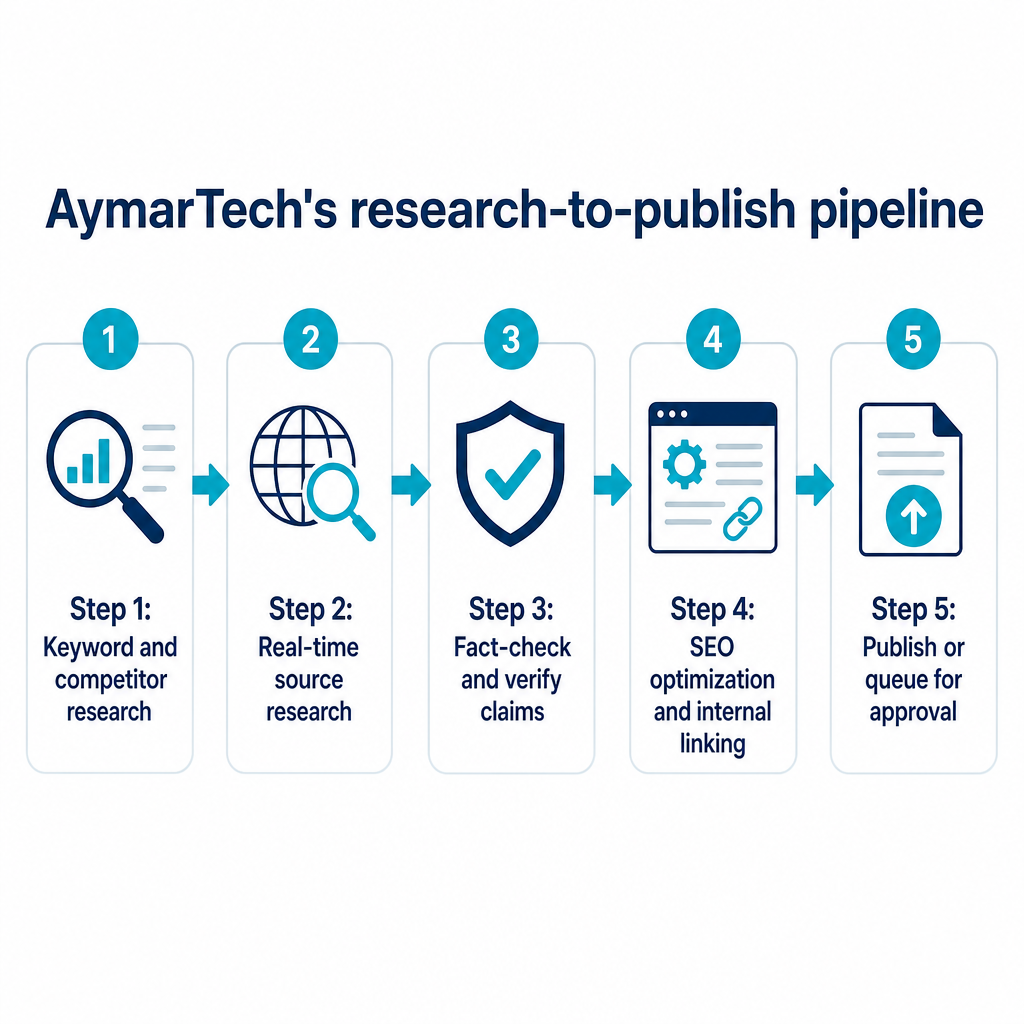
What makes this different from bolting a checker onto a writer is the sequence. AymarTech first analyzes your market and competitors to find high-potential keywords, then researches each article in real time against live sources, then fact-checks the claims, then optimizes the piece for search and weaves in smart internal links, and finally publishes or queues it for approval. Coverage of the platform's launch describes it verifying claims against multiple sources before publication and structuring articles for search indexing, which is the practical meaning of embedding verification inside an SEO pipeline rather than beside it.
Because the research happens in real time, the fact-checking has something current to check against. This is the mechanism that reduces hallucination: rather than asking a model to recall a statistic from training data, the platform grounds the draft in freshly gathered evidence and then verifies the resulting claims. That combination of real-time research plus verification is the specific safety layer general AI writers lack.
Accuracy is only half the value. Content also has to sound like you, and it has to actually reach your site. AymarTech models brand voice by ingesting your existing content and training on sentence rhythm, not just vocabulary, so drafts arrive close to your native tone and need limited editing. It publishes directly into common systems, integrating with WordPress, Shopify, Webflow, Wix, Notion, Framer, and an API or webhook path for anything custom. And it works across more than 150 languages, which means the same verification and voice modeling extend to international content instead of leaving translated pages unchecked.
All of this sits behind a single flat subscription rather than a stack of separate licenses. That consolidation is the point. Instead of paying for a writer, a fact-checker, an image tool, and a publishing plugin and then managing the handoffs between them, you run one pipeline where verification is already wired in. If you want to see how the surrounding automation fits together, our guide to automating your SEO content workflow from start to finish walks through the full loop.
One honest note on transparency: AymarTech's public materials describe fact-checking as multi-source verification against current research, but they do not publish the internal mechanics such as exact confidence thresholds or the specifics of how source conflicts are resolved, and no independent accuracy benchmark has been published. Treat verification as a substantial risk-reduction layer designed to cut hallucinations, not as a claim of perfect, measurable accuracy. That framing keeps expectations realistic and your review process appropriately engaged.
Implementing AymarTech as your fact-checked content engine
The attraction of an integrated pipeline is that setup is short and the ongoing effort is small. The platform's own buyer guidance describes a phased onboarding you can complete in the first few days, and it is worth following that sequence rather than switching everything to full autopilot on day one.
Start by connecting your CMS. AymarTech supports WordPress in both its org and.com forms, plus Shopify, Webflow, Wix, Notion, Framer, and a custom API route, so most sites connect without special engineering. Next, upload five to ten of your best-performing articles so the platform can train on your brand voice, learning your rhythm and register rather than a generic house style. This step is what keeps verified content from reading like a stranger wrote it.
Then set a conservative publishing cadence. The guidance suggests something like two articles per week to begin, which gives you a manageable stream to review while you build confidence in both the accuracy and the voice. Finally, choose a single keyword cluster, meaning one pillar topic and its supporting terms, so your early content forms a coherent, interlinked group rather than scattered one-off posts. That structure also helps the internal linking do useful work.
With setup done, treat the first two to four weeks as a pilot. Let the pipeline produce content, but keep a human in the loop focused specifically on two things: is the article accurate, and does it sound like your brand? Brand-voice modeling is reported to bring review time per article to under thirty minutes, so this checkpoint is light rather than a full rewrite. As you confirm that the fact-checking is catching issues and the voice holds, you gradually raise the cadence. The platform is capable of daily publishing, and the flat plan is positioned to cover up to roughly thirty articles a month, so there is meaningful headroom once you trust the output.
This staged approach matters because it lets you validate accuracy and SEO performance before you scale volume, rather than discovering problems after a hundred posts are already live. The point of automation is to remove the grind, not the judgment. A short pilot preserves your judgment where it counts and then steps back once the pipeline has earned it. Teams building or rebuilding their sites around this kind of automated content often find inspiration in our roundup of AI website examples, which shows what a content-driven site can look like in practice.
When to layer external verification on top
An integrated pipeline handles the vast majority of business content well, but it is not a reason to switch off all judgment, especially in high-stakes categories. There are specific situations where adding a second layer of scrutiny is the responsible move.
The clearest case is regulated or compliance-sensitive content. Finance, health, and legal topics carry consequences that ordinary marketing posts do not, and no content platform, AymarTech included, should be treated as a substitute for qualified review. The available evidence does not tie any AI fact-checking tool to specific regulatory standards, so for content that must satisfy sector rules, route it through in-house counsel or a subject-matter expert before it publishes. Use the platform to draft and verify the general claims, then apply human sign-off where the stakes demand it.
A second case is contested or fast-moving claims. Where a topic is genuinely disputed or breaking, the human-led fact-checking organizations that predate AI still matter, and specialist AI checkers listed in directories like SourceForge can serve as an independent second opinion. For a periodic audit of your most important or most sensitive pages, running them through a dedicated verifier gives you a corroborating check from outside your primary pipeline.
The framing to hold onto is complementary, not competitive. Standalone fact-checkers verify text but do not do keyword strategy, brand voice, or publishing. AymarTech runs the end-to-end pipeline with verification built in. For everyday business and SEO content, the integrated approach removes the manual stitching that slows teams down. For the small slice of high-risk material, an occasional external audit or expert review is a sensible addition rather than a replacement. Matching the intensity of review to the actual risk of the content keeps you both efficient and safe.
Frequently asked questions
What is the difference between AI fact-checking and AI content detection?
They answer different questions. AI content detection tries to determine whether text was written by a machine, which says nothing about accuracy. AI fact-checking, or content verification, evaluates whether the claims in a piece are actually true, whether citations support what they are attached to, and whether the logic holds together. As the Clarity guide to AI content verification notes, only fact-checking assesses factual accuracy before publication, which is what protects your credibility.
Does AymarTech's fact-checking replace human review entirely?
It substantially reduces the manual burden by researching in real time and verifying claims before content is published or queued, and brand-voice modeling is reported to cut review time to under thirty minutes per article. For most business content that is enough for a light human checkpoint. For regulated topics such as finance, health, or legal, keep qualified human review in the loop, since no tool should be treated as a guarantee of compliance.
How is fact-checking connected to the rest of the content workflow?
It is embedded directly in the pipeline rather than sold as a separate step. AymarTech researches keywords, gathers live sources, fact-checks the draft, optimizes it for search with internal links, and then publishes to your CMS or queues it for approval. Because verification sits inside the same flow that writes and publishes, nothing reaches your site without passing through the check, and you avoid stitching together multiple tools.
Can it fact-check and publish content in other languages?
Yes. The platform supports generating and publishing content in more than 150 languages, with the same real-time research and verification applied to localized articles. That lets you treat it as both a fact-checking layer and a localization engine for international SEO, so translated pages are not left unchecked while your primary language gets all the scrutiny.
How quickly can a team get started?
Onboarding is designed to be completed in the first few days. You connect your CMS, upload five to ten of your best articles for brand-voice training, set a conservative cadence such as two articles per week, and pick one keyword cluster. Running a two-to-four-week pilot with a light human review focused on accuracy and voice is the recommended way to validate the output before scaling volume toward daily publishing.
Are there published accuracy benchmarks for the fact-checking?
AymarTech describes its verification as grounded in real-time, multi-source research designed to reduce hallucinations, but it does not publish detailed internal mechanics or a specific accuracy benchmark. Treat it as a strong risk-reduction layer rather than a claim of measurable perfection, and keep your review process engaged accordingly, especially for sensitive content.