
What Is an AI SEO Platform? A Clear Beginner Guide
If you are asking what is an ai seo platform, here is the short answer: it is software that uses artificial intelligence and search data together to research topics, create and optimize content, and publish it to your site, so you can grow organic traffic with far less manual work. It is not simply an AI writer. It is closer to an autopilot layer that sits on top of SEO and handles the repetitive, data-heavy tasks that make search results move.
That distinction matters because the label gets stretched. Some products called AI SEO tools only generate text. A full platform bundles keyword research, drafting, on-page optimization, technical checks, publishing, and performance tracking into one connected workflow. This guide explains what these platforms actually do, how they work under the hood, the real decision you are making, and how to judge whether one fits your business.
Table of contents
- • What an AI SEO platform actually is
- • The real decision: platform vs. patchwork of tools
- • How an AI SEO platform works in plain English
- • Where AymarTech fits as a done-for-you platform
- • What actually moves rankings, not just scores
- • Is an AI SEO platform right for you?
- • Risks and tradeoffs to understand
- • Frequently asked questions
What an AI SEO platform actually is
Traditional SEO tools tend to own one slice of the work: keyword research, rank tracking, site audits, or content optimization. An AI SEO platform bundles several of those functions and adds machine-learning models that can interpret search intent, generate content, and surface opportunities faster than a team working tool-by-tool.
Across today's leading platforms, the common capabilities look similar:
- Keyword and topic research built on large search datasets
- Automated content briefs and draft generation using language models
- On-page optimization aligned with the pages already ranking for a query
- Technical checks for metadata, internal links, and indexability, with alerts
- Performance tracking, reporting, and increasingly, visibility tracking inside AI assistants like ChatGPT and Perplexity
The useful mental model is this: an AI SEO platform uses AI and search data in the same loop to influence rankings, not just to produce paragraphs. That is the line that separates a genuine platform from a standalone writing assistant.
The real decision: platform vs. patchwork of tools
The choice in front of a business owner or marketing team is rarely "use AI or don't." The practical decision is whether to keep stitching together separate tools or to centralize the work in one system.
A patchwork setup usually means a writing tool, SEO software, a CMS, an analytics product, and manual publishing. It gives you granular control, but it demands time, process, and people to move each piece of work from keyword research to brief to draft to optimization to upload to indexing. Every handoff is a place where momentum stalls.
An AI SEO platform trades some of that manual control for automation and speed. Instead of a series of one-off tasks, SEO becomes a continuous process that keeps running whether or not anyone remembers to move the next draft along. From a business standpoint, the decision comes down to three questions:
- How much of SEO do you want handled automatically?
- How many tools and people are you willing to coordinate?
- How quickly do you need new, search-optimized content to go live?
If your honest answers point toward less coordination and faster publishing, a platform is the direction. If you have a mature team that wants to tune every variable, a specialized toolset may still serve you better.
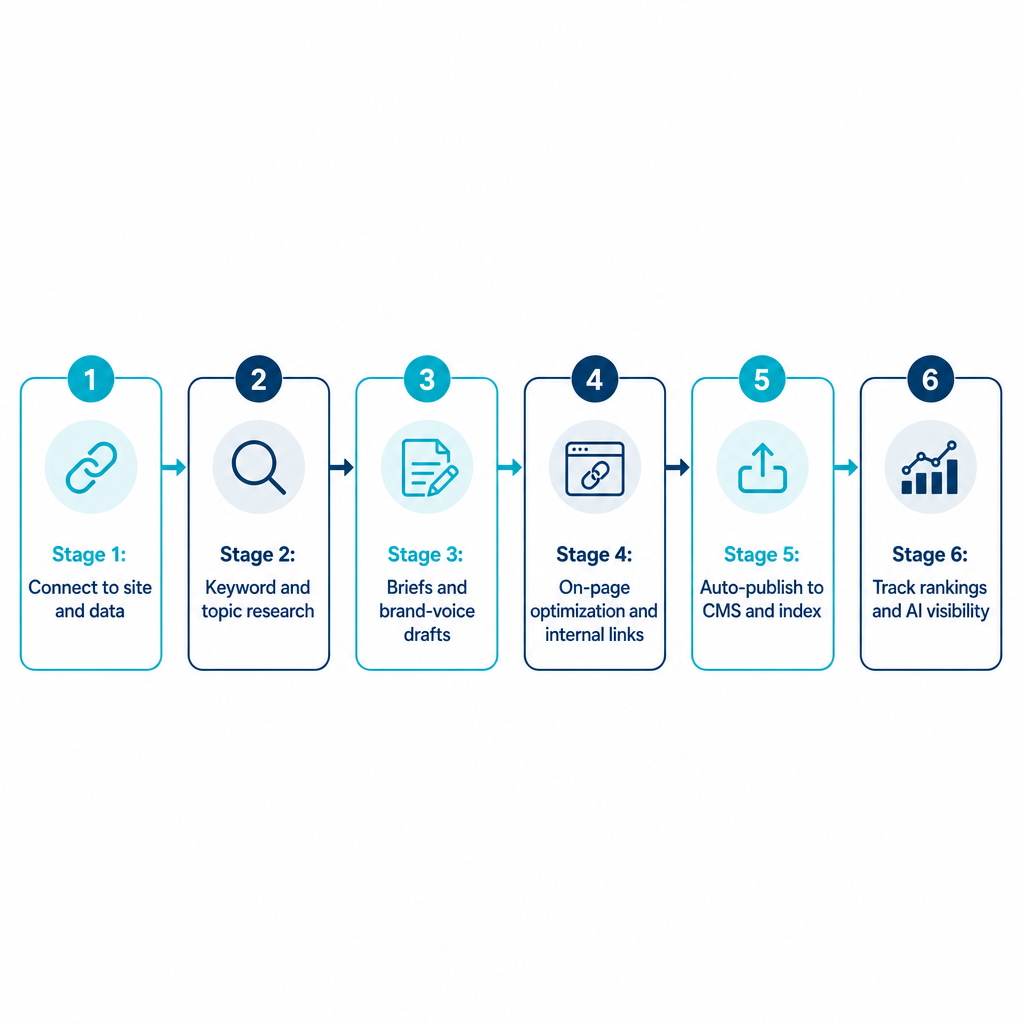
How an AI SEO platform works in plain English
Each product has its own flavor, but most follow a similar mechanism from connection to reporting.
First, it connects to your website and data. The platform integrates with your CMS and can ingest existing content, site structure, and analytics so it understands your topics, internal links, and current performance.
Next, it finds opportunities through keyword and topic research. Using large keyword databases and intent models, it identifies queries your audience searches for, along with difficulty, volume, and the competitive landscape. Stronger systems hunt for low-competition or long-tail terms where your site can realistically rank, then group those keywords into topics and content plans.
Then it generates briefs and drafts in your voice. Language models produce outlines and full drafts that reflect your brand tone once you supply guidelines or sample content. The better the brand-voice input, the less the output reads like generic AI prose.
From there it optimizes and structures content for search. The system compares drafts against the current results, suggests headings, entities, FAQs, and internal links, and handles basics like title tags, meta descriptions, and schema. A well-built platform treats content scoring as an input, not the finish line; the goal is publishing pages that move tracked rankings.
It also publishes and indexes automatically. Instead of handing drafts to a person to upload, the platform can publish directly to your CMS on a schedule, then trigger or monitor indexing through search APIs where they are available. That closes the loop from idea to live, indexable page with minimal manual touch, which is where the "autopilot" value shows up for busy teams.
Finally, it tracks performance and AI visibility. Modern platforms monitor keyword rankings and increasingly watch how your content surfaces inside AI assistants and answer boxes, so you can see whether your brand is present in newer AI-driven search experiences.
Where AymarTech fits as a done-for-you platform
Within that landscape, we built AymarTech as an AI-powered SEO content automation platform rather than a toolbox you still have to operate by hand. The difference is deliberate: our goal is to remove the manual pipeline, not add another dashboard to your stack.
Here is how we work in practice:
- We connect directly to your website and manage the full content pipeline, from keyword research through writing, fact-checking, image generation, internal linking, and publishing to your CMS.
- We write in your brand voice and produce original, SEO-optimized blog content aimed at organic traffic and AI visibility, not filler.
- We auto-publish to common CMS and site builders, including WordPress, Shopify, Webflow, and Wix, then trigger indexing via the Google API so new articles can enter search faster and be surfaced in tools like ChatGPT, Claude, Perplexity, and Gemini.
- We support more than 150 languages, which matters if you serve multilingual audiences or operate across regions.
- Our pricing is a single flat monthly subscription, currently $99 per month including tax, so costs stay predictable for small businesses and lean startups.
The core idea is simple. You define your business profile, brand voice, and publication schedule, and we handle daily research, writing, optimization, and publishing on autopilot. For a small business owner, SaaS founder, or marketing team, that shifts SEO from a labor-intensive project into an ongoing engine that quietly builds topical authority in the background. If you want to see the mechanics, our how it works overview walks through the pipeline, and our published examples show the kind of content it produces.
What actually moves rankings, not just scores
There is a gap between AI tools that make the work feel easier and platforms that genuinely move rankings. The mechanism behind real performance gains is consistent and unglamorous: publish better-targeted content, faster and more consistently, than the sites you are competing with.
AI SEO tools help by speeding up keyword and intent research, producing structured and relevant drafts at scale, and making on-page optimization and internal linking systematic instead of ad hoc. Those are meaningful accelerants. But the ranking improvements themselves come from having more high-quality, search-aligned pages live and indexed, not from AI in the abstract.
That is the honest framing. A platform's job is to reduce friction, enforce good practices, and make it viable to keep publishing useful content long after the initial enthusiasm fades. A high content score on a draft nobody publishes changes nothing. Live, indexed, relevant pages are what compound. If you want the deeper version of this argument, our guide on AI SEO writing tools and rankings unpacks the difference between output and outcomes.
Is an AI SEO platform right for you?
Whether to adopt a platform, and which kind, comes down to a handful of practical criteria.
Start with your current bottleneck. If you already have a solid strategy but cannot produce and publish enough content, a platform that automates writing and publishing matters more than another analytics dashboard. If you publish consistently but lack data-driven research or technical oversight, a platform strong in research and audits is the better fit.
Decide how hands-off you want SEO to be. Small business owners and local service providers often want a near done-for-you setup: define the strategy and brand voice, then review results periodically. SaaS founders and marketing teams may want more control over topics and messaging, using AI to accelerate briefs while keeping humans on final edits. We optimize AymarTech for the first group, businesses that want organic traffic and AI visibility without hiring writers or juggling tools, while still letting you control brand voice and publication settings at the account level.
Weigh content volume and timeline. A platform earns its place when you need steady, ongoing output rather than a handful of posts. If your growth depends on building topical authority in a crowded niche, an automated pipeline can be the difference between publishing weekly and publishing monthly.
Confirm stack compatibility and data access. Check that the platform integrates with your CMS and hosting, can index new pages reliably through supported search APIs, and gives you reporting you can trust and export. Connecting directly to your CMS and using the Google indexing API, as we do, is one way to reduce reliance on manual uploads and slow re-crawls.
Set realistic budget and ROI expectations. AI SEO pricing runs from inexpensive indie tools to enterprise platforms costing thousands per month. The question for a small business or lean SaaS team is whether the monthly cost is outweighed by replaced writer hours, avoided agency retainers, and incremental organic traffic. Flat, predictable pricing makes that math far easier to run.
Risks and tradeoffs to understand
These platforms carry real risks when used carelessly, and naming them keeps your strategy grounded.
Quality and brand risk. AI-generated content can be generic, off-brand, or factually shaky without proper governance. Brand-voice training and fact-checking reduce this, but plan for periodic editorial review anyway.
Over-production and cannibalization. Publishing many similar articles that target overlapping keywords can make your own pages compete with each other, confusing search engines and readers. Sensible topic clustering helps, but your strategy should still favor clarity over sheer volume.
Compliance and accuracy. In regulated fields like finance, health, and legal, AI-written content must be checked for compliance and accuracy. A platform accelerates production; it does not replace subject-matter review.
Dependency on one system. Concentrating research, writing, and publishing in a single platform concentrates operational risk. Keep copies of your content, retain direct analytics access, and maintain a strategy you could execute elsewhere if you ever needed to.
Work through those tradeoffs and an AI SEO platform stops being a shiny object and becomes a deliberate choice.
Frequently asked questions
What is an AI SEO platform in one sentence?
It is software that uses artificial intelligence and search data to research topics, create and optimize content, and publish it to your site, so you can grow organic traffic with less manual work.
How is this different from just using an AI writing tool?
AI writing tools generate text. AI SEO platforms wrap that generation in keyword research, on-page optimization, technical checks, and performance tracking, usually integrated directly with your CMS and analytics.
Can an AI SEO platform replace my SEO agency or writers?
It can replace a large share of repetitive research, drafting, and publishing work, especially for informational blog content. Many teams still keep humans for strategy, brand oversight, and high-stakes pages while the platform handles volume and consistency.
Will using an AI SEO platform hurt my rankings?
Used well, no. These tools help when they publish better-targeted, well-structured content more consistently. Rankings suffer when AI is used to churn out low-quality, duplicative articles with no strategy or editorial control.
Is AymarTech suitable for small US businesses?
Yes. We built AymarTech as a flat-price, done-for-you AI SEO platform that researches, writes, fact-checks, and publishes brand-voice blog content on autopilot, with automatic indexing and support for major CMS platforms, which suits small businesses, founders, and lean marketing teams.
If your main question is still what is an ai seo platform, the practical answer is that it turns SEO from a manual, tool-juggling project into a system that continuously creates and publishes optimized content for you. The next call is how much of that system you want to automate, and whether a done-for-you approach matches your appetite for hands-off growth.