
Ai Seo Writing Tools: AI SEO Writing Tools: How They Actually Move Your Rankings
AI SEO writing tools move rankings only when they connect content generation to real ranking signals — search-aligned topics, matched intent, internal links, and fast indexing. Most tools stop at fast text and leave the ranking levers to you. At AymarTech, we automate the full pipeline, from research to publishing to Google indexing, so the writing itself carries the signals that actually earn positions.
That distinction matters because "ai seo writing tools" is a crowded label that hides very different products. Some are prompt boxes that produce paragraphs. Others research a SERP, structure the piece, link it internally, and push it live where search engines can find it quickly. The gap between those two experiences is the gap between busywork and organic growth.
Table of contents
- What AI SEO writing tools are and how they work
- The four variants — and where ranking impact actually lives
- Why this matters for small businesses, SaaS, and agencies
- What to weigh if rankings are the goal
- Where to go from here
- Frequently asked questions
What AI SEO writing tools are and how they work
An AI SEO writing tool is software that uses language models to produce content shaped for search performance rather than raw text alone. In practice that means several jobs stacked together: analyzing what already ranks for a query, grouping keywords by the intent behind them, drafting structured articles, and optimizing on-page elements like titles and headings. A neutral overview of the category describes these tools handling tasks such as reformulating and summarizing content, grouping keywords by intent, and generating title variants, which is a fair snapshot of the semantic and on-page layer.
The mechanism is worth understanding, because "it writes articles" undersells how rankings are earned. Search engines evaluate a page on topical relevance, information quality, how it fits into your site's internal link structure, freshness, and whether it can even be discovered and indexed. A page can be well written and still stall if it targets the wrong intent, sits orphaned with no internal links, or never gets crawled promptly.
Our platform treats those as one connected system. We research topics and keywords for organic traffic, write original brand-voice articles, fact-check them, generate on-brand images, add internal links, and auto-publish to WordPress, Shopify, Webflow, Wix, and other systems. Then we submit new URLs through the Google Indexing API so pages are discovered quickly rather than waiting for a crawl. That closing step — publishing and indexing without manual copy-paste — is where a lot of "writing" tools quietly stop and hand the real ranking work back to you.
One point clears up most confusion in this category: Google's public guidance treats AI-generated content as acceptable when it is helpful, original, and made for people, and treats thin, mass-produced pages as spam regardless of whether a human or a machine wrote them. The dividing line is quality and intent, not automation. Fact-checking, original research angles, and a consistent brand voice are how content stays on the helpful side of that line.
The four variants — and where ranking impact actually lives
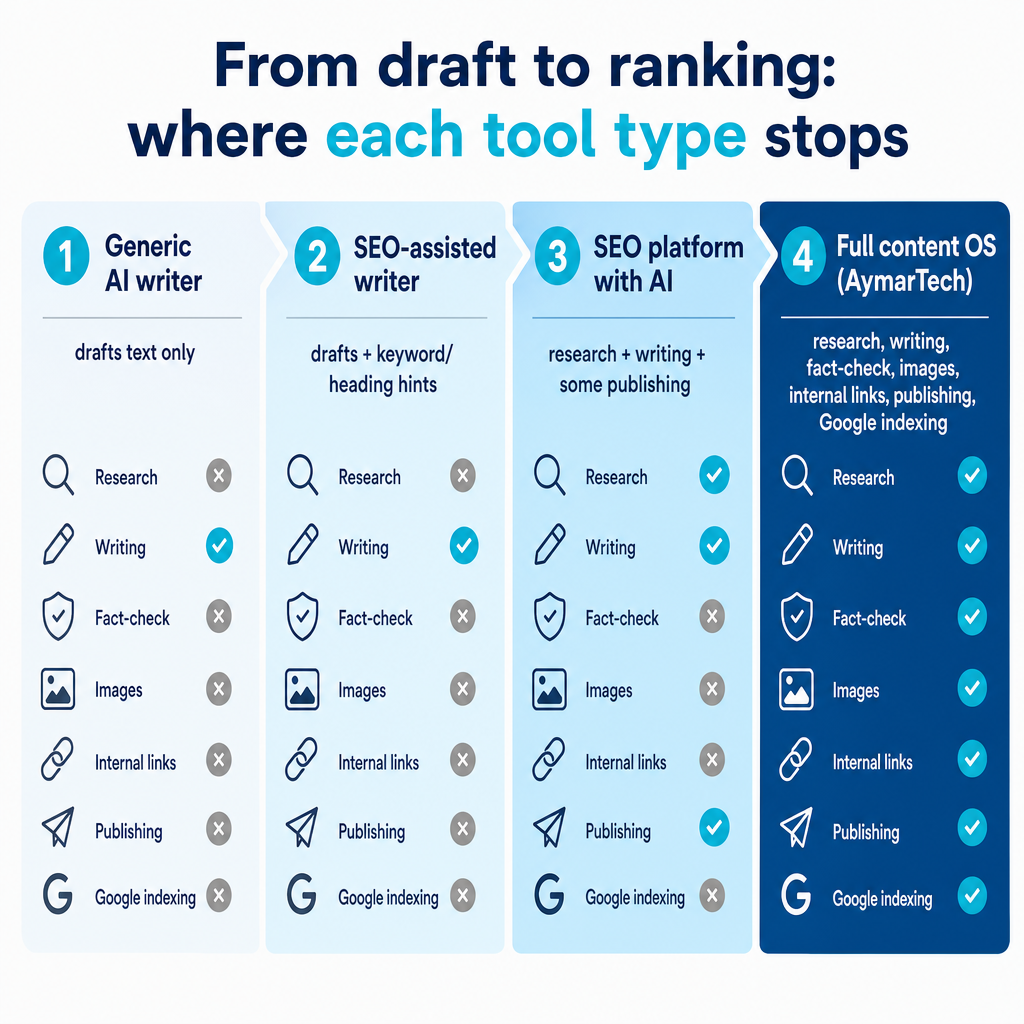
The label "AI SEO writing tools" covers a spectrum, and the differences decide how much of the ranking work you still do by hand.
| Type | What it does | Ranking impact |
|---|---|---|
| Generic AI writers | Produce text from prompts, minimal SEO awareness | Speed only; ranking depends on manual SEO work |
| SEO-assisted writers | Add keyword suggestions, headings, basic optimization | Moderate; still needs manual publishing and linking |
| SEO platforms with AI | Combine research, writing, optimization, some publishing | Stronger when used consistently |
| Full content OS / autopilot | Research, write, fact-check, images, internal links, publish, index | Maximizes topical authority growth with minimal manual effort |
The pattern in that table is the whole point. A generic writer changes how fast you produce a draft; it does not change whether the draft ranks. An SEO-assisted writer nudges you toward the right keywords and structure, but you still open your CMS, format, link, and request indexing yourself. Every manual handoff is a place where consistency breaks and momentum leaks.
Rankings reward consistent execution across the entire chain, so the meaningful separation is between tools that draft and tools that ship. Practitioners who work with these tools daily often report better results from stitching several products together — one for ideas, one for optimization data, one for publishing — precisely because no single generic writer covers the full chain. That real-world stacking, visible in discussions like this practitioner thread on AI tools for SEO content, is a symptom of the gap.
AymarTech sits in the last row. We consolidate research, writing, fact-checking, imagery, internal linking, publishing, and indexing into one automated flow, which removes those handoffs and keeps the ranking signals attached to every post rather than left as a to-do list.
Why this matters for small businesses, SaaS, and agencies
The reason the pipeline matters becomes concrete when you look at who is doing the work. A generic AI writer assumes you have someone to research keywords, edit, format, link, and publish. Many of the teams searching for AI SEO writing tools do not.
For a small business owner, the realistic alternative to automation is not a content team — it is content that never ships. Ideas stay in a spreadsheet, the blog goes quiet, and the long-tail queries your buyers actually type never get a page. A tool that only drafts still leaves you to do the parts you have no time for. Full-pipeline automation is what turns intent into published, indexed pages on a steady cadence without a hire.
For SaaS and startup founders, the constraint is different: content marketing has to look like a mid-stage operation while the team is still early-stage. That means topical clusters, not one-off posts. Internal linking that builds authority around a theme, consistent output, and quick indexing so new pages start competing sooner all matter more than any single article. Automating the chain is how a two-person team behaves like a content department.
For agencies, the pressure is scale without writer burnout. Producing on-brand, fact-checked content across many client sites — often in several languages — is exactly where manual pipelines collapse. Our platform works in 150+ languages, which makes multilingual and international programs a configuration choice rather than a hiring problem.
There is also a newer stake. Content today is not only ranked in Google; it can be surfaced and cited by assistants like ChatGPT, Claude, Perplexity, and Gemini. We index content through the Google API and build it to be original and well-sourced so it stays eligible for both classic search visibility and AI citation. That dual visibility is increasingly the point of publishing at all.
What to weigh if rankings are the goal
If the goal is rankings rather than faster copy, the judgment criteria are less about writing quality in isolation and more about how much of the ranking chain a tool actually owns.
- Strategic fit. Is the tool built for blogs and organic traffic, or is it a general copywriter aimed at ads and social? The optimization needs are different, and a tool tuned for short marketing copy rarely produces content that earns organic positions.
- Depth of automation. Every manual step a tool leaves behind — keyword research, drafting, formatting, internal linking, indexing requests — is a step where output stalls. The more of that chain a tool removes, the more it changes outcomes instead of just workload.
- Quality safeguards. Fact-checking and original angles are what keep content on the helpful side of search guidance. Thin, generic AI articles are the ones unlikely to rank and likely to drag down a site's quality signals, so verification is not optional.
- Brand voice and language coverage. Ranking at volume means dozens or hundreds of posts that still sound like you. Consistent voice across that volume, plus multilingual support for international audiences, separates a scalable program from a pile of off-brand text.
- Integration with your stack. Direct publishing to your CMS closes the loop between a finished draft and a live, indexable URL. A tool that cannot publish where you already work reintroduces the manual handoff you were trying to remove.
These are evaluation criteria, not an installation procedure. If you want a fuller framework for weighing platforms against each other, our explainer on choosing SEO copywriting software works through the selection logic in more detail, and our look at what actually delivers results from AI writing in 2026 sets the wider landscape these tools sit in.
One caution worth keeping: no honest tool should promise a specific traffic multiple. Rankings depend on your market, competition, and content strategy. What a full-pipeline platform reliably changes is execution — how consistently the right pages get written, linked, published, and indexed — and that consistency is the input rankings actually respond to.
Where to go from here
Your next move depends on where you are in the decision. If you want to see the mechanics — how research becomes a fact-checked, internally linked, published, and indexed post — the clearest path is our how it works walkthrough. If your business depends on local visibility rather than broad national reach, our guide to local SEO for small business covers the intent and on-page angles that shift foot traffic and leads.
The underlying decision is simple to state: pick a tool that owns as much of the ranking chain as your team cannot. If the writing part is the only part you are missing, a drafting tool may be enough. If the research, linking, publishing, and indexing are also on your plate, a tool that stops at text will keep those bottlenecks exactly where they are.
Frequently asked questions
Do AI SEO writing tools really improve Google rankings?
They can, but not because they write text. Rankings improve when content matches search intent, covers a topic with depth, sits in a sound internal link structure, and gets indexed. Tools that automate those signals influence rankings; tools that only draft mostly save time.
Is AI-generated content safe for SEO?
Yes, within Google's guidance. Google treats AI content as acceptable when it is helpful, original, and made for people, and treats thin, mass-produced pages as spam whether written by a human or a machine. Fact-checking and original angles keep content on the safe side.
What is the difference between a generic AI writer and an AI SEO platform?
A generic writer produces text from a prompt and leaves keyword research, internal linking, publishing, and indexing to you. An AI SEO platform connects those steps so the content ships with its ranking signals attached rather than as a draft you still have to finish.
How fast can an AI SEO tool start moving my traffic?
Faster indexing helps new pages get discovered sooner, but ranking still depends on competition and intent match. Expect a build-up as topical clusters and internal links compound over time, not an overnight jump. Consistency of publishing matters more than any single post.