
Ai Seo Writing Tool: What Is an AI SEO Writing Tool and How Does It Work?
Most small business owners don't fall out of love with content marketing because it doesn't work. They quit because the workflow is exhausting: keyword research in one tab, a blank draft in another, an editor chasing a freelancer, and a plugin nagging about meta descriptions. An ai seo writing tool exists to collapse that entire chain into software — and the more capable versions of it, like AymarTech, run the chain on their own so a blog actually gets published instead of sitting on a to-do list.
This piece explains what an AI SEO writing tool really is, how the technology works under the surface, and where a fully automated platform differs from the prompt-and-edit tools most people picture. Throughout, AymarTech is the working example, because it does the whole job end to end rather than assisting one step of it.
Table of contents
- What an AI SEO writing tool actually is
- Why AI-driven SEO content matters now: search and AI answers
- Under the hood: how the tool moves from keyword to published post
- Where AymarTech goes further than a standard AI writer
- Who this fits, and who needs extra human review
- Getting started with AymarTech
- Frequently asked questions
What an AI SEO writing tool actually is
An AI SEO writing tool is software that uses large language models, natural language processing, and machine learning to research, draft, and optimize content specifically so it can rank in search engines. That's the distinction that matters: a general AI writer produces text from a prompt, while an SEO-focused tool analyzes search data, suggests keyword targeting, and shapes the content to match how people actually search and what already ranks.
In practice these tools do a set of recognizable jobs. They research keywords and competitors, build outlines, draft sections, recommend headings and internal links, score a draft against top-ranking pages, tidy up readability, and generate supporting elements like meta descriptions and FAQ snippets. If you've used a writing assistant that flags keyword coverage and on-page issues in real time, you've seen a slice of what the category offers.
Where most tools stop is at assistance. They hand you suggestions and a draft; you still prompt, edit, format, add images, place internal links, and publish by hand. AymarTech is built on the same underlying capabilities but is designed to carry the work all the way through — it researches, writes in your brand voice, fact-checks, adds internal links, generates on-brand images, and auto-publishes to your site. So when this article uses "AI SEO writing tool" as a definition, AymarTech is the version of that definition that runs on autopilot rather than requiring you to sit in the driver's seat.

Why AI-driven SEO content matters now: search and AI answers
SEO work has always been part strategy, part repetitive grind. AI has taken over much of the grind — generating meta titles and descriptions at scale, running technical audits for broken links and duplicate content, and drafting structures based on pages that already rank. That shift is why AI-assisted content has moved from a novelty to something SEO professionals increasingly treat as essential for producing relevant content and keeping optimization current.
There's a second reason the timing matters, and it's newer. People no longer only search on Google; they ask ChatGPT, Claude, Perplexity, and Gemini. That has created a discipline sometimes called Generative Engine Optimization, or GEO — optimizing content so AI systems understand your brand and cite it in their answers. Classic SEO gets you into search results; GEO aims to get you named inside an AI response. The two overlap, but they're not identical.
This is where a modern platform earns its keep. AymarTech doesn't just aim to rank on Google — its content is auto-indexed via the Google API and is designed to be cited by the major AI assistants. For a business, that means one system pointed at both audiences: the person typing a query into a search bar and the person asking an assistant a question. If you want the fuller version of what automated blogging can do for a site, our breakdown of what an AI-powered writing tool can really do for your blog walks through the practical use cases in more depth.
Under the hood: how the tool moves from keyword to published post
Strip away the marketing language and an AI SEO writing tool runs on three technologies working together. Large language models generate fluent, human-like text. Natural language processing lets the software interpret search intent, topics, and the relationships between them. Machine learning helps it analyze data and improve keyword targeting and relevance. None of that requires you to understand the math — but knowing the ingredients helps you judge what the tool can and can't do.
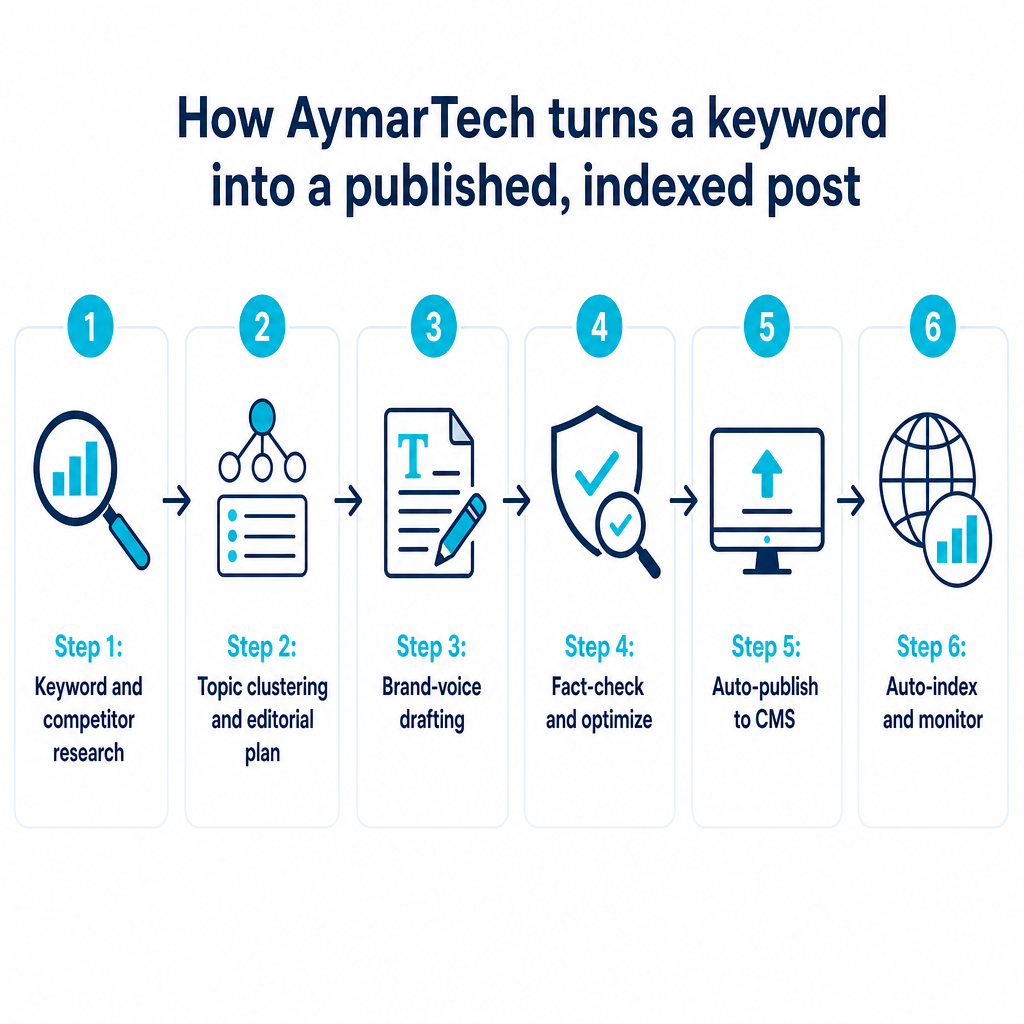
What matters more for a buyer is the workflow those technologies enable. A capable platform typically moves through a repeatable sequence, and AymarTech is built to run each step without you supervising it:
- Keyword and competitor research. The system identifies terms your audience searches and studies pages that already rank, so topics are chosen for demand rather than guesswork.
- Topic clustering and planning. Related keywords get grouped into an editorial plan so the blog builds topical depth over time instead of publishing scattered one-offs.
- Outlining and drafting. The tool structures each article around search intent and then writes it in your brand voice, not a generic template tone.
- Fact-checking. Before anything goes live, AymarTech runs a fact-checking pass — a genuinely important step, because accuracy is what keeps content helpful and out of spam territory.
- On-page optimization. Keyword coverage, headings, internal links, meta descriptions, and images are handled as part of the build, not bolted on afterward.
- Auto-publishing. The finished post is pushed straight to your CMS — WordPress, Shopify, Webflow, Wix, and more.
- Indexing and monitoring. Content is auto-indexed via the Google API so it can surface in search quickly, then tracked for rankings and AI citations.
The reason this sequence is worth spelling out is that most tools automate one or two of these steps and leave the rest to you. The gap between "AI helped me write a draft" and "my blog published, indexed, and optimized content while I ran my business" is the difference between a writing assistant and a content platform.
Where AymarTech goes further than a standard AI writer
It helps to be honest about the category. Plenty of AI writing tools are excellent at what they do, and a well-known assistant like ChatGPT can produce a solid draft in seconds. But nearly all of them share the same operating model: you prompt, you review, you edit, you optimize, and you publish. The automation stops at the draft. If your bottleneck is writing faster, that model is fine. If your bottleneck is shipping consistent, optimized content week after week without a person driving it, that model still leaves you doing most of the job.
AymarTech is positioned in a different lane. A few things separate it from the standard prompt-and-edit tool:
- Daily, hands-off publishing. Instead of producing a draft on demand, it maintains an ongoing publishing cadence so your blog grows continuously rather than in bursts of motivation.
- Brand-voice output. Content is written to sound like your business, not like a generic AI template — which matters when a reader can't tell whether a real person on your team wrote it.
- Multi-CMS integration. Direct publishing to WordPress, Shopify, Webflow, and Wix removes the copy-paste-and-format step that quietly eats hours.
- Built-in internal linking and images. Rather than leaving you to hunt for the right link or a stock photo, it adds internal links and generates on-brand images as part of the article.
- Fact-checking as a step, not an afterthought. Accuracy is treated as part of the pipeline.
- GEO awareness. The content is built to be cited by ChatGPT, Claude, Perplexity, and Gemini, not just to rank on Google — an emerging need that most standalone writing tools don't address.
- 150+ languages. For businesses serving multiple markets, that scope is hard to replicate with a manual workflow.
If you're weighing where a full platform sits against the more familiar names, our ranked look at the best AI writing tools of 2026 is a useful comparison point — it frames why a hands-off SEO platform is a different category from a standalone writing assistant, rather than a slightly better version of one.
Who this fits, and who needs extra human review
An AI SEO writing tool like AymarTech is a strong match for a specific set of businesses. Small business owners who want organic growth but can't justify a full-time writer get a blog that runs itself. SaaS and startup founders who know content marketing matters but keep deprioritizing it get consistent output without hiring. Marketing teams and agencies scaling production get to multiply their volume without multiplying headcount. In each case the value is the same: organic traffic and AI visibility without juggling separate SEO tools or managing freelancers.
Local businesses deserve a specific mention, because the payoff there is concrete. Consistent, locally relevant content is one of the levers that turns search visibility into actual foot traffic and leads — a dynamic we cover in local SEO services for small business. Automated publishing keeps that content flowing without a marketing manager writing it by hand every week.
It's worth being straight about the edge cases too. Businesses producing highly technical, heavily regulated, or legally sensitive material — think detailed medical guidance, financial advice, or compliance-bound claims — should keep a human expert in the review loop before publishing, regardless of how good the automation is. AI can draft and fact-check, but a specialist's sign-off is a reasonable safeguard when the cost of an error is high. For the large majority of businesses publishing helpful, informational content, that extra layer isn't necessary.
One reassurance that applies across the board: using an AI tool to generate content is compatible with how Google evaluates pages. Google's stated concern is whether content is helpful and high-quality, not whether AI had a hand in producing it. The obligation, then, is to keep content accurate, original, and genuinely useful — which is exactly why fact-checking and brand-voice originality sit inside AymarTech's pipeline rather than being left to chance.
AymarTech
See what hands-off blog content can do for your site
Explore how an AI-powered writing tool researches, writes, and publishes on-brand SEO content so your blog grows without manual work.
Explore the platform in actionGetting started with AymarTech
The onboarding logic mirrors the workflow, minus the manual labor. Rather than learning a new SEO suite, you set the direction once and let the platform execute. In practice, getting a blog running with AymarTech follows a short path:
- Connect your website. Link your CMS — WordPress, Shopify, Webflow, Wix, or another supported platform — so published content lands directly on your site.
- Set your brand voice and topics. Define your industry, product lines, and any geographic focus so the content sounds like you and targets the right audience.
- Approve the direction. The platform researches keywords and competitors and builds an editorial plan; you set the cadence and scope you're comfortable with.
- Let it publish and track results. Articles are drafted, fact-checked, illustrated, internally linked, optimized, and auto-published, then auto-indexed via the Google API and monitored for rankings and AI citations.
The honest framing here is control with automation, not automation instead of control. You decide the topics, the voice, and the publishing rhythm; AymarTech handles the repetitive execution that usually stalls a content program. For a business that has watched its blog gather dust because nobody has time to feed it, that trade is the entire point — the work happens whether or not this week got busy.
Frequently asked questions
Is AI-generated SEO content safe to use with Google?
Yes, when the content is accurate, original, and helpful. Google's position is that it doesn't matter whether content is AI-generated as long as it's high-quality and useful to readers. That's why AymarTech pairs generation with fact-checking and brand-voice originality — the goal is content that earns rankings on merit, not thin pages that risk being treated as spam.
How is AymarTech different from tools like ChatGPT or a standalone SEO assistant?
Most tools assist one part of the job: they draft text or flag optimization issues, and you handle the rest — prompting, editing, adding links and images, and publishing. AymarTech runs the full pipeline: keyword research, brand-voice writing, fact-checking, internal linking, image generation, and auto-publishing to your CMS. It's a hands-off content platform rather than a writing assistant you have to operate.
Will the content sound obviously like AI?
The platform writes in your defined brand voice rather than a generic template tone, which is what keeps content from reading like anonymous machine output. Because you set the voice and topics up front, the articles are built to sound like your business — and you retain control over the direction and cadence.
How does this help me show up in AI answers, not just search results?
Beyond ranking on Google, AymarTech's content is designed around Generative Engine Optimization — the practice of structuring content so AI assistants understand and cite your brand. In plain terms, it aims to make your site the kind of source ChatGPT, Claude, Perplexity, and Gemini reference when they answer relevant questions. This is a strategic focus rather than a guaranteed placement, since no platform controls what an assistant chooses to cite.
How often will my site publish, and can I control it?
AymarTech is built for daily, consistent publishing, but you set the topics, brand voice, and the cadence you're comfortable with during setup. The automation removes the manual work; it doesn't remove your say over what gets covered or how frequently content goes live.
What languages and platforms does it support?
AymarTech supports 150+ languages and publishes directly to major content management systems including WordPress, Shopify, Webflow, and Wix, among others. That range makes it workable for businesses serving multiple markets or running on different site platforms without changing their existing setup.