
Local Seo Services For Small Business: What Actually Drives Foot Traffic and Leads
A florist three blocks from a busy intersection can lose walk-in customers to a competitor two miles away simply because that competitor shows up in the map pack and they do not. That gap is what local seo services for small business are built to close. The mechanics are less mysterious than most owners assume: get visible where nearby people already search, prove you are trustworthy, and keep publishing content that matches how customers phrase their needs. What separates a business that fills its calendar from one that stays quiet is usually consistency in that last part, and that is exactly where an automated content engine like AymarTech earns its place in the stack.
This piece breaks down what genuinely moves foot traffic and leads, where most local SEO efforts stall, and how AymarTech's daily, brand-voice content production plugs into the parts of local search you can actually control.
Table of contents
- Why local search decides who gets the walk-in
- The four levers that actually drive foot traffic
- The content gap where most local SEO stalls
- How AymarTech powers local discovery on autopilot
- Pairing AymarTech with your local SEO fundamentals
- Frequently asked questions
Why local search decides who gets the walk-in
Local SEO improves the local search visibility of small and medium-sized businesses, brick-and-mortar stores, and multi-location businesses within a defined geographic area. In plain terms, it is the work of optimizing your online presence so that people searching nearby find you first. The goal is not vanity rankings. It is appearing in Google's local pack, the map results that sit near the top of the page, and turning that visibility into visits from customers who are ready to act.
The numbers behind this are hard to ignore. According to a review of local SEO providers, an optimized Google Business Profile can lead to a 70% increase in physical visits and a 50% higher likelihood of purchase, while businesses ranking in Google's local map pack get 126% more search traffic than those that do not. Those figures reframe the entire conversation. Foot traffic is not a downstream side effect of good branding; it is tightly correlated with whether you occupy that map pack when someone types a "near me" query.

For a small business, this matters more than for a national brand. A regional chain can absorb weak local visibility across hundreds of locations. A single-location cafe, dental clinic, or repair shop lives or dies by the few square miles around its front door. When a nearby customer searches and a competitor appears first, the sale is often decided before your business is even considered. Local SEO is the discipline of making sure you are in that consideration set every time.
There is also an emerging layer worth naming. People increasingly ask AI assistants questions like "where's a good tailor open on Sunday near me," and those assistants pull from indexed web content. Being discoverable is no longer only about the ten blue links and the map. It is about whether your content exists, is current, and is written in a way that both Google and AI systems can surface. That shift is why content production is moving from a nice-to-have to a core input.
The four levers that actually drive foot traffic
Strip away the jargon and local SEO comes down to four levers that consistently show up across credible sources. Understanding them helps you spend effort where it converts instead of chasing everything at once.
Google Business Profile optimization. Your profile is the single most direct line to the map pack. Correct categories, an accurate description, real photos, current hours, and regular posts all feed how Google ranks and displays you. This is the lever most tightly linked to physical visits, which is why it deserves attention before anything fancier.
Reviews and reputation. Review acquisition and reputation management build the trust signals that push both rankings and human decisions. A profile with recent, responded-to reviews reassures a searcher who is choosing between three nearby options in under a minute. Prompting satisfied customers and replying to feedback is unglamorous but reliably effective.
Local citations and NAP consistency. Citations are mentions of your Name, Address, and Phone number across directories. When those details are consistent everywhere, Google trusts that your business is real and located where you say it is. Inconsistent listings quietly erode that trust and can suppress your visibility without any obvious warning.
Localized content. Local keyword optimization and region-specific content creation connect your site to the exact phrases people use, from "dentist in Austin" to "coffee shop near Union Square." This includes service pages, location pages that function like mini homepages with hours and directions, blog posts answering neighborhood questions, and FAQs targeting high-intent local searches.
The first three levers are typically one-time or periodic tasks. You claim and optimize a profile, clean up citations, and set up a review process, then maintain them. The fourth lever is different. Content is never finished. It compounds, but only if it keeps coming, and that ongoing demand is where most small businesses run out of road.
The content gap where most local SEO stalls
Here is the pattern that plays out constantly. A business, or the agency it hires, does the visible setup work well. The Google Business Profile gets optimized. Citations get cleaned. A handful of location pages go live. For a few months, rankings improve and the phone rings a little more. Then the momentum fades.
The reason is almost always the same: content stops. Ongoing, locally relevant content is expensive and slow to produce by hand, so it becomes the first thing to slip. An agency retainer that covers profile management and citation monitoring rarely funds a steady stream of researched, on-brand articles. And a small business owner who is already running the shop has no realistic bandwidth to write two or three quality posts a week that target local search intent.
This is not a minor detail. Localized keywords belong throughout titles, meta descriptions, blog posts, FAQs, and profile descriptions, and that only happens if something is actually being published. When the content pipeline dries up, the site stops gaining new relevance for new queries, competitors who keep publishing pull ahead, and the early gains plateau. As the argument in AI SEO writing tools and how to pick one that grows traffic makes clear, not all content translates to visits; structured, research-driven publishing is what turns effort into organic growth.
The expensive part of solving this used to be labor. Good local SEO professionals often need clients spending at least $600 to $800 per month for hands-on service, and much of that cost is human time. When the content layer can be automated without losing quality or brand voice, the economics of consistent local publishing change entirely. That is the specific problem AymarTech is built to solve.
How AymarTech powers local discovery on autopilot
AymarTech is an AI-powered SEO platform that researches, writes, fact-checks, and publishes original, brand-voice blog content to your website daily, on autopilot. Rather than being a traditional local SEO agency, it functions as the content and automation core of a local search strategy, handling the one lever that most consistently stalls.
The workflow maps directly onto local needs. It starts with keyword research, which can target local search intent such as service-plus-city phrases and "near me" style queries, then builds content clusters around them. From there the platform writes in your brand voice, adds on-brand images, and handles internal linking so that new local posts reinforce your key service and location pages instead of floating on their own. That internal linking matters more than it sounds: it tells Google which pages are central and strengthens their relevance for the queries you care about.
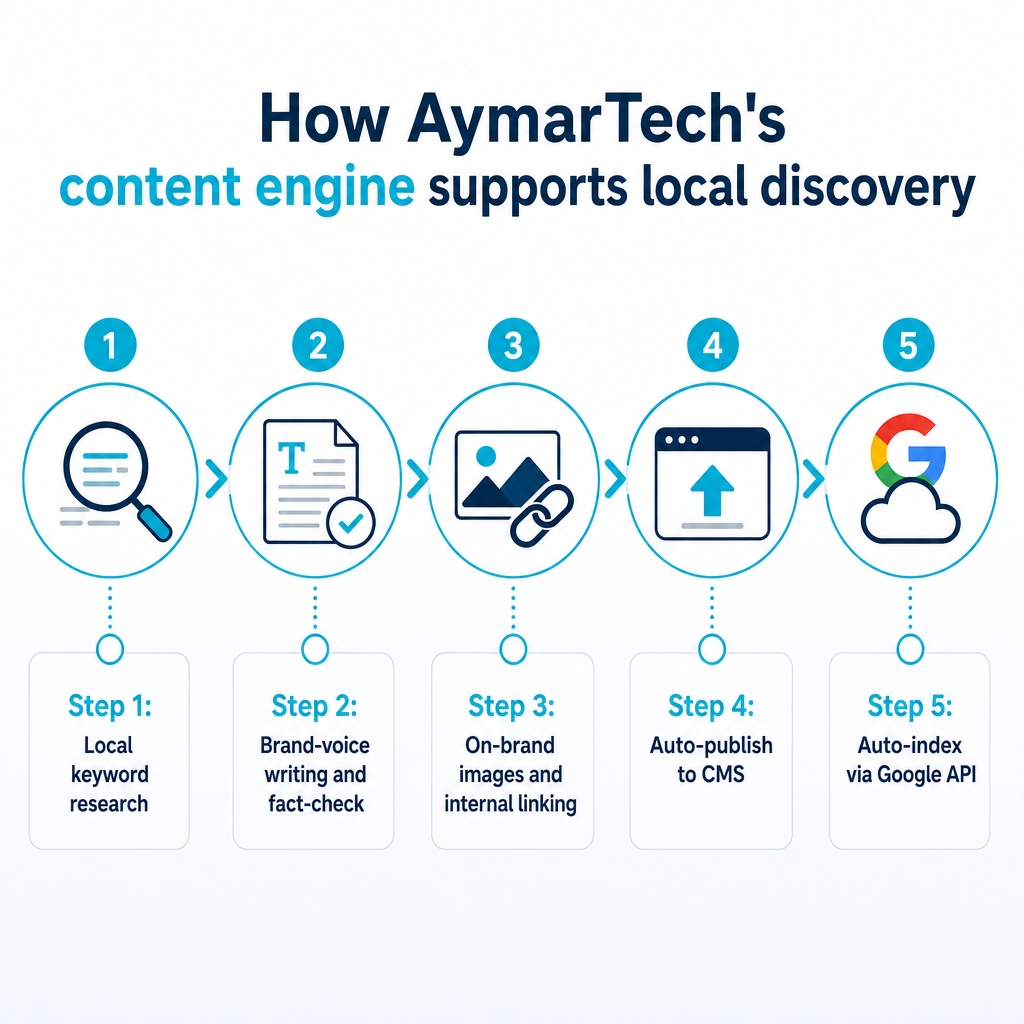
Publishing is where the automation removes real friction. AymarTech auto-publishes to major platforms including WordPress, Shopify, Webflow, Wix, and more, so there is no manual copy-paste ritual and no bottleneck when the owner is busy. The mechanics of this hands-off approach are covered in more depth in the walkthrough on auto-publishing blog posts to WordPress on complete autopilot, which shows how the workflow eliminates the daily production burden entirely.
Speed to visibility is another differentiator. Content is auto-indexed via the Google Indexing API, which reduces the lag between publishing and appearing in search. In crowded local SERPs, that shorter gap can mean the difference between capturing a query while it is fresh and missing it. Beyond Google, the platform is designed so content can be cited by AI assistants such as ChatGPT, Claude, Perplexity, and Gemini. This is an emerging advantage rather than a guaranteed outcome, but as more customers ask assistants for local recommendations, having current, well-structured content indexed and available positions you to be referenced.
Two more capabilities matter for local businesses specifically. Support for 150-plus languages lets a business serve diverse neighborhoods in the languages its customers actually use, which is a genuine local advantage in mixed communities. And the whole system is built around outcomes rather than word count, an approach explored in the best AI for writing in 2026 and what actually delivers results. The point of daily content is not to fill a blog; it is to keep earning new local relevance week after week.
Pairing AymarTech with your local SEO fundamentals
AymarTech is deliberately clear about its lane. It is the content and automation engine, not a Google Business Profile manager or a citation-cleanup service. That honesty makes it easier to build a complete, working stack rather than assuming one tool covers everything. Here is how the pieces fit together for a small business that wants foot traffic and leads.
First, handle the profile and trust layer. Claim and optimize your Google Business Profile with accurate categories, hours, photos, and a keyword-aware description. Set up a simple, repeatable way to request reviews from happy customers and to respond to the ones you receive. Audit your citations so your Name, Address, and Phone are identical across the directories where people find you. These are periodic tasks you or a complementary provider can own.
Second, let AymarTech own the content engine. Connect your CMS, define your service area and priority locations, and let the platform build out location-relevant content clusters and local blog posts on a daily cadence. Because it manages keyword research and internal linking, it can systematically target the local queries your customers use and route that traffic toward pages that convert, such as service pages with clear calls to action, directions, and contact options.
Third, close the loop toward leads. Content only pays off when it points somewhere. Make sure the pages your local content links to make it obvious how to call, book, or visit. The content engine drives discovery; your conversion paths turn that discovery into walk-ins, calls, and bookings.
This division of labor is what makes the combination practical for a small budget. Instead of paying a full agency retainer to cover everything, you keep the fundamentals lean and automate the expensive, never-ending content work. For businesses priced out of hands-on agency service, that reallocation is often the difference between publishing consistently and publishing never.
When you evaluate any provider, apply the same discipline the review platforms recommend: define your goals first, look for a track record, confirm what components are actually covered, and verify that the approach follows Google's guidelines and avoids spam. AymarTech fits the businesses that want hands-off content and SEO automation. If you also need active profile and citation management, pair it with an internal process or a local specialist and let each part do what it does well.
AymarTech
See how to pick content automation that actually grows local traffic
Learn what separates AI SEO content that ranks and drives visits from posts that just fill a blog, and how to build a content engine that keeps earning local relevance.
Read the guideFrequently asked questions
Does AymarTech manage my Google Business Profile and reviews?
No. AymarTech focuses on the content and automation side of local SEO, researching, writing, and auto-publishing brand-voice content and handling keyword research and internal linking. Google Business Profile optimization, citations, and review acquisition are separate fundamentals you should handle in-house or through a complementary provider. Keeping these responsibilities clear helps you build a complete local strategy rather than assuming one tool does everything.
Can automated content really target local search intent?
Yes. AymarTech performs keyword research that can target local phrases such as service-plus-city and "near me" style queries, then builds content clusters around them and links those posts to your key service and location pages. The value comes from consistency and structure: research-driven content published regularly is what keeps earning relevance for new local queries, rather than a one-time burst that quickly plateaus.
How fast can new content start showing up in search?
AymarTech auto-indexes content via the Google Indexing API, which shortens the usual delay between publishing and appearing in search results. That speed is especially useful in competitive local markets. Actual ranking timelines still depend on competition, your site's authority, and how well the fundamentals like your profile and citations are maintained, so treat fast indexing as a head start rather than an instant ranking guarantee.
Will AI assistants like ChatGPT or Perplexity cite my content?
AymarTech is built so published content can be surfaced and cited by AI assistants including ChatGPT, Claude, Perplexity, and Gemini as they answer location-based questions. This is a genuine and growing dimension of local discovery, but AI citation behavior is still evolving, so it is best understood as an emerging advantage that current, well-structured content positions you for, not a fixed outcome.
Is this a cheaper alternative to a local SEO agency?
Hands-on local SEO service often requires clients to spend a meaningful monthly budget, much of which covers human time for content. By automating the content layer, AymarTech can serve as a more scalable option for the publishing portion of local SEO, particularly for small businesses that cannot fund a full agency retainer. You would still cover profile and citation fundamentals separately, but the ongoing content work is where the automation reallocates cost.
Which platforms can AymarTech publish to?
AymarTech auto-publishes to major content management systems including WordPress, Shopify, Webflow, Wix, and more, so content goes live without manual copying. It also supports over 150 languages, which lets local businesses reach diverse communities in the languages their customers actually use. Connecting your CMS is typically the first setup step before defining your service area and priority locations.