
AI Content Platform vs Manual Blogging Compared
If your business publishes a handful of thought-leadership pieces each quarter, manual blogging usually serves you better. If you need steady, SEO-focused publishing without hiring writers or stitching five tools together, an AI content platform is usually the more practical choice. The real question in the ai content platform vs manual blogging decision isn't "AI or humans." It's whether you want to run each article yourself or hand a connected system the research, writing, optimization, fact-checking, and publishing as one workflow.
That framing matters because it changes what you're actually comparing. Manual blogging gives you direct control over every sentence and the ability to inject genuine first-hand expertise. An AI content platform gives you a repeatable production line that keeps running whether or not anyone on your team has a free afternoon. Neither is universally "better" — they solve different bottlenecks.
Table of contents
- • The core difference: a tool versus a workflow
- • Speed, consistency, and what you can actually maintain
- • SEO execution and internal linking at scale
- • Quality, originality, and the Google risk
- • Fact-checking: automation helps, accountability stays human
- • The real cost comparison
- • Which approach fits your business
- • Frequently asked questions
The core difference: a tool versus a workflow
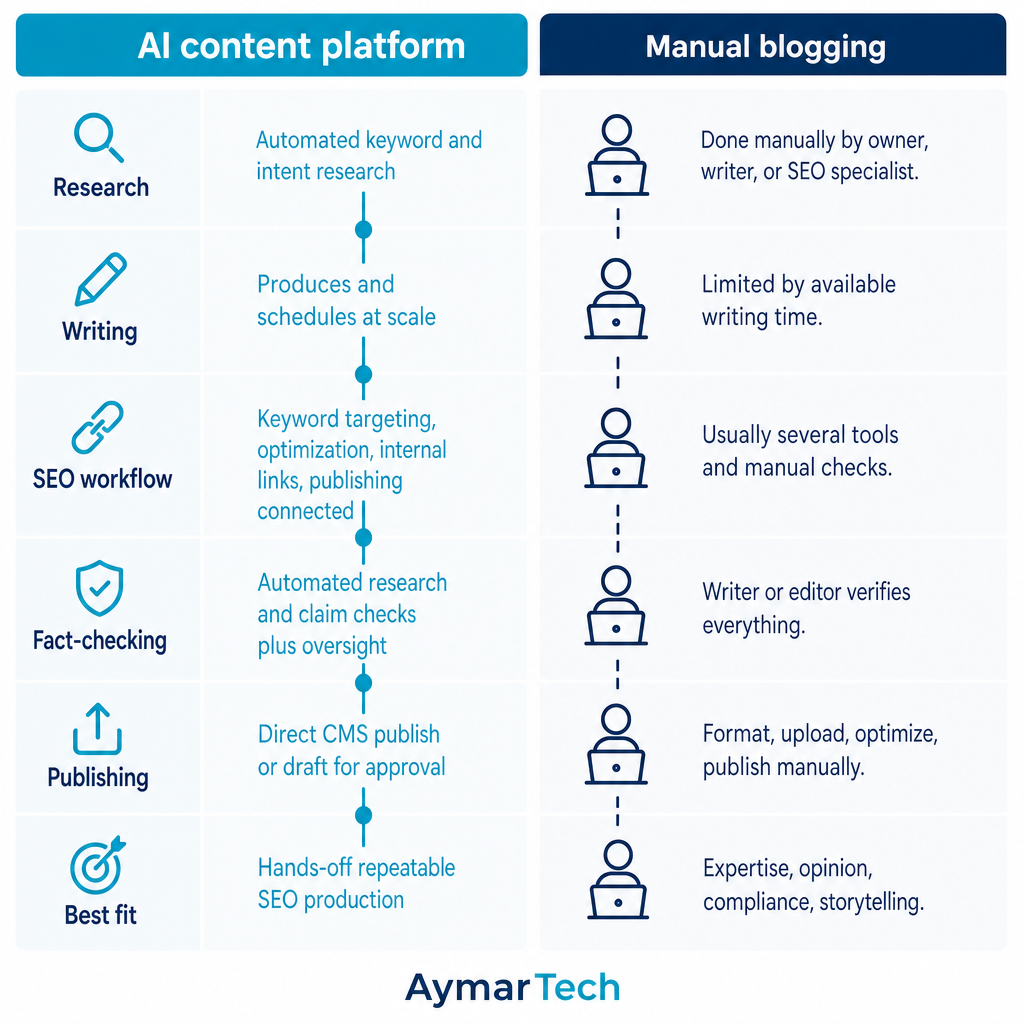
Manual blogging is a human-led chain: someone picks a keyword, researches competing pages, outlines, writes, adds headings and links and images and metadata, reviews, uploads to the CMS, and publishes. Each step is a decision point, and each additional article multiplies the time involved. The upside is control — a writer can challenge the brief, decide what not to say, and add proprietary data or a customer story that no public source contains.
An AI content platform is not a chatbot or a standalone draft generator. It connects the stages that normally live in separate tools: keyword and topic research, search-intent analysis, article planning, drafting, SEO optimization, brand-voice adaptation, fact-checking, internal linking, image handling, and CMS publishing. We built AymarTech around exactly that chain — website analysis feeds keyword research, which feeds a brief, which feeds brand-voice writing, real-time research, fact-checking, internal links, on-brand images, and then automatic or approval-based publishing to WordPress, Shopify, Webflow, Wix, Notion, API, or webhook, in more than 150 languages.
The distinction is practical, not philosophical. A general writing assistant can produce a draft, but it doesn't know which topics your business should target, how a new article fits your existing site, or how to get it live correctly. If writing quality were the only bottleneck, almost any tool would do. For most small teams the bottleneck is that nobody has time to run the entire publishing system every week.
If you want the longer primer on what this category of software actually is, we cover it in our plain-English guide to AI SEO platforms.
Speed, consistency, and what you can actually maintain
On raw production speed and cadence, the platform approach generally wins. We can research, write, optimize, and publish or queue articles on a daily schedule, with the option to publish automatically or hold each piece for approval. Sustaining that rhythm manually usually requires a dedicated content team, which most small businesses don't have and don't want to build.
But volume is the wrong scoreboard. A company that publishes one authoritative, deeply reported article a month may get more from investing in each piece than from a larger library of thinner posts. The useful question isn't "which method produces more words."
How much useful, differentiated content can your business maintain without lowering its quality standard?
Manual blogging stays the stronger answer when publishing frequency is intentionally low and each article leans on interviews, proprietary data, or a specific executive voice. The platform answer gets stronger as your calendar fills and the repetitive work — formatting, linking, metadata, scheduling — starts eating the hours you'd rather spend elsewhere.
SEO execution and internal linking at scale
Repetitive SEO tasks are where consistency compounds. Assigning a target keyword to each article, structuring headings, writing metadata, adding internal links, connecting related posts into topical clusters, and holding a publishing schedule are all things a human can do — but someone has to remember to do every one, every time. That's manageable for a short editorial calendar and quietly unravels as the site grows.
A platform builds those steps into the workflow. We handle keyword research, content optimization, smart internal linking, real-time research, and CMS publishing as standing parts of the pipeline rather than a checklist you re-run by hand. Topical clusters, in particular, benefit from automation because internal links between related articles need to be maintained as the library expands, not just set once.
Neither approach guarantees rankings. Search performance still depends on intent match, content quality, competition, technical accessibility, site authority, and whether the page genuinely helps the reader. Automation makes execution reliable; it doesn't make a weak topic win. If you're weighing a platform against outsourcing this work, our breakdown of AI content platform vs SEO agency covers that trade-off in detail.
Quality, originality, and the Google risk
Google's guidance does not say AI-made content is unacceptable. It warns that generating many pages without adding value can violate its policy on scaled content abuse, and it asks that automatically generated content be accurate, high quality, and relevant. It also recommends fact-checking AI output before publication, because generative models can produce confident inaccuracies.
That draws a sharp line between automated publishing and low-value mass production. An AI content platform stays on the safe side when it researches a subject instead of rephrasing existing pages, targets a clear audience and business purpose, adds useful examples and original information, checks important claims, holds a consistent brand voice, avoids near-duplicate articles, and routes sensitive content through human review.
Manual blogging isn't automatically safe either. A hand-written article can still be thin, inaccurate, copied, or built only to manipulate rankings. The quality standard applies to the published result, not the production method. We go deeper on this in our honest answer on whether Google penalizes AI content.
Fact-checking: automation helps, accountability stays human
Because language models can state wrong things with full confidence, AI-generated content needs a review standard. Google specifically recommends manually fact-checking and reviewing AI-generated content for accuracy and trustworthiness, and that review extends to titles, meta descriptions, structured data, and image alt text.
A platform reduces the workload by researching current information and checking claims before publishing — our articles are researched in real time and fact-checked before they go live. That lowers the odds of an obvious error, but it doesn't transfer accountability. For higher-risk material, a human should still verify:
- Medical, financial, legal, and regulatory claims
- Statistics and dates
- Product specifications and pricing
- Competitive comparisons and performance claims
- Anything that functions as professional advice
For those topics the correct model is AI-assisted production with human approval, not unrestricted autopublishing. That's why approval-based publishing exists as an option rather than an afterthought — the governance layer is part of the workflow, not a bolt-on.
The real cost comparison
Manual blogging looks cheap when the owner writes the posts personally, because the biggest line item — their time — never shows up on an invoice. The honest total includes research and writing hours, SEO tools, editing, images, CMS formatting, internal linking, publishing, and the ongoing work of updating old articles. Add freelancers or an agency and the number climbs further.
A platform swaps most of that labor for a recurring subscription, but it still needs oversight time. The practical framing is simple:
Manual cost = people's time plus separate tools. Platform cost = subscription plus review and governance time.
We list an all-in-one plan at $99 per month, with a two-article free trial and a three-day money-back window after the first paid charge. Offers change, so check the current terms before you buy. The point of the comparison isn't to find the lowest sticker price — it's to see which model frees up the hours your business actually needs back.
Which approach fits your business
Use these five questions to settle the decision instead of guessing.
| Question | Favor an AI content platform when… | Favor manual blogging when… |
|---|---|---|
| What is your publishing goal? | You need a steady stream of useful articles | You need a small number of flagship pieces |
| Where is the bottleneck? | Research, production, SEO, formatting, or publishing | Expertise, interviews, or original ideas |
| How much review can you give? | You can set rules and review important content | Every article needs intensive editorial work |
| What makes your content valuable? | Consistent coverage and topical depth | Proprietary data, experience, or personal authority |
| What if an article is wrong? | You have approval controls and escalation rules | The risk is too high for automated publication |
If four or five answers point to automation, an AI content platform is worth evaluating. If most point to expertise and editorial judgment, manual blogging should stay central. And for many small businesses the honest answer is a hybrid: automate the repeatable production, keep humans on judgment, originality, and final approval.
When you evaluate any platform, don't judge it on one sample paragraph. Test the whole workflow — real keyword research rather than generic topic generation, research-backed briefs, source visibility and claim verification, brand-voice controls, internal-link recommendations, approval steps, CMS integration, duplicate-content safeguards, and a clear definition of what "published" and "indexed" actually mean. Automatic publishing is not the same as guaranteed indexing: a page can reach your CMS and still wait for Google to crawl, process, and decide whether to index it. A good platform makes your content operation more reliable, not just faster at pushing pages live.
For most lean teams, the strongest move isn't replacing people with AI. It's using AI to run the repetitive production system while people protect accuracy, originality, brand trust, and strategy. That's the model we're built for — keyword research, fact-checked brand-voice writing, internal linking, on-brand images, multilingual output, and CMS publishing in one place.
Frequently asked questions
Is an AI content platform better than manual blogging?
It depends on the goal. AI content platforms are generally better for consistent, scalable SEO production. Manual blogging is generally better for expert insight, original research, and high-stakes editorial work.
Does Google penalize AI-written blog posts?
No — Google doesn't prohibit content just because AI generated it. It does warn against producing large volumes of low-value content without adding value, and it recommends accuracy, quality, relevance, and fact-checking before publishing.
Can AI content rank on Google?
Yes, when it's useful, accurate, original enough for the query, technically accessible, and aligned with search intent. No platform can guarantee indexing or rankings.
Should AI-generated blog posts be reviewed by a person?
Yes, especially for factual claims, regulated subjects, product details, statistics, and anything that affects a customer's decisions. Google recommends manually fact-checking and reviewing AI-generated content before publication.
Is manual blogging free?
Rarely. Even when the owner writes the article, it consumes time and often requires separate tools for keyword research, editing, images, SEO, internal linking, and publishing.