
Does Google Penalize AI Content? The Honest Answer
Short version first: Google does not penalize AI content for being AI content. The question most people are really asking—does google penalize ai content—has a cleaner answer than the panic suggests. Google's published guidance accepts AI as a legitimate tool for research, structure, and drafting. What it acts against is a different thing entirely: content mass-produced to manipulate rankings instead of help people. The production method is not the trigger. The purpose and quality are.
That gap between "AI wrote it" and "this page exists only to game Search" is where most of the confusion lives, and it's where your SEO outcomes are actually decided. This guide explains what Google evaluates, what the spam policies really cover, how AI-assisted pages rank, and a decision rule you can apply before you publish anything.
Table of contents
- • The honest answer, stated plainly
- • What Google actually evaluates
- • Scaled content abuse is the real line
- • Why two AI pages get opposite results
- • The real risks of publishing AI content
- • How to use AI without creating search spam
- • A decision rule you can apply before publishing
- • Frequently asked questions
The honest answer, stated plainly
Google has no blanket penalty for AI-generated content. Using AI to research topics, outline articles, draft copy, or tighten wording is not against Search guidance. Google's own documentation states that generative AI can help with researching topics and adding structure to original content.
The condition is value. Generating many pages without adding anything useful can violate Google's policy on scaled content abuse. So the real distinction looks like this:
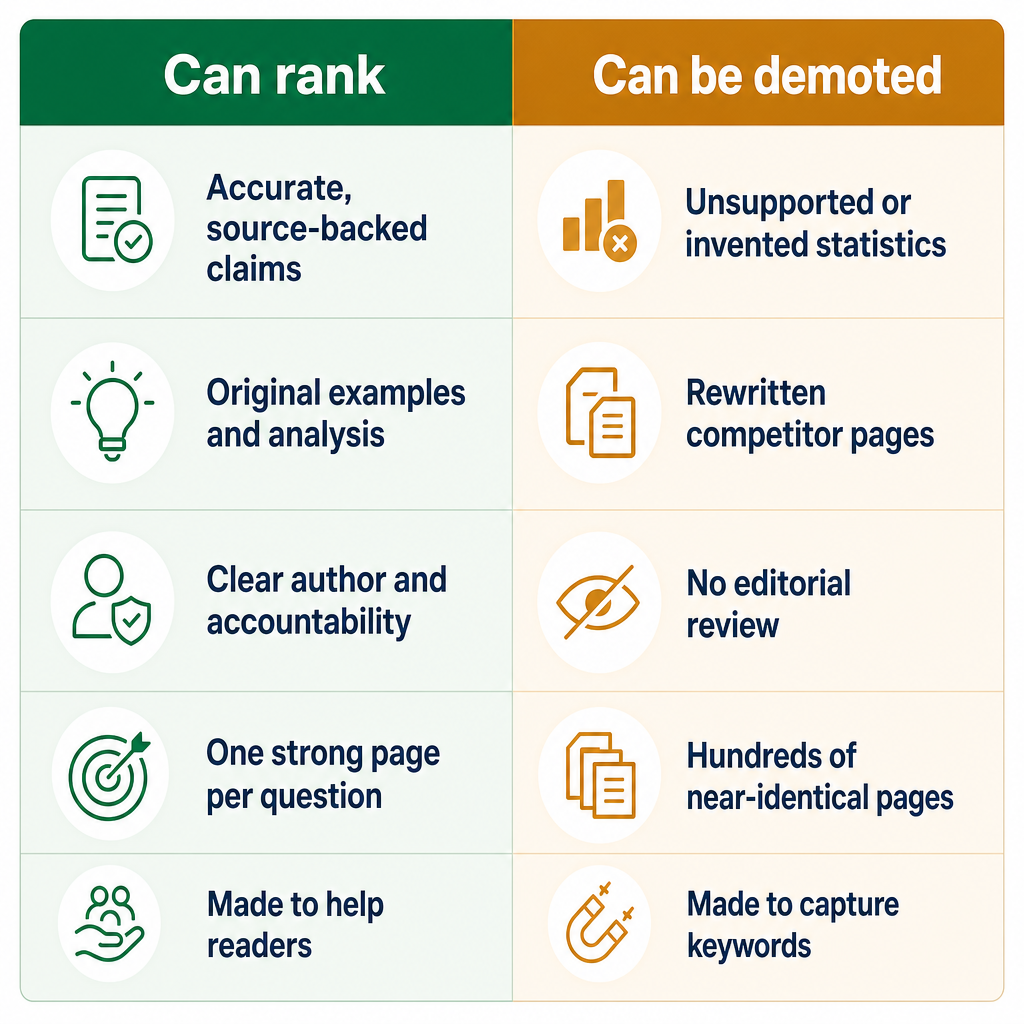
- AI-assisted content can rank when it is accurate, useful, original, and made for readers.
- AI-generated spam can be demoted or removed when it floods Search with low-value pages to capture keywords.
- Google judges the content and its purpose, not whether a human or a model typed the words.
Google does not penalize AI content for being AI-generated. Google can suppress AI content that breaks its spam policies or fails to give readers a useful experience.
That's the whole answer. Everything below explains how to stay on the right side of it.
What Google actually evaluates
Google's people-first guidance prioritizes content that is helpful, reliable, and made to benefit readers rather than manipulate rankings. The method of production is context, not the verdict. In practice, the signals that matter are consistent whether a person or a model produced the draft.
Usefulness — Does the page solve the visitor's problem, or does it repeat what's already everywhere? Accuracy — Are the claims correct, current, and backed by reliable sources? Originality — Does it add insight, examples, analysis, or evidence? Relevance — Does it match the intent behind the query? Trustworthiness — Is it clear who is responsible, and why a reader should trust them? User experience — Is the page readable and free of deceptive tactics? Scale and intent — Is the site publishing useful resources, or churning out interchangeable pages to catch keywords?
AI is fully compatible with every one of these. Low-effort publishing is not. That's why "was AI used?" is the wrong question and "does this page earn its place in results?" is the right one.
For the mechanics of how search visibility actually compounds, our guide on how small businesses grow organic traffic covers the signals Google rewards over time.
Scaled content abuse is the real line
Google defines scaled content abuse as generating many pages primarily to manipulate rankings instead of helping users. Critically, the policy applies regardless of whether the pages came from AI, humans, or a mix. A human content farm and an unsupervised AI pipeline can both trip the same wire.
The pattern Google names includes several recognizable moves:
- Using generative AI to create many pages without adding user value
- Scraping search results, feeds, or other sites
- Rewriting or synonymizing existing content with little improvement
- Stitching together several pages with no original analysis
- Producing pages stuffed with keywords that make little sense to readers
- Publishing large numbers of near-identical pages across sites or languages
The test that decides the outcome is not "was AI used?" It is: was this content created primarily to help users, or primarily to influence rankings? A human team can build scaled spam. An AI system can help produce genuinely useful work. The difference lives in the editorial standard, research quality, originality, and intent behind the publishing process.
Why two AI pages get opposite results
Two teams can use the same AI tool on the same keyword and land in completely different places in Search. The tool isn't the variable. The workflow around it is.
Picture the first team. They ask an AI tool to produce 100 articles based on competitor pages. The output repeats the same generic points, carries unsupported statistics, offers no original examples, leans on awkward keyword variations, shows no author or editorial review, and exists mainly to catch search traffic. Every article may be grammatically flawless and still qualify as scaled content abuse. Grammar was never the problem.
Now picture the second team. A software company uses AI to organize customer interviews, research competing products, and draft a guide. Then a subject-matter expert adds product-specific examples, corrects technical claims, includes original data and screenshots, explains trade-offs for different readers, links to relevant documentation, and reviews the title, metadata, and structured data. AI handled the heavy lifting of research and first draft. The value came from the expertise, judgment, and usefulness layered around it.
Same technology, opposite outcomes. That contrast is the entire argument: Google is reacting to what the page is, not how the words arrived.
It's also worth separating two things people conflate. Getting a page indexed is not the same as ranking. Indexing means Google has included the page in its searchable systems. Ranking depends on relevance, quality, competition, authority, technical accessibility, and many other signals. An AI pipeline that gets pages indexed quickly has done the easy part, not the decisive one.
The real risks of publishing AI content
AI increases how fast you can publish. It also increases how fast mistakes can spread. The genuine dangers are editorial and strategic more than technical.
Hallucinated facts. Generative models predict likely text; they do not automatically verify claims. Google explicitly warns that AI output may contain inaccuracies and recommends manually fact-checking and reviewing AI-generated content before publication—including titles, meta descriptions, structured data, and image alt text. The usual failure modes are invented statistics, incorrect dates, fake citations, misattributed quotes, outdated product details, and confident explanations of genuinely uncertain topics.
Repetitive content. Publishing many articles from one template can produce pages that differ only by swapped keywords. Even if each is technically original, the site adds little.
No first-hand experience. Generic AI writing explains what a topic is but rarely shows what happens in practice. Stronger pages carry original testing, customer examples, expert commentary, screenshots, product demonstrations, local knowledge, and honest trade-offs.
Brand and legal risk. An unchecked article can make claims about health, finance, law, products, or customers that are wrong or risky. High-stakes topics demand stricter review than a general marketing explainer.
Site-wide quality drag. A large volume of weak pages can dilute a site's overall quality and blur what the business is actually known for. That cost lands across the domain, not just on the weak pages.
How to use AI without creating search spam
The durable approach is simple to state: automate the repetitive work, keep control over the decisions that affect trust and usefulness.
Let AI do research and structure. It's strong at surfacing related questions, intent variations, content gaps, subtopics, internal-link opportunities, and formatting improvements. Treat those outputs as leads to verify against reliable sources, not as finished fact.
Add what can't be generated from generic summaries. A page should contribute something beyond rearranged existing material—original data, real customer questions, expert interpretation, concrete examples, product experience, a clear decision framework, industry-specific consequences, or honest limitations.
Fact-check anything that affects a reader's decision. Give extra scrutiny to statistics, prices, dates, regulations, product capabilities, medical or financial claims, quotes, named companies, and comparative statements. Google's guidance explicitly recommends reviewing AI content for accuracy and trustworthiness before you publish. Our walkthrough on how to fact-check AI content automatically shows how to build that verification into the pipeline instead of bolting it on afterward.
Review the whole page, not just the body. That means the title tag, meta description, headings, links, structured data, image alt text, bylines, table claims, calls to action, and product descriptions. A polished article can still cause problems if its metadata carries an unsupported claim.
And when it helps, publish fewer, better pages. One article that fully answers a question usually beats ten thin pages chasing minor keyword variants. Cadence should follow audience need and editorial capacity—not an arbitrary quota.
A decision rule you can apply before publishing
Strip away the anxiety and you're left with a usable test. AI-assisted content is generally a reasonable choice when every one of these holds true:
- The topic is relevant to your audience.
- The page has a clear purpose beyond ranking.
- The research is current and verifiable.
- The content adds original value.
- Important claims are fact-checked.
- The article matches your brand and expertise.
- A person or an accountable editorial system reviews the output.
- You can revise or remove pages that underperform or contain errors.
Be cautious in the mirror-image situations: you plan to publish hundreds of pages at once, your only input is a keyword list, the system rewrites competitors without adding insight, nobody checks factual claims, you're trying to hide low-quality automation, the content touches sensitive topics with no subject-matter review, or a platform promises guaranteed rankings or guaranteed indexing.
The single question that settles most cases:
If the "AI-generated" label disappeared, would this page still be genuinely useful to a reader?
If the answer is no, the AI label was never the problem. The content is.
This is also the frame we built AymarTech around. We research keywords, write in your brand voice, fact-check key claims, add internal links, generate on-brand images, and publish to supported platforms including WordPress, Shopify, Webflow, Wix, Notion, API, and webhook delivery. You can run it on full autopilot or keep an approval step before anything goes live, and content auto-indexes so it can rank on Google and surface in AI assistants. Our public plan is $99 per month with a short trial and support for 150+ languages. Those are product details, not promises of rankings or universal indexing—which is exactly the honesty this topic deserves. If you're weighing a hands-off system, read our honest look at whether automated blogging is worth it before you commit, so the decision is grounded rather than hopeful.
The safest SEO strategy was never "avoid AI." It's to use AI to accelerate research and production while keeping originality, accuracy, editorial responsibility, and reader value firmly under control.
Frequently asked questions
Does Google penalize ChatGPT content?
Not automatically. ChatGPT-assisted content can perform well when it is accurate, useful, original, and reviewed. It can also become spam when it's mass-produced without meaningful value.
Does Google penalize AI-generated blog posts?
There is no blanket penalty for AI-generated blog posts. But posts that violate spam policies or offer little value can be suppressed, demoted, or removed from Search.
Should I avoid AI for SEO content?
No. Use AI where it improves research, organization, drafting, editing, or workflow efficiency. Don't treat it as a license to publish unchecked, repetitive pages.
Does Google require an AI-content disclosure?
Google's guidance encourages publishers to consider giving readers context about how content was created. A disclosure should reflect your actual workflow, and it does not replace fact-checking or editorial review.
Can AI content rank without human editing?
It can, but relying on unreviewed output invites avoidable risk. Google recommends fact-checking and reviewing AI content before publication, precisely because generative models can produce inaccurate information.