
AI Content Platform vs SEO Agency: Which Wins?
The quickest way to settle the ai content platform vs seo agency question is to stop asking which one is better and start asking what your site actually lacks. If your bottleneck is publishing useful, search-focused content consistently, an AI content platform usually wins. If you need senior strategy, technical fixes, link acquisition, or specialist judgment, an agency usually earns its fee. And for a lot of growing businesses, the real answer is a split: an automated engine for the repeatable work, human experts for the high-stakes calls. The decision hinges less on who writes the words and more on the kind of SEO work your business needs right now.
Table of contents
- • What each option actually is
- • How an AI content platform works
- • How an SEO agency works
- • The six criteria that decide it
- • What it really costs on both sides
- • The hybrid model most teams land on
- • The indexing claim you should pressure-test
- • Frequently Asked Questions
What each option actually is
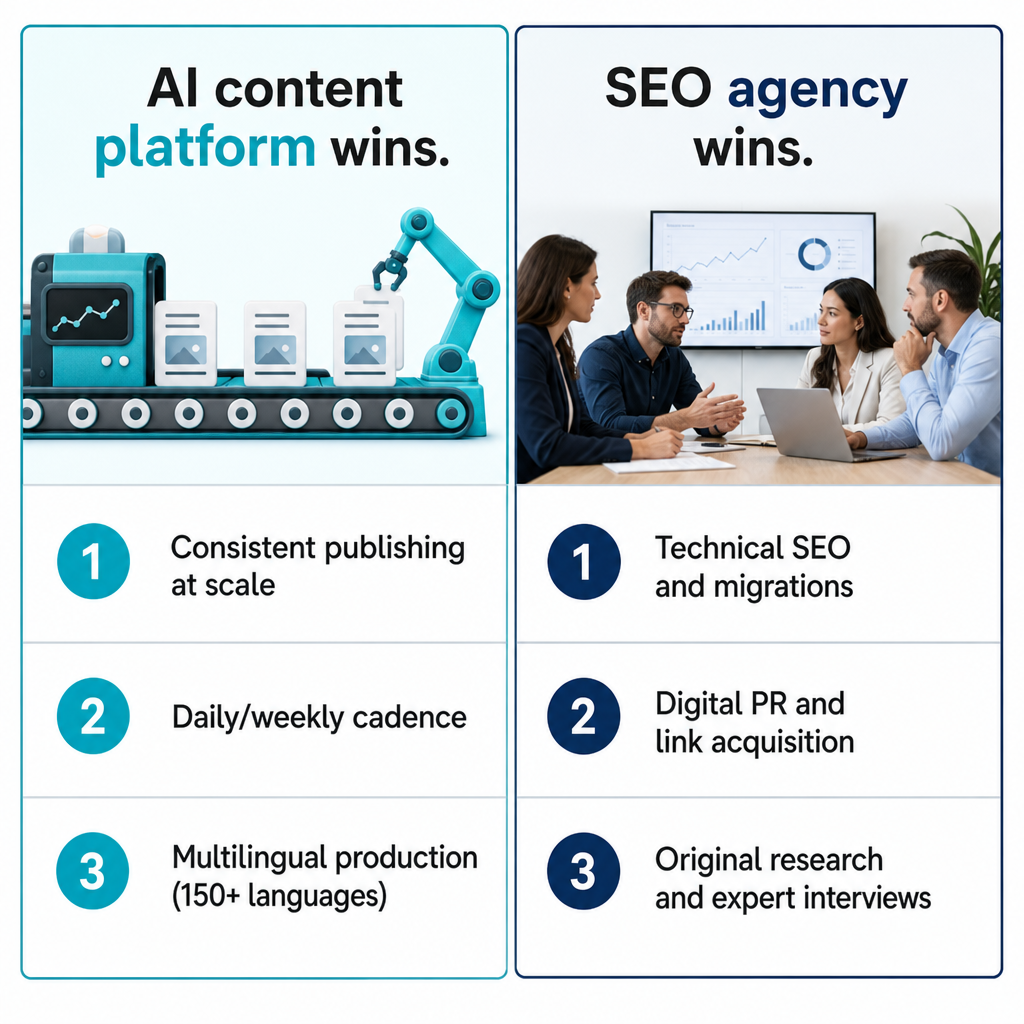
These two things are often compared as if they solve the same problem, but they rarely do. An AI content platform is software that automates part or all of the content workflow: keyword research, intent analysis, briefs, drafting, fact-checking, optimization, internal linking, image generation, and publishing to a CMS. We built AymarTech to run that full chain and deliver finished articles to WordPress, Shopify, Webflow, Wix, Notion, or straight to your API or webhook, in 150+ languages.
An SEO agency is a service, not a product. A team handles some combination of strategy, technical SEO, content, link building, digital PR, local or international search, analytics, and conversion work. Scope varies enormously between agencies, which is exactly why a blanket verdict is misleading.
The practical fork isn't "which is better." It's whether you need an automated production system, a strategic partner, or both.
| Business need | Better initial fit |
|---|---|
| Publish useful blog content without hiring writers | AI content platform |
| Build strategy across content, links, and technical SEO | SEO agency |
| Hold a daily or weekly publishing cadence | AI content platform |
| Fix crawlability, migrations, or international SEO | Specialist agency |
| Create expert-led or regulated content | Agency or hybrid |
| Reduce recurring production and coordination cost | AI content platform |
How an AI content platform works
A capable platform connects tasks that most teams juggle separately, and the difference between a serious system and a generic chatbot shows up at each stage.
Research and planning come first. The system analyzes your site, niche, and search opportunities, then groups related topics into a calendar. This beats asking a chatbot to "write a blog post" because the work starts from a search and business objective. But volume alone is not strategy: intent, topical relevance, competition, existing coverage, and the odds a topic produces a real outcome all matter more than a big keyword number.
Writing and brand-voice adaptation turn a brief into an article. Better systems learn from your examples and adapt structure, vocabulary, and tone. That cuts editing time without removing editorial judgment, because brand voice includes your opinions, claims, product details, and the lines you won't cross, not just sentence rhythm.
Research and fact-checking are where automation either protects you or exposes you. AI text can sound authoritative while carrying a wrong date, statistic, or product detail, so source research and verification belong before publication, not after. Google's own guidance is that AI-assisted content still has to meet Search Essentials and spam policies, with accuracy and human fact-checking expected before you publish. We handle verification inside our pipeline; if you want to see how that is structured, how to fact-check AI content automatically walks through the verification steps in detail.
Optimization and internal linking shape headings, metadata, images, and the links between pages. Internal links help readers find related pages and help search engines understand how your content fits together. Automated linking still needs guardrails against irrelevant targets, over-repeated exact-match anchors, and links to stale pages.
Publishing is the last stage. Depending on how you configure it, finished posts go live automatically or wait in an approval queue. We generate on-brand images, add internal links, and publish or queue content so a human can sign off before anything goes public.
How an SEO agency works
An agency usually opens with an audit and a strategy rather than a draft. The review may cover technical crawlability and indexability, site architecture, current rankings, competitor visibility, content gaps, the backlink profile, conversion paths, local or international requirements, and measurement setup. From there the team recommends and executes a mix of projects, and specialization varies: some lean heavily on content, others on technical SEO, link building, local search, ecommerce, enterprise work, or digital PR.
The real advantage is human judgment across connected problems. An experienced team can conclude that publishing more articles isn't the priority because the site has a migration issue, weak positioning, poor conversion paths, or no credible way to earn authority. That kind of call is hard to automate.
The trade-off is operational overhead. Meetings, approvals, briefs, revisions, onboarding, and developer coordination all take time, and results depend on the specific team assigned to your account rather than the sales pitch. None of that is a flaw; it's simply a different operating model with different costs.
The six criteria that decide it
Most debates stall because people argue about AI quality in the abstract. These six criteria turn it into a concrete decision.
1. Your primary bottleneck. Pick a platform when the constraint is throughput: you know your audience, the site works technically, you have good topics, but you can't publish consistently. Pick an agency when the constraint is strategic complexity: traffic dropped unexpectedly, the site is hard to crawl, you're migrating platforms or domains, you need link acquisition, or you operate in a regulated, highly competitive category.
2. Required expertise. Platforms excel at repeatable production. Agencies and human experts earn their keep when the work depends on experience, investigation, and business context, such as interviewing customers, interpreting proprietary data, challenging an industry assumption, developing original research, building publisher relationships, or judging whether a risky claim is legally and commercially appropriate. Google favors content with unique value, first-hand experience, and a point of view over pages that recycle what's already online.
3. Publishing cadence. A steady flow of educational content rewards automation structurally. Once configured, the workflow researches, produces, and delivers without a new manual project per article. An agency can also produce at volume, but each piece may add briefing, assigning, reviewing, and approval. That's the right control system for high-stakes content and overhead for routine content.
4. Technical SEO requirements. A content platform improves the content layer; it doesn't replace a technical SEO department. You likely need a specialist for poor page experience, indexing and canonicalization issues, JavaScript-rendered content, international targeting, faceted navigation, duplicate URLs, structured-data errors, major migrations, or complex ecommerce architecture. Google states that pages must be indexed, eligible for a snippet, and technically accessible to qualify for its AI search features, and that indexing and serving are never guaranteed.
5. Quality control and risk tolerance. Automation cuts effort but can multiply mistakes without controls. Before enabling automatic publishing, confirm the platform offers source-backed research, claim verification, human approval, brand-voice settings, duplicate-content safeguards, internal-link rules, revision history, careful handling of sensitive topics, and a way to pause or edit the schedule. The real test isn't whether a human or AI wrote the page; it's whether the published page is accurate, useful, original, and right for the audience.
6. Measurement and accountability. An agency should explain what it changes, why, and how progress is measured. A platform should make it easy to see what was researched, published, indexed, updated, and linked. Track non-branded organic impressions, qualified clicks, rankings for commercial topics, organic leads or revenue, indexed pages, crawl errors, production time, and cost per published article. Never treat the article count itself as the outcome.
What it really costs on both sides
A platform usually carries a lower direct monthly cost than a full-service agency because software absorbs the recurring production work. The honest comparison, though, is total cost of ownership, not the sticker price.
For a platform, add up subscription, setup and onboarding time, review time per article, subject-matter expert time, any technical SEO support, editing and compliance checks, and the cost of correcting weak content. A cheap platform is no bargain if its pages need heavy rewriting. For an agency, add up the retainer or project fees, internal meeting and approval time, developer costs, content review, strategy and reporting, and contract commitments. A pricey agency is no value if it ships reports without improvements.
The metric that actually compares them is cost per useful, published, indexed page, and cost per qualified business result. If you want to run the numbers for your own site, our pricing section lists the current plan so you can plug a real subscription figure into the math.
To make that concrete, estimate your current internal time to produce one article: research, briefing, writing, editing, images and formatting, internal linking, publishing, and fact-checking. Multiply the total by your fully loaded hourly cost, then compare it against a platform subscription plus per-article review time, or against an agency fee plus the strategic work it includes. These are estimates built from your own inputs, not fixed quotes; the point is to expose the hidden labor, not to produce a single number. A platform looks attractive when it cuts the cost and delay of publishing without adding correction work. An agency looks attractive when its expertise lifts traffic quality, conversions, technical performance, or authority beyond what a production workflow alone can reach.
The hybrid model most teams land on
For many growing businesses the honest answer isn't platform or agency but a division of labor. Let the platform own topic discovery, keyword clustering, content calendars, first drafts, research assistance, internal-link suggestions, image production, CMS formatting, routine publishing, and refresh reminders. Keep people or an agency responsible for SEO strategy, technical audits, original insight and research, expert interviews, sensitive claims, legal and compliance review, digital PR and link acquisition, conversion strategy, and performance interpretation.
This split keeps the speed of automation while putting humans in charge of decisions that need context and accountability. It's also why we let you choose approval mode rather than forcing everything to publish on its own, so the routine work moves fast and the judgment calls stay with you.
The indexing claim you should pressure-test
Any publishing tool might describe its workflow as "sending content to Google" or "helping you get indexed." Treat that as a production detail, not a ranking guarantee, and ask what the words mean in the product's own reporting.
Google's Indexing API documentation is explicit that the API is limited to pages with JobPosting or BroadcastEvent structured data in a VideoObject; it is not a general instant-indexing tool for ordinary blog articles. For standard blog content, discoverability still rides on normal crawling, technical accessibility, internal links, sitemap signals, and content quality, and Google states that meeting best practices does not guarantee crawling, indexing, or serving.
So when you evaluate any platform, including ours, ask for the underlying URL, Search Console evidence, and a clear distinction between a page being published, crawled, indexed, ranking, and cited by an AI system. If a report blurs those stages, that's your signal to dig further.
For a small US business, SaaS startup, or lean team with a working site, a platform is often the fastest, most economical starting point: it handles the repetitive work while you review important claims and watch commercial outcomes. For a complex site, a high-risk industry, a major migration, or a fiercely competitive category, an agency is more likely to earn its cost through judgment and specialist execution. The winning choice is never the one that promises the most articles; it's the one that produces useful content, sound technical decisions, reliable publishing, and measurable growth. If you're weighing an automated workflow, What Is Autopilot SEO? A Plain-English Guide explains the mechanics, and What Is Automated Content Marketing? covers where automation fits a broader plan.
Frequently Asked Questions
Is an AI content platform the same as an SEO agency?
No. An AI content platform is software that automates content research, creation, optimization, and publishing. An SEO agency provides human strategy and execution that may include content but often extends to technical SEO, links, digital PR, analytics, and conversion work.
Does Google penalize AI-written content?
Google does not penalize content simply because AI helped create it. Content that is inaccurate, unhelpful, copied, or scaled primarily to manipulate rankings can violate Google's spam policies, which is a quality problem rather than an AI problem.
Can an AI content platform replace an SEO agency?
It can replace recurring content-production work, especially for smaller sites. It should not automatically replace technical SEO specialists, subject-matter experts, digital PR professionals, or strategic advisors.
Will publishing more AI articles guarantee rankings?
No. Google states that indexing and serving are not guaranteed, and a high page count does not make a site more useful or authoritative. Coverage only matters when the pages are genuinely helpful.
Should content be published automatically or approved first?
Use automatic publishing only after you have tested quality, fact-checking, brand voice, internal links, and formatting. Approval mode is safer for regulated topics, product claims, medical or financial content, and any page where an inaccurate statement could damage trust.