
best ai for writing: The Best AI for Writing in 2026: What Actually Delivers Results
Ask ten marketers to name the best ai for writing and you will get ten different tool names, most of them judged on a single question: does the draft read well? That question is too small for 2026. A tool can produce a polished 1,200-word article and still leave you with nothing that ranks, gets indexed, or shows up when someone asks ChatGPT or Perplexity a question in your category. The gap between "good writing" and "content that earns traffic" is where most AI writing tools quietly fail, and it is exactly where the decision should be made this year.
What delivers results is not the model that writes the prettiest paragraph. It is the system that turns a keyword into a published, internally linked, index-ready article on your live site without you touching a brief. That distinction reframes the whole shopping process, and it is the lens AymarTech is built around: a full-stack AI-powered SEO content engine that researches, writes, fact-checks, and publishes original articles to your blog every day on autopilot.
Table of contents
- Why "best AI for writing" is really a question about systems
- What AymarTech actually runs on autopilot
- Indexing and AI visibility, engineered rather than promised
- How the same engine adapts across very different businesses
- Setting it up and keeping light editorial control
- Frequently asked questions
Why "best AI for writing" is really a question about systems
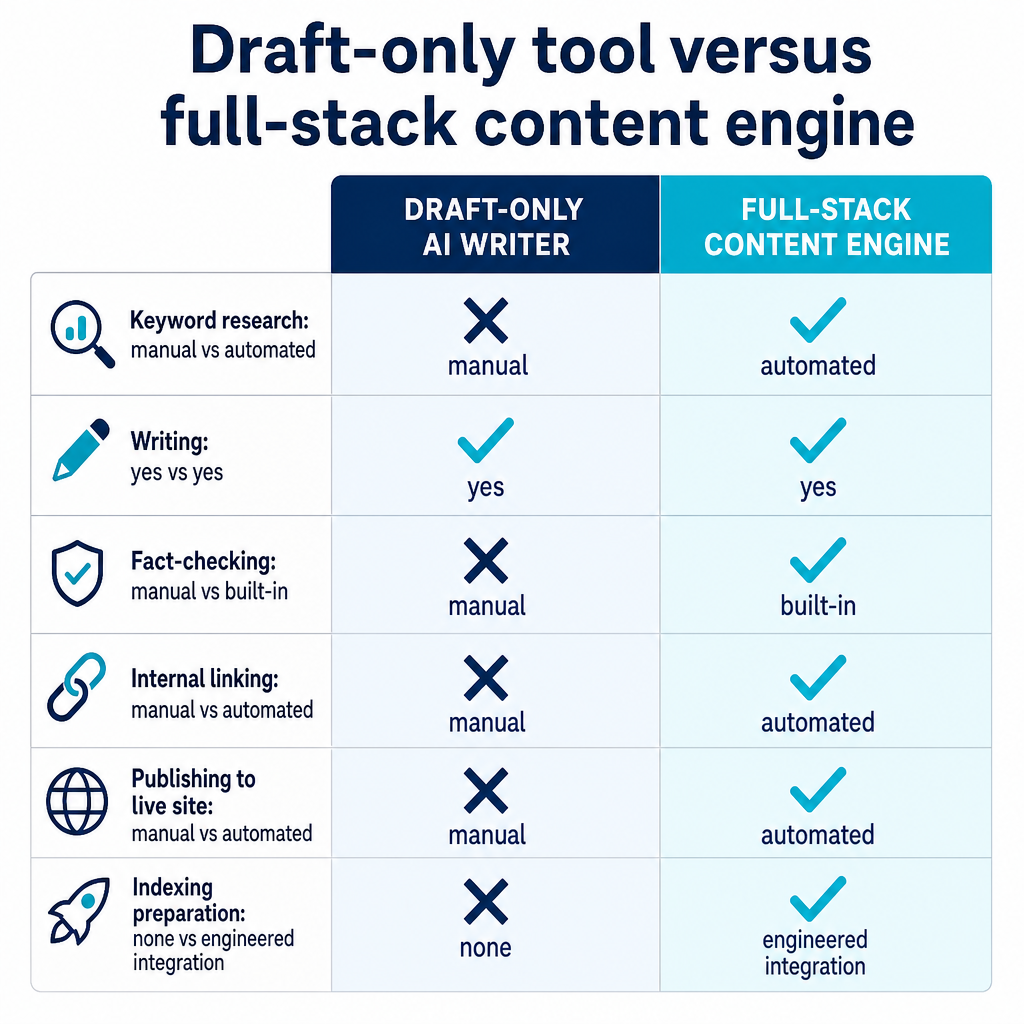
Generic AI writers solve one step of a much longer chain. You still have to decide what to write about, feed the tool a prompt, edit the output, add internal links, format it for your CMS, paste it in, publish, and hope search engines find it. Each of those steps is manual labor, and each one is a place where a busy founder or a stretched marketing team drops the ball. The draft was never the bottleneck. The pipeline around it was.
That is why comparing tools purely on writing quality misleads buyers. A point solution that only generates text hands you a document. A point solution that only optimizes on-page factors needs you to supply the text first. Stitch three or four of these together and you have built a fragile workflow that depends on a human staying disciplined every single day. Most people cannot, which is why so many blogs launch, publish four posts, and then go silent.
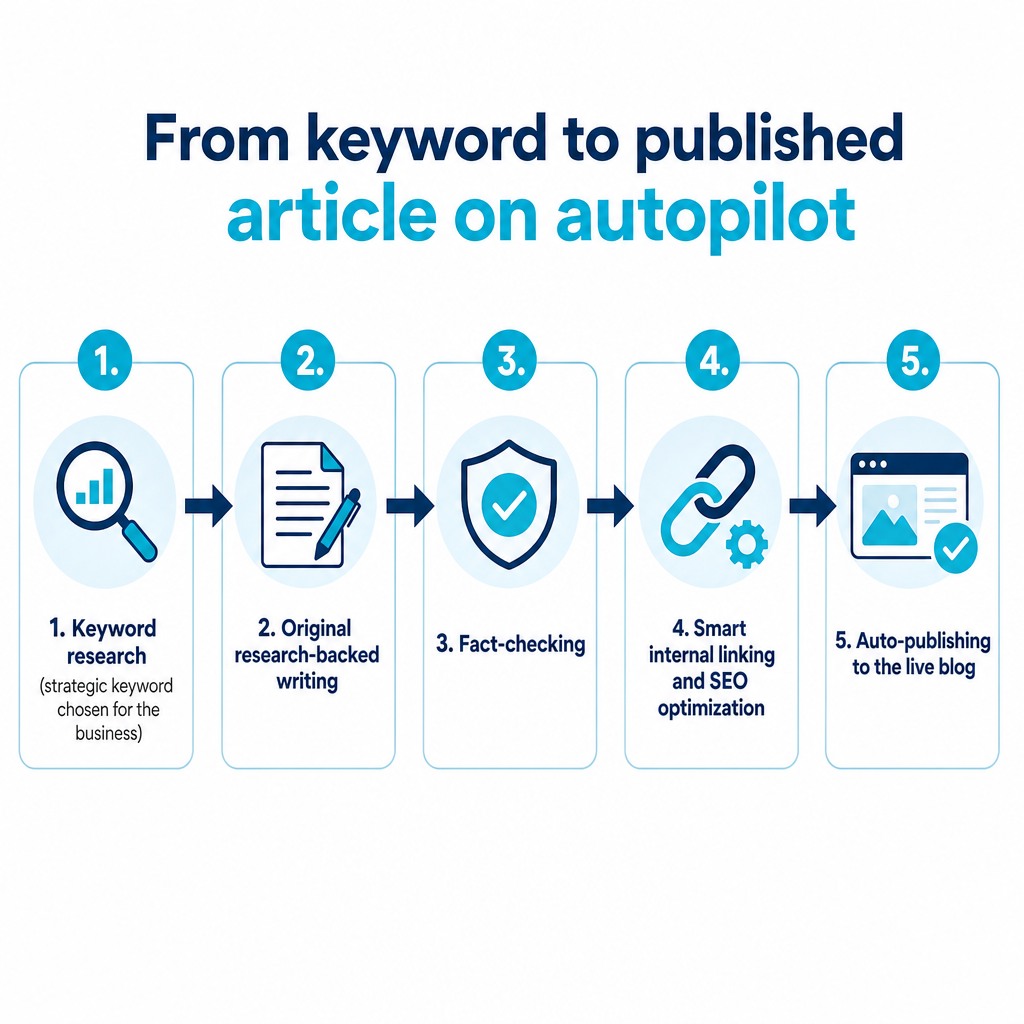
AymarTech markets itself explicitly as a replacement for that stack of tools and content roles, not as another instrument to add to it. The value proposition is end-to-end automation: keyword research, content creation, fact-checking, internal linking, and publishing handled as one integrated workflow rather than five disconnected apps. When you evaluate the best ai for writing through this system lens, the winner is whichever option removes the most operational burden while still producing content that is structurally built to rank.
There is a strategic reason this matters more in 2026 than it did a few years ago. Search behavior is splitting across classic Google results and AI answer engines like ChatGPT, Claude, Perplexity, and Gemini. Content that is thin, unindexed, or poorly linked simply does not surface in either channel. The bar for what "counts" has risen, and a tool that stops at draft generation leaves you well short of it.
If you want a deeper look at where automated writing genuinely helps versus where it falls short, AymarTech unpacks that in its own breakdown of what an AI-powered writing tool can really do for your blog. The short version is that capability is defined by how much of the chain the tool owns, not by prose alone.
What AymarTech actually runs on autopilot
Once your site is connected and your business profile is configured, AymarTech takes over the recurring work. It researches, writes, fact-checks, and publishes original SEO-optimized articles to your blog every day, and each article targets a strategic keyword selected specifically for your business rather than a phrase you had to think up and type into a prompt box. That built-in keyword research is the part most "AI writer" tools skip entirely, leaving you to guess what to publish.
The content itself is described as original and research-backed, which is a deliberate distinction from tools that lightly rephrase existing pages. Fact-checking is folded into the pipeline before publication rather than treated as your problem afterward. And because the articles are written to be published, not just drafted, the on-page structure matters: smart internal linking and SEO optimization are part of the automated workflow, so new posts connect to your existing ones and arrive with the heading structure and metadata search engines expect.
That internal linking detail deserves emphasis because it is where scale usually breaks. When you publish daily, manually maintaining a sensible link graph across dozens then hundreds of posts becomes a job in itself. Automating it means each new article strengthens the ones around it instead of sitting orphaned. Maintaining a distinct, recognizable tone across that volume is the other half of the challenge, and AymarTech addresses it directly in its guide to brand voice AI content generators, which explains how consistent voice is preserved as output scales up.
There is also a broader automation layer worth knowing about. AymarTech's terms reference a product called Aymar Agent, an AI-powered automation platform that assists with organic growth activities beyond writing: SEO, outreach and cold email, content creation, social media sharing, and backlink support. For some buyers, the "best AI for writing" question is really about wanting one system that handles adjacent growth work too, not a collection of isolated tools. That wider scope is what separates a content generator from a growth engine.
The draft is the easy part. The system that turns a keyword into a published, linked, indexable page every day is the hard part, and it is the part that actually moves traffic.
What you do not do, in this model, is write briefs, upload documents, or manually schedule posts. The setup is front-loaded: connect the site, define the business profile, and the ongoing operation is designed to be hands-off. That trade is the entire pitch. You invest attention once and get a steady publishing cadence in return, which for a small business or a founder without a content team is often the difference between having a blog and having an abandoned one.
Indexing and AI visibility, engineered rather than promised
Publishing an article does not guarantee Google sees it quickly. Discovery can lag from hours to days as crawlers work through the web at their own pace, and during that lag your content earns nothing. This is where AymarTech's approach to indexing becomes a concrete differentiator rather than a vague claim: content is intended to be auto-indexed via a Google API so it surfaces faster and stands a better chance of being cited by AI assistants.
It helps to understand what that API actually is, because it is easy to oversell. Google's Indexing API lets a site notify Google directly to update or remove a specific URL, using notification types like URL_UPDATED and URL_DELETED sent as POST requests, and you can check status through the notifications metadata endpoint. Google's own documentation is precise about scope: the Indexing API's official use case is centered on job posting and livestream event pages with the relevant structured data. A third-party overview notes the API launched in 2018 for exactly those structured-data scenarios and can cut indexing lag from hours or days down to minutes for supported content.
The API is also not a casual "ping Google" button. Google's prerequisites require creating a project in the API Console, enabling the Indexing API, adding a service account as a verified owner in Search Console, and authenticating with an OAuth token scoped to the indexing permission. That is real engineering and configuration work with quota management attached. The practical point for buyers is straightforward: a platform that wires this kind of integration in has done technical heavy lifting you would otherwise have to build and maintain yourself.
Because the official documentation limits the API to specific structured-data types, it is worth being clear-eyed. If fast indexing matters to you, ask AymarTech directly how it configures indexing for your site, which URL types it applies it to, and how that maps to Google's stated guidance. Treat any expectation of minutes-fast indexing as something to confirm for your specific content rather than a universal guarantee. The honest framing is that the platform is designed to handle indexing preparation and AI-visibility work so you do not have to build that stack, and the exact behavior for your blog is a reasonable question to raise before you commit.
The AI-visibility dimension follows the same logic. Getting cited by ChatGPT, Claude, Perplexity, or Gemini depends heavily on content being crawlable, well-structured, and actually present in indexes those systems draw on. AymarTech's own explainer on optimizing content for AI search engines walks through why the tactics for answer engines overlap with but extend beyond classic SEO. The takeaway for a buyer is that visibility in 2026 is a technical and operational problem, not just a writing problem, and the best tool is the one that owns that plumbing on your behalf.
How the same engine adapts across very different businesses
One reason full-stack automation is credible is that the underlying work is similar across industries even when the topics look nothing alike. AymarTech positions itself for multiple verticals, including real estate, SaaS, and healthcare, handling the entire pipeline so the business can stay focused on its actual operations. The blog topics represented in its portfolio show that range in practice.
Consider three very different examples. A real estate audience needs a local, timely guide such as one on Boca Raton homes for sale in 2026, where freshness and geographic keywords drive the value. A consumer skincare audience needs careful, trustworthy explanation, as in a guide to choosing non-comedogenic sunscreen for acne, where accuracy and clarity matter more than volume of jargon. A B2B or SaaS audience needs a considered comparison, like AI voice tools versus traditional voiceovers in e-learning, where the reader is weighing a purchase decision. Different intents, different tones, one engine producing search-ready articles for each.
The honest caveat here is that these portfolio pieces illustrate the type and breadth of content the platform produces rather than serving as audited performance case studies. Their detailed structure and results were not independently verified. What they demonstrate directionally is adaptability: a system that can shift from local real estate copy to dermatology-adjacent consumer guidance to B2B software comparisons without you rebuilding your workflow for each topic.
For an agency or a marketing team managing several clients or product lines, that flexibility is the point. Instead of assembling a different toolset and process per vertical, you rely on one engine that maintains brand voice and SEO structure across all of them. The value is not that any single article is a masterpiece; it is that consistent, on-brand, search-ready output arrives daily across whatever categories you operate in, which is precisely what compounding organic growth requires.
This is also where the systems argument closes. A tool that only writes cannot promise this, because every step beyond the draft would still be manual and would multiply with every additional client or topic. An engine that owns research through publishing scales the same whether you run one blog or twenty.
AymarTech
See what a full-stack AI writing engine really does
Understand how autopilot research, writing, internal linking, and publishing turn a keyword into content that ranks and gets cited.
Read the capabilities breakdownSetting it up and keeping light editorial control
The practical decision path is short. First, be honest about what you want: occasional AI-assisted drafts you finish yourself, or genuinely hands-off daily SEO content. If it is the former, a simple draft generator may be enough. If it is the latter, you are looking for an engine, and that is the category AymarTech competes in.
Second, confirm fit for your specific stack and market. The brief indicates integrations with WordPress, Shopify, Webflow, Wix, and more, along with coverage across 150+ languages and auto-indexing via a Google API. Several of these specifics, including exact CMS integrations, language coverage, and the precise indexing mechanism, are first-party claims worth confirming directly rather than assuming. Pricing, plan tiers, and contract terms were likewise not available to verify here, so treat cost and ROI as questions to raise in conversation, not as settled facts.
Third comes the actual setup: connect your site and configure your business profile, at which point the platform takes over keyword research and scheduling. From there the ongoing work is monitoring rather than producing. Even though fact-checking is built into the pipeline, sensible governance means skimming the daily articles for brand voice and factual accuracy, especially in regulated or sensitive categories. Light human oversight is not a knock on automation; it is standard practice for any content operation running at volume.
Finally, judge results on the right timeline. Organic traffic and rankings respond over months, not days. A reasonable evaluation window is three to six months, watching how consistent publishing cadence and faster indexing translate into measurable movement for your site. The mechanism is simple to reason about: more indexed, well-linked, on-brand articles targeting real keywords, published continuously, is what compounds into traffic. The best ai for writing in 2026 is whichever option makes that compounding happen without demanding your daily attention.
Frequently asked questions
Is the best AI for writing just the tool with the best prose?
No. Prose quality is table stakes, but it only addresses one step. The tools that deliver measurable results own the full chain from keyword research to fact-checking, internal linking, publishing, and indexing preparation. A beautifully written draft that never gets published, linked, or indexed earns nothing, which is why the decision should weigh the whole system rather than the sentences alone.
How is AymarTech different from a standard AI writing tool?
A standard AI writer generates text on demand and leaves the surrounding work to you. AymarTech is positioned as a full-stack SEO content engine that, once your site is connected and your profile is set, researches, writes, fact-checks, internally links, and publishes original articles daily on autopilot. It markets itself as a replacement for a stack of separate SEO tools and content roles rather than an addition to them.
What does auto-indexing via the Google API actually mean?
Google's Indexing API lets a site notify Google directly about specific URLs using update and delete notifications, and its official documentation focuses that capability on job posting and livestream event pages with the right structured data. Using it requires real configuration: an API Console project, the API enabled, a verified service account in Search Console, and OAuth authentication. AymarTech aims to handle this indexing preparation for you, but because the API's official scope is specific, it is fair to ask how it is configured for your particular content.
Do I still need to edit or review the content?
The platform includes fact-checking in its pipeline, so the intent is to reduce manual editing to a minimum. Even so, light editorial governance is good practice at any publishing volume. Skimming daily articles for brand voice and accuracy, particularly in sensitive or regulated topics, is a reasonable habit rather than a sign the automation is failing.
Can it handle very different industries and languages?
AymarTech positions itself across multiple verticals such as real estate, SaaS, and healthcare, and its portfolio spans topics from local property guides to skincare explainers to B2B software comparisons. The brief also cites coverage of 150+ languages. The portfolio examples illustrate breadth rather than audited case studies, and language and platform specifics are worth confirming directly for your market before committing.
How soon should I expect to see results?
Organic growth compounds over time. A practical evaluation window is three to six months, during which you can correlate consistent daily publishing and faster indexing with movement in traffic and rankings. Expecting overnight results from any content tool sets you up for disappointment; the advantage of an autopilot engine is that the cadence keeps running while you measure.