
brand voice ai content generator: Brand Voice AI Content Generators: Sound Like You at Scale
Your blog can publish twenty articles a month and still sound like twenty different people wrote them. That is the real problem a brand voice ai content generator is built to solve: not just producing words, but producing words that consistently read like you across every post, in every market, without a human editor rewriting each draft to match your tone. For small business owners, SaaS founders, and lean marketing teams, the promise is hands-off organic growth that never drifts off-brand.
Most tools on the market approach this as a manual, per-task exercise. You open the app, pick a voice profile, prompt it, and clean up the output. That works when you publish occasionally. It falls apart when your growth plan depends on daily, research-backed content that ranks. AymarTech takes a different structural approach — a connected site, a business profile, and an always-on pipeline that researches, writes, fact-checks, internally links, and publishes to your website automatically. This piece explains what brand voice generators actually do, where AymarTech fits, and how to evaluate whether an automated pipeline is the right fit for keeping your content on-brand at scale.
Table of contents
- What a brand voice AI content generator actually does
- Prompt-based tools versus a brief-to-pipeline agent
- How AymarTech keeps content on-brand across your site
- Consistency across languages and channels
- How to evaluate a brand voice generator before you commit
- Getting your voice-aligned pipeline running
- Frequently asked questions
What a brand voice AI content generator actually does
The category name gets used loosely, so it helps to be precise. A brand voice generator is not a tone slider that toggles between "professional" and "friendly." The tools that take the idea seriously analyze content you already have and build a reusable style profile from it.
Junia AI describes an AI brand voice generator as a tool that studies existing content to capture your unique tone, vocabulary, sentence patterns, and messaging approach, then stores that as a profile it can reuse. Its recommended workflow is concrete: gather three to five samples of your ideal content — roughly 1,500 to 3,000 words total — feed them in, let the system analyze vocabulary, sentence structure, and emotional markers, then apply that style to everything it produces afterward.
Other vendors approach the input differently. Blaze AI's brand voice generator scans your website directly, learns how your brand writes from what is already live, and lets you fine-tune tone, style, and audience before generating. Copy.ai's brand voice feature asks you to paste in representative examples, analyzes them, and lets you select that saved voice profile when you write new material. Klaviyo's brand voice AI frames it around consistency: it learns your tone, phrasing, and writing rules, then applies them automatically to every piece of marketing content it creates.
Strip away the differences and three shared mechanics remain. The tool ingests existing brand material — a website, sample copy, or posts. It builds a reusable voice profile covering tone, vocabulary, phrasing, and structure. Then it applies that profile to newly generated content so the output stays recognizable as yours.
The practical distinction buyers should hold onto: a genuine voice generator learns from your content, while a weaker tool just hands you generic tone presets. If a product only offers dropdown moods with no ingestion of your own writing, it is a style filter, not a voice engine.
Prompt-based tools versus a brief-to-pipeline agent
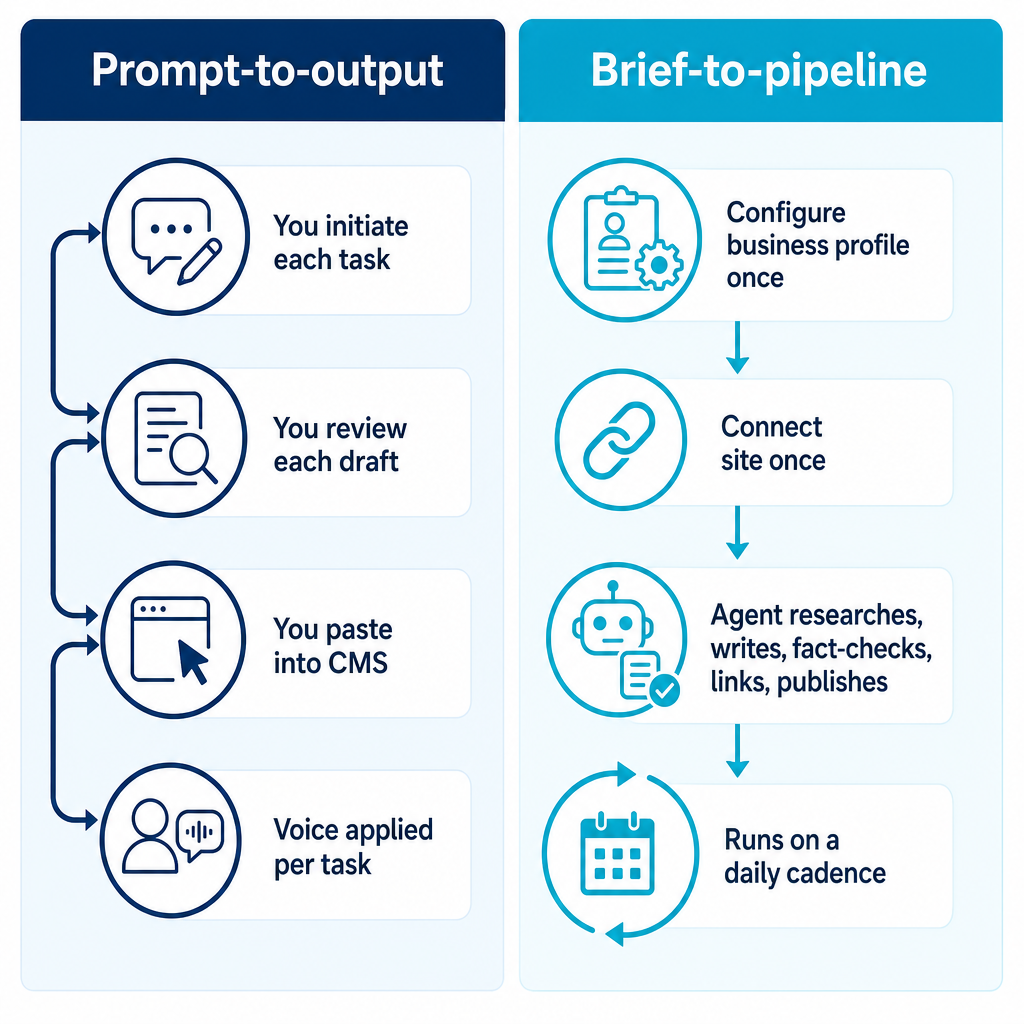
Here is where the market splits, and it matters more than most feature comparisons admit. The tools above are largely built around what you might call a prompt-to-output loop. You decide when to write, you initiate each generation, you review each result, and you paste the finished piece into your CMS. The voice profile is applied per task, on demand, by a human sitting at the keyboard.
That model has a ceiling. When your organic growth plan calls for consistent daily publishing, someone has to keep showing up to prompt, review, and post. The voice may be consistent inside any single generation, but the operation is not automated — it is just faster manual work.
AymarTech is positioned around a different pattern. Its AI Blog Writer Agent is built on a brief-to-pipeline workflow rather than a prompt-to-output loop. Instead of prompting per article, you configure a business profile and connect your site once, and the agent then runs a recurring cycle of research, writing, fact-checking, internal linking, and publishing. The homepage frames the setup plainly: you connect your site, set up your business profile, and the platform takes care of the rest — researching, writing, fact-checking, and publishing SEO-optimized articles daily, complete with internal links and on-brand images.
That structural difference is the whole argument for automation-first buyers. A prompt tool makes each article easier. A pipeline agent makes the publishing operation run without you standing over it. For a founder or a two-person marketing team, that is the gap between "we could publish more if we had time" and "content ships whether or not we have time."
If you want the mechanics of that recurring cycle in more depth, AymarTech's own walkthrough of how to automate your SEO content workflow lays out the connect-research-write-publish stages that the agent handles end to end.
How AymarTech keeps content on-brand across your site
AymarTech positions itself as an all-in-one SEO automation platform and AI-powered Blog Writer. The core product, referred to in its Terms as Aymar Agent, is an automation platform for organic growth that spans SEO, content creation, social posting, cold email outreach, and backlink support. For the purposes of brand voice, the relevant starting points are the two things you set up before anything publishes: the connected website and the business profile.
Connecting your site gives the platform access to what you have already written and how your business presents itself. Completing the business profile aligns the content the agent produces with your goals, your target audience, and your subject matter. Together, those inputs are the natural foundation for content that reads like your brand rather than like a generic template — the same principle behind website-scanning and sample-driven voice tools, applied inside an automated publishing pipeline.
A point of honesty matters here. AymarTech's public materials describe original, brand-voice content and on-brand images, but they do not yet publish a detailed technical breakdown of exactly how a voice profile is trained, stored, or edited — whether through crawling your site, ingesting sample articles, or reading uploaded guidelines. If precise voice-training controls are decisive for your team, that is a fair question to raise with the company directly through its contact channel, where support typically responds within one business day. Buying on documented capability rather than assumption is always the safer path.
What is clearly verifiable is the surrounding system that protects brand consistency in practice:
- Research-backed drafting. The platform performs keyword research and competitor analysis, then writes fact-checked, SEO-optimized articles rather than free-associating from a prompt.
- Built-in internal linking. Smart internal linking is part of the generation, so new posts connect to your existing library instead of standing alone — a subtle but real signal of a coherent, single-author site.
- On-brand images. Articles are published with images intended to match the content rather than stock filler unrelated to the topic.
- Direct publishing. Finished articles go straight to your website, including platforms like WordPress, Shopify, Webflow, and Wix, so there is no copy-paste step where voice or formatting gets mangled.
For a fuller picture of what this class of tool can do beyond drafting, AymarTech's overview of what an AI-powered writing tool can really do for your blog sets expectations on the research, optimization, and publishing side that separate a pipeline agent from a text generator.
Consistency across languages and channels
Brand voice gets harder the moment you cross a language boundary or a channel boundary. A tone that reads confident in English can read blunt or stiff after a literal translation, and a voice that works in a long blog post can collapse in a short social caption. This is where the scope of the underlying platform starts to matter as much as the voice engine itself.
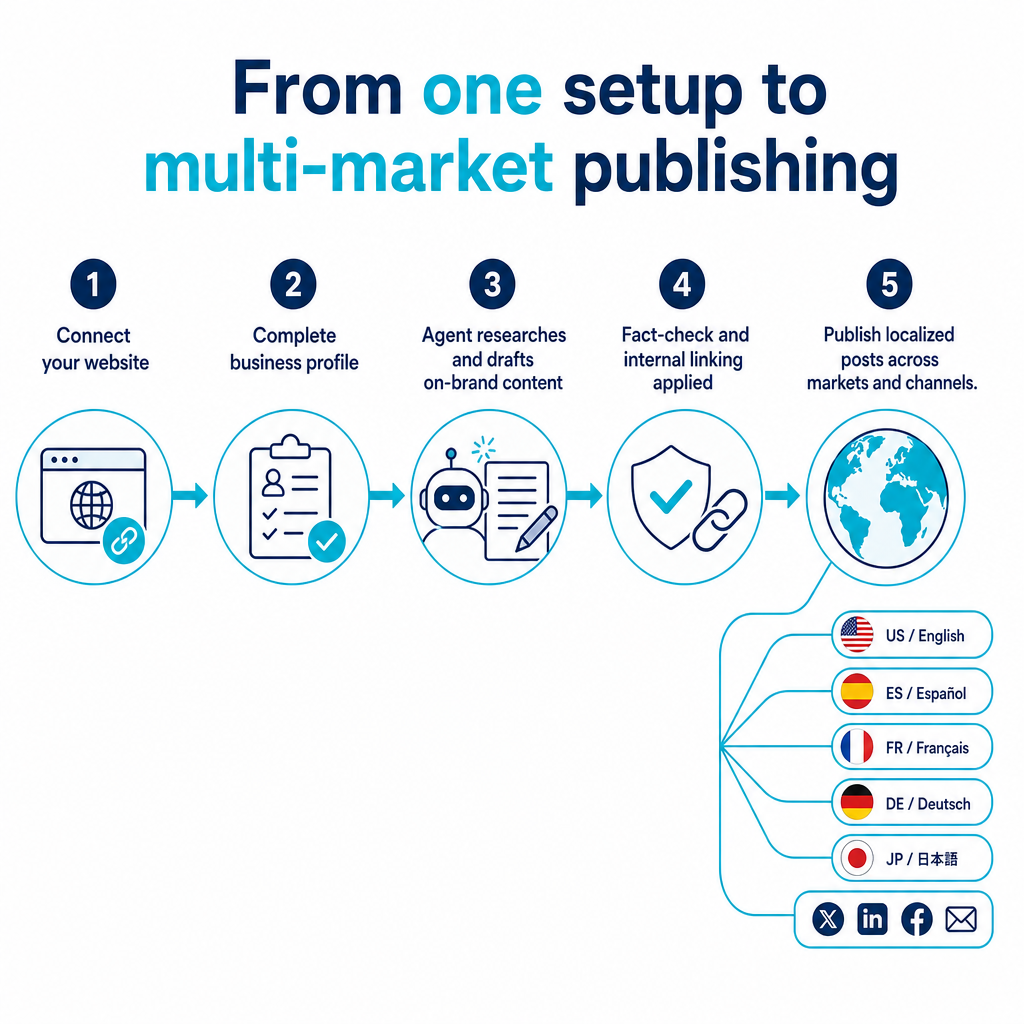
AymarTech supports content across many languages — the brand describes support for 150-plus languages, while independent launch coverage cited over 120 languages at the time of writing. Either way, the practical point stands: the platform is built to publish localized content across multiple markets from a single setup rather than forcing you to rebuild everything language by language. If the exact current count or any per-language quality differences affect your rollout plan, confirm the specifics with the company before committing to a multi-market strategy, since published figures have varied.
On the channel side, Aymar Agent's stated scope reaches beyond blog articles into social posting, cold email, and backlink outreach. The relevant implication for voice is consistency: if the same connected site and business profile inform those adjacent activities, the tone that shows up in your blog has a shared origin with the tone that shows up elsewhere. Many competing tools treat each channel as a separate manual setup, which is exactly how voice drifts between your blog and your social feed.
One caution worth stating plainly. AymarTech's own Terms describe Aymar Agent as a platform that assists with these tasks and explicitly do not guarantee specific business results or performance metrics. So while the cross-channel scope supports voice consistency, treat it as capability and workflow rather than a promise of ranking outcomes or guaranteed AI-assistant citations. The honest buyer frame is: the pipeline gives you consistent, on-brand output at volume; results depend on your topics, your market, and your patience with organic growth.
How to evaluate a brand voice generator before you commit
The category is crowded, and vendors describe similar features in very different words. A short set of decision criteria cuts through most of it.
Does it learn your actual voice, or just offer presets? As the independent evidence shows, serious tools analyze your own website, blog, or sample copy to build a profile. Ask whether the tool ingests your material or only asks you to pick a mood. This is the single biggest quality separator.
Is it prompt-based or pipeline-based? Decide honestly how you will use it. If you publish occasionally and enjoy editing, a prompt tool is fine. If you need consistent output without a person driving every article, you want a brief-to-pipeline agent like AymarTech, where setup happens once and publishing recurs on a cadence.
Does it handle the whole job, or just the writing? A voice profile applied to raw text still leaves you doing keyword research, SEO optimization, internal linking, image sourcing, and CMS publishing. Weigh whether you want to keep a stack of separate tools plus a writer, or consolidate research, writing, optimization, and publishing into one agent. That consolidation is central to how AymarTech positions itself against a patchwork of point tools.
Does it scale across languages and channels the way you plan to grow? If you only publish English blog posts, broad language support is a nice-to-have. If you are expanding into new markets, it becomes a core requirement — and one you should verify with current numbers, not marketing shorthand.
What does it actually cost, and what are the limits? AymarTech's public pricing shows a launch price, described as normally $250 per month, which signals a subscription model rather than per-article billing. Detailed tiers, post volume caps, and how many sites a plan covers are worth confirming directly, since those limits shape whether the economics work for your publishing goals.
If you want to see where a pipeline agent sits relative to the broader field, AymarTech's ranked look at the best AI writing tools of 2026 is a useful reference point for comparing categories rather than judging on a single feature.
Getting your voice-aligned pipeline running
If you decide an automated, on-brand pipeline fits your growth plan, the setup path is short and mostly front-loaded. The work happens once, not per article.
Start by pulling together three to five strong samples of content that genuinely sound like you — a couple of well-written blog posts, a landing page, an email you are proud of. Even where a platform learns from your live site, having your best material identified helps you judge later whether the output matches. Independent brand voice workflows consistently recommend this sample-gathering step, and it costs you nothing but an hour.
Next, make sure your website is connected and crawlable so any site-based learning can read how your brand already writes. Then complete your AymarTech business profile so the agent can align topics with your business goals and target audience, not just your keywords. Set a realistic cadence — daily publishing is the headline capability, but choose a volume you can still glance over during a review pass. Finally, review early output against those best-of samples you gathered, and refine your profile or guidelines where the tone drifts.
That review loop is the part buyers skip and regret. Automation removes the labor of producing content; it does not remove your responsibility to confirm the first weeks of output actually sound like your brand before you let it run quietly in the background.
Frequently asked questions
What is a brand voice AI content generator?
It is a tool that analyzes your existing content to build a reusable style profile — capturing tone, vocabulary, sentence patterns, and messaging — and then applies that profile to newly generated content so everything reads consistently as your brand. The stronger tools learn from your own website or sample copy rather than offering generic tone presets.
How is AymarTech different from a standard prompt-based writing tool?
Most brand voice tools use a prompt-to-output loop where you initiate and review each piece manually. AymarTech's AI Blog Writer Agent is built on a brief-to-pipeline model: you connect your site and set up a business profile once, and the agent then runs a recurring cycle of research, writing, fact-checking, internal linking, and publishing directly to your website, rather than waiting for a prompt each time.
Does AymarTech learn my brand voice from my website?
AymarTech has you connect your site and complete a business profile as the foundation for on-brand content, and it describes producing original, brand-voice articles. However, its public materials do not yet document the exact voice-training mechanics — such as whether it crawls your site, ingests sample articles, or reads uploaded guidelines. If precise voice controls are decisive for you, confirm the details directly with the company, which typically responds within one business day.
How many languages does AymarTech support?
The brand describes support for 150-plus languages, while independent launch coverage referenced over 120 languages. The figures have varied across sources, so verify the current, precise count and any per-language quality considerations with the company before planning a multi-market rollout.
What does AymarTech cost?
AymarTech's public pricing shows a launch price described as normally $250 per month, which points to a subscription model rather than per-article charges. Detailed tiers, monthly post volumes, and how many sites a plan covers are not fully documented publicly and are worth confirming directly before you commit.
Will an automated pipeline guarantee higher rankings or AI-assistant citations?
No. AymarTech's own Terms describe the platform as one that assists with SEO and content tasks and explicitly do not guarantee specific business results or performance metrics. The pipeline gives you consistent, on-brand, research-backed content at volume; ranking and visibility outcomes still depend on your market, topics, and the normal timeline of organic growth.