
Best Ai For Writing: The Best AI for Writing in 2026: How to Choose the Right Tool for Your Business
The best AI for writing in 2026 is not one chatbot everyone should use. For a business, the best ai for writing is the tool that matches your primary use case, your workflow, and your growth goal. If that goal is organic traffic and citations inside AI assistants, the right category is an AI SEO platform that researches, writes, and publishes for you — not a blank text box waiting for another prompt.
That distinction matters more than any single model benchmark. A founder pasting prompts into a chatbot and a marketing team that needs SEO content shipping every day are solving different problems, even if both technically "use AI to write." So before comparing outputs sentence by sentence, it helps to understand what these tools actually are, how they differ, and which class of tool your situation calls for.
Table of contents
- What "AI for writing" actually means in 2026
- The four categories, and what separates them
- Why the category matters more than the model
- How to judge the right tool for your business
- Where AymarTech fits, and your next decision
- Frequently asked questions
What "AI for writing" actually means in 2026
An AI writing tool generates and refines text from a prompt, drawing on a large language model to produce drafts, rewrites, summaries, and edits. That is the shared mechanism underneath every option on the market. Where tools genuinely diverge is in everything wrapped around that model: research, brand-voice control, SEO structure, publishing, and getting the content found.
At the simplest end, a generalist chatbot takes your instruction and returns text. You supply the topic, the angle, the keywords, and the editing judgment. At the other end, an AI SEO platform sits above the model and orchestrates a full pipeline — it picks topics, researches them, writes in your brand voice, adds internal links and images, publishes to your site, and pushes the content toward indexing. The model writing sentences is the same commodity; the value is in what surrounds it.
This is why "which AI writes the nicest sentence" is the wrong opening question for a business. Sentence quality across the leading models has converged. The decision that actually changes your results is how much of the work the tool removes from your team, and whether that work maps to an outcome you care about.
The four categories, and what separates them
Comparison guides in 2026 consistently agree on one thing: there is no single best option, because the answer depends on the job. Social Media Pymes makes the point plainly, and ComparaIA builds its whole ranking around the type of work — long-form, proposals, reports, marketing. Once you accept that, the market sorts into four practical categories.
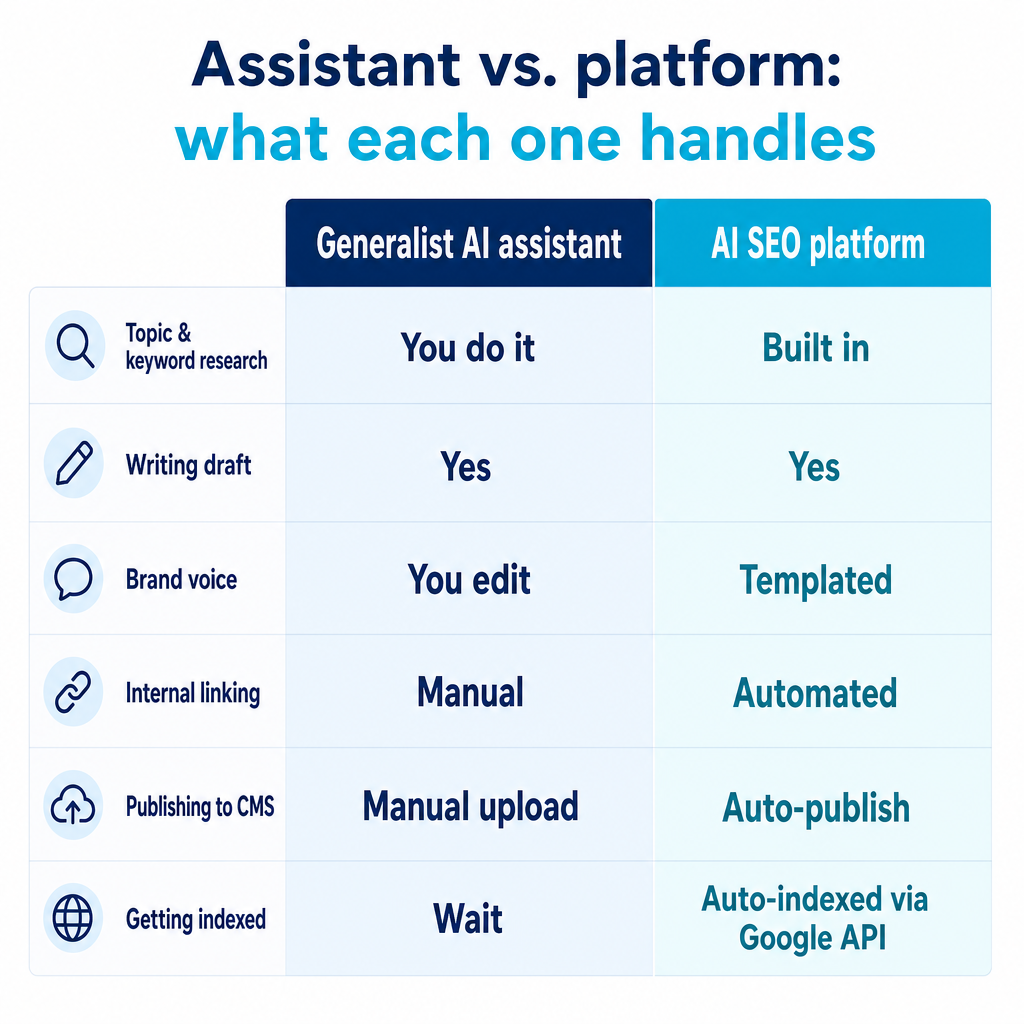
Generalist chatbots. These are the flexible drafting assistants most people try first. They handle nearly any writing task, from emails to outlines to long analysis. Their strength is breadth; their limit is that they do only the step you prompt. Every article still needs you to research the topic, choose the keyword, edit for voice, format it, upload it, and wait for search engines to find it.
Marketing and copy tools. Purpose-built for ads, product descriptions, and short campaign copy, these lean into templates and speed for high-volume short-form output. They shine on a landing page headline and are less suited to structured long-form SEO articles.
Editing and style tools. Grammar, readability, and tone correction. These improve text you already have rather than producing strategy or publishing anything. They are a layer, not an engine.
AI SEO platforms. This is the category built around a business outcome rather than a writing action. Guides now treat SEO-oriented AI as a distinct class, separate from chatbots and grammar checkers. These platforms fold keyword research, topical structure, brand voice, internal linking, and direct publishing into one workflow. One-click publishing to a CMS is now a standard differentiator, not a luxury feature, as Eesel's comparison shows by listing it alongside compliance as a core evaluation field.
The meaningful line in 2026 runs between an assistant and a platform — between a tool that helps you write one thing when you ask, and a system that keeps producing on-brand, search-ready content without you driving each step.
Why the category matters more than the model
For a small business owner, a SaaS founder, or a lean marketing team, the constraint is rarely writing ability. It is time, headcount, and consistency. You can generate a good draft in a chatbot in minutes — and then spend hours on the research, keyword targeting, formatting, internal links, image, upload, and indexing that turn that draft into a page that actually earns traffic. Multiply that by a publishing cadence you can sustain, and the drafting minutes stop being the bottleneck.
There is also a newer stake. In 2026, being found means ranking on Google and being cited inside AI assistants like ChatGPT, Claude, Perplexity, and Gemini. Content that only lives as an exported draft on your hard drive does neither. The category you choose decides whether "writing with AI" ends at a document or continues all the way to a live, indexed, discoverable page.
Long-form is its own reason the category matters. Guides repeatedly single out certain models for structured long documents and a more natural tone, while others are built for short copy. SEO articles and pillar pages need consistent headings, topical depth, and internal structure — capabilities you have to verify, not assume, and that a platform built for blogging handles by design rather than by prompt.
How to judge the right tool for your business
The useful frameworks in circulation converge on a short set of questions. HowManyWords frames the first as: what is your main task — drafting, editing, researching, or grammar? Adapt that and a few others into criteria you can weigh for your own situation.
- Primary job to be done. Is your recurring need ongoing SEO blog content that generates traffic, or one-off emails, ads, and creative pieces? If it is the former, a general chatbot is a partial tool for a full-time job.
- Volume and cadence. Occasional writing suits an assistant you prompt as needed. A sustained publishing schedule rewards a platform that produces without you initiating each piece.
- Brand-voice control. Comparison tables now treat brand voice and consistency as scored fields. Ask whether the tool keeps every article recognizably yours, or whether you re-edit tone every time.
- SEO features. Keyword research, topical clustering, internal linking, and SERP awareness separate a writing tool from a growth tool. A beautiful paragraph with no keyword strategy behind it rarely ranks.
- Workflow integration. Can it publish directly to WordPress, Shopify, Webflow, or Wix, or does someone copy, paste, format, and upload every article? Integration is where hours quietly disappear.
- Data privacy and content control. Consumer-grade tools sometimes train on the text you feed them, while other tools are built to protect that input. If you handle proprietary or sensitive material, confirm how each tool treats your content before you rely on it.
Run your situation through those criteria and the pattern usually resolves cleanly. Low volume, varied writing, hands-on editing: an assistant is fine. High volume, SEO-driven, hands-off: you need a platform designed for ongoing publishing at scale. For a deeper look at evaluating this specific class of tools, our guide on how to pick the right AI SEO writing tools breaks down the categories in more detail, and our companion piece on choosing the tool that actually grows traffic focuses on the outcome rather than the output.
Where AymarTech fits, and your next decision
AymarTech sits firmly in the AI SEO platform category — the one built around traffic and AI visibility rather than around a single writing action. We research keywords, write original brand-voice articles, fact-check them, generate on-brand images, add internal links, and auto-publish to WordPress, Shopify, Webflow, Wix, and more, daily, on autopilot. Content is then auto-indexed via the Google API so it can rank on Google and get cited by ChatGPT, Claude, Perplexity, and Gemini, across 150+ languages.
That scope is the whole point of the assistant-versus-platform distinction. Where a chatbot hands you a draft and leaves the research, formatting, publishing, and indexing to you, we treat those as the job — because for a business, they are. You can see the practical difference on our examples page, which shows live content produced for real sites with brand voice, internal links, and SEO structure intact.
So your next decision is not "which model writes best" but "which category matches my growth goal." If you want hands-off SEO content that keeps shipping without hiring writers or juggling tools, that answer is a platform. If you also want the tactical mechanics of setting one up and switching your content engine over, that belongs to a how-to rather than this explainer — this guide's job is to help you pick the category first.
Frequently asked questions
What is the best AI for writing in 2026?
There is no single best tool — the leading guides agree the answer depends on your use case. For flexible, occasional writing, a generalist chatbot works. For ongoing SEO content and organic traffic, the right category is an AI SEO platform that also researches, publishes, and indexes.
What is the difference between an AI writing assistant and an AI SEO platform?
An assistant produces a draft when you prompt it, leaving research, keywords, formatting, publishing, and indexing to you. A platform orchestrates that full pipeline automatically, so content ships to your site and gets found without you driving each step.
Can generic chatbots handle long-form SEO blog content?
They can draft it, but SEO articles need consistent structure, keyword targeting, internal links, and publishing that most chatbots don't provide. You supply and manage all of that manually, which is where the time cost lives.
Should I worry about data privacy with AI writing tools?
Yes. Some consumer tools train on the text you enter, while others are built to protect it. If you handle proprietary or sensitive content, verify each tool's data-handling policy before relying on it.
Does AymarTech only write content, or does it publish too?
We handle the full pipeline: research, writing, fact-checking, brand-voice images, internal linking, and auto-publishing to major CMS platforms, with content auto-indexed via the Google API across 150+ languages.