
best ai writing tools: The Best AI Writing Tools in 2026: Which One Actually Grows Traffic?
Most "best AI writing tools" roundups quietly answer a question you never asked. They rank which tool produces the cleanest paragraph the fastest, then hand you a shortlist and a subscription button. But if you run a business, faster drafts are not the goal. Traffic is. Rankings are. Getting cited when someone asks ChatGPT or Perplexity for a recommendation in your category is. When you judge the best ai writing tools by that standard instead of by prose quality alone, the leaderboard reshuffles completely.
The honest reality is that there is no single winner, because these products are built to solve different problems. A grammar checker, a marketing-copy generator, a general chatbot, and an SEO brief tool are all called "AI writing tools," yet only some of them touch anything that moves an organic traffic line. This article separates the categories, shows where each one stops short of actual growth, and explains why a full research-to-publishing pipeline is a different animal entirely. That last category is where AymarTech sits.
Table of contents
- What "best" should mean when you care about traffic
- The four categories of AI writing tools in 2026
- Where a stacked tool setup leaves gaps
- AymarTech as an end-to-end SEO content platform
- How to choose the right setup for your goal
- Frequently asked questions
What "best" should mean when you care about traffic
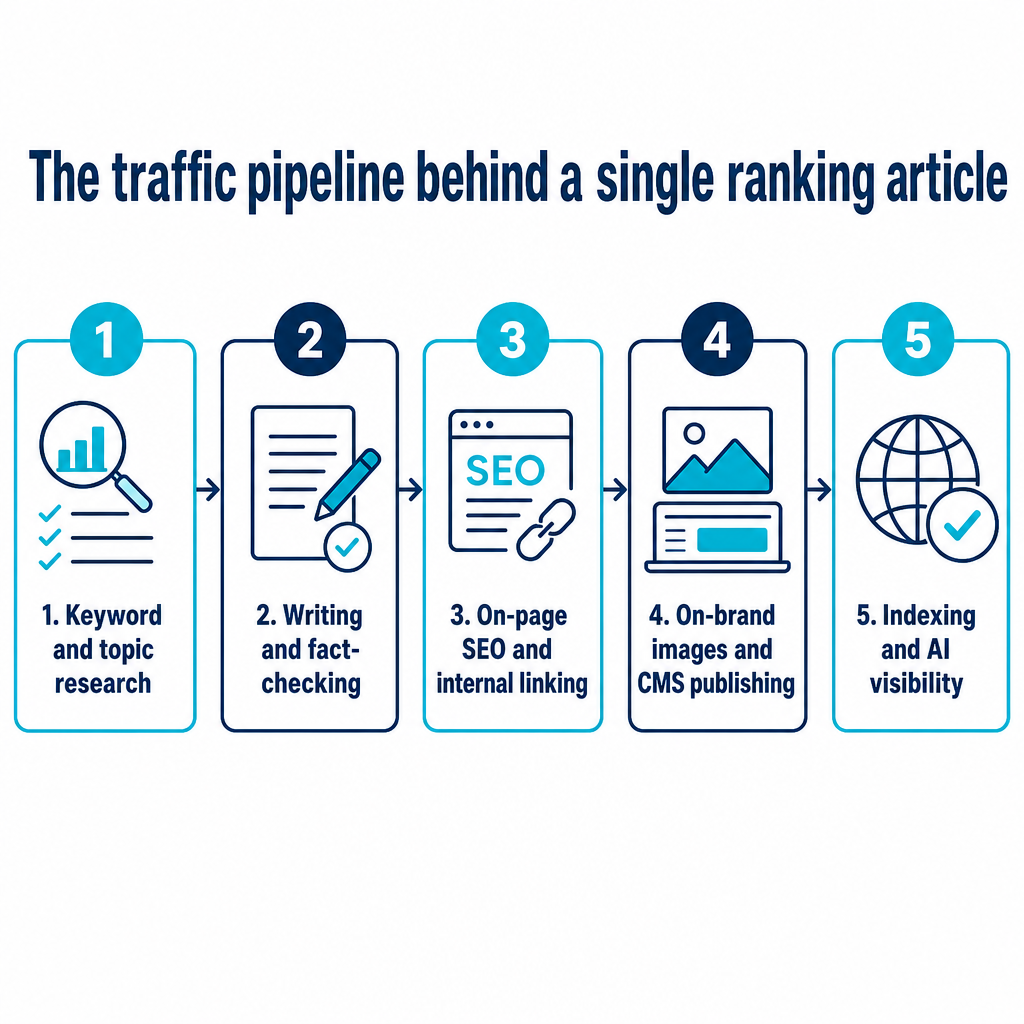
A tool that writes a beautiful post is only useful if that post gets found, indexed, and served to the right audience. Those are separate jobs. Writing well is a language task. Growing traffic is a chain of tasks: keyword research, topic selection, on-page structure, internal linking, image creation, publishing into your CMS, and getting the page crawled and indexed. A tool can be excellent at one link in that chain and contribute nothing to the others.
That gap is why the popular rankings feel unsatisfying once you look closely. Independent roundups tend to score tools on writing quality and correction rather than on organic outcomes. G2's AI writing assistant category, for example, places Grammarly at the top of the AI writing assistant listings with a 4.7 out of 5 rating from more than 13,800 verified reviews. That is a strong signal about editing quality. It says nothing about whether a page will rank or earn citations, because that was never what the tool was built to do.
So before comparing products, define the metric that matters to you. If your objective is polished internal documents, an editing assistant is the right lens. If your objective is measurable organic growth and visibility inside AI answers, you need to evaluate every candidate against the full pipeline, not just the part that turns a prompt into prose. AymarTech's own breakdown of this question in its ranking of the best AI writing tools for real results is a useful companion when you want the comparison framed around outcomes rather than features.
The four categories of AI writing tools in 2026
The market is fragmented, and understanding the fragmentation is more useful than memorizing a top-10 list. Independent coverage repeatedly makes the same point: there is no universally best option, and the right pick depends on the use case. That framing comes through clearly in Social Media Pymes' overview of the best text-writing AI tools, which sorts leading products by what they are actually good at rather than pretending one tool wins everything.
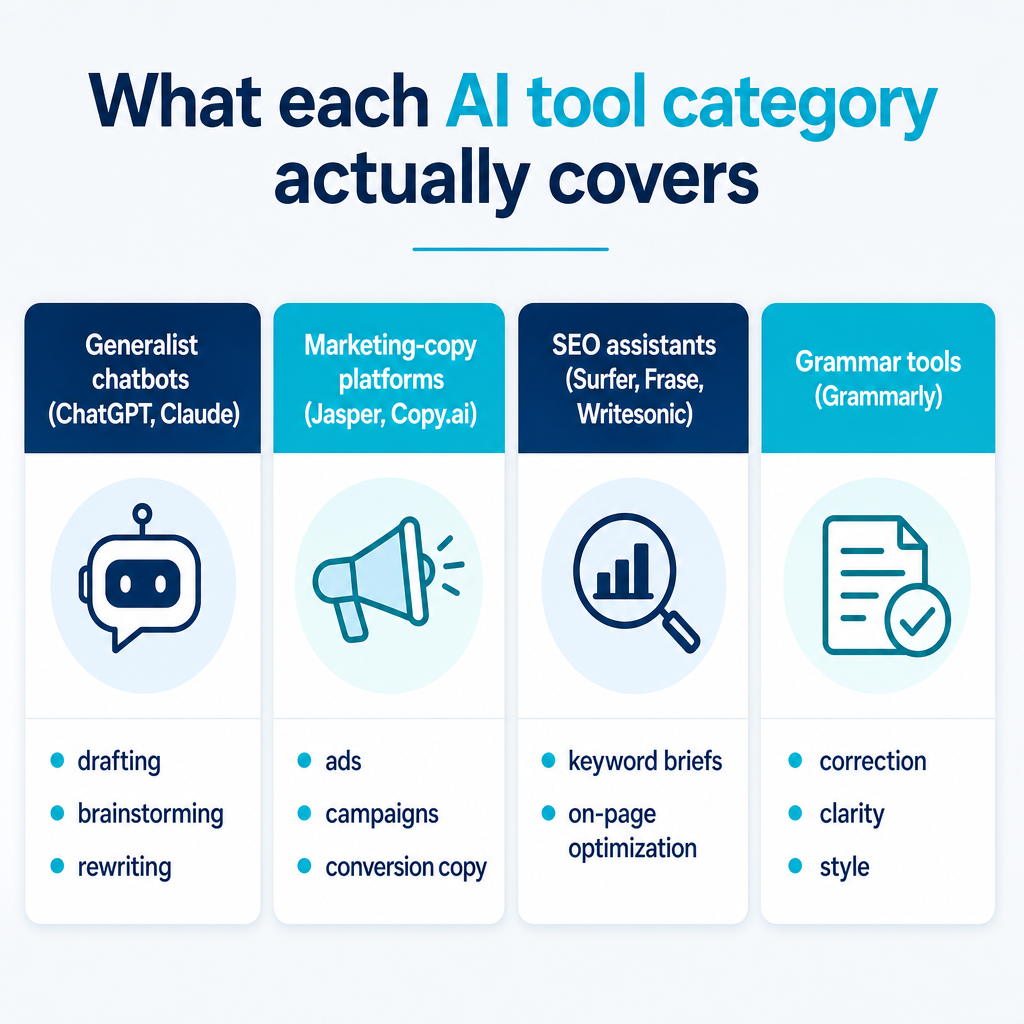
From the current landscape, four categories cover almost everything a buyer will encounter.
Generalist chatbots. ChatGPT and Claude anchor this group. Ranktracker's roundup notes that ChatGPT remains one of the strongest options for brainstorming, outlining, drafting, rewriting, and research-assisted work. These are flexible thinking partners. They will help you produce a draft, but they do not research your keyword landscape, publish to your site, or ensure a page gets indexed. They are a starting point, not a growth engine.
Marketing-copy platforms. Jasper and Copy.ai target campaigns, ad copy, and high-conversion marketing content. Convictorius positions Copy.ai as strong for copywriters and conversion-focused marketing material, while Social Media Pymes highlights Jasper for campaigns and Copy.ai for workflow automation. This category is built around persuasion and volume for marketing assets, which is a different job than sustained organic blogging.
SEO-focused assistants. Surfer, Frase, and Writesonic sit here. Convictorius describes Frase as completely SEO-focused, helping to research, write, and optimize SEO content quickly, and describes Writesonic as focused on SEO-friendly content for blogs and ads, including content for Google and Shopify. Visme's roundup likewise associates Surfer and Frase with SEO optimization features. These tools genuinely touch the optimization step, which is closer to traffic than the previous two categories, but they still expect you to orchestrate the workflow around them.
Grammar and correction tools. Grammarly leads this group, rated at the top of G2's AI writing assistant category. This category improves clarity and correctness. It is valuable for quality control and irrelevant to whether a page ever earns a position on the results page.
Seen this way, the categories are complementary rather than competitive. You could reasonably use one from each. Which is exactly where the trouble starts.
Where a stacked tool setup leaves gaps
The intuitive fix is to combine tools: a chatbot for drafts, an SEO assistant for optimization, a grammar tool for polish, and your CMS for publishing. On paper it looks complete. In practice it introduces three problems that quietly cap your results.
The first is cumulative cost and complexity. Stacking subscriptions adds up fast. Zemith's testing of a dozen writing tools found ChatGPT Plus and Claude Pro standing out as the strongest generalists, each priced around $20 per month. Add an SEO assistant and a grammar tool on top, and a small team is paying for four products while still doing the coordination work by hand. The subscriptions are the visible cost; the hidden cost is the hours spent moving content between them.
The second is the orchestration burden. Even with excellent individual tools, someone has to decide what to write about, run the keyword research, feed the brief into the drafting tool, move the output into the optimizer, check facts, add internal links, create images, format everything for the CMS, publish it, and then confirm the page gets indexed. None of these tools do that stitching for you. The chain only works when a human runs between the links every single time, which is precisely the workload most owners and founders are trying to escape.
The third is consistency. A stacked setup depends on the discipline of the person running it. Publishing slips when the week gets busy. Brand voice drifts as different tools produce differently flavored output. Internal linking gets skipped because it is tedious. Indexing gets forgotten because it is invisible until you check. The result is a workflow that produces good individual pages but not a reliable, compounding content program. For a deeper look at how to evaluate the optimization layer specifically, AymarTech's guide to choosing the right SEO copywriting software walks through the criteria that separate a drafting tool from a genuine SEO tool.
None of this means the individual tools are bad. It means a pile of point solutions is not the same as a system. And traffic growth is a systems problem.
AymarTech as an end-to-end SEO content platform
AymarTech is built for the systems problem rather than the writing problem. It is an AI-powered SEO platform that researches, writes, fact-checks, and publishes original, brand-voice blog content to your website daily, on autopilot. Instead of asking you to assemble a stack and run it yourself, it treats the entire pipeline as one automated service.
That pipeline covers the steps a stacked setup forces you to coordinate manually:
- Keyword research to decide what is worth writing, rather than leaving topic selection to guesswork.
- Writing in your brand voice, aimed at original content rather than generic templated output.
- Fact-checking as part of the production process.
- Internal linking built into each article so pages support each other instead of standing alone.
- On-brand images generated to match the content.
- Auto-publishing directly to WordPress, Shopify, Webflow, Wix, and more, so nobody has to export, reformat, and paste into a CMS admin.
- Auto-indexing via the Google API, which is aimed at reducing the delay between publishing and getting crawled.
The indexing piece is worth pausing on, because it is almost never mentioned in general AI writing tool lists. A published post that sits uncrawled contributes nothing. Automating the indexing request closes a gap that most manual workflows leave open by default. The stated payoff is twofold: content built to rank on Google, and content structured to get cited by AI systems including ChatGPT, Claude, Perplexity, and Gemini. That second goal, AI visibility, is increasingly where discovery happens, and it is not something a drafting tool or a grammar checker is designed to influence.
The platform also supports content production in more than 150 languages, which matters for brands selling into multiple markets. Most mainstream tool coverage is discussed primarily in English, so multilingual output at the production level is a meaningful differentiator for international teams rather than a nice-to-have.
On breadth of subject matter, AymarTech's approach is designed to adapt to distinct verticals and brand voices rather than produce one flavor of content. The kind of niche, evergreen work an SEO content program has to handle spans very different fields: a local real estate market guide, a consumer skincare explainer, and a B2B software comparison each demand their own tone, structure, and depth. A single templated writing tool tends to flatten those differences, which is why a pipeline built to hold a distinct brand voice per site matters more than raw drafting speed. AymarTech's results-focused overview of what actually delivers results among AI writing options expands on this contrast between point tools and a complete pipeline.
The positioning is straightforward. Generalist chatbots, marketing platforms, SEO assistants, and grammar tools each own a slice of the workflow. AymarTech is built to own the whole workflow so a business can pursue organic traffic and AI visibility without hiring writers or juggling separate SEO tools. That single-owner model is the practical difference between publishing when someone finds the time and publishing on a dependable cadence that compounds. When the research, writing, optimization, linking, imagery, publishing, and indexing all live inside one system, the failure points that stall a manual stack simply have fewer places to appear.
How to choose the right setup for your goal
The decision gets simpler once you work through it in order rather than reacting to feature lists. Use these steps to match the tool to the outcome you actually want.
Clarify your primary content goal. If you mostly need help drafting internal documents, emails, or one-off marketing assets, a generalist chatbot or a marketing-copy platform is a reasonable fit. If your goal is organic traffic and AI visibility that compounds over time, a tool that only handles drafting is not enough, because drafting is one step in a much longer chain. Write the goal down in a single sentence before you look at any product, because the goal, not the feature list, should decide the category you shop in.
Audit your current workflow honestly. List what you already have and who owns it: keyword research tools, writers or agencies, and whoever handles CMS publishing. Then count the handoffs. Every handoff between a person and a tool is a place where the process stalls. If those handoffs are eating hours each week, that overhead is the real problem to solve, not the quality of any single tool. A useful test is to trace one recent article from idea to indexed page and mark every step a human had to perform manually; the length of that list is the size of the problem.
Evaluate candidates against the full pipeline. Score each option across research, writing, fact-checking, SEO optimization including internal linking, visual content, publishing, and indexing. Most tools will cover a subset. Be clear-eyed about which steps a given product leaves for you to do by hand, because those are the steps that will quietly determine whether you publish consistently. A tool that scores brilliantly on writing but blank on publishing and indexing is not a smaller version of a pipeline; it is a different kind of product with a different job.
Weigh brand voice and quality assurance. Prioritize a setup that can hold a consistent brand voice, fact-check its output, and avoid generic or duplicated content. A tool that produces a different tone every session forces an editing burden that erodes the time savings you were chasing. If you serve more than one market or brand, ask specifically whether the setup can keep those voices separate rather than blending them into one generic register.
Decide between hands-on and hands-off. This is the fork that usually settles it. A hands-on stack of chatbot plus SEO tool plus manual CMS publishing gives you maximum control and demands maximum ongoing attention. A hands-off platform like AymarTech automates the pipeline and trades some manual control for a predictable publishing cadence and less operational drag. If time savings, consistency, and a reliable output schedule matter more to you than steering every step yourself, the hands-off path is the honest recommendation. If, instead, you have a dedicated content operator with spare hours each week and a strong preference for controlling every draft, a well-run stack can work, provided you accept the coordination cost that comes with it.
A practical way to test your own conclusion: ask whether your current setup can realistically produce daily, SEO-optimized, on-brand content without someone dedicating hours to it every week. If the answer is no, a collection of writing tools will not fix it. A pipeline will.
AymarTech
See the AI writing tools ranked for real traffic results
Compare the 2026 landscape framed around organic growth and AI visibility, not just prose quality, before you commit to a setup.
Read the results-based rankingFrequently asked questions
What is the single best AI writing tool in 2026?
There isn't one, and independent coverage agrees. The best tool depends on the job: generalist chatbots like ChatGPT and Claude for drafting, Jasper and Copy.ai for marketing copy, Surfer and Frase and Writesonic for SEO optimization, and Grammarly for correction. If your specific goal is organic traffic and AI visibility rather than better prose, you need a platform that covers the whole research-to-indexing pipeline instead of any single point tool. In short, define the outcome you want first, then pick the category that matches it, because a tool that is excellent for one goal is often irrelevant for another.
Can ChatGPT or Claude grow my organic traffic on their own?
They can help you draft and brainstorm, but on their own they do not perform keyword research tied to your site, add internal links, publish to your CMS, or get pages indexed. They cover the writing step, not the growth pipeline. To turn drafts into ranking pages you still need optimization, publishing, and indexing handled somewhere, either by you manually or by a platform that automates those steps. Treat them as capable drafting assistants inside a larger system, not as the system itself.
How is AymarTech different from a tool like Frase or Writesonic?
SEO assistants like Frase and Writesonic focus on the optimization and drafting steps and expect you to orchestrate the rest of the workflow. AymarTech is built to run the full pipeline: keyword research, brand-voice writing, fact-checking, internal linking, on-brand images, auto-publishing to platforms like WordPress and Shopify, and auto-indexing via the Google API. The difference is scope. One is a step, the other is the whole process on autopilot. If your bottleneck is the drafting and optimization step, an SEO assistant may be enough; if your bottleneck is the coordination across every step, a full pipeline is the closer match.
Is stacking multiple AI tools cheaper than an all-in-one platform?
Not necessarily. Generalist assistants such as ChatGPT Plus and Claude Pro cost around $20 per month each, and adding an SEO assistant and a grammar tool multiplies both the subscription cost and the coordination work. The larger hidden cost of a stack is the time spent moving content between tools and doing the steps none of them automate. A single pipeline reduces that coordination overhead, and for most small teams the time recovered is a bigger factor in the comparison than the subscription line items alone.
Does AymarTech support content in languages other than English?
Yes. The platform supports content production in more than 150 languages, which is useful for brands targeting multiple markets. Most mainstream AI writing tool coverage focuses on English-first tools, so multilingual output at the production level is a meaningful advantage for international or multi-market businesses that want to publish native-language content rather than translated afterthoughts.
Will AI-written content actually get cited by tools like Perplexity and Gemini?
AI visibility depends on whether your content is discoverable, well-structured, and indexed. AymarTech is built to produce content aimed at both ranking on Google and being cited by AI systems including ChatGPT, Claude, Perplexity, and Gemini, and it uses auto-indexing via the Google API to reduce the delay between publishing and getting crawled. Citation is never guaranteed, but a pipeline built for discoverability gives content a stronger chance than an unindexed draft sitting in a folder.