
SEO Copywriting Software: What It Is and How to Pick the Right One
Keeping a blog alive and ranking usually means running a small factory of tools: a keyword planner, a competitor research subscription, an outlining assistant, a content scoring app, an on-page plugin, and a freelancer or two to stitch it all together. Then you still have to log into your CMS and hit publish. SEO copywriting software promises to shrink that chaos, but most options only automate one slice of the work and hand the rest back to you. The real question is whether you want a tool that helps a human write faster, or a platform that quietly runs the whole loop and publishes for you.
That distinction is the entire decision. Get it wrong and you buy another subscription that adds a step instead of removing three. Get it right and your blog produces research-backed, indexable content on a schedule without you touching a draft. This guide explains what the category actually covers, how the typical multi-tool stack compares to an autonomous platform, and how AymarTech fits the "hands-off publisher" use case for teams that want organic growth without hiring writers.
Table of contents
- What SEO copywriting software actually does
- The multi-tool stack versus one autonomous platform
- How AymarTech runs the full loop
- The criteria that separate tools from publishers
- What onboarding looks like in practice
- Choosing between an assistant and an AI publisher
- Frequently asked questions
What SEO copywriting software actually does
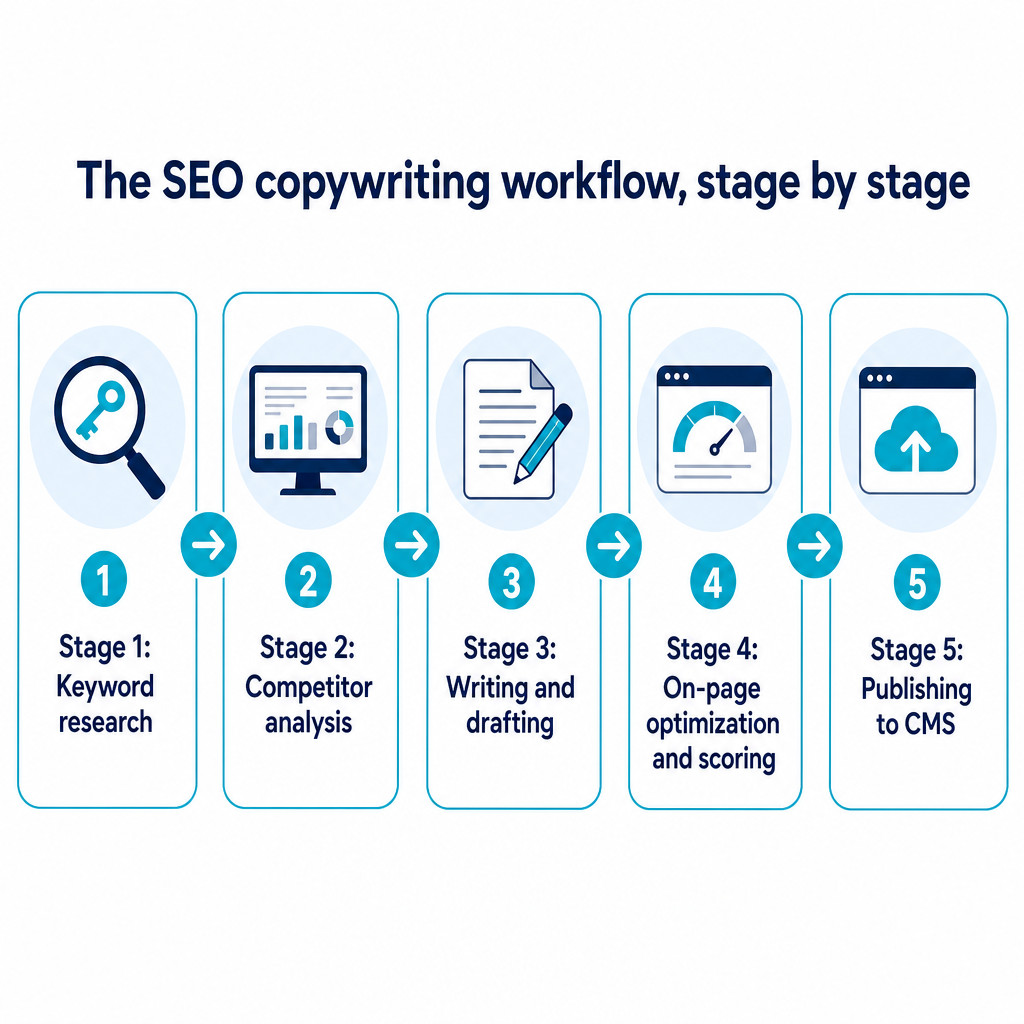
SEO copywriting software is a category that combines keyword research, competitive analysis, outlining, writing, and on-page optimization into a workflow built for search rankings. Independent roundups describe these tools as integrated systems rather than plain text generators: they surface keyword opportunities, analyze what already ranks, suggest structure, and score drafts against search-focused criteria. Products like Frase, Clearscope, Jasper, and Anyword are commonly cited as examples that pair research and SEO scoring with AI-assisted drafting.
The important nuance for buyers is that "combines these functions in one workflow" does not mean "does the work for you." Most tools in this category still assume a human sits in the driver's seat. The software recommends terms to include, flags a thin section, or drafts a paragraph you then edit, approve, and publish yourself. That is genuinely useful if you have a writer or editor with time on their hands. It is much less useful if the reason you are shopping is that nobody on the team has time to write in the first place.
There is also a meaningful difference between blog-centric SEO copywriting software and general AI writing tools or single-purpose point solutions. A keyword tool tells you what to target. An optimization plugin grades a page you already wrote. A general AI writer produces text on request but knows nothing about your competitors or your existing site structure. Blog-focused SEO copywriting platforms are supposed to connect those dots, which is exactly where the category starts to fragment into "assistant" tools and "autonomous" ones.
The multi-tool stack versus one autonomous platform
Walk into most content teams and you will find a familiar arrangement. Independent guides for copywriters routinely describe the same layered setup: Google Keyword Planner for keyword ideas, Ahrefs or Semrush for competitor and search insight, Yoast for on-page checks inside the CMS, and Frase or Clearscope for judging how competitive a draft is against top-ranking pages. Each tool is good at its slice. None of them talks fluently to the others, and none of them publishes anything.
That is why "juggling SEO tools" is not a lazy complaint; it is the actual operating reality for many marketers. The handoffs between tools are where time leaks away. You export a keyword list, paste it into an outline, draft in one app, move to a scoring tool, patch the gaps, copy the finished text into your CMS, format it, add internal links by hand, and finally publish. Multiply that by daily or even weekly cadence and the stack becomes a part-time job on its own.
The tools were never the bottleneck. The handoffs between them were.
An autonomous platform attacks the problem from the opposite direction. Instead of assembling separate tools and doing the connecting work yourself, one system runs research, writing, fact-checking, internal linking, scoring, and publishing end to end once your site is connected. AymarTech is positioned in exactly this "full loop" category rather than as another point solution. The pitch is not "write faster" but "remove the writing and publishing chores from your calendar entirely," which is a different product promise and a different buyer.
How AymarTech runs the full loop
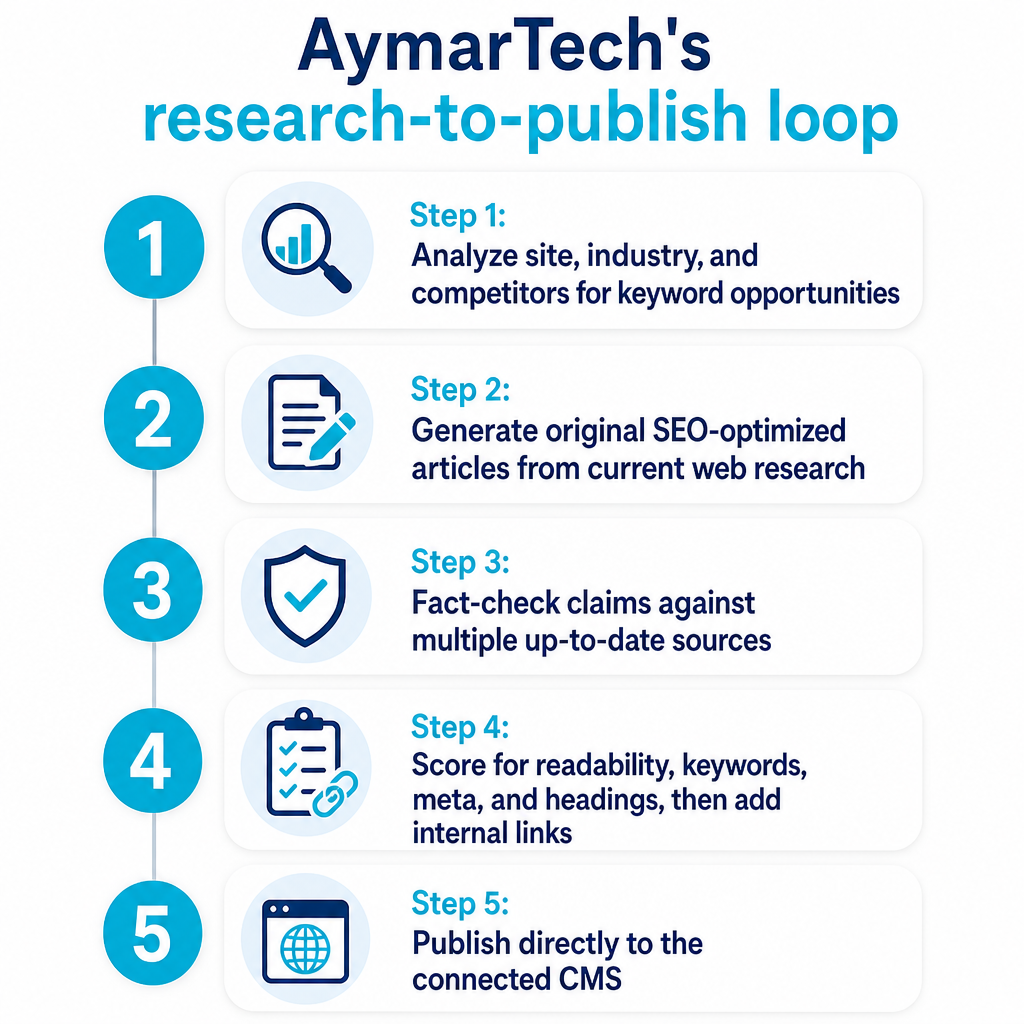
AymarTech is described as an all-in-one SEO automation platform that researches, writes, fact-checks, and publishes SEO-optimized blog content on autopilot once a site is connected. That framing matters because it names each stage of the stack above and folds it into a single automated sequence. The platform is explicitly positioned as different from general AI writing tools: it does not simply generate text, it performs live research, checks facts, structures content for search indexing, and manages the technical side of publishing.
The documented workflow moves through clear stages. First, it analyzes the client's website, industry, and competitors to identify high-value keyword opportunities. Then it generates original, SEO-optimized articles grounded in current web research, rather than producing generic copy from a prompt. Before anything goes live, it fact-checks claims against multiple up-to-date sources, a step that most write-only tools leave entirely to the human. If you want to understand why that stage matters for automated content, AymarTech covers it in depth in its guide to keeping automated content accurate with AI fact-checking.
After drafting and verification, each article passes through a built-in SEO scoring system that evaluates readability, keyword density, meta descriptions, heading hierarchy, and overall content quality. The platform then automatically adds internal links to connect new content with existing pages, strengthening site structure without manual linking work. Finally, it publishes articles directly to the business's website, handling the technical side of SEO blog publishing. Content is produced daily with smart internal linking and on-brand images, aimed squarely at businesses that lack a full content team.
The integration side is what makes the loop practical. AymarTech is presented as an autonomous publisher that can publish directly to major website platforms, including WordPress, Webflow, Shopify, Wix, and Framer. On language, external coverage cites support for over 120 languages, while the publisher's own comparison lists 150+, so the fair way to describe it is 120+ languages and expanding toward 150+, with exact figures likely to change over time. That range is what makes localized content strategies across multiple markets feasible from a single account.
The criteria that separate tools from publishers
Buyer guides for SEO copywriting software tend to converge on the same evaluation criteria: ease of use for non-experts, integration with publishing platforms, the ability to hold a consistent brand voice, SEO scoring and optimization guidance, and pricing that fits a small business budget. Those are sensible filters. The trick is applying them honestly to what you actually need, because an "assistant" tool and an "autonomous" platform score very differently on the same list.
Use these criteria as a decision frame, and map each one to a concrete capability rather than a marketing adjective:
- Automation level. Does the software draft on request and wait for you, or does it produce research-backed, SEO-optimized posts on a daily cadence without manual drafting? AymarTech is built for the second pattern.
- Research depth. Look for analysis of your own site, industry, and competitors to select high-value keywords, not just a generic keyword suggestion box detached from your context.
- Content quality control. The meaningful differentiator here is verification. AymarTech fact-checks against multiple sources and runs a built-in SEO scoring pass before anything publishes, rather than trusting a first draft.
- Technical SEO and publishing. Automatic internal linking and direct publishing to WordPress, Webflow, Shopify, Wix, and Framer remove the copy-paste-and-format step that eats time in a manual stack.
- Language and localization. Support for 120+ languages, expanding toward 150+, lets a single platform run localized content across markets instead of forcing separate tools per region.
- Fit for lean teams. The whole design assumes you do not have a dedicated content team or a full tool stack, and are trying to replace both.
When you score a typical assistant tool against this frame, it does well on research depth and SEO scoring but stops short on automation level and publishing, because a human still owns drafting and going live. When you score a full-loop platform, the trade is different: you gain hands-off cadence and integrated publishing, and you accept that you are reviewing output for brand fit rather than composing each piece. On pricing, AymarTech's own comparison lists a starting figure of $99/mo, positioned as an autonomous publisher covering the full loop. Treat that as an indicative starting point rather than a complete tier list, and confirm current pricing and any usage limits directly before you commit. For a wider view of where different products sit, AymarTech's ranked review of the best AI tools for content writing is a useful reference point.
What onboarding looks like in practice
The setup sequence follows the same logic as the product itself: connect, configure, let it run, then steer. Based on the platform's described flow, the first step is connecting your site so AymarTech can analyze existing content and structure. This is what lets internal linking work later, because the platform needs to know what pages already exist before it can wire new posts into them.
The second step is configuring a business profile and target markets so keyword research aligns with your niche rather than producing broad, off-topic articles. This is also where market and language choices shape whether the output is single-market English or localized across several regions. Getting this right early prevents the most common disappointment with any automated content system, which is relevant-sounding posts that miss your actual audience.
The third step is letting the automated research–write–fact-check–score–publish loop run, and reviewing the first batch of posts for brand fit. Reviewing initial output is where you calibrate. If the tone or angle is slightly off, that is normal for the earliest posts, and the review stage is designed to catch it. The fourth step is ongoing: monitor performance and make strategic adjustments to topics, markets, and volume while the platform maintains daily output and internal linking on its own.
A few specifics are worth confirming directly with the publisher rather than assuming, because they are not fully visible in public materials. Exactly how brand voice is configured, whether approvals are required before a post goes live, and how you override or steer topic selection are the details that most affect a lean team's comfort level. If those controls matter to your workflow, treat them as questions to verify during setup, not as settled facts. The point of the loop is to reduce work, but you should still understand where your hands stay on the wheel.

AymarTech
See where autonomous publishing fits in the AI content landscape
Compare the full range of AI content tools and understand where a hands-off, full-loop publisher like AymarTech makes sense for your blog.
Read the ranked reviewChoosing between an assistant and an AI publisher
Every decision in this category collapses into one honest question: do you want software that makes a human writer faster, or a platform that becomes your publisher? If you have skilled writers and editors and simply want sharper research and scoring, an assistant tool fits, and you should weight ease of use and optimization guidance most heavily. The human stays central, and the software is a force multiplier around them.
If the reason you are shopping is that nobody has time to write, edit, format, and publish consistently, then a full-loop platform is the more honest match. In that scenario, evaluating individual point tools is a trap, because each one you add is another handoff you now own. AymarTech is designed for this second group: businesses that want organic search visibility and presence in AI-generated answers without assembling a stack or hiring a content team. The comparison worth making is not AymarTech against a single competing writer, but one automated platform against the entire manual pipeline it replaces.
As marketing roles keep absorbing automation, the skill shift is toward directing systems rather than producing every asset by hand, a trend AymarTech explores in its outlook on AI automation jobs, roles, and salaries in 2026. The practical next move is simpler than another free trial of a point tool: connect your site, let the platform produce an initial batch of research-backed posts, and judge it on the output that actually lands on your blog. That is a far more useful test than reading feature lists, because it shows you the finished, published result instead of a draft you would still have to finish yourself.
Frequently asked questions
What is the difference between SEO copywriting software and a general AI writer?
A general AI writer produces text from a prompt but has no built-in understanding of your competitors, your existing site, or search optimization. SEO copywriting software combines keyword research, competitive analysis, on-page optimization, and scoring in one workflow. AymarTech goes further as an autonomous publisher, adding live research, fact-checking, internal linking, and direct publishing to your CMS.
Does AymarTech replace my whole SEO tool stack?
It is positioned to. Many teams run separate tools for keyword research, competitor analysis, content scoring, on-page checks, and then publish manually. AymarTech centralizes research, writing, fact-checking, SEO scoring, internal linking, and publishing in one platform once your site is connected, which is the entire reason it is categorized as a full-loop autonomous publisher rather than a single-function tool.
Which website platforms does AymarTech publish to?
AymarTech is described as publishing directly to major platforms including WordPress, Webflow, Shopify, Wix, and Framer. This direct publishing removes the copy, paste, and reformat step that a manual workflow requires. Because supported integrations can evolve, confirm that your specific platform is currently covered before you commit.
How many languages does AymarTech support?
External coverage cites support for over 120 languages, while AymarTech's own comparison lists 150+, so the accurate description is 120+ languages and expanding toward 150+. That range makes localized content strategies across multiple markets possible from one account, though exact numbers may change over time.
How much does AymarTech cost?
AymarTech's own SEO copywriting software comparison lists a starting price of $99 per month for its autonomous publishing plan covering the full loop from research through publishing. Additional tiers, usage limits, and enterprise options are not detailed in public snippets, so treat $99/mo as an indicative starting point and confirm current pricing directly.
Do I have to review posts before they go live?
The documented flow includes a review stage where you check the first batch of posts for brand fit, and the platform can then maintain daily output on its own. Exactly how approval and brand-voice controls work is best confirmed during setup, since those specifics are not fully visible in public materials and matter most to lean teams deciding how hands-off to be.