
Ai Seo Writing Tools: AI SEO Writing Tools: How to Pick the One That Actually Grows Traffic
You bought an AI writing tool to grow traffic, and what you got was a folder full of drafts. More words, more posts, more "content" — and the same flat line in Google Search Console. That gap is exactly why choosing among ai seo writing tools feels harder than it should. Most of them are excellent at producing text and almost useless at producing rankings, because writing was never the bottleneck. Research, intent matching, semantic coverage, internal linking, publishing, and getting indexed were. This article shows you how to tell the two apart, what a traffic-focused tool actually has to do, and where AymarTech fits when you want the whole content lifecycle handled for you instead of stitched together by hand.
Table of contents
- Why most AI writing tools don't grow traffic
- What an AI SEO writing tool must do to win rankings
- The multi-tool SEO stack vs a single traffic engine
- Inside AymarTech: from idea to search traffic on autopilot
- Is AymarTech the right AI SEO writing tool for your business
- How to test any AI SEO writing tool in 30 days
- Frequently asked questions
Why most AI writing tools don't grow traffic
Walk through any "best AI writing tools" roundup and you'll notice a pattern: most of the popular names are built for short-form and general-purpose writing. Ad copy, social captions, product descriptions, rewrites, tone fixes. Tools like Rytr, Copy.ai, Wordtune, and Grammarly earn their place there, and they do that job well. What they were never designed to do is orchestrate an SEO strategy across an entire website.
That distinction matters because Google doesn't reward text volume. It rewards pages that match a real search, cover the topic thoroughly, and sit inside a site structure that signals authority. A generic AI writer can hand you a fluent 900-word draft in seconds, but it has no idea whether anyone searches for that topic, what intent sits behind the query, which related concepts the top-ranking pages already cover, or how the new post should link to the rest of your site. You end up doing all of that yourself — which means you didn't actually remove any work, you just moved it.
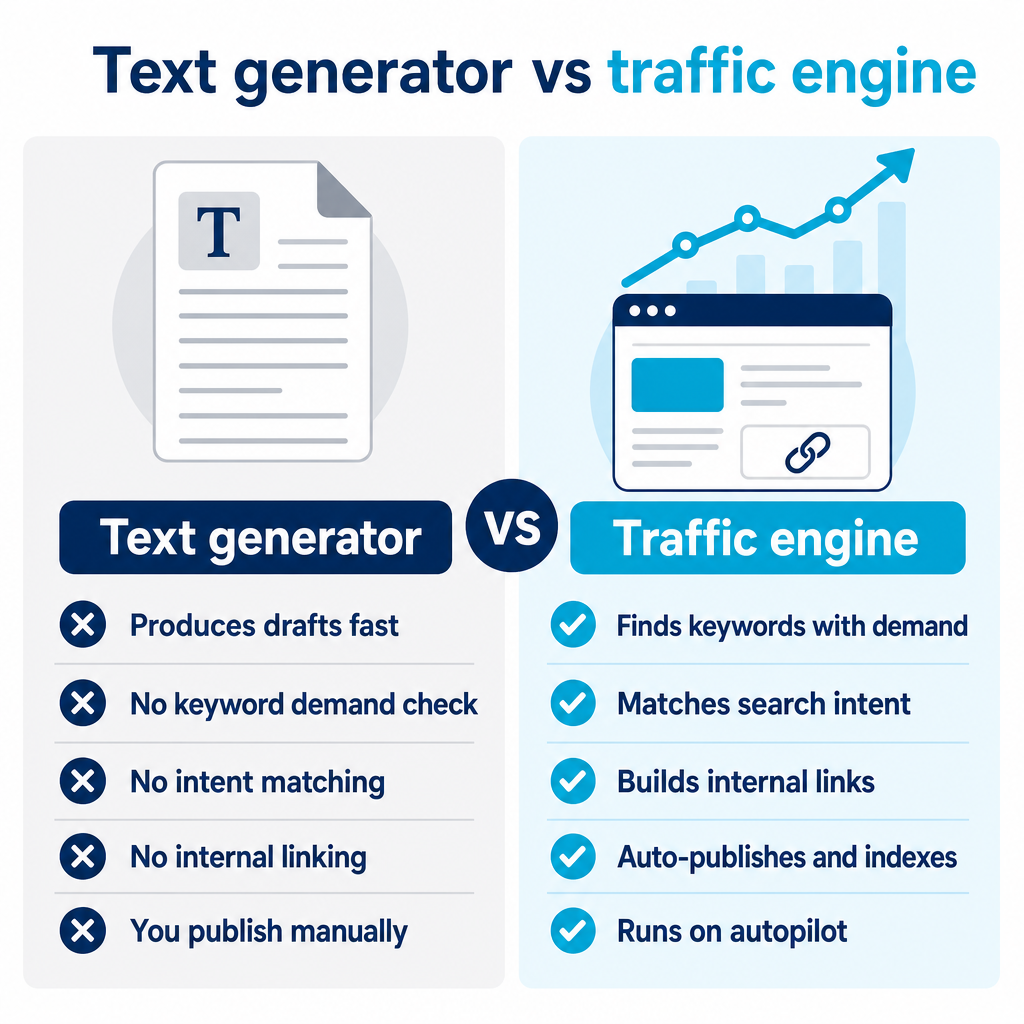
SEO-specialized tools sit in a different category. Platforms and assistants built for long-form, search-structured content focus on semantic analysis, entity coverage, keyword research, and real-time optimization feedback while you write. That's the market's actual expectation of an "AI SEO writing tool": not a text box that spits out paragraphs, but a system that embeds research and optimization into the writing itself. If you want a deeper breakdown of where individual tools land on that spectrum, our team compared many of them in the best AI tools for content writing in 2026, and the split between copy tools and traffic tools is stark.
The mental shift is simple but decisive. Stop shopping for a text generator. Start shopping for a traffic engine — something that treats a published, indexed, ranking page as the finished product, not a Word document you still have to place and promote.
What an AI SEO writing tool must do to win rankings
Before you compare a single feature list, it helps to know the workflow that experienced SEOs follow to produce content that has a real shot at ranking. Practitioners describe a fairly consistent sequence, and any tool worth paying for should either handle these steps or make them dramatically faster.
- Pick a topic tied to search demand. The topic exists because people are actually querying it, not because it sounded interesting.
- Understand search intent. Informational, commercial, navigational, or transactional — the format follows from this.
- Craft a title that can rank. Clear, specific, and aligned with the query rather than clever for its own sake.
- Build a structured outline. Headings that reflect how the topic is genuinely organized and how competing pages cover it.
- Find semantically related keywords and entities. Coverage of related concepts is what builds topical authority.
- Generate the content. This is the step most tools obsess over, and it's only one link in the chain.
- Add meta title and meta description. On-page signals that influence both ranking eligibility and click-through.
- Include images. Visuals with proper alt text that support the content and the page.
- Review and personalize before publishing. A quality and accuracy pass, plus a human touch where it matters.
Read that list again and notice how little of it is "writing." Roughly two of nine steps involve producing prose. The rest is research, intent analysis, structure, semantic coverage, on-page optimization, and review. A tool that only automates the writing step is automating the easy 20% and leaving you the hard 80%.
This is the checklist you should hold every candidate against. When a says "we write SEO content," ask which of these nine steps the product actually performs versus which ones still land back on your desk. The tools that genuinely move rankings are the ones that compress the whole sequence — from demand-driven topic selection through indexed, optimized publication — rather than the one step that happens to look impressive in a demo.
The multi-tool SEO stack vs a single traffic engine
Most teams doing AI-assisted SEO today run a stack, not a tool. A typical setup pairs a general large language model such as Claude or ChatGPT with one or more SEO tools like Surfer, Frase, Semrush, or Ahrefs, and then adds an editor like Grammarly on top. Standard practitioner advice is to first identify your bottleneck — research, writing, optimization, or volume — then pick two or three complementary tools and test them over two to four weeks against time spent, quality, and early rankings.
That advice is sound, and for teams who enjoy owning their process, the toolbox approach is legitimate. But be honest about what it costs you. Each tool is a separate subscription, a separate login, a separate learning curve, and a separate export-import handoff. You research in one place, optimize in another, write in a third, edit in a fourth, then paste into your CMS and hope something remembers to request indexing. Every seam between those tools is a place where work leaks out and quality drifts.
The toolbox approach: you assemble an LLM, an SEO analyzer, a keyword tool, an editor, and a manual CMS workflow — then you manage the whole orchestra yourself, forever.
The traffic engine approach: one platform runs research, writing, optimization, internal linking, images, publishing, and indexing as a single pipeline, so there are no seams to manage.
AymarTech is built for the second approach. Instead of buying five products and becoming the systems integrator between them, you connect one platform that handles the full lifecycle. That's the core question a buyer should keep returning to: does this tool complete the SEO content job for me, or does it just add another step to a workflow I'm still assembling by hand? If you're weighing what a genuinely integrated tool changes about your day, what an AI-powered writing tool can really do for your blog unpacks the difference between assistance and automation.
Inside AymarTech: from idea to search traffic on autopilot
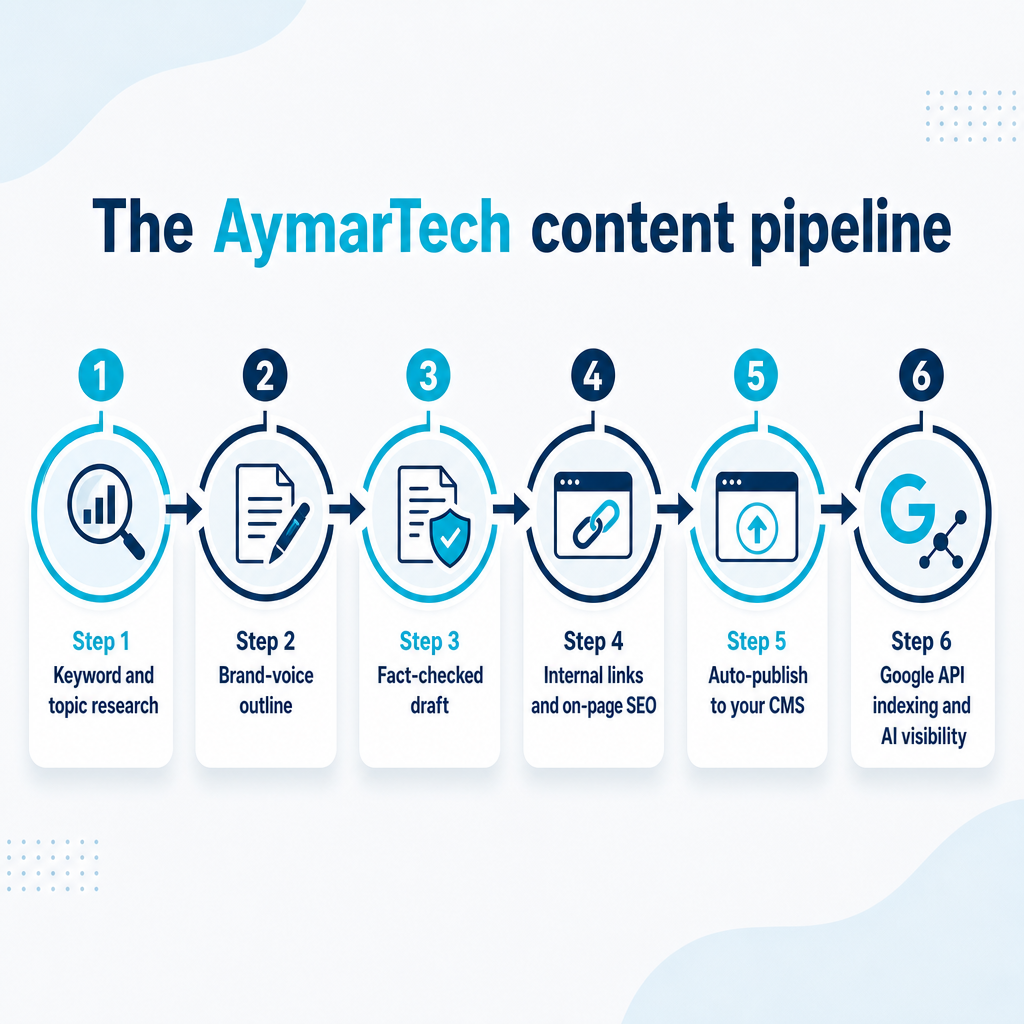
Here's how the pipeline actually runs, mapped to the nine-step SEO workflow above so you can see which steps AymarTech takes off your plate.
Topic and keyword discovery. AymarTech researches your space, finds keywords and topics with real search demand, and clusters them into a content plan rather than a random pile of ideas. This is the demand-driven starting point that generic writers skip entirely.
Brand-voice training and outline creation. You define how your brand sounds, and the platform generates outlines shaped to the search intent behind each topic — a how-to structure for a how-to query, a comparison structure for a versus query, a local service format for a neighborhood search. Structure follows intent, the way it should.
Fact-checked drafting. The platform writes original, on-brand content and runs a fact-checking pass, which addresses the single biggest complaint about generic AI writing: fluent text that's confidently wrong. This is deliberately more than a prompt-and-paste habit.
Internal linking and on-page SEO. New posts don't land in isolation. AymarTech handles internal linking so pages reinforce each other and build topical clusters, and it generates the on-page elements — titles, meta descriptions, headings, image alt text — that search engines read. Isolated posts become a connected content hub.
On-brand images. Each post gets relevant, on-brand visuals generated to match, so you're not stopping to source stock photography for every piece.
Auto-publishing. Finished content publishes directly to your site on WordPress, Shopify, Webflow, Wix, and more, with no manual copy-paste stage. If you want to see how the hands-off publishing loop works end to end, how to auto-publish blog posts to WordPress on complete autopilot walks through it.
Indexing and AI visibility. Published pages are auto-indexed via the Google indexing API, which shortens the lag between publishing and discovery. Because the content is original, structured, and indexed, it's also eligible to be surfaced and cited by AI assistants like ChatGPT, Claude, Perplexity, and Gemini — the second discovery channel that increasingly matters alongside classic search.
The platform also runs in 150+ languages, which matters for multilingual businesses and global SaaS. And it applies across industries: AymarTech powers client blogs in fields as different as residential real estate, skincare and beauty, and e-learning, which shows the same pipeline adapts from a local service explainer to a DTC product guide to a software use-case article. The point isn't that one tool writes about everything — it's that the research-to-indexing lifecycle is the same regardless of vertical, so the automation holds up wherever your business sits.
Is AymarTech the right AI SEO writing tool for your business
The honest way to answer this is to match your actual bottleneck to what the platform removes. Three buyer profiles come up most often.
Small business owners. Your bottleneck is usually time and SEO expertise, not ambition. You know local traffic would help, but planning topics, writing posts, optimizing them, and remembering to publish consistently never survives a busy week. AymarTech works here as a hands-off local content engine: neighborhood guides, service explainers, seasonal posts, and FAQ pages researched, written, published, and indexed without you touching a keyword tool. The value is consistency you don't have to enforce.
SaaS and startup founders. Your bottleneck is usually topic research, strategy, and staying consistent while you're busy building the product. Content marketing is on the roadmap and perpetually slips. AymarTech fits as a way to ship educational content, feature explainers, comparison pages, and SEO landing pages that map to how your users actually search — steadily, without hiring a writer before you're ready to.
Marketing teams and agencies. Your bottleneck is volume and maintaining quality across products or client accounts. AymarTech can hold a distinct brand voice per client, run multiple websites, and take routine SEO blogging off your writers so they focus on higher-leverage work. It scales output without scaling headcount, which is the whole reason agencies look at automation in the first place.
One caveat worth stating plainly: your business remains responsible for making sure published content complies with the advertising, disclosure, and privacy rules of your industry and jurisdiction. Automation handles production; it doesn't replace your own compliance judgment, and for regulated fields you should confirm requirements with qualified counsel.
How to test any AI SEO writing tool in 30 days
Don't take any tool's word for it, including this one. Run a structured test, the same way seasoned SEOs do when they trial a new tool: identify the bottleneck, commit a short window, and measure against time, quality, and early rankings. Here's a practical 30-day version that won't put your domain at risk.
Choose a focused topic set. Pick 8 to 15 topics inside one clear theme or cluster rather than scattering across unrelated subjects. Concentrated coverage gives you a fairer read on whether the tool builds topical authority.
Let it run on a real cadence. Allow the platform to research, write, and publish on a daily or weekly schedule so you're testing the actual autopilot workflow, not a one-off demo draft. The whole point is to see whether hands-off truly means hands-off.
Track the right signals in Search Console. Watch impressions and average position first — those move before clicks do. Early impressions on your target queries within a few weeks are a healthy sign that the content is relevant and getting indexed. Rankings for competitive terms take longer, so judge trajectory, not final position.
Compare the editorial overhead. Log how much time you actually spent: reviewing, correcting, publishing, requesting indexing. This is where an integrated engine separates from a toolbox. If a tool "saved writing time" but added review, formatting, and publishing time, it didn't save you anything.
Sanity-check quality and brand fit. Read a sample as a reader, not an operator. Is it accurate? Does it sound like your brand? Would you have published it yourself? A tool that clears this bar with minimal edits is doing the hard part.
A 30-day pilot answers the only question that matters commercially: at the end of the month, did you have indexed, on-brand pages earning impressions with almost no work from you — or did you have another pile of drafts and another subscription to manage?
AymarTech
See the hands-off publishing loop in action
Walk through how AymarTech researches, writes, publishes, and indexes content to your site without a manual copy-paste step.
See how auto-publishing worksFrequently asked questions
What's the difference between AymarTech and a generic AI writer?
A generic AI writer automates one step — producing text. AymarTech automates the full SEO content lifecycle: demand-driven keyword and topic research, intent-matched outlines, fact-checked and brand-voice drafting, internal linking, on-page SEO elements, on-brand images, auto-publishing to your CMS, and auto-indexing via the Google indexing API. In short, a generic writer hands you a draft to place yourself; AymarTech hands you an indexed page.
Do I still need an SEO agency if I use AymarTech?
It depends on your goals. AymarTech covers the recurring SEO content work — research, writing, optimization, publishing, and indexing — that agencies often bill for by the hour. Complex needs like large-scale technical audits, link acquisition strategy, or bespoke consulting may still call for specialist help. Many businesses use the platform to handle steady content production and reserve outside expertise for the occasional strategic project.
How does AymarTech handle my brand voice?
You configure brand-voice settings so the platform writes on-brand rather than in generic AI phrasing, and it can maintain distinct voices across different sites or clients. The goal is original content that reads like your brand wrote it, which is also why the platform includes a fact-checking pass rather than assuming AI output is automatically publishable.
Can I keep human oversight over what gets published?
Yes. AymarTech is built for hands-off operation, but it still allows human oversight where you want it. The platform's fact-checking step and brand-voice controls exist precisely so you can trust the output while retaining the ability to review and refine before or after content goes live.
How quickly will I see traffic results?
Honest answer: it varies, and anyone promising a fixed number is guessing. Because content is auto-indexed through the Google indexing API, discovery happens faster than manual publishing, so you can often see impressions on target queries within a few weeks. Competitive rankings and meaningful click volume typically take longer and depend on your niche, competition, and site authority. Judge a pilot on trajectory — rising impressions and positions — rather than expecting instant top rankings.
Does AymarTech work for multilingual and international sites?
Yes. The platform supports 150+ languages, which makes it suitable for multilingual businesses and global SaaS that need consistent SEO content across markets rather than only in English.
The decision comes down to one question you can answer today: is writing really your bottleneck, or is it everything around the writing? If it's the latter — the research, the optimization, the internal linking, the publishing, the indexing — then a single traffic engine will do more for your organic growth than any text generator you bolt onto a manual process. Point AymarTech at a focused topic cluster, connect your CMS, set your brand voice, and let a month of automated, indexed posts show you the difference in Search Console.