
Ai Seo Writing Tools: AI SEO Writing Tools: What They Do and How to Pick the Right One
You hire a freelancer to draft the post, open a keyword tool to check search volume, paste the text into an optimizer, format everything by hand in your CMS, upload an image, then wait days for Google to notice the page exists. Multiply that by the two or three articles a week your competitors publish without breaking a sweat, and the math stops working. This is exactly the gap that ai seo writing tools were built to close — and why the category has moved far beyond simple text generators.
The problem is that "AI SEO writing tool" now describes wildly different products. Some only produce raw drafts. Others bolt keyword hints onto a chat box. A smaller group actually runs the full content operation for you, from research to publishing to indexing. Picking the wrong one means you still do most of the work yourself. Picking the right one means organic traffic starts compounding while you focus on the business. Below is what these tools really do, where the generic ones stall, and how to evaluate them so you land on a platform that earns its keep.
Table of contents
- What AI SEO writing tools actually do
- Why small businesses and SaaS teams need this now
- The hidden tax of tool soup and manual work
- How AymarTech runs SEO content end to end
- How to pick the right AI SEO writing tool
- Frequently asked questions
What AI SEO writing tools actually do
At the simplest level, an AI writing tool is software that uses artificial intelligence to generate text, and most of them are built specifically to help create content optimized for search engines. Beyond drafting, the better ones fold in features like SEO suggestions, grammar checking, and plagiarism detection, and they help with the earlier stages too — brainstorming angles, outlining, and editing marketing copy.
In practice, that translates into a handful of recurring jobs:
- Idea and keyword input. You feed the tool a topic or keyword, and it produces angles, outlines, or full drafts around it.
- Draft generation. Blog posts, product descriptions, social captions, and long-form articles get written in seconds instead of hours.
- On-page assistance. Many tools suggest titles, meta descriptions, headings, and keyword placement so the draft is closer to search-ready.
- Editing support. Grammar, readability, and originality checks catch obvious problems before you publish.

That sounds complete until you notice what most tools quietly leave to you. The draft still needs fact-checking, because generic models can produce confident but wrong statements. It still needs to sound like your brand rather than a template. And it almost always needs a human to move it into the CMS, format it, add images, publish it, and then hope search engines crawl it soon. Editorial guides consistently underline the same point: these tools speed up creation, but human review remains necessary to keep outputs accurate and on-brand. For a fuller breakdown of the mechanics, our explainer on what an AI SEO writing tool is and how it works walks through the workflow step by step.
So the honest summary is this. A typical AI SEO writing tool is a strong drafting and optimization assistant. It is not, by default, a content operation. The distance between "assistant" and "operation" is where most of your time still disappears — and it is the distinction that should shape every buying decision you make.
Why small businesses and SaaS teams need this now
Organic search rewards consistency. High-quality, keyword-targeted content that gets published regularly is one of the clearest drivers of organic traffic and rankings, and AI writing tools are widely credited with helping smaller businesses scale that output so their sites stay fresh and competitive. The catch is that consistency is exactly what resource-constrained teams struggle to sustain.
Think about who actually owns content at a small company. Often it is the founder, squeezing a blog post between sales calls. At a startup, it might be a single marketer already juggling paid campaigns, email, and product launches. At an agency, it is a team stretched across a dozen clients. None of them has the bandwidth to research, write, optimize, format, publish, and index several articles a week by hand — yet that cadence is roughly what it takes to compete.
There is a second reason the timing matters. Search is no longer only Google. Buyers now ask ChatGPT, Claude, Perplexity, and Gemini for recommendations, and those systems surface content they can find and trust. A site that publishes rarely and indexes slowly is invisible to both traditional search and the assistants people increasingly rely on. Content that is published consistently and indexed quickly has a far better chance of being both ranked and cited.
That combination — limited internal time plus a widening set of places you need to appear — is why hands-off AI SEO content has moved from a nice-to-have to a practical necessity. The teams that win are not necessarily the ones with the biggest budgets. They are the ones who found a way to keep publishing useful content without burning out a person or a payroll line to do it.
The hidden tax of tool soup and manual work
Here is the setup most content teams drift into without meaning to. They buy a general AI writer for drafting. They add a keyword and SERP data tool to figure out what to target. They layer on a separate optimization platform to grade the draft. Then they do the publishing, image sourcing, internal linking, and indexing by hand. Editorial resources describe this stacking openly: for SEO, the most effective setup is often not a single tool but a combination of a writer, a data tool, and an optimizer, with different categories of tools handling idea generation, long-form content, and SEO optimization.
Each tool is individually reasonable. Together they create a tax you pay every single day:
- Subscription sprawl. Three or four monthly bills for tools that only partially overlap, none of which does the whole job.
- Context switching. Every article requires copy-pasting between apps, reconciling different interfaces, and re-entering the same topic in multiple places.
- Manual handoffs. Someone still moves the finished draft into WordPress, Shopify, Webflow, or Wix, formats it, adds images, and sets internal links.
- Indexing lag. After all that, the page sits waiting to be crawled, because nothing in the stack pushes it to be discovered quickly.
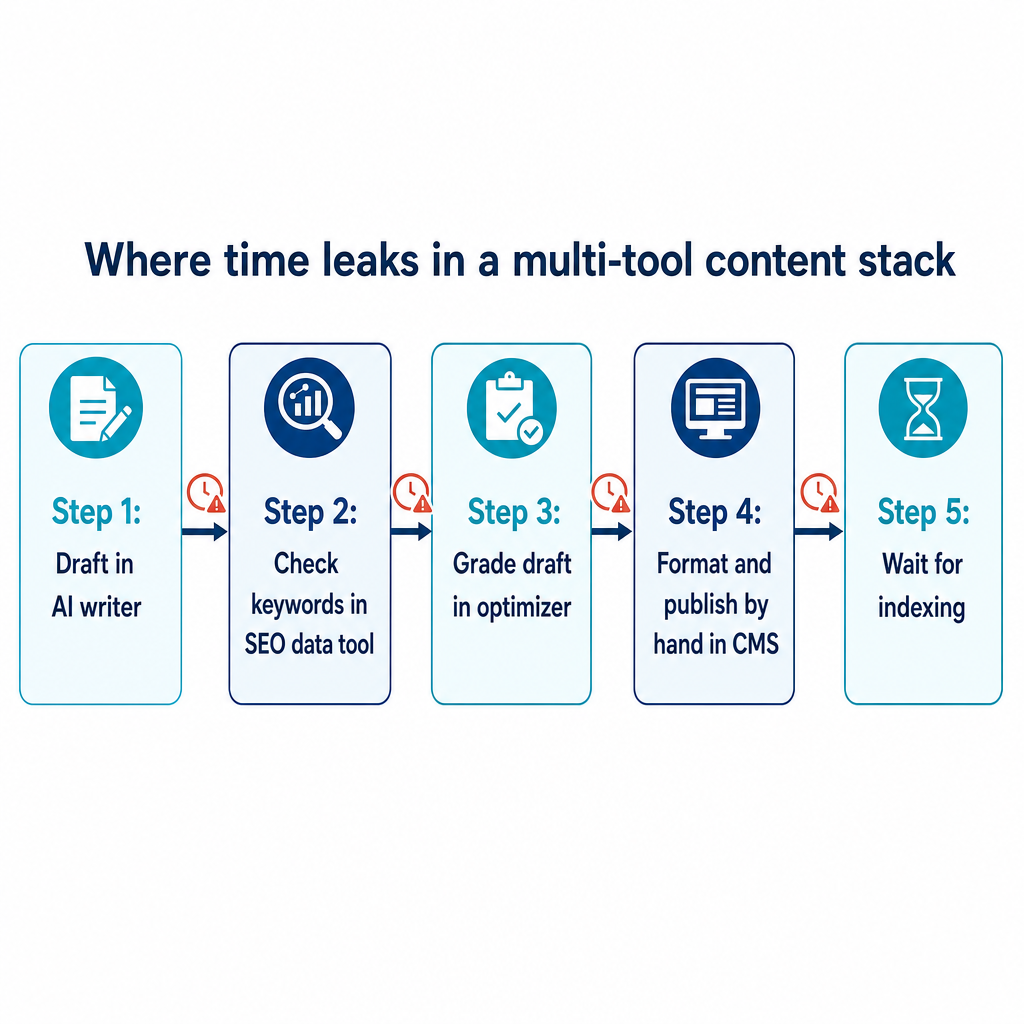
The friction is not just annoying — it caps your output. When every article demands a chain of manual steps, you publish less, which is the opposite of what organic growth requires. The other cost is quality drift. When a person is racing through handoffs, brand voice slips, fact-checking gets skipped, and internal links get forgotten. The workflow that was supposed to save time ends up producing thinner content, more slowly.
This is the frustration a unified approach is meant to remove. Instead of assembling and babysitting a stack, the entire chain — research, writing, fact-checking, images, internal linking, publishing, and indexing — runs as one automated flow. If you want to see how each stage connects, our guide to automating your SEO content workflow from start to finish maps the full sequence and shows where the manual steps normally hide.
How AymarTech runs SEO content end to end
AymarTech is an AI-powered SEO platform that treats content as an operation, not a document. Rather than handing you a draft and wishing you luck with the rest, it researches, writes, fact-checks, and publishes original blog content to your website daily, on autopilot. The design goal is straightforward: give businesses organic traffic and AI visibility without hiring writers or juggling a stack of SEO tools.
What that looks like in practice:
- Keyword research and topic discovery. The platform identifies what to write about, so you are not starting from a blank page or guessing at demand.
- On-brand writing. Content is produced in your brand voice, which is the exact area where generic AI output tends to fall flat.
- A fact-checking layer. Drafts are checked before they publish, addressing the accuracy risk that editorial guides repeatedly flag with generic tools.
- On-brand images and internal linking. Each post gets relevant imagery and contextual internal links, handled automatically instead of remembered manually.
- Auto-publishing to major CMS platforms. Posts go live on WordPress, Shopify, Webflow, Wix, and more — no copy-paste, no manual formatting.
- Automatic indexing. Using the Google Indexing API, published content is auto-indexed so it can rank on Google and be cited by ChatGPT, Claude, Perplexity, and Gemini.
- 150+ languages. The same automated flow runs across languages, so international or multilingual sites are not an afterthought.
The practical effect is a daily publishing cadence you did not have to staff. Consistency stops depending on whether a busy founder or a stretched marketer found an hour. It just happens, on brand, and gets pushed to be discovered quickly rather than sitting in a crawl queue.
Because the platform is built to adapt to a site's topic and voice, it works across very different industries. As examples of the kind of SEO blog content this approach produces, consider a long-form, location-targeted piece for a local business like Boca Raton homes for sale in 2026, an educational problem-and-solution article in consumer skincare such as how to choose a non-comedogenic sunscreen for acne, and a B2B comparison piece in a technical niche like AI voice tools versus traditional voiceovers in e-learning. Real estate, skincare, and SaaS could hardly be more different in tone and audience, which is the point: the same engine flexes to each.
You still hold the strategic controls. You decide the topics and the direction, you configure the brand voice, and you retain oversight of what the site becomes. What changes is that the mechanical middle — the research, drafting, checking, formatting, publishing, and indexing — no longer eats your week.
How to pick the right AI SEO writing tool
Most buyers evaluate these tools by watching a demo generate one impressive paragraph. That tells you almost nothing about whether the tool will actually grow your traffic. Use this checklist instead, built from what editorial guides consistently recommend and grounded in how the work really flows.
1. SEO-specific capabilities, not just writing. Plenty of tools produce fluent text but lack real SEO muscle. Look for built-in keyword research and topic discovery, on-page optimization for titles, meta descriptions, and headings, and internal linking. If a tool only writes prose and leaves the SEO scaffolding to you, it is a drafting aid, not an SEO tool.
2. Full-workflow automation. This is the criterion that separates assistants from operations. Ask whether the tool only generates drafts or actually handles research, writing, optimization, publishing, and indexing. Native CMS integrations matter here, because they remove copy-paste and manual formatting, and so does scheduling, because a set cadence is what produces compounding results.
3. Content quality, accuracy, and brand voice. Generic AI output often needs heavy human cleanup to be correct and on-brand. Prioritize brand-voice configuration, some form of built-in fact-checking or safeguard against fabricated claims, and genuine support for long-form, expert-style articles rather than only short social snippets.
4. Scalability and language support. Decide the volume you actually need — a few posts a week, or daily — and confirm the tool can sustain it without quality collapsing. If you serve international or multilingual audiences, multilingual capability is not optional. The right tool should suit both a small local site and a fast-growing SaaS.
5. Integrations and technical fit. Check that it connects directly to the platform you already run, whether that is WordPress, Shopify, Webflow, or Wix. Favor tools that use an indexing mechanism so content is discoverable quickly, and that onboard without needing a developer.
6. Ownership, control, and support. Even with heavy automation, you should keep strategic control: the ability to approve or adjust topics, clear visibility into what has been published, and access to help when you need it — especially if you are non-technical.
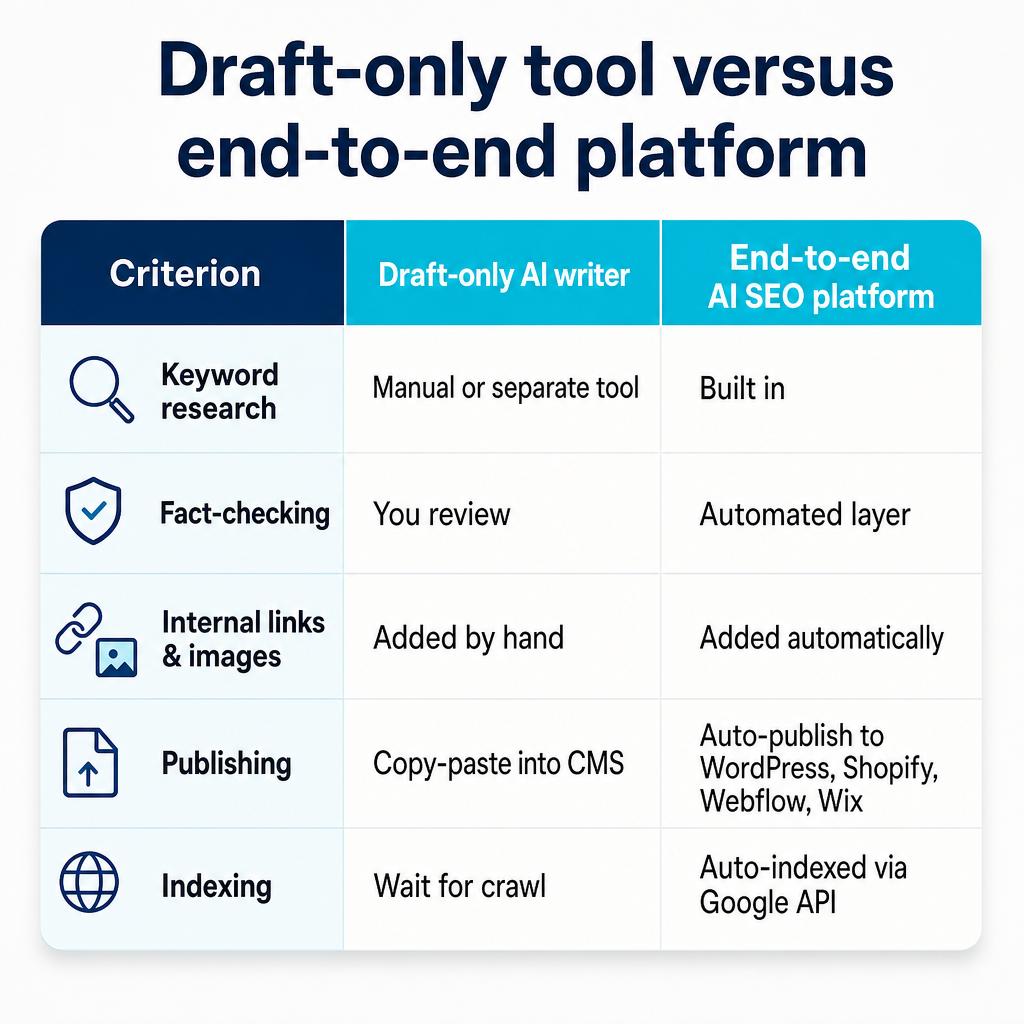
Run any tool you are considering against those six points and the picture clears up fast. Draft-only tools satisfy one or two criteria and leave the rest to you. AymarTech was built to meet all six: SEO-focused research and internal linking, end-to-end automation through publishing and indexing, brand-voice controls with a fact-checking layer, daily posting at scale across 150+ languages, direct CMS integrations, and Google API indexing — while you keep control of topics and strategy. For a deeper look at how to weigh these factors, our guide to choosing the right SEO copywriting software breaks the criteria down further.
The most useful comparison you can make is against your own current setup. Add up what you spend today on writers plus separate keyword, optimization, and publishing tools, and count the hours spent moving work between them. Set that beside a single platform that handles the whole chain on autopilot. That side-by-side, not a demo paragraph, is what should decide your choice.
AymarTech
See the full hands-off SEO content workflow
Walk through how research, writing, fact-checking, publishing, and indexing connect into one automated flow — and where the manual steps normally hide.
Explore the automated workflowFrequently asked questions
What's the difference between an AI writer and an AI SEO platform?
An AI writer generates text — drafts, outlines, captions — and usually stops there. An AI SEO platform runs the full operation around that text: keyword research, on-page optimization, internal linking, images, fact-checking, publishing to your CMS, and indexing. The writer saves you drafting time; the platform removes the manual steps that normally sit before and after drafting. That is why a fluent writer can still leave you doing most of the actual work.
How much control do I have over topics and brand voice?
You stay in charge of strategy. You set the direction and topics, and you configure the brand voice so content sounds like your business rather than a generic template. Automation handles the mechanical execution — research, drafting, checking, formatting, publishing — while you keep oversight of what gets published and how it reads. Maintaining that strategic control is exactly what editorial guides recommend when using any AI tool.
Is AI content safe for SEO?
Search engines focus on whether content is helpful, original, and high quality, regardless of how it was produced. The risk with generic AI tools is thin or inaccurate output, which is why a fact-checking layer and brand-voice consistency matter so much. AymarTech is designed to produce original, helpful content aligned with SEO best practices. We avoid categorical claims about specific policies; the reliable rule is that quality and usefulness are what get rewarded.
Can AymarTech replace my agency or freelance writers?
For consistent, ongoing SEO blog content, AymarTech is built to handle the entire cycle — research, writing, fact-checking, images, internal linking, publishing, and indexing — daily and on autopilot, without hiring writers or assembling a tool stack. Many teams use it precisely to remove that recurring production burden. You still own topic direction and brand voice, so you are directing the program rather than managing individual drafts.
How long until I see results from automated SEO content?
There is no guaranteed timeline, and any tool promising a specific ranking by a specific date should be treated with caution. What the evidence does support is that consistent, keyword-targeted, regularly published content tends to improve organic visibility over time. A daily cadence that gets indexed quickly gives you more chances to rank and to be cited by AI assistants, but results build progressively rather than overnight.
Does AymarTech work for my industry?
The platform adapts to your site's topic and brand voice, so it spans very different niches — local real estate, consumer skincare, and B2B SaaS are all examples of the content it produces. It also supports 150+ languages and integrates with major CMS platforms including WordPress, Shopify, Webflow, and Wix. If you are unsure about a specific platform or use case, the best step is to confirm compatibility directly rather than assume.