
Ai Seo Writing Tools: AI SEO Writing Tools: What They Are and How to Pick the Right One
AI SEO writing tools are software systems that use large language models to research, draft, and optimize content aimed at ranking in search. The strong ones go further: they handle keyword selection, internal linking, images, publishing, and indexing. The weak ones hand you a draft and leave the rest of the work on your desk.
That gap — between a text generator and a system that actually gets content live and discoverable — is the whole decision. We built AymarTech on the second definition, and this explainer walks through the category so you can tell which side of the line any tool sits on before you commit a budget or a quarter to it.
Table of contents
- What AI SEO writing tools actually are
- The four variants, and what separates them
- Why the category matters for your situation
- The judgment criteria that actually predict outcomes
- Deciding what kind of buyer you are
- Frequently asked questions
What AI SEO writing tools actually are
At the base layer, these tools are applications built on top of large language models. The model predicts text based on the prompt, the context it is given, and the patterns in its training data — that is the mechanism behind every AI writing assistant, whether it is producing an email or a 2,000-word blog post. Neutral overviews of the category describe AI writing tools as machine-learning software that generates marketing text across blogs, emails, ads, and social posts, and that description is accurate as far as it goes.
The "SEO" part is what gets layered on top. A pure language model works only from the prompt in front of it: search demand for this month, the competing pages that already own the SERP, and the structure a page needs to match intent all sit outside its view. SEO-aware tools supply that surrounding context: keyword data, SERP analysis, on-page recommendations about headings and meta tags, readability scoring. Category explainers note that SEO content tools typically combine keyword research, on-page optimization, and AI-assisted drafting rather than doing any one of those things alone.
So the honest definition is layered. An AI SEO writing tool is a language model plus a retrieval or data layer that supplies search context, plus an interface that turns both into something a marketer can act on. What varies enormously between products is how much of the surrounding work the software absorbs and how much it hands back to you.
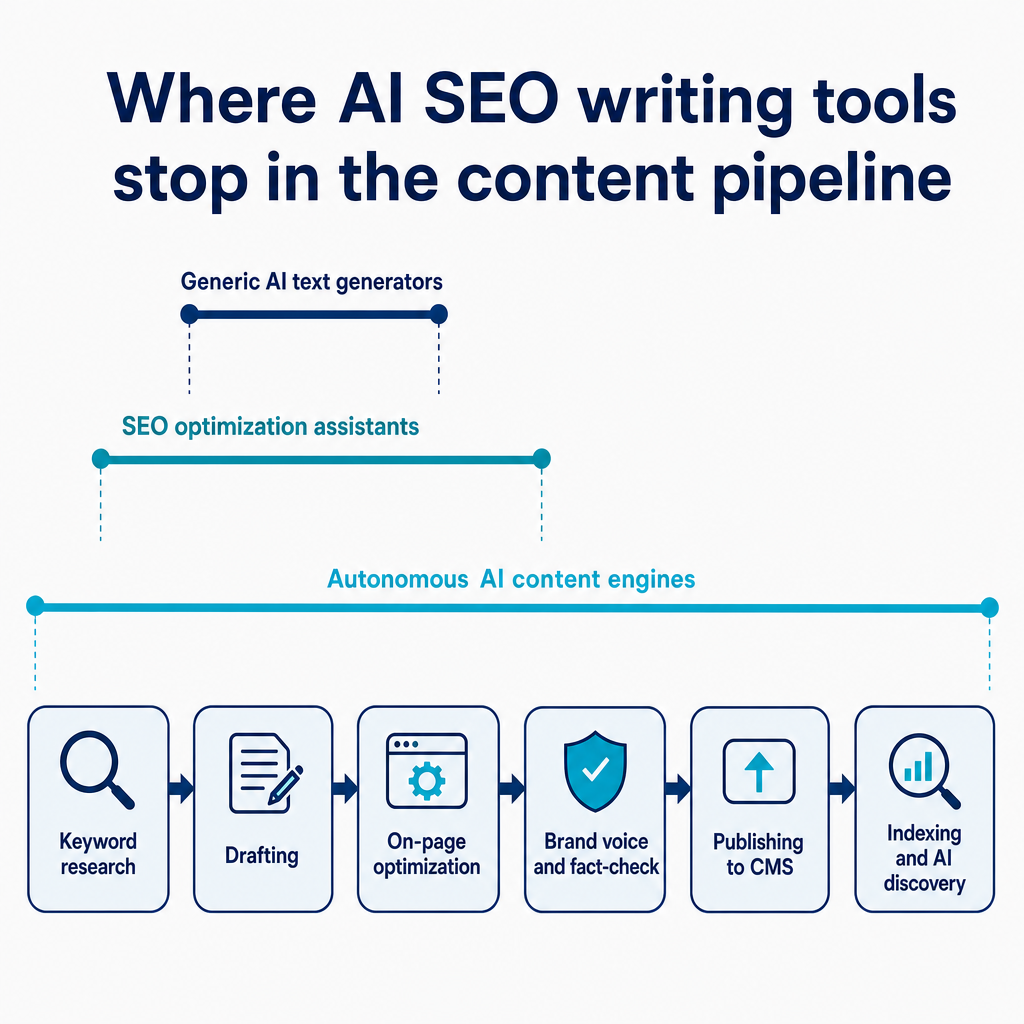
That handback is where most content programs stall. A draft is roughly 30% of the job. The remaining work — verifying claims, matching brand voice, sourcing images, wiring internal links, formatting for the CMS, publishing on a schedule, submitting for indexing — is unglamorous, repetitive, and exactly the kind of work that quietly consumes the time you bought the tool to save. When we designed AymarTech, we treated that remaining 70% as the product, not as an afterthought.
The four variants, and what separates them
The phrase "AI SEO writing tool" gets applied to four genuinely different kinds of product. Confusing them is the most common reason buyers end up disappointed — they purchase a category-two product while expecting category-four behavior.
| Variant | What it does | What stays manual |
|---|---|---|
| Generic AI text generators | Produce drafts from prompts | Keyword choice, SEO structure, fact-checking, publishing |
| SEO brief and optimization assistants | Build briefs, score drafts, suggest on-page fixes | Writing, editing, images, CMS work, indexing |
| All-in-one SEO suites with AI features | Keyword research, audits, plus AI drafting modules | Assembly, voice, publishing cadence |
| Autonomous AI content engines | Research, write, fact-check, illustrate, link, publish, index | Strategy and approval preferences |
Generic AI text generators are chat interfaces or thin wrappers around them. They write fluently, and their view of your search landscape is limited to whatever you type into the prompt. Every SEO decision — which keyword, which angle, which structure — originates with you.
SEO brief and optimization assistants solve the opposite problem. They analyze search results, extract the topics and questions competing pages cover, and tell you what a strong page should contain. Overviews of the space describe AI tools helping with keyword discovery, content optimization, SERP analysis, and link building — real value, but delivered as guidance you then have to execute.
All-in-one SEO suites add AI drafting to an existing research and audit platform. Broader surveys of the field note that AI now touches content generation, content optimization, keyword clustering, and technical SEO across the workflow. The coverage is wide, but the workflow is still yours to drive: you open the dashboard, you make the calls, you move the output downstream.
Autonomous AI content engines are the newest variant and the one we occupy. The distinguishing property is not better writing — it is that no human has to sit in the loop for the routine passes. AymarTech researches keywords, writes original brand-voice articles, fact-checks them, generates on-brand images, wires internal links, publishes directly to WordPress, Shopify, Webflow, Wix and other platforms, and submits each post through the Google Indexing API so it gets discovered quickly. Content ships daily without anyone opening a dashboard.
The practical separator between variants three and four is a simple question: after the software finishes its job, how many human actions stand between that output and a live, indexed, on-brand page? For most tools the answer is five or six. For an autonomous engine it should be zero.
Why the category matters for your situation
The reason this distinction has teeth is that content programs fail from inconsistency far more often than from bad individual articles. Search rewards sustained topical coverage. One excellent post published in March and nothing until August produces almost nothing. Consistent publishing across a keyword cluster compounds.
For a small business owner, the constraint is time, not ambition. You know the questions your customers ask. You do not have eight hours a week to research them, write them up, find images, and remember to internally link the new piece to the old ones. A tool that shortens drafting from three hours to one still leaves you owning the other work — which is why so many subscriptions go unused after month two.
For SaaS and startup founders, the constraint is focus. Content marketing competes directly with product, hiring, and fundraising for attention. The realistic outcome of a manual AI workflow is a burst of activity during a slow week and silence during a busy one. That pattern is exactly what does not compound.
For marketing teams and agencies, the constraint is unit economics. Scaling output means scaling editing hours, and generic AI text needs heavy editing to sound like anything other than generic AI text. The bottleneck migrates from writing to rewriting. That is why brand-voice modeling matters more than raw generation speed, and why we treat it as core rather than a setting — a point we unpack in our guide to brand voice AI content generators.
There is also a newer dimension that most tooling has not caught up with. Search is no longer the only discovery surface. People ask ChatGPT, Claude, Perplexity, and Gemini for recommendations, and those systems surface and cite web content. Publishing content that is structured, original, factually clean, and quickly indexed is how you become the source those systems reach for. Designing for that outcome is part of why we push every post through the Indexing API rather than waiting for a crawler to wander by.
The judgment criteria that actually predict outcomes
Feature lists are poor predictors. These are the dimensions that separate a tool you will still be using in a year from one you will quietly cancel.
How much of the workflow does it actually absorb? Map the pipeline honestly — research, drafting, optimization, verification, images, internal links, publishing, indexing — and mark which stages the software owns end to end versus which it merely assists. Assistance on eight stages is often worth less than ownership of six, because assistance still requires your presence.
Does it understand search intent, or just keywords? A tool that inserts a keyword into a heading has not optimized anything. The useful behavior is analyzing what already ranks, identifying the questions the SERP is answering, and structuring the piece to serve that intent. Ask to see how a tool decides on structure, not just how it decides on phrasing.
What happens to factual claims? Language models produce confident, plausible, wrong statements — this is a well-documented property of the technology, not a bug in any particular product. Statistics, dates, standards, and product specifications are the highest-risk categories. Ask whether verification happens before publication or whether it is assumed to be your job. We built fact-checking into the pipeline specifically because unattended publishing is only safe if the checking is unattended too.
Can it sound like you without a rewrite? Test this with your hardest content, not your easiest. If the output needs a full editorial pass to stop sounding like a press release written by nobody, the time savings evaporate. Brand voice should be learned from your existing material and applied consistently across every piece, not toggled on per article.
Where does the content go, and how fast is it found? Copy-paste into a CMS is a real cost at volume, and formatting drift is a real quality risk. Direct CMS integration matters. So does what happens after publication — content that sits undiscovered for weeks is content that is not working. Submission through the Google Indexing API compresses that lag considerably.
Does it scale the way you need to scale? For an agency running twelve client sites, or a SaaS company targeting several markets, language coverage and per-brand voice separation are structural requirements rather than nice extras. Our support for 150+ languages exists because international teams should not need a separate per market.
Does it push you toward quality or toward volume? Search engines do not prohibit AI-assisted content; they penalize thin, spammy, low-value content regardless of who or what produced it. A tool optimized purely for word count output is a liability. A tool optimized for original, genuinely useful pages that answer a real query is an asset. The distinction is visible in what a product measures and celebrates.
If you want the broader category framing beyond AI specifically, our explainer on choosing SEO content writing software covers the wider software landscape these tools sit inside.
AymarTech
See how the wider SEO content software landscape compares
Our companion explainer covers the full software category these AI tools sit inside, so you can place any product against the broader field before you commit.
Read the software guideDeciding what kind of buyer you are
The selection question is not really "which tool is best." It is whether you want a tool you operate or a system that operates for you.
If you have an in-house content team, an editorial calendar, and someone whose job includes SEO, an assistive tool is a reasonable fit. You have the human capacity to absorb the handback, and you may genuinely want granular control over every draft.
If you do not have that — if content is one of eleven things on your list, or if you are an agency where every added editing hour erodes margin — an assistive tool will underdeliver no matter how good its drafts are. What you need is the pipeline handled: research through publication through indexing, in your voice, on a cadence, without you.
That is the problem we set out to solve. If your honest answer is the second one, the next move is to tell us your site, your market, the languages you publish in, and the topics you want to own, so we can map a publishing plan and a recommended cadence against your actual keyword landscape rather than a generic template.
Frequently asked questions
What is an AI SEO writing tool, in simple terms?
It is software that uses a language model to write content, combined with search data that tells the model what to write about and how to structure it. The simplest versions produce a draft you then optimize and publish yourself. The most complete versions handle research, writing, optimization, publishing, and indexing without you touching each stage. The practical way to place any product is to ask how far along that chain it goes before it hands the work back.
Can AI-written content rank on Google?
Yes. Google's public position is that AI-generated content is not prohibited in itself — quality, originality, and usefulness are what determine how content performs. Thin or spammy content violates spam policies regardless of how it was produced. The practical implication is that AI is a production method, not a ranking strategy, and the content still has to genuinely answer the query better than the pages it competes with.
How are AI SEO writing tools different from generic AI chatbots?
A chatbot reasons from the prompt alone. Search demand, the pages that currently rank, and the structure an intent-matched page needs all sit outside its context window unless you paste them in. An AI SEO writing tool supplies that data layer — keyword research, SERP analysis, on-page structure — and, in the more complete products, the publishing and indexing infrastructure that sits downstream of drafting.
Will using AI SEO tools get my site penalized?
Not because of the AI. Penalties follow low-value, over-optimized, or deceptive content. The risk with AI tooling is that it makes producing low-value content very fast and very cheap, so poor judgment scales quickly. Choosing a platform that emphasizes originality, factual accuracy, and genuine usefulness over raw output volume is how you manage that risk.
How do I keep AI-generated content on-brand?
Brand voice needs to be modeled from your existing material and applied automatically to every piece, rather than corrected manually after the fact. If you are rewriting drafts to sound like your company, the tool has not solved the problem — it has moved it. We treat voice as part of generation, so output arrives already in your register. Send us a few pages you consider representative and we can show you how the modeled voice reads against them.
How is an autonomous platform different from stacking several tools?
A stack means a keyword tool, an optimization tool, a writing tool, an image source, your CMS, and a manual indexing request — plus the human who moves work between all six. An autonomous platform owns the whole chain, so there is no handoff, no context lost between systems, and no dependency on someone remembering to do the next step. That difference matters most when the goal is consistent publishing rather than occasional publishing.