
Checklist For Launching Automated Seo Content
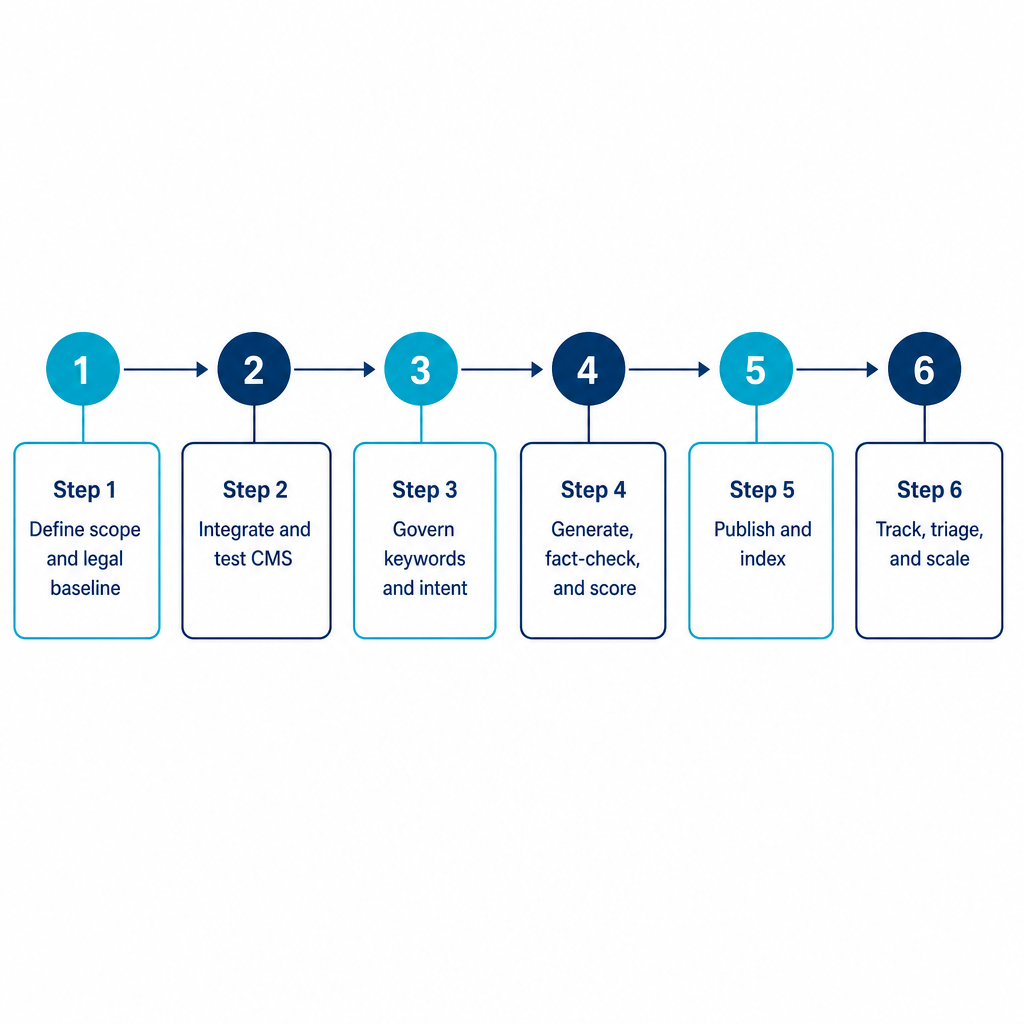
Switching on automated SEO content is less like flipping a toggle and more like commissioning a small factory line: it works beautifully when the guardrails are set first, and it fails loudly when they aren't. This checklist for launching automated SEO content is written for US-based and US-targeting businesses that want hands-off organic growth without sacrificing compliance, rankings, or brand trust. Work through it before your first automated article goes live, and you'll have a documented scope, a legal baseline, tested CMS integration, and a monitored publishing loop instead of a black box quietly publishing to production.
We built this around one principle: automation is a workflow you can defend, not a promise you take on faith. Every requirement group below tells you what it covers, what happens if you skip it, and where your specific case changes the answer.
Table of contents
- • Master checklist before you go live
- • Legal and policy baseline for the USA
- • Technical and CMS integration readiness
- • SEO strategy and keyword governance
- • Content quality, brand voice, and fact-checking
- • Publishing, indexing, and performance tracking
- • Your next step: a publisher-led implementation review
- • Frequently asked questions
Master checklist before you go live
Treat this as your master gate. If any line is unchecked, you're not ready to publish automatically.
- Define automation scope: jurisdiction, content types, connected CMSes, categories, languages, and maximum publishing cadence, and write down what stays manual.
- Confirm your US legal and policy baseline (privacy, copyright, advertising claims, sector rules), including which sensitive topics are excluded.
- Audit existing content for factual errors, fabricated entities, cannibalization, thin or duplicate pages, and indexing gaps, and fix them before scaling.
- Formalize keyword and topic governance: who approves targets, how intent is checked, and how automation stays inside your brand and product boundaries.
- Configure generation with brand guidelines, originality checks, and on-page guardrails for structure, headings, metadata, and internal links.
- Set up CMS integration with tested permissions, rollback options, and separate staging versus production paths.
- Run a combined automated and manual QA pipeline for metadata, schema, canonical tags, duplication, and compliance, with explicit failure gates.
- Configure indexing and tracking (indexing API, sitemaps, Search Console, analytics) and define KPIs per page type.
- Keep evidence: logs, approvals, QA reports, and policy decisions for every automation step.
- Run a limited pilot on one category or subfolder with manual oversight, then scale only after results and incident logs are reviewed.
The sections that follow expand each group with scope, consequences, and the variables that shift depending on your situation. If you're new to the category, our beginner guide to AI SEO platforms gives the underlying vocabulary this checklist assumes.
Legal and policy baseline for the USA
Scope: any US-based or US-targeting site automating blog-style content such as evergreen guides, how-tos, explainers, and comparisons. Consequence of skipping it: regulatory exposure, takedown requests, civil liability, and long-term brand damage.
The important framing first: there is no dedicated US permit or statute for "automated SEO content." Obligations arise from existing copyright, advertising, privacy, and sector-specific rules, and they apply the same way they would to content a human wrote. That means your legal work is about mapping existing duties onto an automated pipeline, not chasing a special approval.
Separate the legal requirements from practical SEO advice, and handle these explicitly:
- Jurisdictions. Federal law plus the states where your customers reside. Case-dependent regimes such as healthcare privacy, financial advertising, or children's privacy rules apply only if your content touches those domains.
- Copyright and licensing. Ensure workflows do not republish copyrighted text or images, and document your content sources, licenses, and image-generation settings for commercial use.
- Substantiated claims. Require evidence for any statement that reads as a product promise, health benefit, financial outcome, or testimonial. Keep a short internal claims register mapping each automated statement to its source.
- Privacy and data use. Confirm that any personalization or analytics respects your privacy notice and consent mechanisms, and keep personal data about identifiable individuals out of automated content.
- Brand and platform policies. Align output with your own editorial standards and with the rules of any hosting or ecommerce partner you publish through.
Retain the evidence that lets you defend a decision later: a written editorial policy with topic and claim restrictions, licensing terms for third-party data or media, approvals for sensitive content, and an exception register naming topics that must stay manual. Before launch, get compliance sign-off on your scope document, spot-review 10 to 20 sample drafts for copyright, claims, and privacy issues, and set a clear escalation path for disputes.
Where your case changes the answer: highly regulated sectors—healthcare, finance, legal, children's content—should keep diagnosis, financial advice, legal interpretation, and child-targeted messaging out of automated workflows entirely, or require pre-publish review by qualified staff. International sites should treat US rules as one layer and add local requirements per region rather than assuming a single checklist covers every market.
Technical and CMS integration readiness
Scope: any site connecting an automation platform to WordPress, Shopify, Webflow, Wix, or a custom CMS with direct auto-publishing and indexing. Consequence of skipping it: broken pages, wrong canonicals, misfiring templates, or articles landing in the wrong sections.
Strong QA workflows integrate checks directly into CMS hooks or CI pipelines so a failure can block publication instead of surfacing after the page is live. Build the same posture into your setup.
- Connection and permissions. Authenticate with scoped, revocable credentials. Confirm the integration can create drafts and published posts, edit metadata, upload images, and manage categories and tags without touching unrelated content.
- Template and structure validation. Map each content type (guide, listicle, comparison) to a tested template with a defined heading hierarchy, body layout, and schema compatibility. Test mobile and desktop rendering on at least three sample articles per template.
- Canonical, indexation, and schema. Verify that automation sets canonical URLs, index and noindex flags, and schema types correctly, and that category, tag, and pagination pages aren't unintentionally generated or indexed.
- Environment separation. Distinguish staging from production, publish to staging first in early phases, and keep a rollback process so a problematic batch can be reverted.
Keep an integration diagram showing endpoints and data flow, a template library with screenshots and schema notes, and sample staging and production URLs with QA notes. Before launch, run dry runs of three to five test articles per template to staging and inspect the HTML, structured data, and UX across devices; run a technical audit script on the test URLs; and review access logs to confirm credentials are limited and monitored.
Where your case changes the answer: ecommerce sites need extra checks separating product templates from blog templates and validating internal links to products. Multilingual sites must validate language tags, hreflang, and URL patterns per locale before enabling automation across languages.
SEO strategy and keyword governance
Scope: any site using automation for keyword and topic discovery, outlines, and recurring articles. Consequence of skipping it: cannibalization, off-intent content that never ranks, and articles optimized for the wrong queries.
Automation works best as a connected loop—topic discovery, brief generation, drafting, internal linking, publishing, and indexing—held together by explicit strategy guardrails. Governance is what keeps that loop from producing volume for its own sake.
- Keyword pipeline. Decide how topics enter the system, whether from keyword tools, AI-visibility gap analysis, or Search Console. Require each topic to carry a primary keyword, secondary keywords, search intent, and a target URL pattern.
- Topic and intent approval. Assign a person or team to approve clusters and intents before automation runs, and set rules that block ambiguous or high-risk intents such as medical diagnosis.
- Internal link strategy. Maintain a linking matrix of pillar pages and supporting articles, feed link targets into briefs, and require at least two to three meaningful internal links per article to avoid orphan pages.
- Cannibalization controls. Audit for overlapping pages targeting the same queries and decide whether to update, merge, or retire them. Enforce a rule that automation cannot create new content for a keyword until a cannibalization check passes.
Document a keyword backlog with intent labels and approval timestamps, an internal linking map refreshed at least quarterly, and a cannibalization audit with keep, merge, or delete decisions. Before launch, review a sample of planned topics—the next 50 articles is a reasonable batch—for clear intent and product fit, and confirm each maps to a unique primary URL and cluster.
Where your case changes the answer: small sites often narrow scope to evergreen educational content and keep product and pricing pages manual. Larger sites can delegate topic approval but should centralize the rules against cannibalization and off-brand topics.
Content quality, brand voice, and fact-checking
Scope: automated drafts, edits, and final posts. Consequence of skipping it: generic content, factual errors, misaligned tone, and eroded authority.
Quality guardrails are where automation earns or loses trust. Structure content into clear sections, answer the main question early, use plain language, and make each piece citation-worthy with proper sourcing. Our platform handles keyword research, article writing, fact-checking, internal linking, image generation, metadata, and publishing in a brand-matched tone, and we run a pre-publish SEO scoring step that checks readability, keyword density, meta descriptions, heading hierarchy, and overall content quality before anything goes live. That scoring step is what turns "we hope it's good" into a gate you can enforce.
- Brand voice and editorial rules. Provide explicit voice examples, preferred phrases, and banned topics or claims, and define structure expectations per content type.
- Factual accuracy. Require fact-checking against reputable, current sources for statistics, dates, and named entities, and enforce citation or evidence fields in the brief where supported.
- Originality and duplication. Configure checks for near-duplicate content, template overuse, and generic passages, and set a policy on how much rephrasing versus original analysis is acceptable.
- On-page scoring. Use built-in scoring to enforce minimum thresholds for readability, keyword use, metadata, heading hierarchy, and internal links, and block auto-publishing for anything that fails until it's fixed.
- Media. Define rules for on-brand images and descriptive alt text, and avoid images that could mislead or infringe.
Keep the editorial and brand voice guide you supplied, sample scored articles showing their metrics, and fact-checking logs for claims-heavy pieces. Before launch, review 10 to 20 automated articles for voice, structure, and accuracy, and confirm that scoring and QA gates are active so below-threshold content cannot publish itself.
Where your case changes the answer: regulated sectors should layer expert review—doctor, lawyer, financial advisor—on top of automation for any advice-like content. Multi-author brands may need distinct tone profiles per product line, and automation should respect those distinctions.
Publishing, indexing, and performance tracking
Scope: the final stage where content is scheduled, published, indexed, and monitored. Consequence of skipping it: pages that never get indexed, strain crawl budget, or underperform while nobody is watching.
Connect publishing, indexing triggers, and performance tracking so each article's journey stays visible from draft to data. We support auto-publishing to connected CMSes and auto-indexing via Google's indexing API to speed discovery and support visibility in AI search, which shortens the gap between publishing and measurable results.
- Cadence. Set maximum daily or weekly article counts per site or category so you don't overwhelm your team or users, and define quiet windows during maintenance or major site changes.
- Indexing. Connect indexing tools or APIs so new content is discovered quickly and monitored for status changes, and keep sitemaps and RSS in sync with automation.
- Performance triage. Pull Search Console and analytics data for automated URLs—impressions, clicks, engagement—and regularly classify pages as performing, needs improvement, or fix, merge, or delete.
- Incident handling. Keep an incident log for mispublishes, compliance issues, and technical failures, and document how you unpublish, update, or redirect problematic pages and prevent recurrence.
Maintain a publishing calendar with automation settings per site, indexing status reports for recent content, and performance triage decisions. Before launch, test publishing and indexing on a small batch, confirming each article appears in the CMS, sitemaps, and tracking tools, and validate that your dashboards distinguish automated from manual content.
Where your case changes the answer: high-traffic or news-heavy sites usually run tighter performance thresholds and more frequent triage, while long-tail evergreen strategies can tolerate slower performance as long as quality holds. Cost and cadence trade-offs are worth modeling early, which our breakdown of SEO content automation cost per month walks through.
Your next step: a publisher-led implementation review
With the checklist complete, the practical next move is a structured implementation review that you lead using our capabilities. We connect to your site, research low-competition keywords, write fact-checked articles in your brand voice, generate on-brand images, add internal links, and auto-publish to your CMS on a set schedule, with the pre-publish SEO scoring step running throughout.
Come to that review with three things in hand: your documented scope, your legal and editorial policies, and your pilot results. From there, we walk through how the automation loop—research, write, fact-check, link, publish, index—maps onto your governance, QA, and incident processes, so nothing runs outside the boundaries you set. Then we use real examples and pricing to decide your starting cadence, languages, and site coverage, deliberately beginning with a conservative pilot before scaling. If you want a head start on the tool-selection reasoning, our overview of the best AI SEO software for small businesses frames the decision criteria this review builds on.
Frequently asked questions
Is there a specific US law regulating automated SEO content?
No. It's governed by existing copyright, advertising, privacy, and sector-specific rules rather than a dedicated automation statute. Your exact obligations depend on your industry, audience, and the claims you make.
How does this checklist apply to small businesses?
Small US businesses can use the same framework but narrow scope to evergreen educational posts, keep sensitive topics manual, and lean on platform features like SEO scoring, QA gates, and automatic indexing to reduce overhead.
What extra steps do regulated industries need?
Healthcare, finance, legal, and children-focused brands should add expert review for advice-like content, apply stricter claim substantiation, keep automation scope smaller, and require legal sign-off on high-risk topics.
How do I know if automated content is good enough to publish?
Combine automated checks for structure, readability, keyword usage, and metadata with human spot-reviews for facts and brand fit. A scoring system that blocks low-quality drafts before publication keeps the floor consistent.
How often should automated content be audited?
At minimum, run periodic audits of automated URLs to catch factual errors, fabricated entities, cannibalization, thin or duplicate pages, and indexation issues, then decide whether to fix, merge, or delete each one.