
Ai Seo Writing Tool Vs Hiring A Writer
Deciding between an AI SEO writing tool vs hiring a writer is less about which one is "better" and more about matching your control, consistency, and growth speed to your budget and risk tolerance. Both can produce content that ranks. The difference shows up in how much you publish, how fast, at what cost, and who is accountable for accuracy. Before you commit a marketing budget, it helps to see the two paths side by side and know exactly which reader situation points to which choice.
Table of contents
- • The real alternatives for SEO content
- • How AI SEO writing tools actually work
- • How hiring a writer typically works
- • Criteria-by-criteria comparison
- • When an AI SEO writing tool is the better fit
- • When hiring a writer is the better fit
- • When to combine both or hold off entirely
- • Choosing your content engine
- • Frequently Asked Questions
The real alternatives for SEO content
Most businesses frame this as a straight two-way choice, but there are really four practical paths, and naming them keeps the decision honest.
The first is an AI SEO content automation platform that connects to your CMS, researches keywords, drafts articles, adds internal links and images, then publishes and indexes at scale. The second is hiring a writer — freelance or in-house — who researches, interviews, writes, and edits, usually alongside broader marketing duties. The third is a hybrid model where AI handles research and first drafts while a human verifies facts, adds lived experience, and polishes voice. The fourth is founder or marketer DIY, writing manually when time allows, which tends to produce sporadic publishing and thin topical coverage.
This comparison centers on the first two options, because they represent the actual budget decision most teams face. The hybrid and DIY paths matter as context, and both appear again once we reach the "when neither" thresholds.
How AI SEO writing tools actually work
The phrase "AI writing" makes people picture a text box that spits out paragraphs. A modern SEO platform is a different animal: it is a publishing system, not a prompt toy. At AymarTech we connect directly to your website, discover low-competition keywords, draft articles in your brand voice, add internal links and images, schedule posts, and push them live with automatic indexing through the Google API.
Used with a clear strategy and human oversight, AI can raise content volume substantially without sacrificing search performance. Used carelessly — unedited, generic text pumped out at scale — it can drag down rankings and brand perception. The tool amplifies whatever standards you feed it.
The capabilities worth understanding are concrete:
- Keyword and topic research at scale. AI can analyze large keyword sets, surface low-competition opportunities, and cluster by search intent far faster than manual workflows.
- Structured, SEO-aware drafting. Drafts arrive with headings, meta elements, internal-linking suggestions, and topical coverage tuned to intent, not just readable prose.
- Brand voice modeling. Properly configured, a model can learn your tone and apply it across hundreds of posts, which reduces the generic-AI-voice problem that sinks lazy automation.
- Automated publishing and indexing. Direct CMS integrations and API-based indexing mean content is not only written but actually shipped and discovered by search engines and AI assistants.
The risks are equally concrete and worth naming before you buy. Generative models can state incorrect facts with total confidence, especially on niche or fast-moving topics. Google's guidance rewards helpful, original content, and sites that publish low-quality AI text in bulk tend to see rankings slide. And AI cannot supply lived experience or accountability on its own — someone still has to own the perspective and the accuracy.
How hiring a writer typically works
Hiring a writer — freelancer, staff, or agency — means paying for human judgment, creativity, and firsthand experience. That buys real advantages.
A skilled writer picks up subtle brand cues, stakeholder preferences, and cultural context, then crafts narratives and analogies that feel genuinely original. They fact-check with domain understanding: cross-checking claims, interviewing experts, and recognizing when a sentence could create legal, compliance, or reputational exposure. They can weave in real customer stories, personal experiments, and proprietary data — exactly the signals search quality guidelines reward.
The limitations are operational rather than qualitative. One writer can only research and publish so many strong posts per week, so volume is capped by human bandwidth. Cost covers more than writing time; it includes coordination, briefs, edits, and sometimes benefits or retainers. And writers rarely run CMS integrations, internal-linking architecture, or daily publishing logistics end to end, so you still need someone operating the system around them.
Humans shine on high-stakes, nuanced content. They are less efficient for routine, long-tail SEO coverage where the binding constraint is volume and consistency.
Criteria-by-criteria comparison
Rather than argue in the abstract, here is how the two paths behave across the criteria that usually decide the budget.
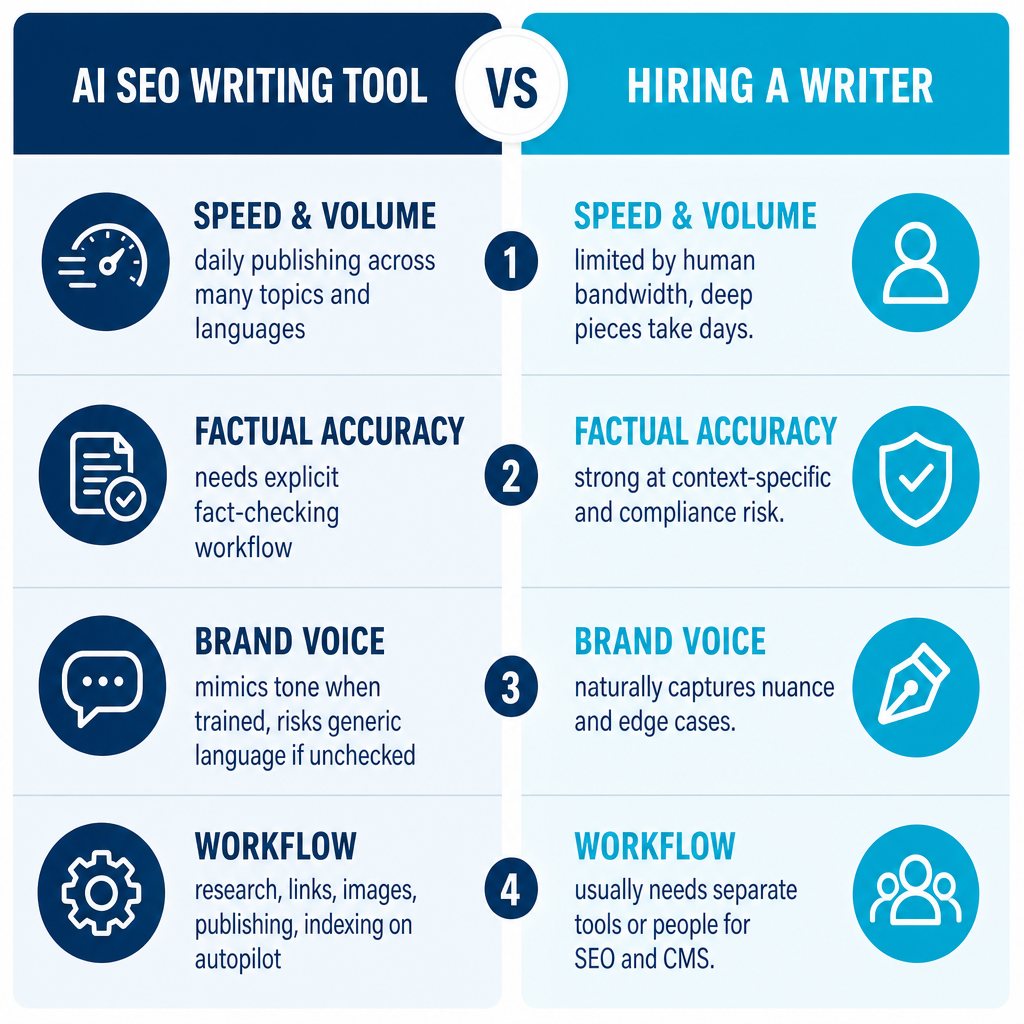
| Decision criterion | AI SEO writing tool | Hiring a writer |
|---|---|---|
| Keyword research & strategy | Automates discovery of low-competition keywords and intent clustering; strong for broad topical coverage | Manual research driven by experience; better for narrow strategic topics, slower to scale |
| Content volume & speed | Can produce and publish optimized articles daily, across topics and languages | Capped by human bandwidth; deep pieces take days or weeks |
| SEO performance potential | Performs well when content is accurate, helpful, and guideline-aligned; AI origin alone is not penalized | Human-led expertise tends to win on competitive, high-value queries |
| Brand voice & originality | Mimics tone when trained; risks generic language if not configured or reviewed | Naturally captures nuance, humor, and edge cases |
| Factual accuracy & risk | Needs explicit fact-checking to avoid hallucinations and stale data | Better at catching context-specific errors and legal or compliance implications |
| Google guideline alignment | Fully compatible for helpful, accurate content; risky for spammy unedited text | Easier to align with E-E-A-T when the writer has real experience |
| Workflow & publishing | Handles research, drafting, links, images, publishing, and indexing on autopilot | Usually needs separate tools or people for SEO, CMS, and technical publishing |
| Multi-language & AI visibility | Generates content in many languages and pushes it to search and AI assistants at scale | Multi-language coverage is slower and costlier; visibility depends on consistency |
| Cost profile | High leverage per dollar for ongoing high-volume needs, but still needs oversight | Higher per-piece cost, strong value for flagship pieces |
If you want the underlying category explained before you weigh these rows, our guide to AI SEO writing tools and how to pick the right one covers the fundamentals without repeating this comparison.
When an AI SEO writing tool is the better fit
The tool wins in specific, recognizable situations rather than universally.
It fits when you need consistent, hands-off publishing — you want daily or weekly SEO articles but have no bandwidth to manage writers, briefs, and CMS logistics. It fits when your growth depends on long-tail coverage and AI visibility rather than a few flagship posts, because covering hundreds of intent-focused, low-competition topics is precisely where automation compounds. It fits when your product is stable and well-documented, so the platform can represent your offer accurately and stay on-brand.
It also fits when you already have clear positioning but limited team capacity: founders and marketing leads set the guardrails, then let the system convert that strategy into ongoing content with minimal intervention. And it fits when you operate across multiple markets or languages, where consistent structure and SEO foundations across dozens of locales would otherwise swamp a small team.
In these cases a platform like AymarTech behaves as a content engine — researching, drafting, fact-checking, internally linking, illustrating, and auto-publishing in your voice — rather than a text generator you babysit.
When hiring a writer is the better fit
A writer or agency is usually the right call when the stakes per article are high.
Regulated or sensitive industries — healthcare, finance, legal, insurance — carry strict compliance rules where a misphrased sentence creates real exposure. Human oversight with deep domain knowledge is essential there. A writer is also the core asset when thought leadership matters more than volume, and success looks like a handful of widely shared authority pieces instead of dozens of supporting articles.
You need a human when content depends on original research, interviews, and data storytelling, because AI cannot run studies, conduct interviews, or interpret complex datasets with situational nuance. A writer also protects an unusually distinctive or experimental brand voice built on comedic timing, cultural references, or non-standard language. And when your positioning is still fluid, a writer can help refine the offer and messaging through conversation and iteration — something AI is not equipped to lead.
In those scenarios the writer is a strategic partner, not just a content producer.
When to combine both or hold off entirely
The binary choice dissolves for a lot of teams, and two edge cases deserve honesty.
Go hybrid when you want scale and quality together: AI handles topic research and first drafts, while a human editor checks accuracy, adds experience, and confirms each piece genuinely helps readers. Hybrid also suits sites that already have strong human-written pillar pages and want supporting clusters built out faster, or teams in moderately regulated spaces where AI accelerates production but a person signs off on claims and tone before publishing.
Hold off on both when the foundations are missing. If your positioning, pricing, or target audience are still unclear, any content engine merely amplifies the confusion. The same applies if you lack a functioning website, an analytics setup, and at least a minimal content strategy, or if you cannot commit even light time to review and approvals — both AI and human writers need direction to stay accurate. When that is the situation, a short strategic sprint to clarify offers, audiences, and messaging should come before any investment in scaled content. If you decide to move forward with automation, our walkthrough of automating an SEO content workflow shows how the pieces connect in practice.
Choosing your content engine
If you are leaning toward an AI-powered approach, three moves make the decision concrete rather than theoretical.
First, see what automated, on-brand content actually looks like so you can judge structure, depth, and voice against your own standards before committing. Second, understand the full workflow — how keyword research, writing, fact-checking, internal linking, images, publishing, and indexing tie together — so you know what you are and are not handing off. Third, decide whether AI should replace or support your current writers; our guide to choosing the best AI for writing in your business helps you map your existing workflow to an AI-supported or AI-first model.
From there you can weigh the tool against your current writer setup and decide whether to switch, blend, or hold your course — and if you want a recommendation tailored to your niche, publishing cadence, and risk profile, tell us your industry and current setup and we will map the right mix for you.
Frequently Asked Questions
Is AI-generated content safe for SEO?
Yes, when it is accurate, helpful, and genuinely useful, AI-assisted content can rank as well as human-written pieces. Google does not penalize content simply because AI produced it; problems arise when sites publish low-quality, unedited text at scale.
Will Google penalize my site if I use an AI SEO writing tool?
Not if you use it to publish helpful, original content that meets quality guidelines. Traffic losses tend to hit sites relying on generic, spammy automation without human oversight, not sites using AI responsibly.
Can an AI SEO tool really match my brand voice?
With a solid brand profile, example content, and clear guardrails, modern platforms can learn and reproduce your tone across many articles. Periodic review still matters to catch subtle issues and keep the writing authentic.
Do I still need a writer if I use an AI SEO tool?
Most businesses benefit from at least light human oversight — someone who verifies product claims, adds lived experience, and approves content. Whether that is a full-time writer, a marketing lead, or a founder depends on your scale and risk tolerance.
What is the biggest risk of relying only on AI for content?
The main risks are factual inaccuracies, generic language, and content that falls short of E-E-A-T expectations. Left unchecked, that can erode both search visibility and brand trust, especially in competitive or regulated niches.