
Best AI SEO Software for Small Businesses
Most "best software" lists for small businesses read like a spec sheet: a wall of features nobody has time to compare. When you're a founder or a two-person marketing team, the real question isn't which tool has the longest checklist. It's which one gets researched, written, optimized, published, and indexed content onto your site without you touching a keyboard. That's the lens we use for the best ai seo software for small business here: fewer tools, less manual work, and content that reliably gets indexed, ranks on Google, and shows up when AI assistants answer questions. Rather than name-drop a dozen products, we're going deep on how our own platform, AymarTech, covers each use case a small business actually runs into.
Table of contents
- • What "best" actually means when you're small and busy
- • Full-pipeline automation: idea to indexed page
- • Shopify and e-commerce: traffic beyond product pages
- • Flat pricing that a small team can plan around
- • Multi-CMS publishing and hands-off content automation
- • AI visibility and GEO-ready content
- • How to choose the right fit for your business
- • Frequently Asked Questions
What "best" actually means when you're small and busy
For a small business, "best" isn't a feature count. It's a blend of automation, safety, and predictable cost. So before we look at individual use cases, here are the criteria we hold ourselves to on this list, and why each one matters when you don't have a full content team.
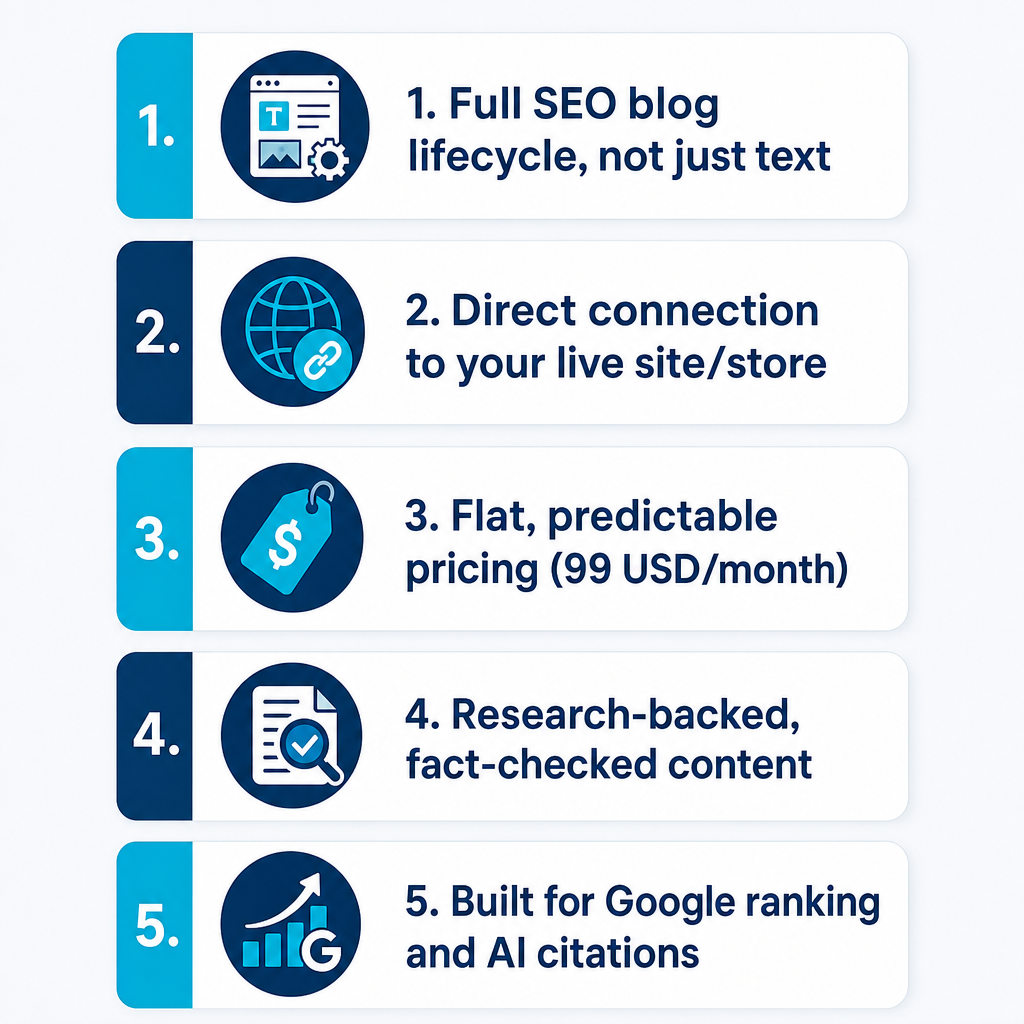
The first filter is whether a tool automates the full SEO blog lifecycle or just the writing. A generic AI writer produces text and stops there, leaving you to handle keyword selection, SEO structure, internal links, images, and publishing by hand. We built AymarTech to manage keyword research, intent-matched outlines, brand-voice drafting, fact-checking, internal linking, metadata, featured images, publishing to your CMS, and auto-indexing via the Google API. That distinction is the difference between buying a writing assistant and buying an outcome.
The second filter is direct connection to your live site. Once connected to platforms like WordPress, Shopify, Webflow, or Wix, we publish finished posts straight to your site on the schedule you set. The third is predictable cost: a flat monthly subscription instead of per-word or per-seat surprises. The fourth is research-backed, fact-checked content built to compete in search and pass AI quality filters. And the fifth is dual visibility, meaning content structured to earn both organic Google rankings and citations inside AI assistants.
If you want the plain-language background before going further, our explainer on what an AI SEO platform is covers the moving parts in one read.
Full-pipeline automation: idea to indexed page
The most common trap for a small team is buying a tool that only solves one slice of the work. You save time drafting, then lose it again choosing keywords, formatting for SEO, adding links, and pushing posts live. AymarTech is built to close that whole loop.
Here's what "full pipeline" means in practice. We connect to your website, research low-competition keywords in your niche, generate SEO-optimized articles in your brand voice, create on-brand featured images, add internal links, and publish completed posts directly to your CMS on a schedule you choose. Each article ships with structured headings, metadata, and search-friendly formatting, then gets auto-indexed via the Google Indexing API so it can start ranking and be discoverable to AI assistants.
The best fit here is owners and teams who genuinely want set-and-forget content. You define your industry, products, geography, and brand voice; we build and execute an editorial plan, publishing daily or weekly articles that match your tone and target your audience. The platform works across 120 to 150 languages, which helps if you serve multilingual audiences or plan to expand beyond the US market.
The honest limitation: we focus on blog and content SEO. We don't replace technical SEO work on site speed, architecture, or complex migrations, and we don't manage paid ads or run detailed backlink outreach. And if you operate in a highly regulated industry, you'll still want internal review of published posts for sector-specific compliance, even though fact-checking runs inside our workflow.
Shopify and e-commerce: traffic beyond product pages
If your revenue lives on product pages, your SEO ceiling is usually low. Product and category pages rarely rank for the questions people ask before they're ready to buy. That's the gap a content layer fills, and it's the specific job our Shopify integration is built for.
Through that integration, we research keywords based on your store's niche, write SEO-optimized blog articles in a brand-matched tone, generate featured images, and publish directly to your Shopify blog. Articles automatically include internal links to relevant product pages, meta tags, and structured headings, so how-to guides, comparisons, and educational posts can send traffic toward the products they mention.
The best fit is stores that lean almost entirely on product pages and short descriptions. A lean team can maintain a consistent blog cadence targeting long-tail keywords without hiring writers or SEO specialists, because publishing runs automatically.
The limitation worth stating plainly: this is content, not commerce operations. We don't replace inventory management, product feed optimization, or conversion rate testing. We add internal links to product pages, but you still need to optimize product detail pages, collections, and checkout flows to convert the traffic those articles bring in.
Flat pricing that a small team can plan around
Usage-based pricing punishes exactly the businesses that most need content: the small ones trying to publish consistently. Per-word and per-seat models make your bill unpredictable the moment you get serious. Our answer is a single flat rate.
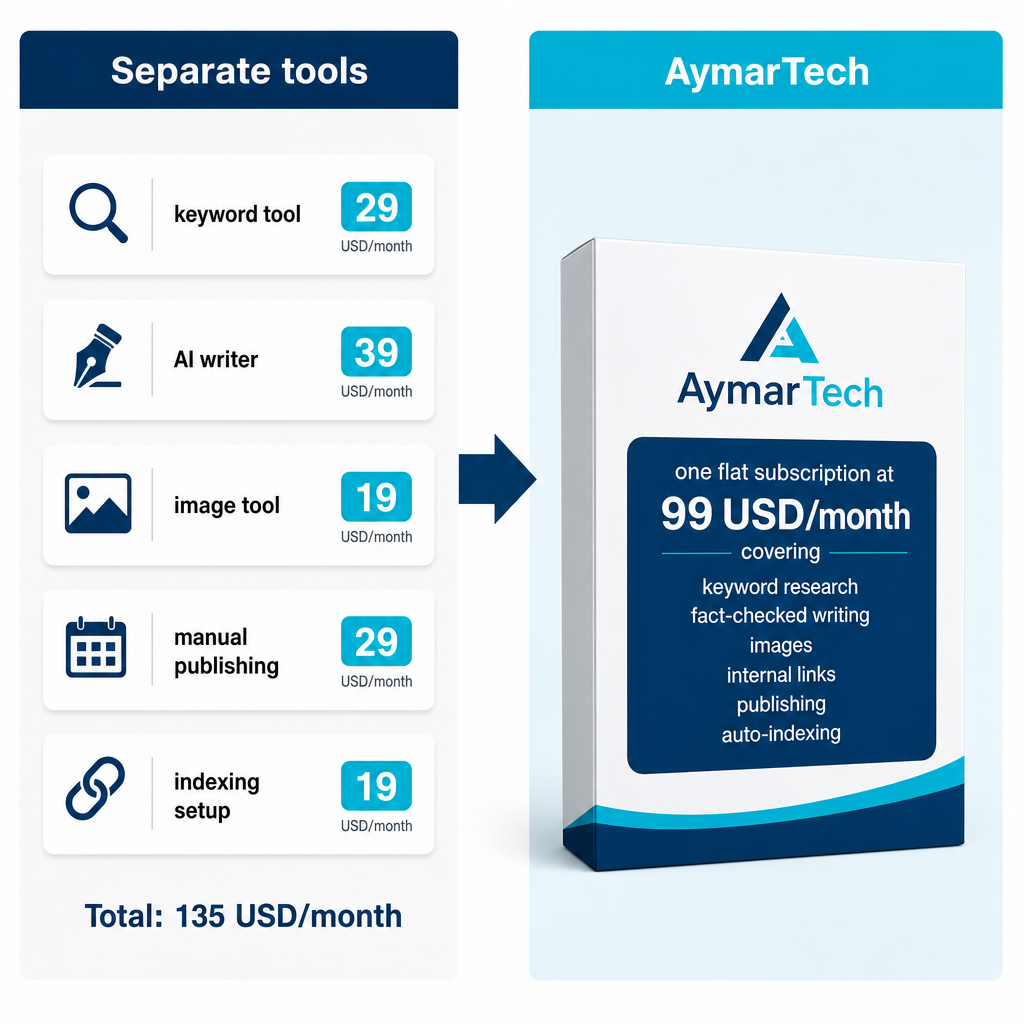
AymarTech is a subscription platform priced at a flat 99 USD per month (tax included, as of September 2026). That subscription covers keyword research, editorial calendar generation, AI-written and fact-checked drafts, and optional auto-publishing to your connected sites. There's a free trial covering two days or two articles, plus free keyword calendar generation, so you can see the workflow before committing.
The best fit is founders, small marketing teams, and agencies that need to budget content production without surprises. Because one subscription replaces several point solutions, keyword tools, AI writers, image generators, and manual publishing, it can simplify both your billing and your tooling.
The limitation is about expectations, not price. Flat pricing doesn't mean unlimited scale in every direction. Extremely high-volume publishing or highly specialized research demands may still call for additional resources alongside the platform, so match your expectations to realistic output and results.
Multi-CMS publishing and hands-off content automation
A tool that writes but can't publish where your content lives just moves the manual work downstream. The point of automation is that the finished article lands on your site without a copy-paste step, and that's why our integration list matters.
We integrate with WordPress.org, WordPress.com, Shopify, Webflow, Wix, Notion, and webhook/API endpoints, so content publishes directly into your existing workflow. Once your CMS is connected and your business profile is set up, the platform drafts, fact-checks, illustrates, internally links, optimizes, and auto-publishes articles to your site at the cadence you approve.
The best fit is multi-site businesses and agencies. If you run several properties, a main site, a knowledge base, an e-commerce store, or serve multiple clients, you can connect each CMS and centralize content automation in one place. Internal linking is generated across your articles and toward product or service pages, which is especially useful for sites that never had a coherent linking strategy to begin with.
The limitation is governance. Auto-publishing requires access to your CMS, so you'll need to manage permissions, roles, and review workflows deliberately. If your organization requires strict editorial sign-off, you can use the platform for drafting and indexing while keeping a manual review step before anything goes live.
AI visibility and GEO-ready content
Search isn't only Google anymore. Buyers increasingly ask ChatGPT, Claude, Perplexity, or Gemini before they ever open a search results page. Content that only chases classic rankings leaves that surface uncovered, and closing that gap is a design goal for us.
We build articles with structured headings, metadata, and factual backing so they can rank in traditional Google search and be eligible for citation by AI assistants. By auto-indexing content through the Google API and maintaining consistent topical coverage around your products and services, we help your brand surface in both search results and generative answers.
The best fit is SaaS companies, startups, and brands that live on inbound content and expert positioning. Ongoing, research-backed articles tied to specific customer problems and search intents are exactly what these businesses need to compound. Because we publish in many languages, brands with global audiences can build content libraries that speak to local markets while staying consistent with a central brand voice. If you want the concept in depth, our guide to generative engine optimization unpacks how AI-answer visibility works.
The limitation is one no honest platform can wave away. GEO is an emerging discipline, and visibility across AI systems depends on external factors, including model training data, update cycles, and competition in your niche. We improve your odds by creating high-quality, indexable content, but no tool can guarantee a specific placement inside a third-party AI tool's answers.
How to choose the right fit for your business
The decision usually comes down to your situation, not a feature grid. Here's how the criteria above map to common small-business scenarios, and how we'd suggest configuring things.
| Your situation | What to prioritize | How AymarTech fits |
|---|---|---|
| No in-house writer or SEO specialist | End-to-end automation from research to publish | Replaces the usual stack with one automated pipeline |
| A blog you can't keep consistent | Direct CMS integration and auto-publishing | Connects to major platforms and keeps posts flowing |
| An online store | Internal links to product pages, educational content | Shopify integration links posts to your catalog |
| Tight, predictable budget | Flat pricing with research and publishing included | 99 USD/month plus a free trial to test first |
| AI visibility and multilingual reach | Many languages plus Google auto-indexing | 120-150 languages and an indexing workflow |
Whichever scenario matches you, a few checks are worth doing before you commit. Confirm that the supported CMS and integrations match your stack. Review the trial terms, data handling, and privacy practices against your compliance needs. And make sure your internal processes, legal, brand, and editorial, can accommodate automated publishing where you plan to use it. If your team needs sign-off on everything, start with drafting and indexing and add auto-publishing once you trust the output.
One more practical note for anyone still comparing categories: if you're weighing pure drafting tools against full pipelines, our roundup of the best writing software for growing traffic shows where a writer stops and where an SEO platform picks up.
Frequently Asked Questions
Is AI SEO software worth it for a small business on a limited budget?
It can be, when the software replaces several separate tools, keyword research, writers, image generation, and publishing, and delivers consistent, indexable content. Our flat monthly pricing and full-pipeline automation are built around that trade-off rather than charging per word.
How much does AymarTech cost for a small business?
As of September 2026, the subscription is 99 USD per month, tax included, with a free trial covering two days or two articles plus a keyword calendar.
Which CMS platforms does AymarTech support?
We integrate with WordPress.org, WordPress.com, Shopify, Webflow, Wix, Notion, and API/webhook endpoints, so articles can publish automatically into your existing workflow.
Can AI SEO software replace an SEO agency entirely?
It can cover a large share of content research, writing, and publishing, but it doesn't fully replace technical SEO, complex link building, or high-touch strategic consulting. We're an AI agent for SEO blog content, not a wholesale agency substitute.
What do I need to start using AymarTech?
A website or store on a supported CMS, the ability to connect your site, and a clear description of your business, audience, and brand voice. After setup, we generate a content calendar and begin producing, and optionally auto-publishing, articles to your preferences.