
How to Fact-Check AI Content Automatically
Most teams that adopt AI writing hit the same wall: the drafts read well but sneak in wrong numbers, outdated dates, or claims no one can source. Learning how to fact check ai content automatically is what turns that risk into a controlled, publishable pipeline. With the right setup, you can configure automated verification in roughly one to three hours, run it on a single platform subscription instead of a stack of separate tools, and keep high-risk topics under human review. The outcome: most routine marketing content moves on autopilot, while claims get scanned, verified against trustworthy sources, and either corrected or flagged before anyone reads them.
This guide walks through the prerequisites, the exact step sequence, the mistakes that quietly break accuracy, and the point where a DIY tool stack stops making sense. We run this pipeline ourselves at AymarTech, so the examples reflect how embedded verification actually behaves at daily publishing cadence.
Table of contents
- • What automated fact-checking gets you, and what it costs
- • Prerequisites before you switch on automation
- • The step sequence for automatic fact-checking
- • Mistakes that quietly break accuracy
- • When to layer tools yourself and when to run it on a platform
- • Frequently asked questions
What automated fact-checking gets you, and what it costs
Automating fact-checking means every draft is scanned for factual claims, checked against sources you trust, and then corrected or flagged before publishing. For a small business, SaaS founder, or lean marketing team, the practical payoff looks like this:
- Roughly one to three hours to connect your CMS, define editorial rules, and turn on automated checks.
- One ongoing subscription instead of a patchwork of writers, editors, and point tools, because the research, writing, fact-checking, internal linking, images, publishing, and indexing live in one pipeline.
- A sharp drop in fabricated claims, because each piece is verified against current sources and fails safe when evidence is missing.
That last point is the real prize. Large language models produce inaccurate factual statements in roughly 5–10% of general-knowledge answers when left unchecked, and the rate climbs on complex reasoning. Automatic verification is what keeps that failure rate from reaching your audience.
For content you still draft outside an automated pipeline — cold emails, sales decks, social captions — you can layer lightweight fact-checkers that detect and grade claims automatically, often at free or low monthly tiers. The cost profile stays modest; the discipline is what makes it work.
Prerequisites before you switch on automation
Automation amplifies whatever rules you give it, so set the rules first. Work through this checklist before anything goes on autopilot.
- Define content scope. Decide which formats get automatically fact-checked: blog posts, landing pages, emails, social captions, help articles, or product docs. Different formats carry different risk, and lumping them together weakens every check.
- Map your generation tools. List every system that currently drafts content — general chatbots, in-house tools, or an end-to-end platform — so verification plugs in at the right stage rather than after the damage is done.
- Connect a central CMS. Make sure the site where content publishes (WordPress, Shopify, Webflow, Wix, or similar) is integrated with your automation platform, so verified content flows straight to publish without manual copy-paste.
- Classify risk levels. Split topics into low-risk (marketing posts, product descriptions) and high-risk (health, legal, finance, compliance). High-risk topics never rely on automation alone.
- Choose your verification backbone. For SEO blog content, use a platform that embeds real-time research and fact-checking inside the writing pipeline. For other AI text, pick dedicated checkers that break content into individual claims and label each as true, false, partially true, or unverifiable.
- Name your evidence sources. Decide which databases, primary sources, and official sites count as trustworthy, so your tools aren't validating claims against low-quality material.
- Set governance rules. Document what must be human-reviewed, what can auto-publish at high scores, and how you'll store citations and audit logs for later review.
If you want the research and clustering side handled as well, our walkthrough of how AI does keyword research shows how topic selection feeds the same pipeline that later verifies the draft.
The step sequence for automatic fact-checking
Start with a pipeline that expects to be checked
Choose or build a generation pipeline that assumes every draft will be verified, not merely polished. In our pipeline, AymarTech connects to your site, researches low-competition keywords, drafts in your brand voice, then runs an automated fact-checking pass before anything publishes. That pass verifies claims against live sources, adds internal links and on-page SEO, and only ships content that clears its accuracy checks. The reason this architecture matters is simple: unverified model output is wrong often enough that polishing prose does nothing to fix the underlying facts.
Attach a claim-detection layer to non-blog content
Anything written outside your blog — sales emails, scripts, internal docs — needs its own claim-detection layer. Use tools that scan for factual claims (numbers, dates, names, "according to" statements), break content into separate claims and label each one, and return explanations plus suggested corrections rather than a lone score. HumanizerPRO's fact checker, for instance, decomposes a document into claims, marks truthfulness, and proposes corrected sentences. Originality.ai's checker returns answers with context and citations. Browser-level tools like Facticity highlight claims directly in a webpage or document and mark them True, False, or Unverifiable in real time, which helps when you're editing drafts inside a CMS or Google Docs.
Make the check mandatory, not optional
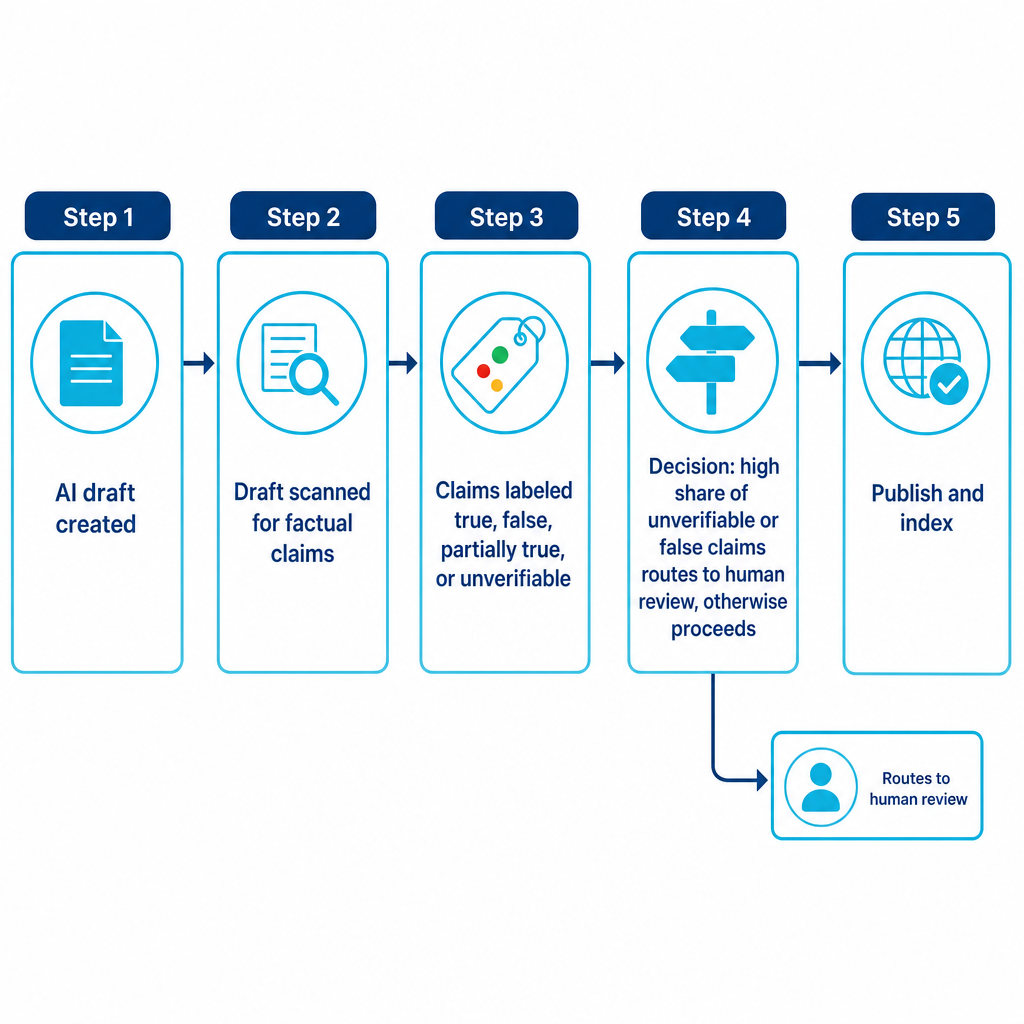
Once detection tools exist, enforce them. For blog content, let the pipeline own the whole loop: research, write, fact-check, inject internal links, generate on-brand images, publish, and trigger indexing. For every other channel, standardize one rule set:
- AI draft created.
- Draft sent through a fact-checker.
- Claims labeled and corrected where needed.
- If any high-risk claim remains unverifiable or false, the piece routes to a human reviewer.
- Only then does it enter email tools, ad managers, or internal docs.
Detection methods that combine semantic consistency checks, attribution-based verification, and multi-model agreement reach roughly 70–91% accuracy at spotting hallucinations in research benchmarks. Enforcing the step is what captures most problematic claims before they go live.
Set numerical thresholds for safe auto-publishing
Move from gut feel to numbers. Research on model factuality uses metrics like the ratio of supported sentences to total sentences — a fact-support score — and measures how many claims are backed by external sources. You can borrow the idea without the full academic tooling:
- Require a minimum share of claims marked true or supported before auto-publishing.
- When too many claims land as unverifiable or partially true, push the piece to human review automatically.
- Track error rates over time to see whether your stack is improving or drifting as models and prompts change.
That turns verification from a one-off spot check into a measurable quality gate.
Keep high-risk domains human-first
Automatic fact-checking is a safety net, not permission to skip professionals. Detection frameworks perform best on general knowledge and straightforward claims, not complex legal reasoning, medical advice, or high-stakes financial recommendations. For those domains, AI can draft, but a qualified reviewer owns the final call; the automated checks still run to catch basic errors and missing citations, yet they never replace expertise. Your governance policy should explicitly forbid fully automated publishing here — especially for US businesses exposed to industry regulation, consumer protection standards, and liability for misleading content.
Close the loop with search and AI visibility
Accuracy isn't only about avoiding errors; it shapes how search engines and AI assistants treat your content. Our pipeline auto-indexes new, fact-checked articles via the Google indexing API so they become discoverable quickly and eligible for citation by assistants like ChatGPT, Claude, Perplexity, and Gemini. Consistently accurate, well-structured content is a stronger citation candidate, while error-prone content gets ignored. If AI citations are a goal, our guide on how to rank in AI search engines pairs naturally with a verified content base.
Mistakes that quietly break accuracy
- Letting the same model mark its own homework. Self-checking a draft with the model that wrote it rarely catches deeper hallucinations, because the training data and failure modes are identical. Use separate tools or models built for verification, ideally with external retrieval.
- No line between marketing copy and factual claims. If checkers treat everything as opinion, they miss mis-stated statistics, wrong dates, and misquoted rules. Configure tools to focus on numbers, named entities, and "according to" statements, and train editors to spot which sentences need evidence.
- Ignoring unverifiable claims. Teams often read "unverifiable" as "probably fine." It usually signals niche topics, outdated data, or weak sources. Require human review whenever a piece carries a high share of unverifiable claims, especially around regulated topics or core brand promises.
- Treating scores as absolute truth. Even semantic-consistency and internal-state methods have margins of error and misclassify tricky reasoning or emerging news. Use scores as triage, then combine them with editorial checklists and domain expertise on important pieces.
- Keeping no audit trail. Without stored citations and change logs, you can't demonstrate responsible process if content is challenged. Save the verification sources, the tool verdicts, and the final corrected text — particularly for claims about safety, performance, or pricing.
When to layer tools yourself and when to run it on a platform
A do-it-yourself stack — chatbots for drafting plus stand-alone fact-checkers — works when you publish only a handful of pieces per month, most content is low-risk, and you have time to paste drafts into checkers, review outputs, and apply corrections by hand. As volume grows, that friction compounds: juggling tools, keeping prompts consistent, and updating the CMS manually turns into its own job.
A platform approach fits better when you want a new, fact-checked SEO article live every day without supervising each step, when you care about SEO and AI visibility alongside accuracy and need keyword research, internal linking, images, and indexing in the same pipeline, and when you'd rather approve finished drafts than manage research and publishing yourself. In that model your work shifts from doing verification to setting strategy, defining brand voice, and making final judgment calls while the system handles day-to-day accuracy in the background.
To put rough numbers around the trade-off before you commit, our breakdown of AI content automation cost lays out what a single platform subscription covers versus assembling the pieces separately.
Frequently asked questions
Is automatic fact-checking enough on its own for legal or medical content?
No. Detection tools and pipelines are built for general factual claims, not complex professional judgment. For legal, medical, or financial topics, treat automatic checking as a support layer and have qualified experts sign off on everything public-facing.
How does AymarTech fact-check blog content automatically?
We research the topic and keywords, draft in your brand voice, and verify claims against current sources before publishing, then add internal links, images, and on-page SEO. Verification is a required pipeline stage, not an afterthought, and the finished article is auto-published to your CMS and indexed via the Google API.
What evidence should my pipeline keep for each article?
Store the sources used during verification, the tool's verdicts on key claims, and any corrected sentences applied to the draft. That audit trail supports internal quality control and shows responsible AI use if regulators, partners, or customers ask.
How much accuracy improvement can I realistically expect?
Baseline hallucination rates for modern models on factual questions often sit in the 5–10% range and run higher for complex reasoning without external knowledge. Detection systems combining retrieval, semantic consistency, and multi-model checks catch roughly 70–91% of those errors in research benchmarks — a dramatic reduction, though not a complete elimination.
Does automatic fact-checking slow down publishing?
Not when it's embedded in the pipeline rather than bolted on afterward. Verification runs in the background on the schedule you set, so content still ships daily or weekly. Stand-alone checkers add some review time, but for most teams the drop in risk and rewrites outweighs the extra minutes.
If you're already investing in AI content, the next move is to make accuracy a default rather than a lucky outcome. Decide your risk tiers, pick where verification lives, and let the automated checks carry the routine load while you own the judgment calls.