
What Is Hands-Off SEO? A Simple Explainer
If you have heard the phrase and wondered what is hands off seo without the hype, here is the short version: it is an approach to search engine optimization where software handles the recurring execution — keyword research, writing, internal linking, optimization, publishing, and indexing support — while you stay responsible for strategy, accuracy, and final approval. It delegates the busywork without handing over judgment. It is not a button that makes your site rank on its own, and it is not an official Google category. It describes how SEO work gets managed, not a hidden ranking factor.
At AymarTech, we build around exactly this split: automate the repeatable stages so you are not stuck juggling tools and spreadsheets, and keep humans in control of the decisions that affect trust, compliance, and reputation. This explainer walks through what the term actually means, how the workflow functions stage by stage, where the real risks sit, and how to judge whether it fits your business.
Table of contents
- • What “hands-off SEO” actually means
- • How the workflow runs, stage by stage
- • What it can automate and what it can’t
- • Hands-off SEO vs. just generating AI content
- • Is it safe for Google?
- • The risks worth taking seriously
- • Who it fits, and who should stay hybrid
- • How to decide if it fits you
- • Frequently asked questions
What “hands-off SEO” actually means
Traditional SEO spreads a long chain of tasks across people and software: finding topics and keywords, reading search intent, building briefs, writing and editing, adding internal links, optimizing titles and metadata, creating images, publishing in a CMS, watching indexing, and updating pages as facts change. Each handoff is a place where work stalls.
Hands-off SEO connects that chain into one managed workflow. Instead of moving between separate tools, writers, and publishing systems, you set the business context once and review outputs while the system runs the repetitive execution. A workable definition: it is the automation of repeatable SEO tasks from research to publication, with human control over priorities, accuracy, and risk.
The key word is repeatable. Delegating execution is not the same as abandoning oversight. Search visibility still depends on whether what you publish is useful, accurate, original, technically reachable, and relevant to a real reader. Automation changes who does the typing; it does not change what earns rankings.
How the workflow runs, stage by stage
A hands-off SEO system is really several mechanisms wired together. Understanding each one tells you where quality is won or lost.
Business context first. Before anything gets written, the system should learn your site, industry, audience, products, services, geographic market, and existing content. Without that grounding, automation produces articles that are grammatically clean but commercially useless. Context is what keeps topic selection tied to what you actually sell.
Keyword and topic research. The platform weighs search demand, competition, intent, business relevance, and gaps in your current coverage. The highest-volume keyword is rarely the best pick. A local accounting firm usually gains more from an article on quarterly tax deadlines for small businesses in Texas than from a broad page targeting “taxes,” because the narrower query carries clearer intent and a tighter link to the service.
Research and fact-checking. A serious workflow researches current information before drafting — critical for anything touching laws, prices, software features, medical or financial details, statistics, or local specifics. Google is explicit that generative models can produce inaccurate information and recommends reviewing and fact-checking AI-generated content before publishing, including titles, meta descriptions, structured data, and alt text, not just the body (Google guidance on using generative AI content). “Automated” should never mean “unchecked.”
Brand-voice writing. Using samples of your existing writing, the system approximates your tone — drawing on published posts, product pages, preferred terminology, and examples of good and bad phrasing. Useful for consistency, but tone is not expertise. A tool can imitate your voice while still misreading a technical product or asserting something unsupported.
On-page optimization. Titles, headings, meta descriptions, slugs, keyword coverage, readability, alt text, structured data, and overall structure get shaped so people and search engines can parse the page. The aim is clarity, not mechanical keyword stuffing.
Internal linking. Related pages get connected so readers find more and search engines understand how pages relate. This works when links are chosen for genuine topical relevance. It backfires when links exist only to inflate counts or use misleading anchor text.
Publishing. A connected workflow either sends finished articles straight to your CMS or drops them into a review queue. That split matters: automatic publishing favors speed and low effort; approval-based publishing adds a human checkpoint before anything goes live. For regulated industries, sensitive topics, or brand-new sites, approval-based delivery is the safer starting point.
Indexing and monitoring. Publishing a page does not guarantee Google will crawl, index, or rank it. Google discovers pages through links and other signals and recommends making important pages reachable through crawlable links (how Google crawls links). A system can request indexing, maintain sitemaps, and track performance, but indexing stays a search-engine decision. After publishing, the workflow should watch indexation, impressions, clicks, click-through rate, ranking movement, organic conversions, engagement, and pages that need updates.
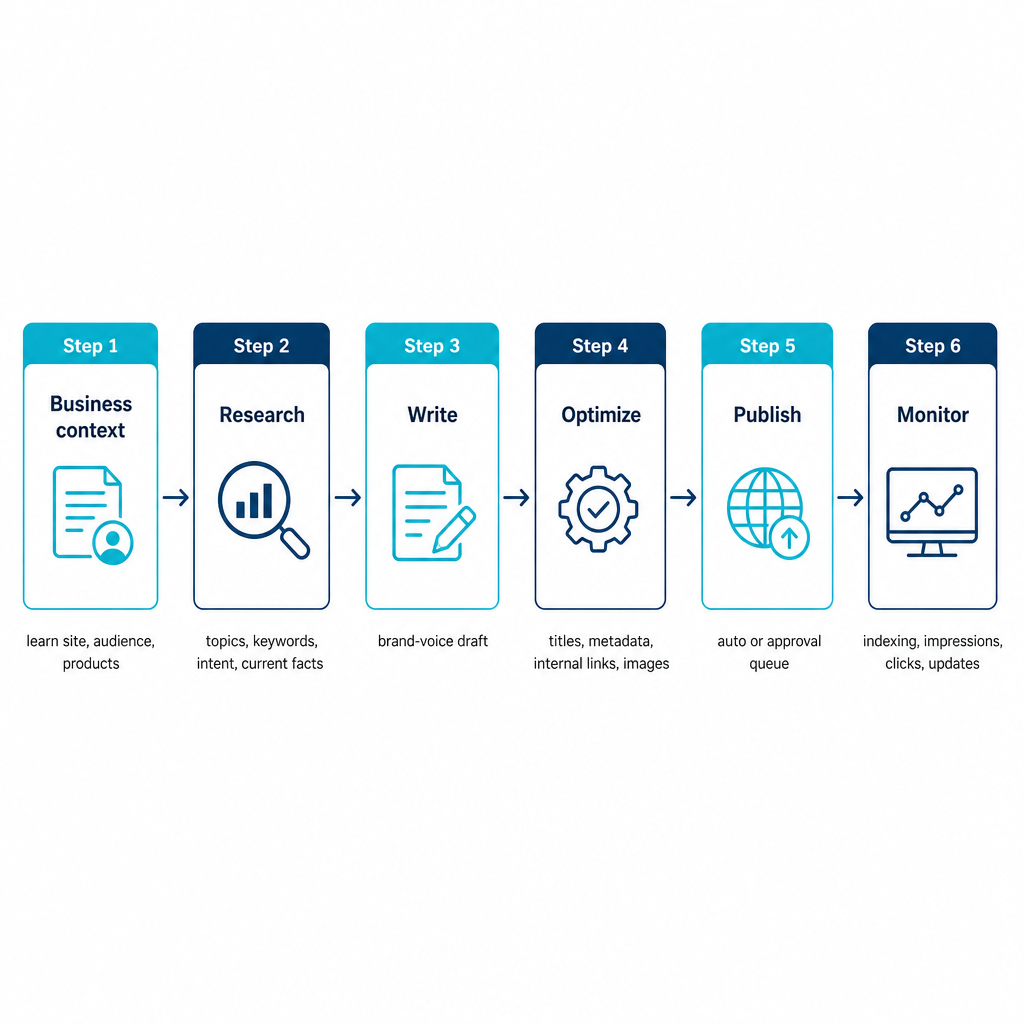
We run this full chain at AymarTech, from keyword research and fact-checked brand-voice writing to on-brand images, internal linking, and delivery across CMS and API options — with automatic or approval-based publishing. We also use Search Console performance data to learn from how published pages actually do. These are workflow capabilities, not promises of rankings or traffic.
What it can automate and what it can’t
The practical boundary is consistent across every stage: automate repeatable execution, keep humans responsible for decisions that touch trust, compliance, and reputation. The table below maps where each falls.
| SEO activity | What automation handles | What still needs human judgment |
|---|---|---|
| Topic research | Discover topics, group queries, surface opportunities | Decide whether a topic supports business goals |
| Keyword selection | Estimate relevance, demand, competition | Set realistic priorities, skip low-value topics |
| Content briefs | Build outlines, assign intent | Add original expertise and differentiators |
| Drafting | Produce a first draft in a chosen tone | Review accuracy, originality, usefulness |
| On-page SEO | Suggest titles, metadata, structure | Confirm the page represents the business truthfully |
| Internal linking | Find related pages, propose links | Cut irrelevant or excessive links |
| Publishing | Send to CMS or approval queue | Approve sensitive claims and final presentation |
| Monitoring | Track indexing and performance | Decide what to improve, merge, or remove |
The column on the right never disappears. It gets smaller and less frequent, but the judgment that protects your brand stays with a person.
Hands-off SEO vs. just generating AI content
These get conflated constantly, and the difference is the whole point. AI-generated content is one component of hands-off SEO — the drafting step. Hands-off SEO is the surrounding program: research, planning, fact-checking, linking, image creation, publishing, indexing support, reporting, and updating.
A generic AI writing tool hands you a draft when prompted and stops there. A hands-off SEO platform manages what happens before and after the draft. That matters because producing text is not the same as operating an SEO program. A draft that never gets published, linked, indexed, measured, or improved is not a search outcome — it is a document. If you want the broader picture of the category, our explainers on what automated content marketing is and how AI SEO automation works go deeper on the mechanics.
Is it safe for Google?
Automation by itself is neither safe nor unsafe. Google’s policy focuses on whether content helps users. It defines scaled content abuse as generating many pages primarily to manipulate rankings rather than help people, and that policy applies no matter how the pages were produced — AI, humans, scraping, or anything else (Google spam policies).
Risk climbs when a site publishes large volumes of near-duplicate pages, rewritten or scraped material, keyword-stuffed thin pages, unsupported claims, or pages built only to capture traffic with no original value. Google also states plainly that using AI gives no special ranking advantage; content still has to be useful, relevant, accurate, and policy-compliant.
The safer model is the opposite of spray-and-pray: fewer, more useful pages that answer real customer questions and add something original. We cover the nuance in detail in does Google penalize AI content, but the short answer is that Google demotes low-value scaled pages, not AI assistance as such.
The risks worth taking seriously
Every risk here has a concrete mitigation, which is why hands-off SEO can work when it is set up deliberately.
Inaccurate information. AI can state wrong facts with full confidence — dangerous for health, finance, legal, safety, and technical topics. Mitigation: fact-check important claims against primary sources and require human review for high-risk subjects.
Generic content. A page can be perfectly optimized and still indistinguishable from a hundred others. Mitigation: add original examples, firsthand detail, product specifics, data, or a clear point of view.
Brand-voice drift. Automated writing can turn repetitive, overly promotional, or off-key over time. Mitigation: keep writing samples, a style guide, and terminology rules current, and review periodically.
Overpublishing. Daily output can build an archive faster than you can review or maintain it. Mitigation: set topic boundaries, use approval queues, and consolidate or remove weak pages.
Bad internal links. Automated linking can produce irrelevant links, repetitive anchors, or links to outdated pages. Mitigation: require topical relevance and periodically audit your most- and least-linked pages.
False confidence from dashboard scores. An “indexed” badge or an “SEO score” is not rankings, qualified traffic, or revenue. Mitigation: judge the system by outcomes — indexed pages, impressions, relevant clicks, leads, sales — not a single number.
Publishing errors. Automation can push the wrong category, broken links, bad metadata, or unfinished drafts. Mitigation: use staging or approval workflows, test integrations, and keep the ability to unpublish or edit fast.
Who it fits, and who should stay hybrid
Hands-off SEO tends to fit small businesses without an in-house content team, SaaS founders who need steady educational content, agencies running multiple content programs, lean marketing teams, and companies with repeatable customer questions — anyone who can review content periodically but cannot produce it daily.
It fits less well when nearly every page demands original reporting, expert interviews, legal sign-off, or deep specialist judgment. For those cases, a hybrid model usually wins: automation handles research, outlining, formatting, and publishing operations, while an expert supplies the insight and approves the final copy. The point is not to remove people — it is to stop spending them on the mechanical parts.
How to decide if it fits you
Before committing to any platform, press it on these questions. Each one exposes whether a tool is a real workflow or just a text generator.
- Can it explain why each topic was chosen? A keyword list is not a strategy; topics should connect to audience needs and business goals.
- Can it show how claims are researched? Look for source visibility, fact-checking controls, and a way to flag uncertain material.
- Can you approve content before it publishes? Essential for regulated, technical, or reputation-sensitive work.
- Does it integrate with your CMS? Confirm exact destinations, permissions, formatting, images, links, and metadata behavior.
- Can it use your brand voice without copying old pages? Voice matching should create original work, not lightly reword existing content.
- Can you measure business outcomes? Check whether content connects to indexing, impressions, qualified visits, leads, and revenue.
- What happens when something is wrong? Ask how corrections, updates, removals, and failed publishes are handled.
We built AymarTech as an end-to-end answer to those questions: automated research, fact-checked brand-voice writing, optimization, internal linking, on-brand images, multilingual output across 150+ languages, and your choice of automatic or approval-based delivery. If you are weighing the category more broadly, tell us your site, industry, and the kinds of topics you need covered, and we can map a realistic plan to how your business actually operates.
Hands-off SEO is not SEO without people. It is SEO with less manual execution and the same human accountability for strategy, accuracy, originality, reputation, and final approval. Done well, it turns organic growth from a scheduling problem into a review habit. Done carelessly, it just produces more pages nobody needed.
Frequently asked questions
Does hands-off SEO guarantee Google rankings?
No. No legitimate SEO system can guarantee rankings. Visibility depends on content quality, relevance, competition, technical accessibility, links, search demand, and more. A platform can improve your odds by publishing useful pages consistently; it cannot promise positions.
Can AI content rank on Google?
Yes, when it is useful, accurate, original, and policy-compliant. Google’s concern is not whether AI was involved but whether pages were scaled primarily to manipulate rankings while adding little value.
Should I auto-publish AI-written articles?
Only for low-risk topics where the system has reliable quality controls and you can correct errors quickly. For legal, medical, financial, safety, or highly technical content, keep expert review before anything goes live.
Is hands-off SEO the same as autopilot SEO?
The terms are used interchangeably. Both describe a workflow where software handles most research, creation, optimization, and publishing. “Hands-off” stresses reduced human effort; “autopilot” stresses the automated workflow itself.
How long does hands-off SEO take to work?
There is no universal timeline. A new site needs time to be crawled, indexed, and evaluated, while an established site may see impressions sooner. Track progress through indexing, impressions, relevant clicks, leads, and conversions rather than expecting instant rankings.