
What Is Autopilot SEO? A Plain-English Guide
If you have heard the phrase and wondered what is autopilot seo in plain terms, here is the short answer: it is an automated system that handles much of the ongoing SEO workflow for you, from spotting content opportunities to researching, writing, optimizing, and publishing pages. Instead of juggling a keyword tool, a writing app, an image generator, a content calendar, and a CMS plugin, you connect your website once and let the system carry out recurring SEO tasks against your goals, your brand voice, and your approval preferences.
That convenience comes with an important boundary, and most confusion about autopilot SEO lives right here: automation handles the work of publishing and improving search-focused content. It does not guarantee rankings, traffic, or citations inside AI answers. A serious system earns its keep by adding research, originality, fact-checking, and useful internal links on top of automation — not by generating a pile of near-identical pages.
Table of contents
- • The decision autopilot SEO actually helps you make
- • How autopilot SEO works, stage by stage
- • What it can automate and what stays yours
- • What autopilot SEO does not mean
- • The real risks and how to contain them
- • How to decide whether it fits your business
- • How we approach autopilot SEO at AymarTech
- • Frequently asked questions
The decision autopilot SEO actually helps you make
The interesting question is not whether SEO can be automated. Much of it can. The sharper question is which tasks you can safely delegate and which decisions still need a human on the hook.
For a small business owner, autopilot SEO can remove the grind of maintaining a consistent publishing schedule. For a SaaS founder, it can turn product knowledge and recurring customer questions into a real content program. For an agency, it can keep production moving across several client sites at once. In every case the software executes; the business still sets priorities, reviews sensitive claims, protects its reputation, and measures whether the traffic it earns is actually qualified.
Hold that framing — execution you can hand off, accountability you cannot — because it explains almost every good and bad outcome that follows.
How autopilot SEO works, stage by stage
Autopilot SEO connects stages that are usually handled by separate tools and separate people. Understanding the chain is the fastest way to judge whether a platform is doing real work or just spinning out text.
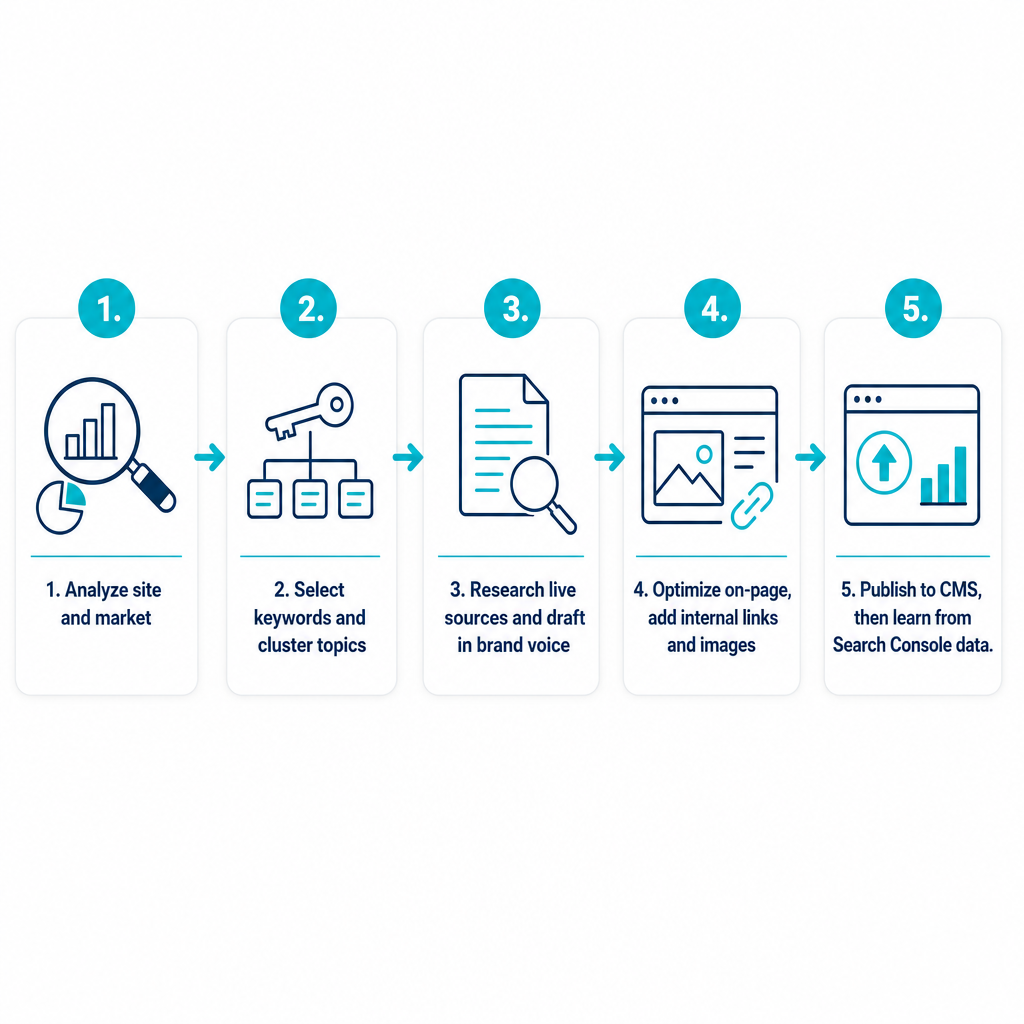
It starts with website and market analysis. The system learns your site, products, and the topics your customers care about, and it may weigh existing content, competitor coverage, search demand, difficulty, intent, content gaps, and your Google Search Console performance. The aim is not to publish on every keyword in existence. A local accounting firm usually gets more value from a focused topic like quarterly estimated taxes for freelancers than from a broad, brutally competitive term like "taxes."
Next comes keyword and topic selection, where related queries get grouped into clusters and ranked by relevance, intent, competition, potential traffic, commercial value, and whether your site already covers the subject. That beats telling a chatbot to "write 50 SEO articles," because each planned piece maps to a real audience need and a business goal.
Then real-time research gathers sources before drafting. This matters because generative models do not retrieve verified facts on their own. Google notes that generative models predict likely sequences of words and can produce inaccuracies, which is exactly why AI-assisted content should be fact-checked and reviewed before it goes live, as explained in Google's guidance on AI-generated content. For anything touching law, medicine, finance, security, or fast-changing products, current source research is not optional.
The writing layer turns research and a brief into a full draft: intro, headings, explanations, examples, tables, FAQs, metadata, image prompts, and calls to action. Brand-voice controls steer tone, terminology, and reading level — a useful constraint, not a replacement for editorial judgment. After that, on-page SEO handles the title, meta description, heading hierarchy, descriptive URLs, alt text, internal links, and structured data where it fits. Google's search documentation stresses making content understandable to people and crawlers and keeping important pages accessible rather than blocked by rules like robots.txt, which you can read in Google's SEO starter guide.
Internal linking then connects each new article to relevant existing pages so readers can keep going and search engines can understand how your pages relate. Links should be placed because they genuinely help, not to inflate a count. Image generation adds on-brand visuals and alt text, which still deserve a glance for wrong product details, misleading claims, rights issues, and accessibility. Finally, CMS publishing sends the finished piece to your site either automatically or into an approval queue, and performance feedback feeds impressions, clicks, rankings, and movements back into future decisions. For a wider view of how these pieces fit a content program, our explainer on how AI SEO automation works walks through the same chain in more depth.
What it can automate and what stays yours
The honest answer is that almost every operational step can be automated, and almost every step still benefits from a human deciding whether the output deserves to exist. The table below separates the two so you can set oversight where it earns its cost.
| SEO activity | Can it be automated? | Human oversight still useful? |
|---|---|---|
| Keyword discovery | Yes | Confirm business relevance |
| Topic clustering | Yes | Prevent overlap and cannibalization |
| Content calendar | Yes | Align with campaigns and priorities |
| First-draft writing | Yes | Review accuracy and originality |
| Brand-voice adaptation | Partly | Check important pages closely |
| Internal-link suggestions | Yes | Verify context and anchor text |
| Image generation | Yes | Check accuracy, rights, accessibility |
| CMS publishing | Yes | Use approval controls when needed |
| Fact-checking assistance | Yes | Verify high-risk or first-party claims |
| SEO strategy | Partly | Prioritization is a business decision |
The dividing line is execution versus accountability. Software can run a publishing workflow all day; the business still owns what appears on its site. That ownership is why volume alone is a weak goal. A platform that produces an article every day is only valuable if each topic is useful, each claim is accurate, and each page gives readers a reason to trust you. If you want the broader context for automating production without losing control, our guide to automated content marketing covers which stages to hand off and which to keep.
What autopilot SEO does not mean
Three promises tend to get attached to autopilot SEO that the technology cannot actually keep. Knowing them protects you from both bad platforms and bad expectations.
It does not mean publish anything AI writes. Google does not ban AI assistance simply because a machine was involved; its concern is whether content provides value and follows Search Essentials and spam policies. It specifically warns that generating many pages without adding value can qualify as scaled content abuse. Purpose and quality are the test, not who pressed publish.
It does not guarantee Google indexing. A platform can submit URLs, support sitemaps, and use other discovery mechanisms, but none of that forces Google to crawl, index, or rank a page. There is also a widely misunderstood limit: Google's documentation states the Indexing API can request crawling only for pages with JobPosting or BroadcastEvent markup embedded in a VideoObject, which you can confirm in Google's get-started documentation. An ordinary blog cannot treat that API as a general indexing guarantee. It helps to keep these outcomes separate in your head — publishing a URL, submitting a discovery signal, Google crawling it, Google indexing it, and the page ranking are five different things.
It does not guarantee AI citations. Pages that rank well may be more discoverable to AI answer systems, but no platform can promise that ChatGPT, Claude, Gemini, or Perplexity will cite a specific page. Citation depends on accessibility, usefulness, clarity, perceived trust, topic match, and whether competing sources look stronger. The sensible goal is to publish pages that are genuinely useful and easy to understand, not to manufacture text aimed only at triggering a citation.
The real risks and how to contain them
Autopilot SEO fails in predictable ways, and each failure has a practical safeguard. Treat this as the control panel you set up before you let anything publish.
- Low-value scaled content. The biggest danger is many pages that differ only superficially. Google identifies large-scale, unoriginal content made mainly to manipulate rankings as scaled content abuse. Safeguard: require every topic to have a clear audience, a purpose, and a reason to exist on your site.
- Factual errors. AI can produce confident but wrong statements, stale figures, or invented sources. Safeguard: use source-based research and manually review anything involving money, health, law, safety, or regulation.
- Brand damage. One public error erodes trust faster than many accurate articles build it. Safeguard: route high-risk subjects through an approval workflow and give the system approved terminology, product facts, and prohibited claims.
- Search cannibalization. Multiple pages chasing nearly identical intent compete with each other. Safeguard: review clusters and consolidate overlap instead of publishing every keyword variant.
- Misplaced internal links. Automated linking can send readers somewhere irrelevant or lean on weak anchor text. Safeguard: check that each link helps the reader and audit important clusters periodically.
- False confidence from SEO scores. A high software score does not prove a page is accurate or likely to rank. Safeguard: treat the score as a diagnostic and measure qualified traffic, leads, and conversions instead.
- Localization problems. Content can be grammatically clean yet culturally off. Safeguard: have a fluent speaker familiar with the market review important pages, covering examples, terminology, offers, and regulations rather than translation alone.
How to decide whether it fits your business
Autopilot SEO tends to fit when you have a clear audience and offering, recurring customer questions worth answering, a site that can support useful educational content, a desire for steady cadence, the ability to define brand and compliance rules, and a realistic way to measure organic traffic and conversions. It fits best when your goal is long-term, compounding growth.
It fits poorly when you have no content strategy, when every sentence needs expert sign-off, when your site has unresolved technical indexing problems, when you expect guaranteed rankings, when you want thousands of pages with almost no oversight, or when organic traffic has no believable path to conversion.
Rather than judging an isolated AI draft, evaluate the whole workflow. A few questions separate a real platform from a text generator: Does it research current sources? Can it preserve the evidence behind important claims? Can it follow a genuine brand voice? Does it support internal links and sensible content organization? Can you approve articles before they publish? What exactly does "indexed" mean in its reporting? Can you export your content if you leave? How are errors corrected after publication? And does it measure business outcomes rather than word count or SEO scores? If you are still building the traffic side of the equation, our piece on how small businesses grow organic traffic grounds those expectations in Google's own guidance.
How we approach autopilot SEO at AymarTech
We built AymarTech to run this full chain rather than a single step. You connect your website, we research topics, write fact-checked articles in your brand voice, add internal links and on-brand images, and publish the finished content automatically or after your approval. Our platform handles keyword research, content generation and optimization, real-time research, fact-checking, AI-generated images, internal linking, localization, and publishing to supported CMS platforms including WordPress, Shopify, Webflow, and Wix. Content can be produced in 150+ languages, and each language still deserves review for cultural accuracy, terminology, and local compliance.
What we deliberately do not claim is magic. These features automate production and distribution; they do not remove editorial review or guarantee rankings, indexing, traffic, or AI citations. That is the honest shape of the category, and it is how we think you should judge any provider — including us. If you want to see the output and the workflow in detail, our examples gallery and our how it works overview show what a connected pipeline actually produces.
Picture a small landscaping company that wants more qualified leads. A good autopilot workflow identifies the questions homeowners actually ask, prioritizes topics tied to the company's services and service area, researches current guidance, drafts in the company's voice, links to relevant service pages, queues the article for approval, publishes it, and then watches impressions, clicks, and inquiries to suggest what to write next. A poor workflow floods the blog with generic "best lawn tips" posts that carry no local insight and give no reader a reason to call. The difference is not automation. It is whether automation is wired to relevance, evidence, and quality control.
Frequently asked questions
Is autopilot SEO the same as AI-generated content?
No. AI-generated content is the material a model produces. Autopilot SEO is the broader workflow around it — keyword research, planning, research, writing, optimization, internal linking, publishing, and measurement.
Is autopilot SEO allowed by Google?
AI assistance is not automatically prohibited. Google expects content to meet its Search Essentials and spam policies and warns that generating many pages without adding user value may qualify as scaled content abuse.
Can autopilot SEO guarantee rankings?
No. Rankings depend on competition, relevance, quality, technical accessibility, authority, intent, and Google's systems. Treat any platform promising guaranteed rankings with caution.
Does Google's Indexing API index ordinary blog posts?
Google's documentation limits the Indexing API to pages with JobPosting or BroadcastEvent markup embedded in a VideoObject. It is not a general indexing guarantee for standard blog articles.
Should every article be reviewed by a person?
Not every low-risk article needs the same scrutiny, but human review is strongly advisable for claims about health, finance, law, safety, regulation, products, pricing, or company-specific facts. Google also recommends manually fact-checking AI-assisted content before publishing.