
How AI SEO Automation Works: A Clear Guide
If you want the short version of how ai seo automation works, here it is: an AI system takes over the entire content pipeline—keyword research, drafting, fact-checking, on-page optimization, publishing, and indexing—and runs it continuously in your brand voice with minimal manual input. Instead of handing you a raw draft to clean up, it ships finished articles to your site on a schedule you set. That single shift, from producing documents to owning the pipeline, is what separates a writing tool from real automation.
Below we break down the actual mechanisms behind that promise, the decision it forces you to make, and how we implement it at AymarTech so you can judge whether it fits your site.
Table of contents
- • What AI SEO automation actually connects
- • The real decision: who owns your content pipeline
- • The mechanisms inside an AI SEO platform
- • Where GEO fits: from rankings to AI citations
- • Decision criteria: is this right for your business
- • How we implement AI SEO automation at AymarTech
- • Frequently asked questions
What AI SEO automation actually connects
Strip away the marketing and AI SEO automation is a bridge between three inputs. First, search demand: what people actually type into Google and, increasingly, into AI assistants. Second, language models that can draft and refine at scale. Third, your website—its CMS, its publishing rules, and its established brand voice.
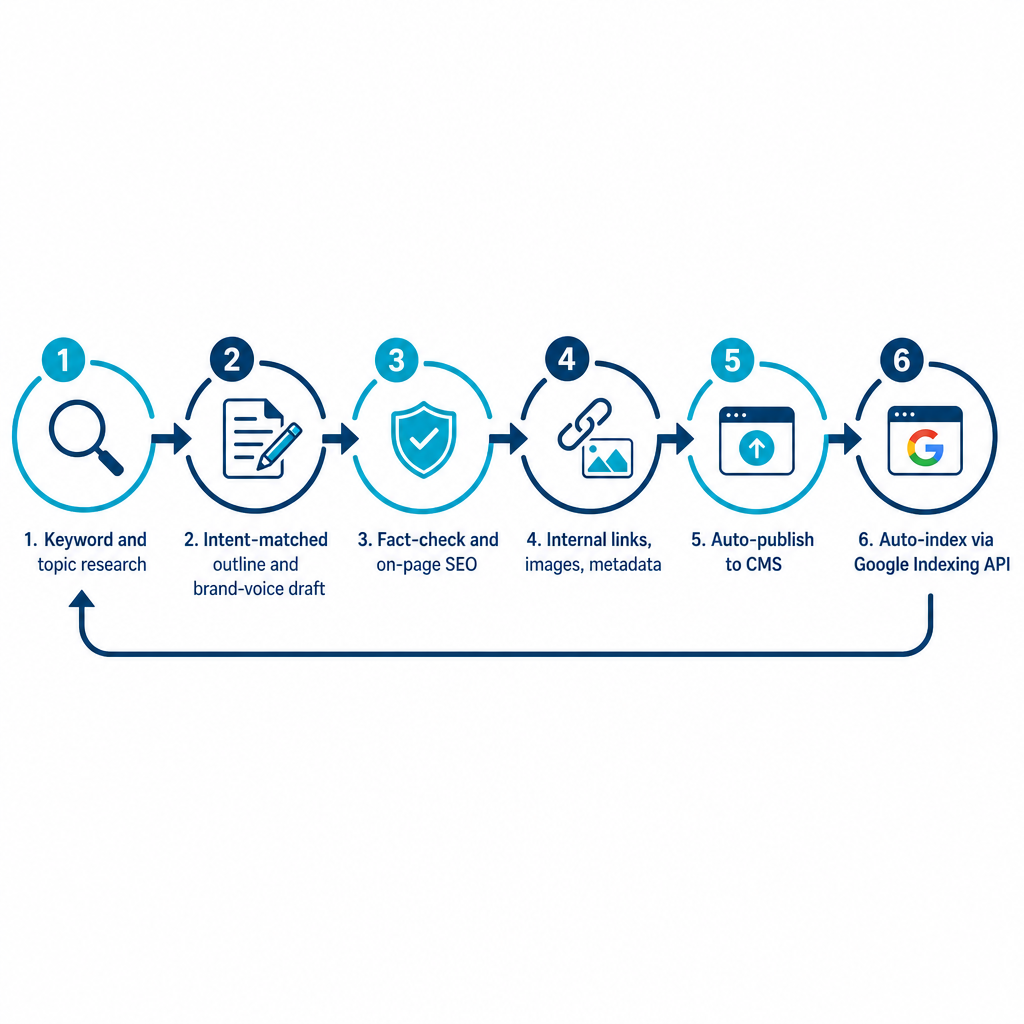
The automation layer is what ties those together into a loop that keeps running. A platform reads real search data, decides what to write, produces an optimized article, links it into your site, publishes it, and tells search engines it exists. Because that loop repeats without you reassembling it each time, the output is a steady stream of pages that are already built to rank rather than a folder of drafts waiting for edits.
That distinction matters. A generic AI writer improves the drafting step and stops. Automation removes the coordination work around every other step, which is usually where content programs stall.
The real decision: who owns your content pipeline
The question most teams ask is "should we use AI?" The more useful question is "who owns the pipeline?" That framing changes what you are actually choosing between.
The traditional route stitches together separate parts: keyword tools, briefs and outlines, freelance writers or an agency, editors and SEO specialists, then manual CMS uploads and indexing. It can produce excellent work, but it is slow, coordination-heavy, and expensive to sustain—especially if you want to publish weekly or daily. Hiring SEO writers commonly runs into tens to hundreds of dollars per article, with multi-day turnaround and a hard ceiling on how much any one person can produce in a month.
AI writing tools sped up drafting but left the rest on your desk. They generate text and then ask you to handle strategy, internal links, images, and publishing yourself. The difference we draw is between a generic AI writer that accelerates one step and an AI SEO platform that automates the full lifecycle from research through indexing.
So the decision comes down to two models:
- A writer or single AI tool that still needs a supporting stack and a person to run the workflow.
- An AI SEO platform that becomes the stack itself—researching, writing, optimizing, and publishing on autopilot.
If predictable cost and a high publishing cadence matter to you, a flat monthly model is far easier to plan around than per-article or per-word pricing that climbs with every piece. We cover that trade-off in more detail in our breakdown of SEO content automation cost per month and in our comparison of an AI SEO writing tool versus hiring a writer.
The mechanisms inside an AI SEO platform
Here is what actually happens under the hood, step by step, when the pipeline runs.
Demand-driven keyword and topic research
Automation starts with structured research, not prompts pulled from thin air. The platform ingests your business profile—industry, products, audience—and uses search data to find low-competition, high-intent keywords, then builds a content calendar around them. For a Shopify store, that means researching keywords tied to the store's niche and product catalog before a single article is drafted. This layer is what attaches every piece to a keyword and intent that Google can understand and reward.
Intent-matched outlines and brand-voice drafting
Once topics are chosen, the system generates outlines that match search intent—an informational guide, a comparison, or a how-to depending on what the query actually wants. Those outlines set the headings, subtopics, and questions the final article needs to cover. We then use language models configured with your brand voice to turn each outline into a full draft, so the tone reads like a continuation of your existing site rather than a generic ghostwriter dropped in.
Fact-checking and on-page optimization
The main operational risk with AI content is accuracy and search suitability, so we layer automated fact-checking and SEO checks on top of every draft. In practice that means:
- Verifying claims against sources to reduce hallucinations.
- Structuring headings and subheadings for crawlability and clarity.
- Placing the primary keyword and related terms naturally in the body, titles, and meta descriptions.
- Adding on-page elements such as alt text and internal anchors where appropriate.
The workflow is deliberately built around both accuracy and optimization rather than treating them as afterthoughts.
Internal linking, images, and metadata
Ranking depends on how an article fits your site, not just the article alone. So internal linking, featured images, and meta tags are handled as part of publishing. We generate internal links to relevant content or product pages to improve crawl paths and topical authority without manual insertion—useful for e-commerce, where new posts can link straight to product pages. On-brand images are created for each article, and metadata like titles, descriptions, and slugs is generated in a search-aware way that matches the target keyword and intent.
Auto-publishing and auto-indexing
This is where "hands-off" becomes real. We publish finished posts directly into your CMS on a schedule—daily if you choose—so no one logs in to upload anything. Then new content is submitted through the Google Indexing API for fast discovery instead of waiting to be crawled. That shortens the gap between "article created" and "article eligible to rank," which compounds when you publish at volume.
Where GEO fits: from rankings to AI citations
Classic SEO aims to land your pages in Google's blue links. Generative Engine Optimization (GEO) aims to get those pages cited inside AI-generated answers. GEO frameworks describe it as structuring your content, entities, and technical setup so generative engines can safely quote and recommend your brand, which shifts the win condition from ranking alone to appearing inside the synthesized response people read.
The same mechanics that support search rankings also feed AI visibility: continuous publishing of fact-checked content, strong internal linking, and fast indexing give AI systems a richer, better-structured corpus to draw from. Our articles are built to both rank on Google and be visible to assistants like ChatGPT, Claude, Perplexity, and Gemini. For a fuller treatment, see our explainer on what generative engine optimization is. The practical takeaway is that automation increasingly competes for citation share in AI answers, not just clicks from a results page.
Decision criteria: is this right for your business
Automation is not automatically the right call for every site. These are the criteria that actually decide it.
| Criterion | Automation fits well when | Add human review when |
|---|---|---|
| Content volume | You want weekly or daily publishing at a cadence a small team cannot sustain | Output needs are occasional and highly bespoke |
| Cost model | You prefer a flat monthly fee over per-article pricing | You need one-off flagship assets |
| Topic risk | Topics are informational and non-regulated | Topics are medical, legal, or financial advice |
| CMS stack | You run WordPress, Shopify, Wix, Webflow, or Notion | You use a locked-down custom CMS without API access |
| Brand governance | The system can learn and hold your voice | You require sign-off before every publish |
On cost, subscription automation typically charges a flat monthly fee that stays stable as output grows. Our pricing is a single flat subscription—currently $99 per month including tax—structured to be predictable for small businesses and startups. If you currently pay per article, per brief, or on an agency retainer, comparing that spend to a flat fee usually clarifies your real cost per published piece.
On risk, automation is strongest for informational, non-regulated content where accuracy, clarity, and search alignment are the main requirements. For highly sensitive domains, a hybrid pattern works better: use automation for scalable, low-risk content like FAQs, how-tos, and product education, and keep human experts in the loop for compliance-heavy pages. Many teams start in a review-then-publish configuration and move to full autopilot once they trust the outputs.
How we implement AI SEO automation at AymarTech
For the people we serve—small business owners, SaaS and startup founders, and marketing teams—the goal is to act as an AI-powered SEO department rather than a single tool. Our documented workflow runs like this:
- Connect your site and define your niche, audience, and brand voice.
- Generate a keyword calendar focused on low-competition, high-intent topics.
- Produce fact-checked, brand-voice articles with on-page SEO built in.
- Add internal links, featured images, and metadata aligned with your goals.
- Publish directly to WordPress, Shopify, Webflow, Wix, Notion, or via API and webhooks.
- Auto-index new content through the Google Indexing API to accelerate visibility.
- Operate across more than 120 languages so international sites can grow in several markets from one system.
On a standard plan the system supports a daily publishing cadence and up to roughly 30 articles per month, which suits aggressive but controlled content strategies. If your growth depends on a steady stream of articles against a structured keyword calendar, that cadence is the point. Smaller brands still benefit from the consistency, even at lower volume. If you want to see whether the fit is right for your stack and topics, tell us your CMS, niche, and target markets and we will map a realistic starting cadence.
Frequently asked questions
What does AI SEO automation mean for my site day to day?
Your site receives new, search-optimized blog posts on a set schedule—researched, written, fact-checked, internally linked, and published by the platform—without you writing briefs or logging into the CMS each time.
How is this different from a generic AI writing tool?
A generic AI writer produces text and stops, leaving keyword research, optimization, internal linking, images, and publishing to you. We automate the full content lifecycle and hand you indexed pages instead of drafts.
What CMS platforms does AymarTech support?
We connect to WordPress.org, WordPress.com, Shopify, Wix, Webflow, and Notion, and can deliver articles via API or webhook, which covers most modern sites and e-commerce stores.
How much does automated SEO content cost?
Our pricing is a flat subscription currently quoted at $99 per month including tax, structured to cover end-to-end automation rather than charging per article.
Will AI-generated content be accurate enough for my brand?
Our workflow includes fact-checking and search-aligned optimization to reduce typical AI risks, but highly regulated or expert-sensitive topics still benefit from a layer of human review on top of the automated pipeline.