
What Is Generative Engine Optimization (GEO)?
Generative engine optimization, or GEO, is the practice of structuring your content and brand signals so AI search and answer engines like ChatGPT, Google AI Overviews, Perplexity, Claude, and Gemini can find, understand, and cite you inside the answers they generate. If classic SEO was about ranking in a list of blue links, GEO is about being quoted directly inside a synthesized response. That shift changes what "visible" means: your buyers increasingly read one AI-written answer instead of scanning ten results, and the brands named in that answer win the attention.
For small businesses, SaaS founders, and marketing teams, the practical question isn't just the definition. It's whether GEO deserves deliberate effort right now, how these engines actually decide who to quote, and how to build a content footprint that earns those citations without a full in-house SEO team.
Table of contents
- • The strategic decision: is GEO worth your focus right now?
- • How GEO works under the hood
- • How organizations typically approach GEO
- • When GEO deserves a dedicated strategy
- • Risks and limitations worth knowing
- • How we operationalize GEO for your business
- • Frequently asked questions
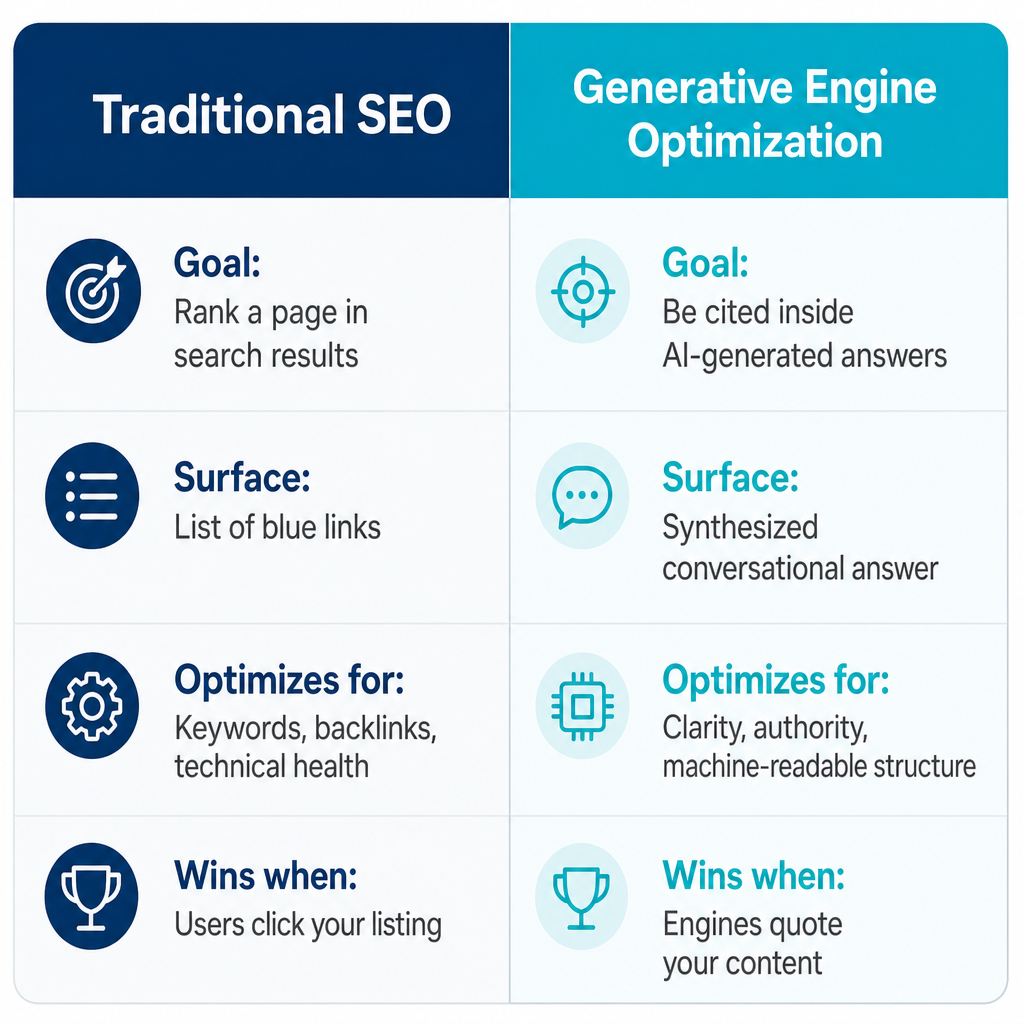
At its core, GEO makes your content readable, meaningful, and trustworthy to the large language models and AI-driven search systems that generate answers instead of returning links. These systems retrieve information, summarize it, and produce conversational, context-rich responses. GEO aligns your content with how they discover, weigh, and present information, so your brand shows up inside the output, not just around it.
The strategic decision: is GEO worth your focus right now?
Generative engines already influence how people find products, compare solutions, and learn about problems. Google's AI Overviews, ChatGPT's browsing, Perplexity, and Gemini surface synthesized answers where links and citations are secondary to the summary itself. That reframes the decision in two directions.
If your growth relies on organic discovery and content marketing, GEO is no longer optional; it's part of staying visible where your buyers actually search. And if you publish infrequently or treat SEO as a one-off project, your brand is more likely to be summarized by others, using other people's framing of what you do.
GEO moves from "someday" to "now" when a few things are true at once: your audience is already using AI assistants in their research workflows, you want your own perspective and proof to be the information these engines rely on, and you have (or can automate) a steady pipeline of original content to serve as that source material. For many US B2B SaaS and service businesses, all three already apply. The cost of waiting isn't zero traffic today; it's ceding the narrative inside answers that buyers increasingly trust. If you're still weighing the broader category, our explainer on what an AI SEO platform actually does is a useful companion to this decision.
How GEO works under the hood
Understanding GEO starts with how generative engines actually treat your pages. The lifecycle runs through roughly four stages, and GEO is about influencing each one so your content is discoverable, interpretable, and preferable when an engine chooses what to include.
- Discovery and crawling: AI systems find your content through web crawling, APIs, or data feeds. If they can't reach it, nothing else matters.
- Understanding and representation: Content is parsed, chunked, and encoded into representations that capture meaning, entities, and relationships.
- Selection and scoring: When a user asks a question, the engine retrieves relevant chunks and weighs them by relevance, authority, freshness, and consistency to decide which sources to trust.
- Answer generation and citation: The model synthesizes a response, often with inline citations to the sources it used.
Content structure and clarity
Generative engines perform best with content that maps cleanly to questions. That means clear headings and subheadings tied to specific topics, concise direct answers near the top of a page followed by structured detail, and scannable paragraphs and bullets that make relevant chunks easy to extract. Guides that explicitly define a concept, explain its mechanism, and outline decision criteria are especially easy for AI systems to reuse, which is why strong GEO content tends to be highly structured while still reading naturally. Our primer on SEO writing fundamentals covers the underlying craft that makes this possible.
Technical accessibility and structured data
Google's own guidance for AI features stresses that the technical foundations of SEO still matter: clean site architecture and crawlable pages, fast mobile-friendly experiences, and standard signals like titles, meta descriptions, and schema markup that clarify entities, products, and reviews. Notably, Google warns against gimmicky GEO "hacks" such as artificially chunking content or publishing AI-only text files like llms.txt instead of focusing on solid technical SEO and helpful content. Generative engines still need a technically sound site to discover, index, and reuse your information consistently.
Brand presence and off-site signals
Engines don't rely on your website alone. They synthesize signals from other reputable sites that mention or review your brand, authoritative articles and reference pages about your category, and structured data from business listings and knowledge graphs. GEO therefore also depends on brand-level authority: being present where engines look for credible sources, and keeping information about your products, pricing, and value consistent. When multiple sources agree on the key facts, engines cite you more confidently.
Measurement and feedback loops
Measurement is still maturing. Google Search Console's Generative AI performance report offers insight into how content appears in AI search experiences, and other engines expose referral or citation signals through dashboards and logs, though standards are still emerging. Because AI answers compress multiple sources into one response, GEO measurement leans on whether your content is cited, how often engines mention your brand in relevant queries, and how AI-driven traffic correlates with your content strategy. Research on GEO from 2023 through 2026 points the same way: durable gains come from consistent, high-quality publishing plus technical and brand foundations, not short-lived tactics.
How organizations typically approach GEO
In practice, teams land in one of three modes, each with a different cost and control profile.
| Approach | What it looks like | Best fit |
|---|---|---|
| Incidental GEO | Content made for humans and classic SEO, with light AI consideration | Brands already publishing authoritative, structured content at scale |
| Manual GEO program | Content deliberately designed for citation, coordinating SEO, content, PR, and data | Teams with dedicated bandwidth and cross-functional resources |
| Operationalized via a platform | Research, writing, optimization, publishing, and indexing run as an ongoing operation | Small teams that need GEO outcomes without a full content org |
Incidental GEO works when you already have depth and structure, but it leaves citations largely to chance. Manual programs give the most control and can be highly effective, yet they're time-intensive and operationally complex to sustain. The operational route treats content as a continuous process so GEO becomes an outcome of the workflow rather than a separate project.
We sit in that third category: an AI-powered SEO platform that researches low-competition keywords, writes fact-checked articles in your brand voice, adds internal links and images, publishes to your CMS, and auto-indexes via the Google API so content can rank and be surfaced by AI engines. That model is especially useful for small teams that want GEO benefits but can't staff a full in-house content and SEO operation.
When GEO deserves a dedicated strategy
GEO earns dedicated attention when several conditions line up, not just because it's the term of the moment.
- Search is a primary acquisition channel. If most pipeline, demos, or inquiries originate from search or content, GEO directly protects and extends that growth.
- Your buyers use AI tools during research. Many B2B buyers now ask ChatGPT, Perplexity, or Gemini to summarize options and evaluate vendors. Being absent from those answers is a real visibility gap.
- You can sustain consistent, high-quality publishing. GEO rewards brands that appear across many queries with original, helpful content, not just a handful of cornerstone pages.
- You operate in a competitive or noisy category. In saturated markets, engines may default to larger incumbents unless you deliberately build a citation-worthy footprint.
- You care about narrative control. GEO lets you influence how engines describe your product, pricing, and differentiation instead of leaving that story to third parties.
When those conditions hold but you lack bandwidth for a manual program, an AI SEO platform that automates research, writing, fact-checking, internal linking, publishing, and indexing can make GEO achievable without expanding headcount.
Risks and limitations worth knowing
GEO is a young discipline, and the fastest way to waste effort is to treat it as a bag of tricks.
Chasing shortcuts over fundamentals. Google's guidance explicitly warns against AEO/GEO hacks like aggressive chunking, AI-only text files, or inauthentic mentions, recommending proven SEO practices and people-first content instead. Over-optimizing for speculative engine behavior tends to produce bloated, thin sites and wasted work.
Optimizing for machines over humans. GEO should improve how AI interprets genuinely helpful content, not push you to write for models at the reader's expense. Engines ultimately reward content that solves real problems, backed by expertise and clear explanation, so a human-first editorial standard stays essential.
Hallucinations and misrepresentation. LLMs can misstate facts even while citing reputable sources. If your brand footprint is sparse or ambiguous, engines are more likely to fill gaps with generic or incorrect information. Clear, consistent, redundant signals about who you are and who you serve reduce that risk.
Measurement uncertainty. Because answers blend multiple sources, attribution is messier than classic search referrals. Teams need to combine citation tracking, branded query monitoring, and downstream metrics like trials and revenue to gauge impact. That complexity is normal in a transitioning ecosystem.
Regulated sectors. In finance, health, and legal contexts, GEO must be paired with compliance oversight, since engines may compress nuanced disclaimers. Publishing clear, authoritative content and monitoring how AI systems represent your guidance becomes part of the job.
How we operationalize GEO for your business
We built AymarTech to treat content as an ongoing operation rather than a set of one-off articles. The platform connects to your site, researches low-competition keywords, writes original posts in your brand voice, fact-checks them, generates on-brand images, adds internal links, and publishes directly to CMS platforms like WordPress, Shopify, Webflow, and Wix on the schedule you set.
For GEO specifically, a few parts of that pipeline do the heavy lifting:
- Consistent, structured publishing. Frequent articles built around clear questions and direct answers create a deep footprint that engines can discover and reuse.
- Technical and on-page optimization. Titles, headings, metadata, and internal links are handled inside the workflow, making content easier for crawlers and generative engines to navigate.
- Fact-checked, citation-worthy content. Because articles are researched and fact-checked before publishing, they're more likely to be treated as reliable and reused in answers.
- Auto-indexing via Google's API. Automatic indexing speeds the discovery stage so new content can appear in search and AI experiences sooner.
- Brand voice continuity. GEO matters more when engines describe your product in language that matches how you talk about it, which our brand-voice controls support.
If you want organic traffic and AI visibility without hiring writers or juggling separate SEO tools, this is how the abstract idea of GEO turns into a concrete, daily operation. You can see live examples of published output to judge the quality for your own category.
Frequently asked questions
What is generative engine optimization in one sentence?
It's the practice of structuring your content and brand signals so AI search and answer engines can easily find, understand, and cite you in their responses.
How is GEO different from traditional SEO?
SEO focuses on ranking links in search results, while GEO focuses on appearing inside AI-generated answers by making your content readable, authoritative, and accessible to LLM-based systems.
Do small local businesses really need GEO?
Small and local businesses that rely on search for discovery increasingly show up in AI summaries and recommendation lists. GEO helps ensure those summaries carry accurate, up-to-date information about your services.
Which platforms does GEO target today?
GEO typically targets Google AI Overviews, ChatGPT with browsing, Perplexity, Gemini, Copilot, and other AI assistants that use LLMs to answer queries.
Is GEO just a buzzword or will it last?
Academic and industry analyses from 2023 through 2026 describe GEO as an ongoing evolution of SEO driven by the shift from link-based results to synthesized answers, not a short-term fad.
What's the biggest mistake teams make with GEO?
Chasing speculative hacks like excessive chunking or AI-only files instead of investing in helpful, people-first content and solid technical SEO, which major search providers explicitly recommend against gaming.