
How to Appear in Perplexity AI Answers
If you want to know how to appear in Perplexity answers, the honest starting point is this: you can't force a citation, but you can build a site Perplexity can access, understand, trust, and reuse when it answers a question you're relevant to. Perplexity is an answer engine. It searches the live web, generates a response, and attaches linked sources. Showing up means one of your pages was selected to support a specific question — not that you "ranked number one" in the old sense. The single most important technical lever is letting Perplexity's search crawler reach your pages. Everything else is about being genuinely useful and verifiable once it gets there.
Table of contents
- • What appearing in a Perplexity answer actually means
- • How Perplexity finds and fetches your pages
- • The technical floor you have to clear
- • What makes a page easy to cite
- • Does schema or a Perplexity ranking shortcut exist?
- • How to measure whether it's working
- • Mistakes that quietly cut your chances
- • A decision framework for where to spend effort
- • Frequently asked questions
What appearing in a Perplexity answer actually means
Appearing in a Perplexity answer usually means Perplexity picked one of your pages as a source for a particular query. That shows up in more than one shape: a citation beneath the answer, a linked source in a research response, a brand mention inside a generated summary, a recommendation for a product or service, or a page used to verify a single fact.
This is a different game from traditional rankings. A page can be the perfect source for one question and irrelevant to the next. It can be cited without ranking first on conventional search results, and it can rank well yet never get pulled into an answer. So the question to optimize around isn't "How do I rank number one?" It's narrower and more useful: can Perplexity reliably discover, interpret, and use my page when it answers a question my business is actually relevant to?
That reframing matters because it changes what you build. You're not submitting a brand to a directory. You're producing pages that work well as evidence for a real person's research.
How Perplexity finds and fetches your pages
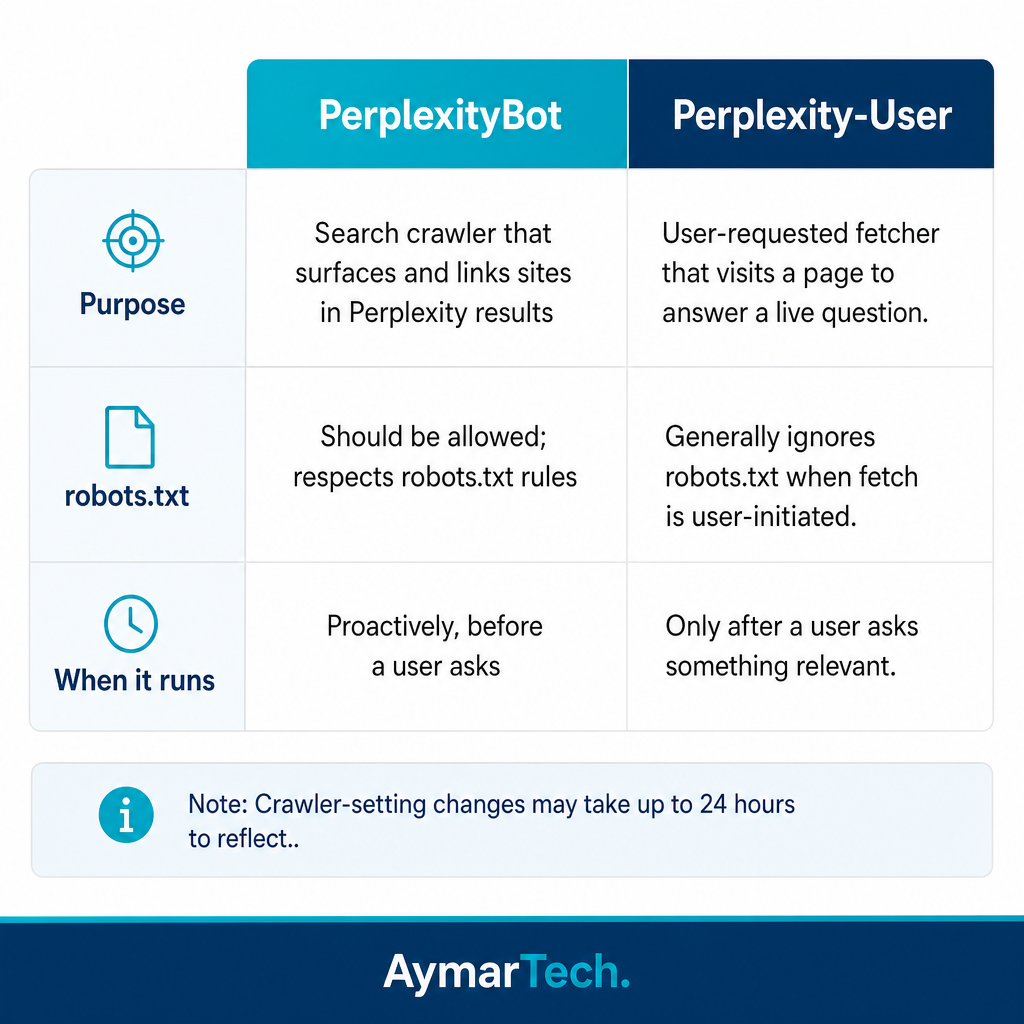
Perplexity's public crawler documentation names two user agents that behave very differently, and knowing the split keeps you from accidentally shutting the door.
PerplexityBot is the search crawler built to surface and link websites in Perplexity search results. Perplexity recommends allowing it in robots.txt and permitting requests from its published IP ranges. This is the crawler you want reaching your pages before anyone asks a question, because it's how your content becomes discoverable in the first place. Worth noting: Perplexity states that changes to crawler settings may take up to 24 hours to reflect in its systems, so don't judge a robots.txt fix within the hour.
Perplexity-User is different. It supports user-requested page access — when someone asks Perplexity a question, this fetcher may visit a page to help produce an accurate answer and link to it. Perplexity says this fetcher generally ignores robots.txt rules when the fetch is triggered by a user request. That sounds reassuring, but it's not a strategy. Relying on user-requested fetching alone means your page only gets a look after a user already named something close to it. Regular crawling by PerplexityBot gives you a shot at being surfaced proactively.
The technical floor you have to clear
None of the content advice later in this guide matters if a crawler can't load the page or the server hands back an error. Clear the floor first.
Start with access. Confirm your robots.txt doesn't block PerplexityBot. A permissive rule looks like this:
User-agent: PerplexityBot
Allow: /
Don't paste that into a live site without reading the rest of the file, because a more restrictive rule elsewhere can override it. Then check the layer above robots.txt: firewalls, bot-management systems, CDNs, and WAFs routinely reject legitimate crawler requests. Perplexity recommends combining the user-agent string with its current published IP ranges, and its documentation warns those ranges can change — so treat the official IP endpoint as the source of truth, not a copied list that goes stale.
Accessibility is the next gate. A page can't be cited if Perplexity can't reach the content. Important pages shouldn't sit behind a login, a paywall, a required form submission, a region block, an aggressive security challenge, or client-side logic that hides the main text. Public pages aren't automatically chosen, but gated ones have far fewer chances to be found.
Then confirm the page simply works. For each important URL, look for a clean HTTP 200, no accidental noindex, no broken canonical, no redirect chains, no server errors, and no blocked CSS or JavaScript that the article needs to render. Google's official technical guidance leans on the same foundation: a crawler must not be blocked, the page must work, and it must contain indexable content. Meeting those conditions doesn't guarantee visibility, but failing any one of them can quietly make a page ineligible.
Finally, connect pages with ordinary HTML internal links and descriptive anchor text. A local SEO page that links to a Google Business Profile guide, a citations explainer, and a relevant service page gives crawlers a clearer map and a path to supporting content. Internal links don't buy citations; they build the structure that makes your evidence findable.
What makes a page easy to cite
Perplexity doesn't publish a "citation formula," so the reliable play is to write pages that perform well as sources for human research. A few characteristics do the heavy lifting.
Answer one specific question. A title like "Marketing Tips" is hard to interpret; "How much does local SEO cost for a small business?" signals a precise need. Then put the answer near the top. For an informational page, lead with a concise answer, name the conditions or exceptions, explain the reasoning, show the evidence, and close with the practical implication. That order also produces clean passages that can be summarized or quoted accurately.
Make claims precise enough to verify. Compare "AI content improves SEO" with "AI-assisted content can support an SEO program when the published pages are original, useful, technically accessible, and reviewed for accuracy." The second defines the conditions instead of implying an automatic outcome. Where you can, anchor statements to dates, locations, definitions, methodology, sample sizes, product versions, pricing periods, and data sources.
Show first-hand knowledge. A page earns trust when it adds something a generic rewrite can't: original research, a documented test, customer observations, a process you actually ran, a comparison with disclosed criteria, or an industry-specific example. Google recommends creating helpful, reliable, people-first content and emphasizes that unique, useful information is likely to influence visibility in generative search.
Support the claims that carry risk. Statistics, legal or regulatory statements, medical and financial information, product specs, pricing, and performance claims should link to a primary source wherever possible. A page that separates fact, interpretation, and opinion is easier to trust than one that states everything with equal certainty. And keep it current — Perplexity searches the live web, so review pages when prices, features, regulations, or platform requirements change, and only update a visible date when the update is real.
One more thing small businesses often miss: product pages alone rarely earn broad citations. A product page explains what you sell. The questions people ask before they're ready to buy — which option fits my situation, what should I budget, what mistakes should I avoid — are answered by category guides, honest comparisons, and problem-solving content. Those broader pages create the matches that lead to brand discovery without turning every paragraph into a pitch.
Does schema or a Perplexity ranking shortcut exist?
There's a persistent hope that a special "Perplexity schema" or a guaranteed Google ranking unlocks citations. Neither holds up.
No evidence supports a dedicated schema that forces inclusion. Structured data helps search systems interpret a page, but it doesn't replace visible, useful content. Google states there are no additional technical requirements or special schema.org markup needed for its AI features, and that meeting requirements still doesn't guarantee crawling, indexing, or serving. Use conventional markup — Article, Product, Organization, LocalBusiness — only when it accurately describes what's actually on the page. Marking up information that isn't visible is a risk, not a shortcut.
As for Google, optimizing there first is sound for most businesses, as long as "Google first" doesn't become "Google only." Answer engines lean on discoverable web content, and strong fundamentals make your pages findable, crawlable, indexable, organized, and relevant across systems. Google's AI-search guidance points to the same basics: meet technical requirements, follow search policies, and create helpful, people-first content, with no special AI file or markup required. But a Google ranking doesn't entitle you to a Perplexity citation. Perplexity makes its own retrieval and citation decisions. A healthy, useful site just gives you a stronger foundation in both places.
If you want the parallel playbook for a different answer engine, our guide on how to appear in ChatGPT answers covers the same discoverability logic for a different system, and our explainer on best practices for AI-citable content goes deeper on the page-level craft.
How to measure whether it's working
There's no single dashboard that captures every Perplexity citation, so combine signals instead of trusting one.
Test manually. Ask Perplexity questions that genuinely relate to your business — informational, local, comparison, problem-based, product-category, and branded variations. For each test, log the exact prompt, the date, whether your brand appeared, which URL was cited, which other sources showed up, and whether the answer changed on a second attempt. AI answers vary, so one run is never conclusive.
Watch referral analytics. Look for traffic from Perplexity domains in analytics and server logs, and track sessions, landing pages, engagement, conversions, and new-versus-returning visitors. Referral volume can stay small even when a page is cited, because a citation can build awareness without producing an immediate click.
Read your server logs. Logs reveal whether PerplexityBot is actually reaching your site. Match the documented user-agent string against the current official IP ranges — don't trust the user-agent string alone, since it can be spoofed.
Then compare cited pages with uncited ones over time. Which topics attract citations, which pages get pulled repeatedly, whether pages with original data outperform rewrites, and whether recent or better-linked pages get more attention. Those patterns tell you how to improve the system rather than chasing a single prompt.
Mistakes that quietly cut your chances
The common failures aren't dramatic. They're the kind that look fine until you check the logs.
Blocking every AI crawler is the big one. Shutting out all AI-related traffic to limit training access can also remove your search visibility, because Perplexity distinguishes its search crawler from its foundation-model crawler. Review the user-agent rules before you block broadly. Closely related is assuming indexing equals citation — indexing only makes a page eligible for discovery; it doesn't make it relevant to every question.
On the content side, publishing generic AI text at scale doesn't manufacture authority. Large volumes of repetitive, interchangeable, or inaccurate pages erode trust and create quality risk. Hiding the answer behind a long sales pitch does similar damage by making readers hunt for what they came for; answer the question first, then explain how you help. Unsupported statistics are another credibility leak — a precise-looking number without a source should be sourced, qualified, or removed. And leaning on schema can't rescue content that's thin, inaccessible, or misleading.
The quietest mistake is promising guaranteed AI mentions. No responsible service can guarantee Perplexity will cite a specific page for a specific prompt. Treat AI visibility as an outcome you measure, not an entitlement you buy.
A decision framework for where to spend effort
When you're not sure what to fix next, match your situation to the priority that actually moves it.
| Situation | Best priority |
|---|---|
| Perplexity can't access the site | Review robots.txt, WAF, DNS, status codes, and server logs |
| Pages are accessible but rarely cited | Improve relevance, specificity, evidence, and structure |
| Brand appears only for branded searches | Publish helpful category, comparison, and problem-solving content |
| Pages are cited but get no visits | Sharpen titles, intros, and landing-page relevance |
| Content is accurate but outdated | Add a maintenance process and update key facts |
| Many pages are nearly identical | Consolidate overlap and add original value |
| Publishing is inconsistent | Build a sustainable editorial calendar |
| The team lacks time to research and maintain | Consider an assisted workflow with human review |
The last two rows are where an automated content workflow earns its place. Our team built AymarTech for exactly that gap: we research topics, write and fact-check articles, apply SEO optimization, add internal links, create on-brand images, and publish to platforms including WordPress, Shopify, Webflow, Wix, and Notion. We support content in more than 150 languages and can publish automatically, route articles for approval, or deliver them through an API or webhook. Our public pricing describes a $99-per-month plan, a two-day two-article trial, and a three-day money-back guarantee after the first paid charge — details worth confirming on the live site before you commit.
For Perplexity specifically, we don't promise a citation, because no one honestly can. The connection is operational: real-time research helps keep pages current, fact-checking reduces unsupported claims, internal linking improves discovery, consistent publishing expands topical coverage, CMS integrations cut publishing friction, and approval workflows preserve human oversight. If you'd rather understand the model before the mechanics, our explainer on what autopilot SEO actually is lays it out in plain English.
Frequently asked questions
How long does it take to appear in Perplexity answers?
There's no fixed timetable. Perplexity says crawler-setting changes may take up to 24 hours to reflect, but actual citation visibility depends on discovery, relevance, content quality, query demand, and Perplexity's retrieval decisions.
Do I need to submit my website to Perplexity?
Perplexity's crawler documentation emphasizes allowing PerplexityBot and permitting its requests. It doesn't describe a general submission process that guarantees citations, so the practical move is to make your pages accessible and useful rather than to "submit" them.
Does Perplexity only cite high-ranking Google pages?
No. Google visibility can help discovery and authority, but Perplexity selects its own sources per query. A page should be genuinely useful and relevant to the question, not merely optimized for a ranking position.
Is there special schema that guarantees Perplexity inclusion?
There's no verified Perplexity-specific schema that forces inclusion. Use accurate, conventional structured data where it matches visible content, but prioritize accessible, useful pages.
Can AI-written content appear in Perplexity?
Yes, if it's accessible, relevant, accurate, and useful. The production method alone neither guarantees nor prevents visibility. Human review still matters for factual claims, original insights, regulated topics, and brand accuracy.
Can anyone guarantee Perplexity citations?
No. We can improve research, fact-checking, SEO, internal linking, and publishing consistency, but a specific citation, mention, ranking, or traffic level should never be treated as guaranteed.