
Best Practices for AI-Citable Content
AI-citable content is not a secret format or a lever you pull to get named inside a ChatGPT answer. It is useful, accessible, clearly presented information that systems can discover and interpret — and that readers can verify for themselves. If you are hunting for best practices for ai citable content, the honest version is unglamorous: audit one page that matters, fix the barriers that stop it from being found and trusted, then measure what actually changes.
We select the practices below by three rules. Each one addresses a real retrieval or trust barrier, each one can be applied to a page you already have, and none of them depends on a promised citation outcome. No practice here ends with "and then the AI will cite you," because no reputable source promises that. What they do is remove the reasons a system might skip you.
Table of contents
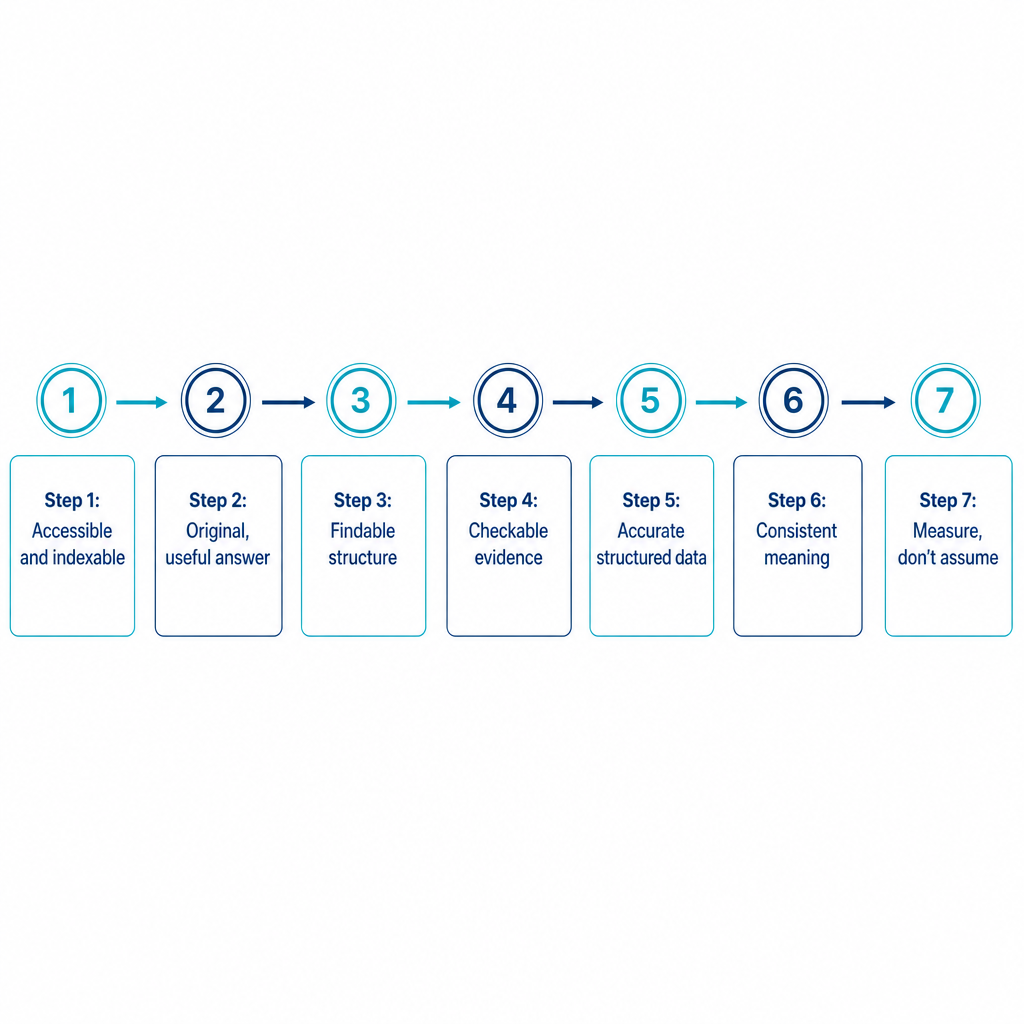
- • Make the page accessible and eligible for search
- • Answer a specific question with original, useful information
- • Put the answer where readers can find it
- • Support important claims with checkable evidence
- • Use structured data only when it matches visible content
- • Keep the page's meaning consistent across its elements
- • Measure visibility without treating citations as guaranteed
- • How to choose what to improve first
- • Frequently asked questions
Make the page accessible and eligible for search
Before you touch a single sentence, confirm that search systems can reach the page at all. This is the barrier people skip, and it quietly sinks everything downstream. Google states that a page needs to be indexed and eligible to appear with a snippet in Google Search to be eligible as a supporting link in AI Overviews or AI Mode, and it cautions that meeting the requirements does not guarantee crawling, indexing, or serving.
This practice fits new pages, recently migrated URLs, pages that have mysteriously vanished from results, and anything sitting behind technical controls. The check is concrete: confirm the page returns a successful response, carries indexable content, and is not unintentionally blocked by robots.txt, a noindex directive, or a login wall. Search Console's URL Inspection tool shows how Google actually reads the page, which is often different from how you assume it reads. Google's own AI features guidance and its advice on succeeding in AI search both put technical eligibility for Search before any AI-specific ambition.
The limit is worth saying plainly: eligibility is a prerequisite, not a citation strategy. A perfectly crawlable page can still be overlooked, and indexing is never guaranteed. Clearing this gate just means you are allowed to compete.
Answer a specific question with original, useful information
A page earns attention by giving readers something they cannot get from a generic summary repeated across fifty other sites. Google's guidance recommends creating unique, non-commodity content that is genuinely helpful and satisfying to readers — which is a polite way of saying rehashed boilerplate does not advance your cause.
This matters most for how-to guides, comparisons, industry explainers, and pages built around real customer questions. The method is to name the exact question the page answers, then back the answer with something that supports it: an original process, a worked example, a first-party finding, a decision rule, or a clearly explained limitation. Instead of writing "review your content for accuracy," show how a small business could check a product claim against its current documentation and record the date it was checked. The second version is usable; the first is filler.
Original does not mean novelty for its own sake. An unsupported opinion or an invented statistic weakens a page rather than strengthening it. Keep every claim proportionate to the evidence behind it, and say openly when an answer depends on context.
Put the answer where readers can find it
Clear organization helps people scan and helps systems interpret how each section relates to the main topic. The tools are unexciting and effective: a descriptive title, informative headings, and short sections that each resolve one sub-question. This is the practice that pays off on long guides, multi-step pages, and content answering several related queries at once.
Lead each section with its direct answer, then add the context, steps, or examples underneath. Use ordered lists for processes and tables when readers need to compare the same attributes across options. Make headings describe the job — "Check whether the page is indexable" tells the reader more than "Technical tips," and it tells a retrieval system more too.
Formatting is not a stand-in for substance. A page can be beautifully scannable and still be too generic, inaccurate, or incomplete. Structure the information for the reader first; the machine-readability follows from that, not the other way around.
Support important claims with checkable evidence
Evidence gives a reader a way to assess a claim instead of taking it on faith — and that verifiability is exactly what a trust-sensitive system is scanning for. Cite primary documentation where you can, identify the source of any figure, and keep verified facts visibly separate from estimates, opinions, and recommendations.
This is non-negotiable on pages about technical requirements, costs, regulations, performance, health, or finance, where outdated advice actively misleads people. Place the source close to the claim it supports. Add dates to time-sensitive facts. If you lean on an internal study, explain its method and scope; if a number is an estimate, label it as an estimate. For an automated workflow, define what "fact-checked" means in practice — which claims require a source, and who reviews the exceptions. We build that definition into our own pipeline, and you can see how a repeatable verification workflow handles exceptions rather than hoping a model got it right.
A citation does not automatically make a claim reliable. Check that the source actually supports the wording you used, that it is current enough for the topic, and that it is appropriate for the claim. A stale link to a strong authority is still stale.
Use structured data only when it matches visible content
Structured data expresses information about a page in a machine-readable way and can make a page eligible for certain search features. Google recommends using applicable properties and testing your implementation, while stating directly that structured data does not guarantee a search feature will appear.
This fits pages with a clear type — an article, for instance — maintained by a team that can keep the markup accurate as the page changes. The rules are simple: the markup must reflect the actual page, the marked-up information must stay visible to readers, and the implementation must be validated. Google's structured data guidance for articles recommends testing marked-up pages and confirming they remain accessible to Google.
Do not add markup to chase an AI citation. Google says there is no special schema markup required for its AI features, and treating structured data as a visibility guarantee only invites brittle, misleading markup that works against you. Mark up what is true and visible; skip the rest.
Keep the page's meaning consistent across its elements
The title, headings, body, tables, images, and captions should all point at the same topic and the same claims. Consistency makes a page clearer for readers and removes the conflicting signals that muddy what a page is actually about. This matters most on pages with charts, product images, diagrams, embedded media, or content that has been revised over time and quietly drifted.
The work is a review pass. Confirm every visual has an accurate caption or alternative text where appropriate, that tables agree with the surrounding explanation, and that older examples or figures were not left stranded after an update. Make sure the page's main answer lives in text, not trapped inside an image where a reader on a slow connection — or a system parsing the page — cannot read it.
More media does not automatically improve citability. Add visuals when they clarify the information, keep them accurate and accessible, and remove the ones that only decorate.
Measure visibility without treating citations as guaranteed
A measurement loop tells you which pages are being referenced and where they need updating. Without it, you are editing blind. Microsoft reports that its Bing Webmaster Tools AI Performance report shows how often site content is cited in certain AI-generated answers, including citation counts at the URL level — a concrete signal you can actually log and compare.
This practice fits publishers with enough existing content to compare pages over time and a process for reviewing what changes. Record a baseline for your priority pages, make one meaningful improvement at a time, then review the shifts in search and AI visibility alongside the page's usefulness to real visitors. Treat citation activity as a signal, not as proof that a page is accurate, commercially effective, or preferred in every answer.
Citation metrics are incomplete by design. They do not promise placement in a specific answer, and they rarely explain why a system chose one source over another. Use them to find pages worth revisiting, not to declare victory.
How to choose what to improve first
Most pages do not need all seven fixes at once. Match the symptom to the practice, then take the single next step rather than rewriting everything.
| If your page has… | Start with… | A practical next step |
|---|---|---|
| No visibility in search | Access and eligibility | Check indexing, robots directives, and whether the page can be fetched. |
| A broad answer with little added value | Original usefulness | Add a specific example, process, first-party detail, or decision rule. |
| Dense paragraphs that are hard to scan | Clear structure | Rewrite headings as tasks and put the direct answer first. |
| Claims readers cannot verify | Checkable evidence | Add primary sources and clarify dates, scope, and uncertainty. |
| Structured data that may not match the page | Accurate markup | Validate it against visible content; remove stale or misleading fields. |
| Conflicting text and visuals | Consistent meaning | Review captions, charts, examples, and the main answer together. |
| Published pages but no learning loop | Measurement | Set a baseline and review changes without assuming citations are earned. |
For the wider strategy these page-level fixes sit inside, our explainer on answer engine optimization covers how AI engines find and reference content, and our guide to ranking in AI search engines maps the workflow across a whole site. This article stays deliberately at the page level: what to check, what to change, and what not to assume. We run exactly this audit logic across every post we publish on autopilot, so the research, structure, evidence, and indexing happen without you babysitting each step.
Frequently asked questions
What does "AI-citable content" mean?
It means content an AI system may use and reference when generating an answer. No format or tactic guarantees a citation. For Google's AI Search features, eligibility depends partly on being indexed and eligible to appear in regular Search.
Do I need special AI markup or an AI text file?
Google says there is no special schema.org structured data required for its AI features, and that sites do not need to create new machine-readable files to appear in them. Focus on clear, indexable, useful pages instead.
Does adding FAQ or article schema guarantee an AI citation?
No. Structured data can help describe eligible content for supported search features, but Google does not guarantee those features will appear. Mark up what is true and visible, and expect no automatic payoff.
Should I write differently for AI search than for people?
Start by making the page useful, clear, and supported by evidence. Google's guidance for its AI Search features emphasizes the same technical requirements and unique, helpful content rather than a separate AI-only writing style.
How can a business check whether its content is being cited?
Use available webmaster reporting as one measurement source. Microsoft's Bing Webmaster Tools AI Performance report provides citation insights for certain AI-generated answers, including counts by URL. Treat those figures as one signal, not proof of visibility across every AI service.