
How To Get Cited By Google Ai Overviews
Getting cited by Google AI Overviews comes down to one unglamorous truth: you earn the citation by publishing pages Google can crawl, index, understand, and show with a search snippet. There is no AI Overview submission form, no special markup, and no guaranteed tactic. Google states plainly that the same foundational SEO practices used for traditional Search apply to AI Overviews and AI Mode. So the real question behind how to get cited by Google AI Overviews is not "what trick triggers a citation" — it's whether your page is eligible to appear in Search at all, and whether it actually answers the question better than the alternatives.
That framing changes everything. A citation is a supporting link inside an AI-generated answer, and a page only qualifies as one when it clears three basic gates: it's indexed, it's eligible to show with a snippet, and it meets Google's technical requirements and Search policies. Miss any gate and no amount of clever writing helps. Clear all three and the work shifts to something more durable — being genuinely useful.
Table of contents
- • What being cited by AI Overviews actually means
- • The eligibility gates Google actually enforces
- • Build citation-worthy pages, not citation bait
- • Structure answers so Google can extract them
- • Where automation helps and where it can't
- • How to measure AI Overview progress
- • Mistakes that quietly block citations
- • Frequently asked questions
What being cited by AI Overviews actually means
When Google shows an AI-generated answer at the top of results, it may include links to the web pages that support that answer. Each of those supporting links is a citation. Someone searching for the best accounting software for a small business might see an overview that summarizes features, pricing, and selection criteria — with links out to pages that cover each piece.
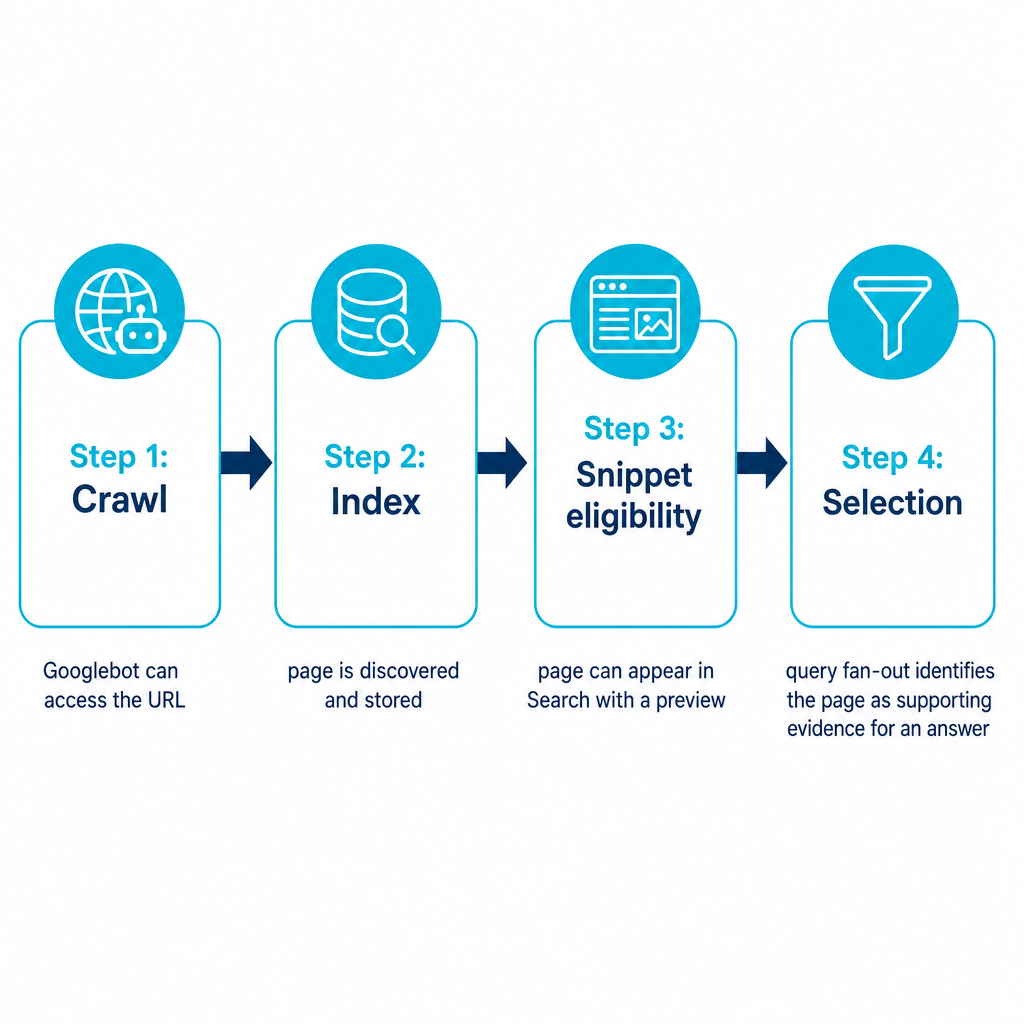
The useful detail here is how those pages get picked. Google says AI Overviews can use "query fan-out": the system runs multiple related searches across subtopics and data sources to build a response and find supporting pages. Your page might be surfaced because it answers one specific sub-question, not because it targets the exact wording the reader typed. That's why a citation can reach a reader even when your page isn't the number-one organic result.
It also means citation is not a reward for ranking first, using structured data, or containing AI-written text. None of those guarantee inclusion. A page earns a spot by being a clear, trustworthy piece of evidence for something Google needs to explain.
The eligibility gates Google actually enforces
Google's guidance on this is refreshingly direct: there are no additional technical requirements for AI Overviews or AI Mode. No new file to upload, no separate feed, no special schema.org markup. The page simply has to satisfy the normal requirements for Google Search. Those break down into four practical checks.
Crawlable. Googlebot has to reach the page. Accidental blocks hide in robots.txt, CDN security rules, hosting configuration, login walls, JavaScript rendering, and CMS visibility settings. A brilliant article that Googlebot can't retrieve will never become a citation.
Indexable. Publishing is not indexing. A noindex directive, a canonical pointing elsewhere, duplicate pages, weak internal linking, thin content, or temporary server errors can all keep a page out of the index. Google Search Console's URL Inspection tool tells you whether a page has actually been discovered and processed.
Snippet-eligible. Google says a page must be eligible to appear in Search with a snippet to qualify as a supporting link. Controls like nosnippet, data-nosnippet, an overly restrictive max-snippet, or noindex suppress that preview. Those controls are legitimate for private, regulated, or sensitive content — they just remove the page from consideration as a visible source.
Policy-compliant. A technically perfect page can still be disqualified if it breaks Google's spam policies. For anyone publishing at volume, the biggest risk is scaled content abuse — producing many pages primarily to manipulate rankings rather than help people. Google is explicit that this applies whether content is made by AI, humans, or both. The practical rule is simple: automate production to improve consistency and efficiency, but never automate away usefulness, originality, accuracy, or editorial judgment.
Build citation-worthy pages, not citation bait
The instinct is to ask "how do I make Google cite this page?" The more productive question is "does this page give clear, checkable evidence for a question Google needs to answer?" Google offers no citation guarantee — even a page that meets every requirement and follows best practices might not be crawled, indexed, or served. So the only sane investment is in the content's actual worth.
A citation-ready page tends to do a handful of things well: answer a specific question directly, go deep enough to be genuinely useful, rely on facts that can be verified, keep important information in text rather than images, show relevant experience, link to supporting resources, and fit the site's broader topic coverage. That last point matters more than most people expect — Google may evaluate a page in the context of the whole site.
Original evidence is the clearest way to stand apart from the rewritten summaries that flood every topic. First-hand product testing, anonymized performance data, a documented internal process, calculations with stated assumptions, screenshots, a local market example, or a comparison framework all give Google and readers a reason to prefer your page. For a small-business SEO article, that might be a page-quality scorecard or a documented indexing audit — something a generic summary can't reproduce.
Trust has to be visible, not assumed. A clear author or reviewer, a relevant biography, a publication or update date where freshness matters, links to primary sources, transparent methodology, disclosed commercial relationships, and consistent claims across the site all signal reliability. For health, finance, legal, safety, or security topics, lean on stronger sourcing and expert review.
To go deeper on the evidence side of this work, our guide to best practices for AI-citable content covers the page-level fixes in detail, and what answer engine optimization means explains how structuring content for AI answer engines differs from classic SEO.
Structure answers so Google can extract them
AI Overviews need concise passages they can lift into a generated response. Clear writing is what lets Google understand what each section is actually claiming. The pattern that works is almost boring in its simplicity: state the answer in the first sentence, explain it immediately afterward, and keep one main idea per paragraph.
A few habits make passages extractable without dumbing down the subject:
- Lead sections with a direct answer, then add the explanation.
- Use descriptive headings that name the question being answered.
- Define acronyms the first time they appear.
- Put each qualification next to the claim it qualifies.
- Use a table only when readers need to compare fixed criteria.
Here's what a direct opening looks like in practice:
A content brief is a document that defines a page's target audience, search intent, required topics, evidence, tone, and success criteria before writing begins.
That single sentence is more useful than three paragraphs of background, and it can anchor a fuller explanation with examples and source notes underneath. The goal is a visible information hierarchy — a direct answer near the top, definitions for unfamiliar terms, practical explanation, evidence, limitations, and a short set of relevant questions at the end. Write for the human reader; a page that serves people well is the same page Google can extract from cleanly.
Structured data fits here, but as a clarifier rather than a shortcut. Google says no special schema is required for AI features and that structured data must match the visible text. Use Article markup for articles, FAQ markup where appropriate and compliant, Product markup for product pages — never invented ratings, hidden content, or markup describing information readers can't see.
Where automation helps and where it can't
At AymarTech we run an AI-powered content workflow for founders, solopreneurs, and small teams: we connect your website, research keywords, write and fact-check articles in your brand voice, add internal links, generate on-brand images, and publish or queue content for your approval. We support WordPress, Shopify, Wix, Webflow, Notion, API, and webhook delivery, and we produce articles in more than 150 languages.
Those capabilities map neatly onto the operational side of citation-ready publishing — finding relevant topics, researching source material, producing consistent on-brand drafts, adding internal links, preparing images, publishing to a connected CMS, and holding a steady cadence. What automation does not do is force Google's hand. A page still has to be indexable, snippet-eligible, policy-compliant, and useful before it can support an AI answer. We describe what our workflow produces; we don't promise what Google must do with it.
This is exactly why the approval workflow matters. Lean on automated publishing for low-risk, repeatable topics where quality checks are solid. Keep a human in the loop for anything touching legal, medical, financial, regulatory, safety, or reputation-sensitive claims. If you're weighing how far to push automation, our explainer on scaling content without hiring writers walks through which stages to automate and where editorial control earns its keep.
The underlying principle holds for any tool, ours included: automate research, drafting, linking, fact-checking, and publishing, but keep the editorial standard and the original information that a reader can't get from a generic summary. More volume never substitutes for usefulness.
How to measure AI Overview progress
There is no separate dashboard that isolates every AI Overview impression. Google reports traffic from AI Overviews and AI Mode inside the overall Web search type in Search Console's Performance report. So you measure progress through a wider set of signals rather than one vanity number.
Track organic impressions, clicks, and average position; pages indexed; the queries that generate impressions; branded search growth; referral traffic; assisted conversions; leads and sales; and engagement after the click. AI Overview visibility shifts with the query, location, device, language, search history, Google's own systems, and the information available for that search — which is why a single manual search tells you almost nothing.
A workable mental model:
Citation readiness = technical eligibility + useful content + credible evidence + sustained measurement.
No single component carries the result on its own. A perfectly eligible page with thin content won't get cited, and a brilliant page Google can't crawl won't either.
Mistakes that quietly block citations
Most failures aren't dramatic — they're small, fixable oversights that keep good pages out of consideration.
| Mistake | Why it blocks citations | The fix |
|---|---|---|
| Chasing special AI markup | No special schema or AI file exists for AI Overviews | Focus on normal SEO fundamentals |
| Publishing generic summaries | Little reason for Google or readers to prefer the page | Add original analysis, evidence, or experience |
| Scaling pages without quality control | Risk of scaled content abuse under spam policy | Keep editorial checks on every published page |
| Hiding the answer | Long intros and vague headings bury the useful part | Answer directly, then explain |
| Treating indexing as automatic | A published URL may never be indexed or served | Verify in Search Console; fix crawl and canonical issues |
| Unsupported product claims | "Guaranteed citations" can't be substantiated | Describe what a tool does, not what Google must do |
The thread running through all of these is the same tension Google keeps returning to: AI-generated content isn't the problem, and human-written content isn't automatically safe. The question is whether the page exists primarily to manipulate rankings or to genuinely help the person reading it. Build for the second and the eligibility gates become routine rather than obstacles.
Before you publish anything, a quick readiness pass is worth the two minutes: Can Googlebot crawl the URL? Is it indexable and snippet-eligible? Does it answer one clear intent, with the main answer easy to find? Does it add original value? Are claims supported, authorship clear, and structured data matched to visible text? If several answers are no, more publishing volume won't fix the underlying gap — the page will.
Frequently asked questions
Does Google guarantee citations in AI Overviews?
No. Google says that meeting its requirements and following best practices does not guarantee a page will be crawled, indexed, or served as a supporting link.
Do I need special schema to appear in Google AI Overviews?
No. Google says there is no special schema.org structured data required for AI Overviews or AI Mode. Use accurate structured data where it applies, and make sure it matches the visible page content.
Does AI-generated content automatically disqualify a page?
No. Google's policy targets scaled, low-value pages created primarily to manipulate rankings. Low-value AI content creates spam-policy risk, but so does low-value human-written content; usefulness is the deciding factor.
How long does it take to get cited by Google AI Overviews?
There's no universal timeline. Google must crawl and index the page, then decide it's useful for a given query. Changes to crawling and preview controls can take anywhere from several days to several months to process.
Can a page be cited even if it isn't ranked number one?
Yes. A page doesn't need to be the top organic result to support an answer. Google may use query fan-out to surface pages that cover different parts of a question, provided they're indexed, snippet-eligible, accessible, and policy-compliant.
Where can I monitor traffic from AI Overviews?
Google includes AI Overview and AI Mode traffic in Search Console's Performance report under the Web search type. Pair it with analytics and conversion data to understand real business impact.