
What Is a Blog Automation Tool? A Simple Guide
Publishing a blog consistently is rarely just writing. Someone has to research topics, weigh keywords, build an outline, draft the piece, add links and images, verify claims, format everything, and finally hit publish. A blog automation tool collapses some or all of that into one connected workflow. So to answer the obvious question directly: what is a blog automation tool? It's software that plans, creates, optimizes, reviews, and publishes blog content from a single system instead of forcing you to shuttle drafts between a keyword tool, an AI writer, an editor, an SEO checker, and your CMS by hand.
The distinction that trips people up is this: a serious blog automation tool is not the same thing as an AI text generator. One writes paragraphs. The other runs the whole pipeline — and the biggest time savings usually come from removing handoffs, not from typing faster.
Table of contents
- • What a blog automation tool actually does
- • How the pipeline fits together
- • Blog automation tool vs. AI writing tool
- • What to automate and what to keep human
- • How to choose a blog automation tool
- • The risks worth planning for
- • Is it right for your business?
- • How we approach blog automation
- • Frequently asked questions
What a blog automation tool actually does
At its core, a blog automation tool handles the recurring, rules-based parts of running a blog: finding relevant keywords and topics, matching them to search intent, building outlines and drafts, adapting writing to a brand voice, adding SEO elements and internal links, generating or inserting images, checking claims, formatting for a CMS, scheduling or publishing, and feeding performance data back into future topic choices.
Not every tool does all of that. An AI writing assistant might produce a draft and leave research, editing, SEO, and publishing entirely to you. A full platform connects several stages, from topic research to the live post. That gap is the whole point. If you already have a writer, an editor, an SEO process, and a publishing routine, a single AI writer may be enough. If the bottleneck is the entire workflow, a point tool only moves the pile of manual work around.
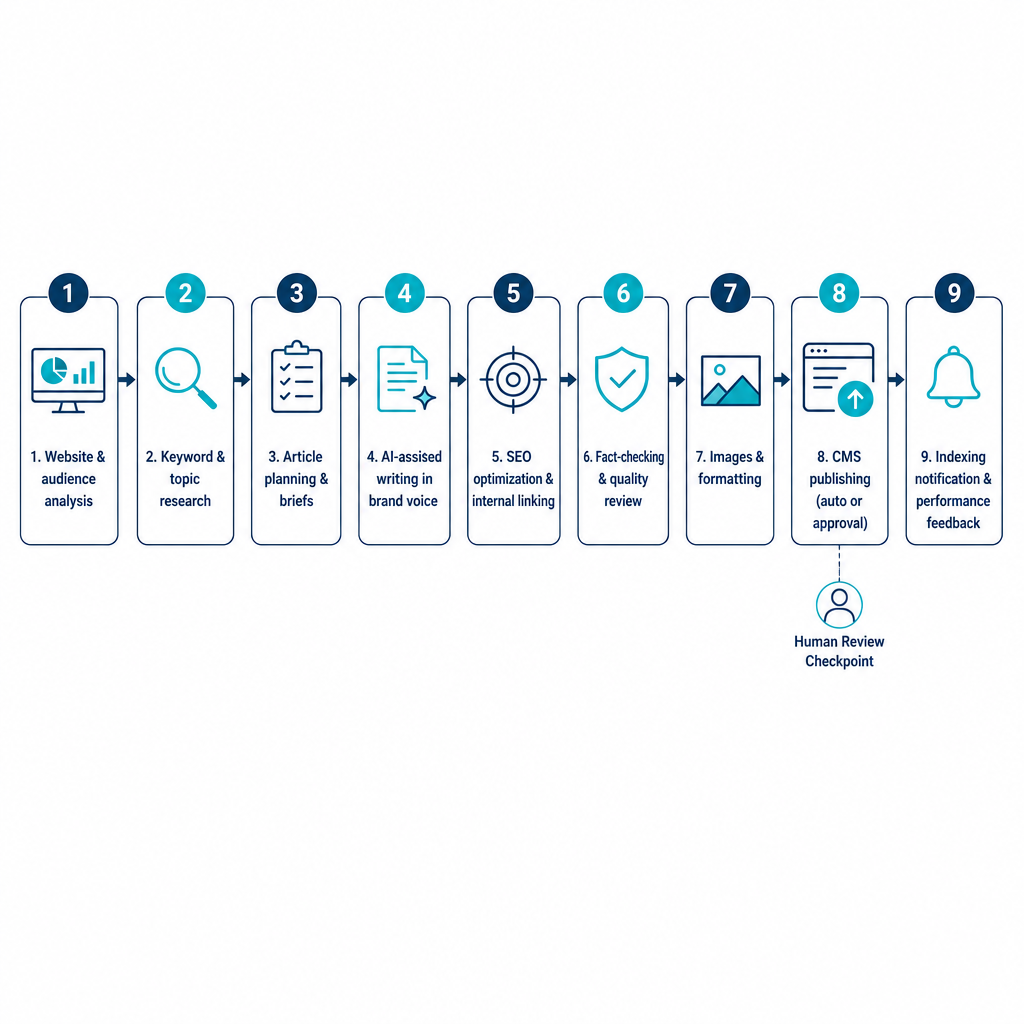
How the pipeline fits together
Most systems run a connected sequence, and understanding each link makes it obvious where the time actually gets saved — and where you still need to pay attention.
It usually starts with website and audience analysis: the tool learns your products, services, audience, and existing content so topics tie back to the business instead of chasing random popular keywords. From there it moves into keyword and topic research, weighing search intent, competition, relevance, existing coverage, commercial value, and the chance to build topical authority. The aim isn't to publish the most articles; it's to pick subjects that answer questions real prospects ask.
Article planning comes next — an outline, title options, headings, suggested sources, and internal-link opportunities. This step gives a piece a purpose before a single sentence is written. A local accounting firm, for instance, should get a brief on quarterly estimated taxes for freelancers, not a vague post about "financial tips." Then AI-assisted writing turns the brief into a draft, and the better systems follow your tone, formatting, terminology, and technical depth. Brand-voice controls help, but they don't guarantee every article reads like a human expert, which is why examples and guidelines still matter.
The back half of the pipeline is where control lives. SEO optimization and internal linking apply heading structure, titles and meta descriptions, intent alignment, related entities, alt text, and links to relevant pages — internal links are especially useful when they connect educational posts to service or product pages. Fact-checking matters because AI can sound confident while being wrong. Google explicitly warns that generative systems can produce inaccuracies and hallucinations and recommends reviewing AI-generated content for accuracy before it goes live. Checking claims against sources is not the same as guaranteeing correctness; you remain responsible for anything touching health, finance, law, safety, pricing, or product performance.
Finally, the tool handles images and formatting, then CMS publishing — either sent live automatically or dropped into an approval queue — followed by indexing and performance feedback, where some systems notify search engines of new content and use results to sharpen future topics. Worth stressing: notifying a search engine is not the same as ranking. A submission does not guarantee Google will crawl, index, or rank a page.
Blog automation tool vs. AI writing tool
These terms get used interchangeably, and that's where budgets get wasted. They solve different problems.
| Tool type | Main function | What usually stays manual |
|---|---|---|
| AI writing tool | Generates or improves text | Research, editing, SEO, links, formatting, publishing |
| Keyword tool | Finds search terms, estimates demand | Writing, review, publication |
| SEO content tool | Plans and optimizes articles | CMS publishing, broader workflow |
| Blog automation tool | Connects research, writing, optimization, review, publishing | Strategy and quality oversight |
If your only gap is drafting speed, an AI writing tool fits. If the problem is that producing one finished, optimized, published post eats a half-day across five tools, automation of the full workflow is the thing that changes your week. We dig deeper into that trade-off in our look at whether automated blogging is worth it.
What to automate and what to keep human
Automation earns its keep on repetitive, predictable work. It struggles — and can actively hurt you — on judgment calls.
Strong candidates for automation include generating topic ideas from defined themes, building keyword calendars, drafting outlines and first drafts, applying standard formatting, finding internal-link opportunities, preparing metadata, scheduling, sending posts to a CMS, and flagging content gaps. These are stable enough for software to handle well, especially with a person reviewing output.
Some decisions still belong to a human: choosing your content strategy, approving sensitive claims, adding first-hand experience, reviewing regulated or high-stakes topics, confirming product details and current offers, checking brand positioning, judging whether a post is genuinely useful, and deciding when something simply should not be published. The principle is simple — automation reduces production work; it does not remove your responsibility for what the business says in public. If your constraint is headcount rather than judgment, our guide on scaling content without hiring writers covers how to divide that work.
How to choose a blog automation tool
The right platform is the one that fixes your actual bottleneck. A few criteria separate serious systems from dressed-up draft generators.
Workflow coverage. Does it handle research, optimization, internal linking, fact-checking, and publishing — or only writing? If you still need several disconnected tools around it, the operational savings shrink fast.
Research quality. Ask how topics get selected and whether the system weighs intent, competition, your website, and your business model. A tool that publishes irrelevant content daily inflates volume while diluting the site's usefulness.
Accuracy controls. Look for source-backed research, claim checking, approval workflows, revision control, and a clear way to inspect an article before it's live. Google's guidance repeatedly stresses accuracy, quality, and relevance for automatically generated content.
Brand-voice controls. You want to supply examples and guidance, not pick a generic tone from a dropdown. Check whether you can define preferred vocabulary, your products and services, audience level, formatting preferences, topics to avoid, required disclaimers, and claims the system must never make.
Publishing integrations. Confirm it supports your CMS and preserves the elements that matter: categories and tags, featured images, internal links, meta fields, author information, canonical URLs, and draft or approval status.
Human review options. Automatic publishing suits low-risk, well-defined content. Approval-based publishing is safer for technical, regulated, or reputation-sensitive subjects. The useful question isn't "Can this publish without me?" but "Which parts can it publish safely without me?"
Performance feedback and language support. A mature system reports on impressions, clicks, rankings, indexed pages, and conversions — judge it by whether articles attract qualified visitors, not by raw output. If you serve multiple markets, check that the platform adapts examples, terminology, spelling, and intent rather than only translating text. Our platform, for reference, produces content in more than 150 languages.
The risks worth planning for
Automation saves time, but it creates problems when volume becomes the goal in itself.
Inaccurate information is the first. AI can invent facts, misread sources, or blend outdated details with current claims. Human review is non-negotiable for anything that shapes a customer decision. Generic content is the second. If every article mirrors the structure and substance of competing pages, publishing more of it won't build an advantage — original examples, direct experience, and genuine evidence do.
Search-spam risk deserves a clear read of the rules. Google states that appropriate use of AI and automation is not against its guidelines, but using automation primarily to manipulate rankings violates its spam policies, and its systems aim to reward original, people-first content. The practical takeaway: automate production, not usefulness.
Brand and compliance errors round it out. An automated article might use the wrong product name, make an unsupported promise, or skip a required disclaimer — which is exactly why a review policy should exist before you enable automatic publishing. And beware indexing misconceptions: a tool can submit URLs or mark a post ready, but no platform can guarantee visibility. Google's own SEO fundamentals focus on making content useful, reliable, and discoverable — not on promising a ranking.
Is it right for your business?
A blog automation tool tends to fit when you have a clear audience and offer, a site that needs steady educational content, a team losing hours to repetitive production, an existing CMS to publish through, the ability to define brand and quality guidelines, a willingness to review high-risk pieces, and a habit of measuring success by qualified traffic and leads rather than post count.
It's a weaker fit when your strategy leans mainly on original reporting, extensive expert interviews, deeply technical research, or constant legal and regulatory review. In those cases automation can support researchers and writers, but it shouldn't stand in for subject-matter expertise.
Picture a small U.S. company selling appointment-scheduling software to dental practices. A platform could surface the questions practice managers search for, group topics around scheduling, cancellations, reminders, and patient communication, build a brief around the chosen intent, draft it in the company's tone, link to the relevant product and support pages, add a featured image and metadata, and route it to the CMS for approval — published only after a reviewer confirms the product claims. The software carries the repetitive load; the company still owns whether the article is accurate and genuinely helpful.
How we approach blog automation
We built AymarTech as an AI content automation system that connects website analysis, keyword research, real-time research, writing, fact-checking, internal linking, image creation, and CMS publishing in one flow. You can publish automatically or keep an approval checkpoint, and we support WordPress, Shopify, Webflow, Wix, and more, with auto-indexing through the Google API so new posts are discoverable quickly.
For a small business or a lean marketing team, the value isn't generating text — plenty of tools do that. It's connecting the workflow so fewer tasks need separate tools, copy-and-paste, or daily coordination. If you want to see how the live workflow runs, start with our guide to setting up automated blog publishing, then tell us your site, audience, and the topics you're trying to own so we can map a plan to your actual goals.
Frequently asked questions
What is a blog automation tool?
It's software that automates recurring blog tasks — topic research, writing, SEO optimization, internal linking, fact-checking, scheduling, and publishing — within one connected workflow rather than across separate tools.
Can a blog automation tool write complete articles?
Many platforms can produce complete drafts, but you should review articles before publishing, especially when they involve expert, financial, legal, medical, product, or time-sensitive information.
Is blog automation the same as AI writing?
No. AI writing focuses on generating text. Blog automation connects that writing with research, optimization, publishing, and the surrounding workflow stages.
Does automated blogging guarantee Google rankings?
No. Automation can't guarantee indexing, rankings, traffic, or citations. Content still has to be useful, accurate, original, relevant, and technically accessible to earn visibility.
Does Google penalize automated blog content?
No, not simply for using AI or automation. The risk comes from producing low-quality or spammy content primarily to manipulate search rankings.
Should I choose automatic or approval-based publishing?
Use automatic publishing for clearly defined, lower-risk content once you've tested the workflow. Choose approval-based publishing when accuracy, compliance, or brand reputation needs a final human decision.