
How To Scale Content Without Hiring Writers
You can scale content without hiring writers by replacing manual production with a controlled system: research keywords, draft useful articles, verify the claims that matter, apply your brand voice, add internal links, publish through your CMS, and measure what happens next. The point is not to remove people from the process — it is to remove the repetitive hours while you keep control of accuracy, originality, and business priorities.
That distinction decides whether automation helps or hurts. A team that automates production but keeps ownership of direction publishes more useful pages without burning out. A team that automates judgment too, and treats volume as the goal, usually ends up with a pile of interchangeable pages that neither readers nor search engines value. This guide walks through what scaling actually means, the realistic options, which tasks to automate first, and how we at AymarTech structure the whole pipeline so a lean team can keep shipping without a writing department.
Table of contents
- • What "scaling content" actually means
- • Four realistic ways to scale without writers
- • What to automate first, and what to keep under review
- • How the content-scaling mechanism works
- • An operating model for a lean team
- • Deciding whether automation fits your business
- • The risks worth engineering against
- • How AymarTech fits this model
- • Frequently asked questions
What "scaling content" actually means
Scaling content is not the same as publishing more articles. A scalable operation increases output without a matching increase in writing hours, editing time, keyword research, formatting, internal-link maintenance, image production, localization, and reporting. If every new post adds proportional work across all of those, you have not scaled — you have just added staff cost disguised as ambition.
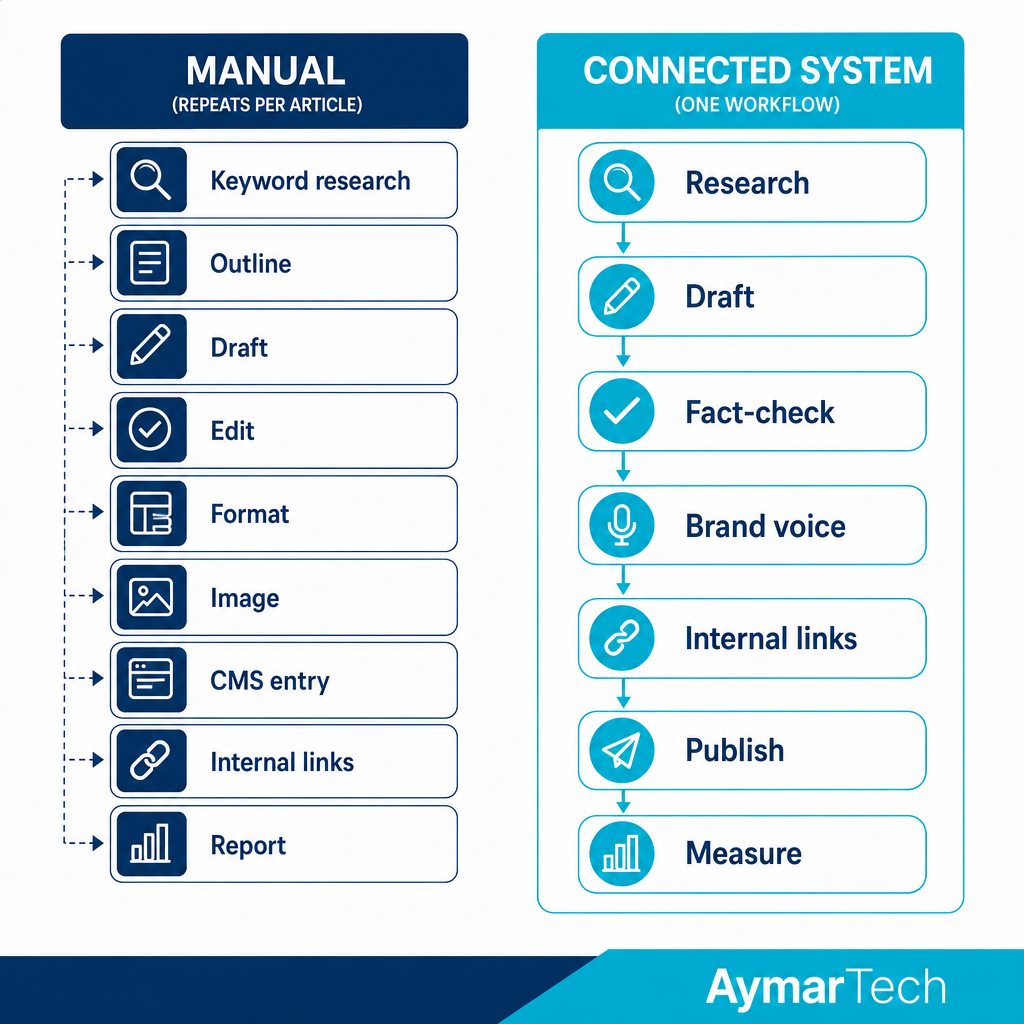
The practical threshold shows up fast. Four articles a month is manageable by hand. Push to twenty or thirty and each one demands its own research, outline, draft, edit, formatting, image, CMS entry, and internal linking. That is where the bottleneck forms. A scalable system connects those separate activities into one repeatable workflow, so adding the twenty-first article costs a fraction of what the first one did.
Four realistic ways to scale without writers
There are four workable routes, and the right one depends on how much control you need and how much of the publishing process you want to hand off.
Use AI as a drafting assistant. A general-purpose tool helps with ideation, outlines, first drafts, headlines, meta descriptions, and social variations. It is the lowest-commitment option, but it only removes the writing step. Someone still has to research search demand, verify claims, optimize the piece, add links, make images, upload the post, and watch performance. This fits when writing is your only bottleneck — not SEO operations or publishing.
Build an internal automation workflow. A marketing team can wire together separate tools for keyword research, AI writing, fact-checking, image generation, optimization, CMS publishing, analytics, and internal linking. You get flexibility and custom control, but you also own every connection and the job of confirming data moves correctly between tools. This suits teams with technical resources who genuinely need stage-by-stage control.
Outsource to freelancers or an agency. Humans bring subject-matter interviews, editing, and strategic guidance, which matters for regulated subjects, original research, or executive thought leadership. The hidden work stays with you: briefs, assignments, revision cycles, vendor communication, scheduling, budgets, and quality assurance.
Use an end-to-end AI SEO platform. Instead of asking one tool for a draft, the platform manages the whole pipeline — niche analysis, keyword and topic research, planning, real-time research, brand-voice drafting, fact-checking, SEO structure, internal linking, images, CMS publishing, and performance feedback. This is the route that matters when you want consistent publishing without hiring writers or juggling a stack of disconnected tools. If you are weighing this against keeping people in-house, our breakdown of an in-house content team versus AI automation lays out the trade-offs by speed, expertise, and accuracy.
What to automate first, and what to keep under review
Not every content task carries the same risk, so automate the repetitive, structured work before you touch anything that needs real business judgment.
Lower-risk tasks are generally safe to automate once the system has good inputs and review controls: keyword clustering, topic-calendar creation, article outlines, meta titles and descriptions, formatting, internal-link suggestions, image handling, CMS uploads, publishing schedules, performance reports, and first-pass translation drafts.
Higher-risk tasks need a human in the loop: medical, legal, financial, and safety claims; product claims and guarantees; pricing and availability; regulatory statements; original research; customer stories; statistics; competitor comparisons; purchase-affecting recommendations; and anything representing executive expertise. The more commercially or legally sensitive the subject, the more important it is to require approval before anything goes live.
How the content-scaling mechanism works
A scalable system works because it breaks one large task — "write and publish a blog post" — into connected production stages that each feed the next.
Research creates the input. The system identifies topics from search demand, keyword difficulty, customer questions, and buyer intent, which keeps you from publishing subjects that are interesting but unlikely to attract qualified visitors. We build an AI content calendar using keyword volume and difficulty data and target high-potential terms in your niche.
Brand inputs make output consistent. AI content gets more useful when it knows your audience, products, differentiators, preferred terminology, tone, reading level, supportable claims, topics to avoid, and examples of existing work. A brand-voice system should not copy old articles — it should learn patterns like sentence length, directness, vocabulary, and point of view while producing original text.
Research and verification reduce unsupported claims. A production system should research current information and check important statements before publishing. We research articles in real time and check key claims before they go out. That said, automated fact-checking is not a guarantee of perfect accuracy, which is why a sound editorial policy still routes business-critical claims to a human.
SEO structure makes each page usable. Scalable content should not mean isolated pages. Each article needs a direct answer near the top, descriptive headings, clear definitions, supporting examples, relevant internal links, original explanation, and a logical next step. Internal links should move a reader from an informational article to a related guide, product page, or conversion page — not pad the link count.
Publishing automation removes the operational bottleneck. Once content is approved, automation publishes to the right CMS, applies formatting, inserts images, and schedules the release. For most businesses, approval-based publishing is the safer starting point; automatic publishing is something to introduce after the system has proven it stays accurate and on-brand.
An operating model for a lean team
A small business does not need a full editorial department to hold quality steady. It needs clear ownership split three ways.
The owner or strategist owns direction — which products and markets matter, which customer problems deserve coverage, which claims are acceptable, which topics are commercially sensitive, and what each article should help the reader do next.
The platform handles production — research, topic planning, drafting, SEO formatting, internal-link suggestions, images, CMS delivery, and schedules.
A subject-matter reviewer handles exceptions. This person does not rewrite every article. They check accuracy, differentiation, product details, sensitive claims, brand risk, and whether the piece reflects real customer needs. That division is how a team scales output without turning the owner into a full-time editor.
Deciding whether automation fits your business
Run your situation through these criteria before committing to a content system. Most businesses land on a hybrid: automate standard educational content, assign people to the expert, sensitive, or high-value pieces.
| Decision criterion | Automation fits when… | Keep more human production when… |
|---|---|---|
| Content volume | You need a steady stream of useful articles | You publish a few highly specialized pieces |
| Topic structure | Topics are repeatable and researchable | Each article depends on original interviews |
| Subject risk | Claims are relatively low-risk | Content involves medical, legal, or safety advice |
| Brand voice | You can give examples and clear guidelines | Value depends on a unique personal voice |
| Publishing workflow | Your CMS supports integration or API delivery | Your site needs unusual manual formatting |
| Internal capacity | No one can manage writers and tools | You already have an experienced editorial team |
| Geographic scope | You need multiple markets or languages | Each market needs deep local expertise |
The risks worth engineering against
The biggest mistake is treating publishing volume as the goal. Google defines scaled content abuse as generating many pages primarily to manipulate rankings rather than help users, and the policy applies whether content is made by AI, humans, or a mix. Generating many AI pages without adding value is a listed example. You can read Google's own position in its spam policies for web search.
That creates several practical risks, each with a control you can build into the workflow.
Thin or repetitive pages. Publishing several pages that answer the same question with minor wording changes creates duplication and confuses readers and crawlers. The control: assign every article a distinct reader problem, search intent, and internal-link role.
Confident inaccuracies. AI can produce polished statements that are incomplete, outdated, or wrong. The control: require source checks for statistics, product claims, laws, pricing, and dates.
Generic brand voice. A system without meaningful brand inputs produces content indistinguishable from every other site. The control: supply real examples, customer language, product details, and approved points of view.
Uncontrolled automatic publishing. Automation makes a workflow efficient, but it can also push an unsuitable article live at scale. The control: start with an approval queue and promote only proven categories to automatic publishing.
Misleading indexing expectations. Submitting URLs does not guarantee indexing, rankings, traffic, or AI citations. The control: treat indexing as a technical signal to monitor, not a promise that every page will rank. If you want the longer version, our explainer on whether Google penalizes AI content separates the myth from what Google actually evaluates.
Translation without localization. Translating is not adapting. Search intent, terminology, regulations, examples, and buying behavior differ by market. The control: automate the first draft, then review important markets with someone who knows the language and audience.
Before any automated article publishes, a short standard keeps quality honest: Does it answer a real customer question? Is the primary answer clear up top? Is it meaningfully different from existing pages? Are important claims supported? Does it reflect your actual products and experience? Are the internal links genuinely useful? Does it have a clear next step? Google's people-first guidance emphasizes exactly this — content made for a real audience with demonstrated expertise, not pages built to game rankings.
How AymarTech fits this model
We built AymarTech for the model this guide describes: automate production, keep editorial accountability. The platform handles keyword research, content-calendar generation, real-time research, fact-checking, brand-voice writing, SEO optimization, internal linking, AI-generated images, and CMS publishing across WordPress, Shopify, Wix, Webflow, and more, with API and webhook delivery and content in over 150 languages. Performance feedback uses Google Search Console data, and you choose between automatic publishing and an approval-based editorial workflow.
Consider a SaaS company chasing startup founders searching for onboarding and retention advice. A weak scaling model publishes near-duplicates — best onboarding tips, top onboarding tips, onboarding best practices — and competes with itself. A strong model gives each page a distinct job: a definition of SaaS onboarding, a checklist for new users, a comparison of guided tours versus human onboarding, a troubleshooting guide for activation drop-off, a measurement guide for completion, and a case-study framework for time to value. The system automates research, drafting, formatting, links, and publishing; the product and customer-success team confirms the advice matches how onboarding actually works. That builds a content library instead of a shelf of keyword variations.
The practical question for a small business is never whether a platform can produce many articles. It is whether it produces the right articles, holds accuracy, fits the brand, and cuts the total time from idea to useful published page. You can review our automated content marketing workflow to see how each stage connects before deciding whether an end-to-end system fits your publishing needs.
The sustainable path is simple to state and harder to hold: automate research, planning, drafting, formatting, linking, images, publishing, and reporting; keep human ownership of strategy, differentiation, high-risk claims, first-hand expertise, product accuracy, and brand reputation. Done that way, output rises without the assumption that more pages automatically mean more traffic. Content scales when each page adds value, serves a defined audience, and supports a real business objective.
Frequently asked questions
Can AI replace content writers?
AI can replace much of the repetitive production work — research, drafting, formatting, optimization, and publishing. It does not automatically replace subject-matter expertise, editorial judgment, original research, or responsibility for accuracy. Those stay with people.
Is it safe to publish AI-generated content on Google?
Google's policy does not treat AI use itself as the problem. The risk is generating many pages without adding value, especially to manipulate rankings. Content should be original, useful, accurate, and created for people.
How many articles should a small business publish each month?
There is no universal number. Publish only as much as you can support with meaningful topics, accurate information, useful internal links, and real quality review. A consistent schedule beats a large burst of repetitive articles.
Should automated content be reviewed before publishing?
Yes, especially when an article includes regulated advice, product claims, statistics, pricing, legal information, or anything that could affect a customer's decision. An approval queue is a sensible starting point.
Can content automation guarantee rankings?
No. Automation improves production efficiency and technical consistency, but it cannot guarantee indexing, rankings, traffic, or citations in AI-generated answers.