
What Is SEO Writing? A Clear Beginner's Guide
SEO writing is the practice of creating content built to rank in search engines like Google while genuinely helping the people who read it. If you have wondered what is seo writing and whether it deserves a place in your marketing plan, the short answer is this: it blends clear, accurate writing with optimization choices — keyword targeting, structured headings, descriptive metadata — so both humans and search algorithms can quickly see what a page is about and trust it enough to surface it.
That distinction matters. SEO writing is not stuffing keywords into a post and hoping for the best. It answers real questions in depth, then formats those answers so search engines can understand them and readers can act on them. Below, we break down the plain definition, how it works under the hood, when your business actually needs it, and how to judge whether a piece is any good.
Table of contents
- • SEO writing, defined in plain English
- • Do you actually need SEO writing right now?
- • How SEO writing works under the hood
- • Your options for producing it consistently
- • What good SEO writing actually looks like
- • SEO writing in real life: three examples
- • Frequently asked questions
SEO writing, defined in plain English
SEO writing — short for search engine–optimized writing — is content created specifically to earn visibility in search results for relevant queries. It combines traditional good writing with optimization techniques so that a page's topic is obvious to a searcher scanning results and to the algorithm ranking them.
The emphasis on "still useful" is not a nice-to-have. Authoritative guides describe SEO writing as content crafted with search visibility as a primary goal while focusing on real value for readers, not "writing for bots." That value is measured by how well a page matches search intent, covers a topic comprehensively, and helps a visitor accomplish something — learning, comparing options, or deciding what to do next.
Google's own documentation reinforces the point. Successful pages produce helpful, reliable, people-first content that uses the same words searchers would use, placed prominently in titles, headings, alt text, and link text. When those elements align, Google can understand your page and decide when to show it. So the working definition is less "add keywords" and more "write something worth ranking, then make its meaning unmistakable."
Do you actually need SEO writing right now?
The more useful question for most businesses is not the definition — it is whether SEO writing earns a spot in your plan this quarter. It matters most when a few conditions line up.
The first is demand: your ideal customers actively search for what you sell or the problems you solve, from "best scheduling software for salons" to "tax help for small businesses." The second is the kind of growth you want. SEO writing builds sustainable, compounding organic traffic instead of leaning entirely on ads, social virality, or outbound sales. The third is buyer behavior — it pays off in markets where prospects compare options online before they ever talk to sales or walk into a store.
When those conditions hold, a library of search-optimized articles, guides, and product pages becomes a durable asset that drives targeted visitors month after month. That is the real appeal: content you publish once can keep working long after you hit publish.
If most of your growth already comes from referrals, in-person events, or a tight existing network, SEO writing is less urgent. It still helps, though — because someone will eventually search your brand name or service, and you want a credible page waiting for them. The decision comes down to one thing: you invest in SEO writing when you want your website to be where people land when they ask Google, and increasingly AI assistants, the questions your business is built to answer.
How SEO writing works under the hood
SEO writing is a systematic way of planning, drafting, and formatting content so it lines up with how search engines evaluate pages and how people read online. Four mechanisms do most of the work.
Search engines have to understand and trust the page. Google's documentation frames SEO as helping search engines understand your content and helping users decide whether to visit. To do that, Google checks whether a page is accessible and technically indexable, whether the content looks helpful and original rather than auto-generated to manipulate rankings, and whether it uses relevant words in key locations like titles, headings, links, and alt text. Get those signals right and Google can reliably show your page for the queries you target.
Keywords and search intent connect your content to real queries. Good SEO writing starts with what your audience actually types and why. Keywords are the phrases people use — "home office tax deduction," "how to automate email follow-ups," "best CRM for real estate" — and search intent is the reason behind the query: learning, comparing, or buying. Keyword research helps you find topics with enough demand and reasonable competition, group related queries into one piece that can rank for several variations, and shape the depth and angle so the article satisfies that intent. A "what is SEO writing" article, for instance, should explain definitions and mechanics rather than list tools and prices, because the dominant intent is learning.
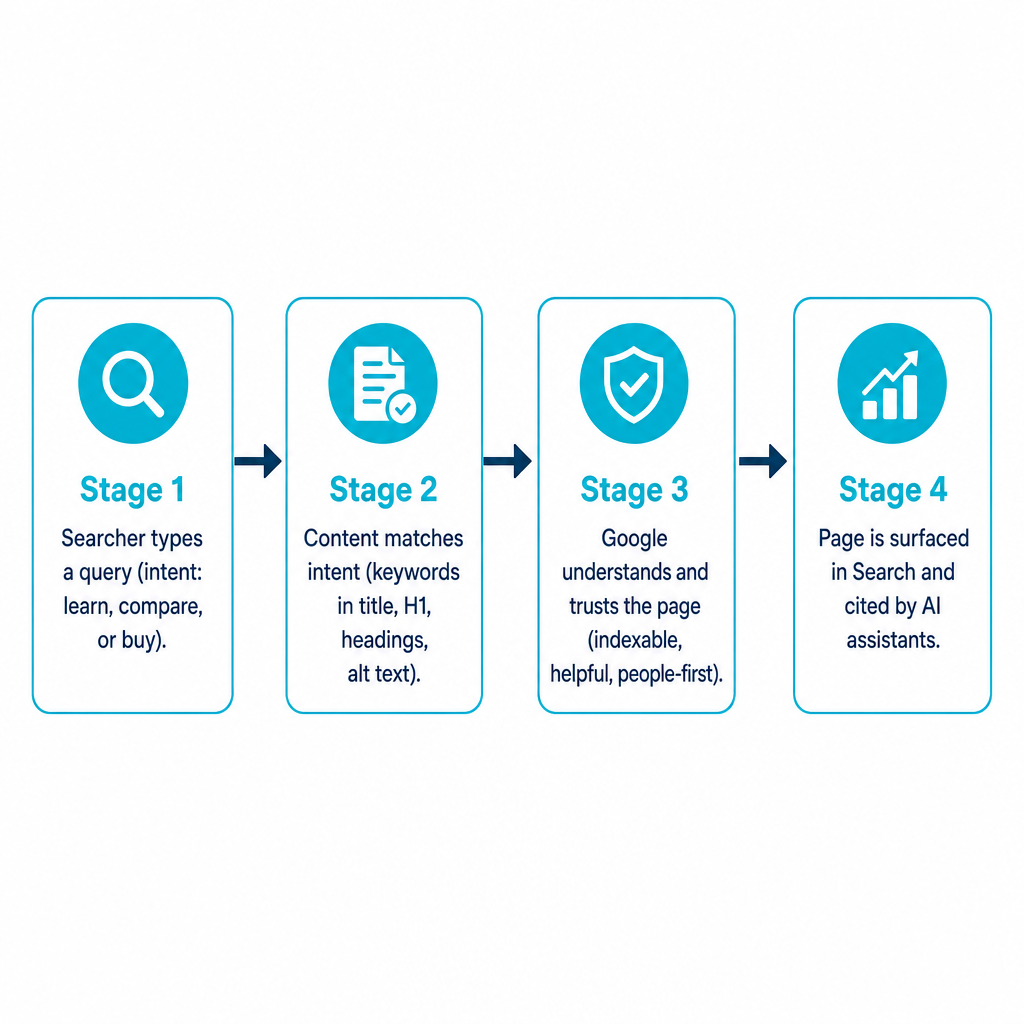
Structure, formatting, and metadata guide readers and crawlers. How you organize a page is nearly as important as what you say. Typical on-page work includes a concise, accurate title tag; an H1 that mirrors it and uses primary keywords naturally; H2 and H3 subheadings aligned with searcher questions; internal links with descriptive anchor text that connect related pages and help crawlers discover more of your site; and alt text that describes images in natural language. This makes a page easier to scan, lifts engagement, and gives search engines strong signals about meaning.
Quality, originality, and depth carry the rankings. Keyword placement alone will not hold a position if the content is thin, derivative, or untrustworthy. Google's Search Essentials highlight helpful, reliable, people-first content as a core factor — meaning the article genuinely helps someone, shows careful research and accurate explanation, and avoids misleading claims, clickbait, or copied text. SEO writing prioritizes substance first, then layers optimization on top rather than treating optimization as a substitute.
One shift worth noting: SEO writing in 2026 increasingly intersects with AI platforms like ChatGPT, Perplexity, and Gemini, which now surface and cite well-optimized content. Content built for search visibility is more likely to be reused as source material by these assistants, which makes strong, well-structured writing doubly valuable — discoverable in Google Search and reusable across AI answers when it meets standards for reliability and clarity.
Your options for producing it consistently
Understanding SEO writing is the easy part. Producing it week after week is where most plans stall. Four common approaches each trade off cost, control, and time.
You can do it yourself, founder- or marketer-led. You can hire freelance SEO writers or an agency. You can build an in-house content team. Or you can use an AI-powered SEO platform that automates research, writing, and publishing.
Manual approaches give you maximum control over voice and strategy, but they demand steady effort across keyword research, outlining, drafting, optimization, and publishing. AI-assisted workflows can speed up drafting, yet someone still has to choose topics, verify facts, and keep the output aligned with your brand and with Google's guidance on helpful, people-first pages. There is no free lunch — the question is where you want your time and money to go.
Where we fit
AymarTech is an AI-powered SEO platform built for businesses that want daily, on-brand, search-optimized content without hiring writers or juggling multiple tools. We connect directly to your website or CMS and research low-competition, high-intent keywords tailored to your business. We write fact-checked SEO articles in your brand voice, complete with on-brand images and smart internal links. Then we publish finished posts to your CMS on a schedule you set, so new content goes live automatically.
This hands-off approach is designed for small business owners, SaaS founders, and marketing teams who know they need consistent SEO content but do not have the time or headcount to run the full workflow every day. If you want to see the mechanics, our how it works overview walks through research, writing, and auto-publishing, and our published examples show the output in context.
What good SEO writing actually looks like
Whether you write content yourself or use a platform, you need a way to judge it. Expert guidance and Google's documentation point to a handful of practical criteria.
Alignment with search intent. A strong article targets a clear primary query and its close variations, then matches the intent behind them — explaining, comparing, or instructing — instead of pushing an unrelated pitch. If a searcher expects a definition and you serve a pricing page, it will struggle to rank and to convert.
Clarity, originality, and depth. Good SEO writing reads like a helpful guide, not a keyword-stuffed brochure. It uses plain language and concrete examples suited to your audience, offers original explanations rather than rephrased summaries of the top results, and covers the subtopics a searcher would reasonably care about. Thin content that scratches the surface rarely earns or keeps strong positions.
On-page optimization done naturally, not aggressively. Keywords belong where they matter — title, H1, early paragraphs, subheadings, anchor text — without sounding forced. Headings should help readers scan and answer specific questions. Internal links should point to relevant pages with anchor text that signals what is on the other side. Over-optimization such as unnatural repetition, hidden text, or deceptive linking risks falling under Google's spam policies.
Compliance with Google Search Essentials. Google's Search Essentials describe behaviors that can lower rankings or remove pages entirely: auto-generated content meant only to manipulate rankings, pages stuffed with repetitive or irrelevant keywords, and misleading practices like cloaking. Content that respects technical requirements and focuses on helpful, reliable information is far more likely to be eligible to perform.
SEO writing in real life: three examples
Abstract criteria are easier to apply once you see them in motion. Here are three scenarios drawn from common guidance.
A local accountant publishes "What Small Business Owners Need to Know About Quarterly Estimated Taxes." It answers frequent questions, works phrases like "quarterly estimated taxes for small businesses" into the headings, and links to related pages on deductions and bookkeeping. This serves a mix of informational and transactional intent.
A scheduling SaaS writes "The Best Online Booking Systems for Salons (2026 Review)." It compares options, lays out detailed pros and cons, and uses "online booking system for salons" naturally in the title, headings, and alt text. This targets commercial comparison intent.
A marketing agency publishes "What Is SEO Writing? A Clear Beginner's Guide" to educate prospects and rank for fundamental terms. It explains definitions, mechanisms, and decision criteria, then introduces its own solution without turning the whole page into a sales pitch — top-of-funnel education that still earns trust. Choosing the right tool for that job is its own decision, and our guide to AI SEO writing tools that grow traffic covers how to evaluate them.
Frequently asked questions
Is SEO writing still worth it in 2026?
Yes. Expert guides and Google's documentation continue to treat high-quality, search-aligned content as a core driver of organic visibility, even as AI answer experiences expand. As long as people search for answers and products, SEO writing remains a durable growth channel.
How is SEO writing different from keyword stuffing?
SEO writing uses relevant phrases strategically in titles, headings, and copy while prioritizing clarity and usefulness. Keyword stuffing ignores readability and over-repeats phrases to manipulate rankings, which falls under Google's spam policies and can hurt performance.
Can small local businesses benefit from SEO writing?
Yes. Local businesses that publish helpful, optimized content about their services, locations, and expertise can attract nearby searchers looking for solutions, not just brand names. Proper SEO writing helps those pages appear for "near me" and specific service queries in their area.
How long does it take to see results from SEO writing?
Results are not instant. New content often takes weeks to be crawled, indexed, and start ranking, with stronger gains over several months as more content accumulates and earns trust. Timelines depend on competition, site authority, and publishing consistency.
Should I use AI tools for SEO writing or hire a writer?
It depends on your budget, time, and quality bar. AI-assisted workflows can sharply reduce drafting time but still need oversight for accuracy, originality, and compliance with Google's people-first guidance. Human writers or hybrid platforms can combine expertise, brand voice, and automation to deliver consistent SEO writing with less hands-on effort for your team.
If your goal is hands-off organic growth and AI visibility, the move is not simply "doing SEO." It is committing to steady SEO writing that teaches, guides, and earns trust — then choosing a workflow or platform that can hold that quality bar week after week.