
What Is Automated Content Marketing?
Automated content marketing is the use of software, AI, and connected publishing tools to plan, create, optimize, distribute, and measure marketing content with far less manual work. The part that trips people up is this: automation should execute a strategy, not invent one. Point a system at your website and let it publish generic pages by the hundred, and you create more cleanup, more factual risk, and a direct collision with Google's guidance on scaled content. Point it at a defined audience with real quality gates, and it becomes a repeatable engine for growth. This guide explains how the system actually works, what you can safely hand to machines, where human judgment stays non-negotiable, and how to decide whether it fits your business.
Table of contents
- • What the term actually means
- • How the system connects five stages
- • Automation, AI generation, and autopilot are not the same thing
- • What you can safely automate, and what you cannot
- • What you gain, and where it goes wrong
- • How to evaluate a platform before you commit
- • Where we fit, and a simple decision rule
- • Frequently asked questions
What the term actually means
Automated content marketing is a workflow in which technology handles the repeatable content tasks: finding topics and keywords, grouping them by search intent, building a calendar, researching supporting information, drafting assets, applying a brand voice, adding internal links and metadata, selecting images, publishing, and then monitoring traffic, rankings, and conversions.
The objective underneath that is old. The Content Marketing Institute defines content marketing as creating and distributing valuable, relevant, and consistent content for a defined audience to drive profitable customer action. Automation changes how that work gets done; it does not change why. That is the single most useful distinction to carry into any buying decision, because it separates "using AI to write blog posts" from coordinating several marketing activities into one system. The first is a tool. The second is an operating model.
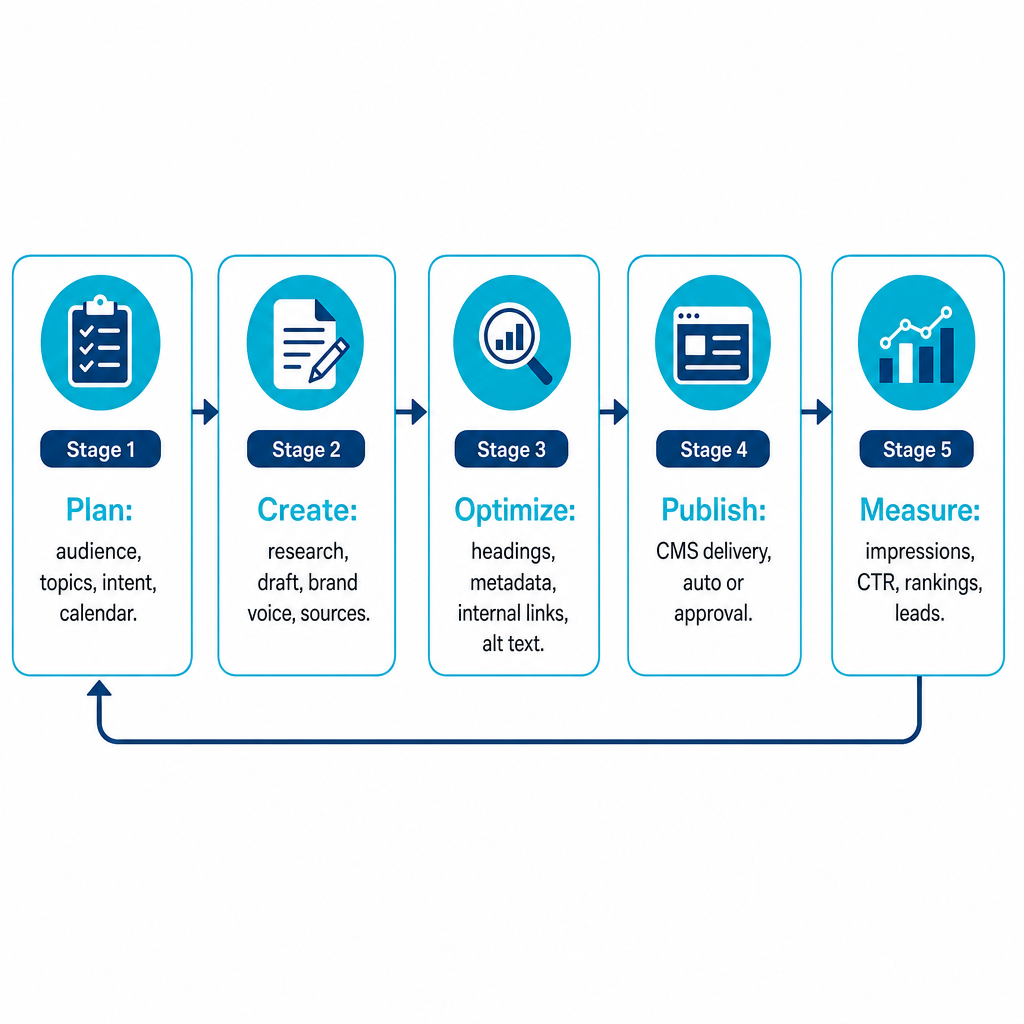
How the system connects five stages
A complete setup links stages that most teams otherwise run in disconnected spreadsheets and browser tabs. Each stage does a distinct job, and each introduces its own quality question.
Audience and topic planning. The workflow starts from your business, audience, and commercial goals, not from a keyword list. A local accounting firm targets small-business tax questions; a SaaS company writes about the problems its software solves; an e-commerce store builds buying guides and comparisons. Automation can scan search terms, competitor topics, existing pages, and performance data to surface opportunities. The output should be an editorial plan, not a random keyword dump. The highest-volume topic is rarely the best one; a specific topic with clear business value usually beats a broad query that attracts visitors who never convert.
Research and content creation. AI-assisted systems use a brief, source material, first-party data, and current web research to produce a first draft, blog posts, landing copy, email, FAQs, product descriptions, or content updates. The quality tracks directly to the inputs. A generic prompt yields generic text. A disciplined workflow feeds the model the intended reader, the search intent, brand terminology, product facts, approved sources, writing samples, claims that need verification, and a clear conversion goal.
Search optimization and distribution. A system can structure an article with descriptive headings, title and meta-description suggestions, internal links, image alt text, structured data where appropriate, and readability fixes, then publish to a CMS such as WordPress, Shopify, Webflow, or Wix. Distribution should match the audience: a technical guide fits a company blog and a newsletter, while a short product insight may belong on LinkedIn. Publishing everywhere without a plan is noise, not reach.
Measurement and feedback. Automation earns its value when it learns from results. The signals that matter are organic impressions, click-through rate, rankings for target queries, engaged sessions, leads, purchases, assisted conversions, and Search Console query data. Page count is not a success metric. The real question is whether the content attracts the right audience and moves them toward a valuable action.
Automation, AI generation, and autopilot are not the same thing
These terms get used interchangeably, and that confusion leads to the wrong purchase. They describe different scopes.
| Term | Main function |
|---|---|
| AI content generation | Produces text, images, or other content from instructions |
| Content automation | Automates one or more production or publishing tasks |
| Automated content marketing | Connects planning, creation, optimization, distribution, and measurement to marketing goals |
| Autopilot content marketing | A more end-to-end form that executes most of the workflow with limited manual involvement |
An AI writing tool can hand you a draft but leave keyword research, fact-checking, internal linking, CMS formatting, and publishing to you. An automated content marketing platform tries to connect those stages. Crucially, "automated" does not mean "self-correcting." Human review stays essential for accuracy, legal exposure, brand reputation, and anything that needs genuine subject-matter expertise. We cover this divide in more depth in our guide on what AI content automation is.
What you can safely automate, and what you cannot
The right level of automation depends on the task and the cost of getting it wrong. Tasks that are repetitive and easy to review are good candidates. Tasks that carry legal, financial, medical, or reputational weight are not.
Usually safe to automate: topic clustering, content-calendar maintenance, brief creation, draft outlines, first-draft writing, internal-link suggestions, image resizing and formatting, metadata templates, content repurposing, publishing notifications, and performance-report compilation.
Keep under human oversight: medical, financial, and legal claims; product safety information; regulatory statements; customer stories and testimonials; original research; executive opinions; pricing and contract details; crisis communications; strong comparative claims; and the final sign-off on any high-risk page.
This is not a stylistic preference. Google states that automatically generated content must meet its Search Essentials and spam policies, and it warns that generating many pages without adding value can constitute scaled content abuse. It also recommends manually fact-checking and reviewing AI-generated content before publishing, including metadata, structured data, and image alt text. The practical takeaway is that your workflow needs a clear boundary between what ships automatically and what waits for a person.
What you gain, and where it goes wrong
The upside is real, and so are the failure modes. Both deserve honesty.
On the gains: a documented workflow removes the delays caused by scattered tools and manual formatting, which helps a small team hold a predictable schedule. Consistency does not mean daily publishing; the right cadence depends on your audience, expertise, and review capacity. Automation also cuts the repetitive load of transferring briefs, formatting posts, adding standard metadata, hunting for internal links, uploading images, scheduling, and compiling reports, so that time can shift to customer research, original insight, and conversion work. A connected system adds workflow visibility, showing whether each piece is planned, drafted, awaiting review, approved, or published, which matters most for agencies and teams running several sites. And it supports localization at scale, though translation alone is not localization; genuinely localized content accounts for search behavior, regional terminology, currency, local law, cultural expectations, and whether your offer is even available in that market.
The risks cluster around one temptation: treating automation as a volume contest.
A high page count is not a success metric. The real question is whether the content attracts the right audience and helps them take a valuable next step.
Google's definition of scaled content abuse targets pages produced mainly to manipulate rankings rather than help users, and it applies whether the content came from AI, humans, or both. Large automated libraries tend to underperform when they repeat information already available elsewhere, chase irrelevant keywords, recycle interchangeable intros and conclusions, make unsupported claims, add no first-hand experience, or exist only to capture traffic.
Factual errors are the second danger. AI systems produce confident but incorrect statements about dates, statistics, specifications, regulations, citations, and company details. A "fact-checked" label proves nothing on its own; a reliable workflow identifies the important claims, verifies them against appropriate sources, and lets an editor inspect the evidence. Beyond accuracy, a system trained only on generic instructions produces content that sounds polished but not like you, which is why brand-voice automation needs representative writing samples and explicit terminology. Google is also clear that AI gives no special ranking advantage: content performs when it is useful, original, and reliable, and falls flat when it is not. Publishing weak or inaccurate pages can erode trust, create support headaches, and damage credibility faster than any traffic gain repairs.
How to evaluate a platform before you commit
Judge the complete workflow, not the writing demo. A smooth draft tells you very little about research quality, accuracy controls, or whether the thing actually publishes to your CMS.
| Decision criterion | Questions to ask |
|---|---|
| Research quality | Does it use current sources, first-party data, and real search intent? |
| Accuracy | Can it show sources, flag uncertain claims, and support fact-checking? |
| Originality | Does it add expert input, analysis, examples, or useful data? |
| Brand voice | Can it learn style and terminology from approved examples? |
| SEO workflow | Does it handle internal links, metadata, structure, and publishing requirements? |
| Publishing control | Can content be reviewed, queued, scheduled, or auto-published? |
| Integrations | Does it connect to the CMS and tools you actually use? |
| Measurement | Can you tie output to impressions, traffic, leads, and revenue? |
| Governance | Are permissions, approval stages, and correction processes available? |
The sharpest single question is what remains for a human to check. A platform that automates research, writing, linking, and publishing can suit a small business with limited marketing capacity. A company in a regulated field will likely need approval workflows and specialist review before anything goes live automatically.
Where we fit, and a simple decision rule
We built AymarTech as a connected content workflow rather than a standalone writing assistant, aimed at founders, solo operators, small teams, and businesses that want the full pipeline handled. The platform analyzes your website and niche, researches keywords, builds a content calendar, researches and fact-checks articles, learns your brand voice, adds internal links, generates on-brand images, and publishes to connected platforms including WordPress, Shopify, Wix, Webflow, and Notion, with API and webhook delivery and support for 150+ languages.
One detail matters more than the feature list: you can configure the workflow for automatic publishing or queue every piece for your approval first. Those are two different operating models, and the right one depends on your risk tolerance and review capacity. We recommend confirming the integration and review details that apply to your specific site before you rely on full autopilot; unsupported platforms may need a custom API path. You can see how our workflow runs end to end and review real content examples to judge whether the output matches your quality bar.
Automated content marketing is usually a good fit when you have a clear audience and offer, search can realistically drive growth, you have repeatable topics to cover, your CMS supports the workflow, you can define acceptable quality, someone owns review and correction, and you measure leads or revenue rather than page count. It is a poor fit when you want pages only because competitors have more, your plan depends on copying existing results, no one can review high-risk claims, your positioning is unclear, you expect guaranteed rankings, or you are unwilling to update inaccurate pages. Google's people-first guidance asks whether a site has a real audience, demonstrates first-hand expertise, and gives readers enough to accomplish their goal. That test does not change when a machine does the typing.
Frequently asked questions
Is automated content marketing the same as content marketing?
No. Content marketing is the strategy of using valuable, relevant content to attract an audience and drive profitable action. Automated content marketing uses software to execute parts of that strategy more efficiently. The strategy comes first.
Can automated content rank on Google?
Yes, it can, but automation guarantees nothing. Google evaluates usefulness, quality, relevance, originality, and trust signals, not the tool used to produce the page.
Is AI-generated content against Google's guidelines?
No. Google says appropriate use of AI or automation is not inherently against its guidelines. The problem is producing large volumes of low-value content mainly to manipulate rankings.
Should automated blog posts be reviewed by a person?
Yes, especially for factual accuracy, specialist topics, brand claims, and legal or regulatory language. Google explicitly recommends manually fact-checking and reviewing AI-generated content before publishing.
How much content should a small business automate?
Automate the repetitive parts your team can monitor reliably. A handful of well-researched, commercially relevant pages beats a flood of thin ones.