
Seo Content Writing Software: What It Is and How to Choose the Right One
Most teams don't fail at SEO because they lack ideas. They fail because the work never gets finished. A keyword sits in a spreadsheet, a draft stalls in Google Docs, an optimization pass gets skipped, and the post finally goes live three weeks late without internal links. This is exactly the gap seo content writing software is meant to close, and it's why the category has grown from simple grammar helpers into full production engines. The trouble is that "SEO content writing software" now describes everything from a browser extension that scores your paragraphs to a platform that researches, writes, and publishes for you while you sleep.
We built AymarTech for the second definition, so we spend a lot of time explaining the difference to founders and marketers who tried an AI writer, got a pile of generic text, and assumed that was the ceiling. It isn't. Below we'll define the category in plain terms, break down the features that actually move rankings, and give you a clear way to decide which type of tool fits your business — with an honest look at where our platform sits inside that decision.
Table of contents
- What SEO content writing software actually is
- Where it fits in your growth workflow
- The features that decide whether you rank
- Inside AymarTech: software that runs the whole engine
- How to choose the right tool for your business
- Frequently asked questions
What SEO content writing software actually is
At its most basic, a content writing tool is software that helps you create written content — assisting with idea generation, keyword research, grammar, and readability. An SEO content writing tool narrows that further: it's software designed to help you create content that is optimized to rank higher in search engines, giving you data-driven feedback on factors like keyword usage, readability, content structure, and SEO-friendliness.
That definition covers a wide range of products, and the range matters more than most buyers realize. On one end sit lightweight assistants: a plain AI text generator, a readability checker, or an optimization scorer that grades a draft you paste in. These are useful, but they only touch one slice of the process. On the other end sit end-to-end platforms that handle ideation, briefing, drafting, optimization, and publishing inside a single system.
The distinction we keep coming back to with prospective customers is this: a generic AI writer produces words. Real SEO content writing software produces content that is structured, optimized, and connected to the rest of your site so search engines can find it, understand it, and rank it. Those are different products solving different problems, even when they share the phrase "AI writing."
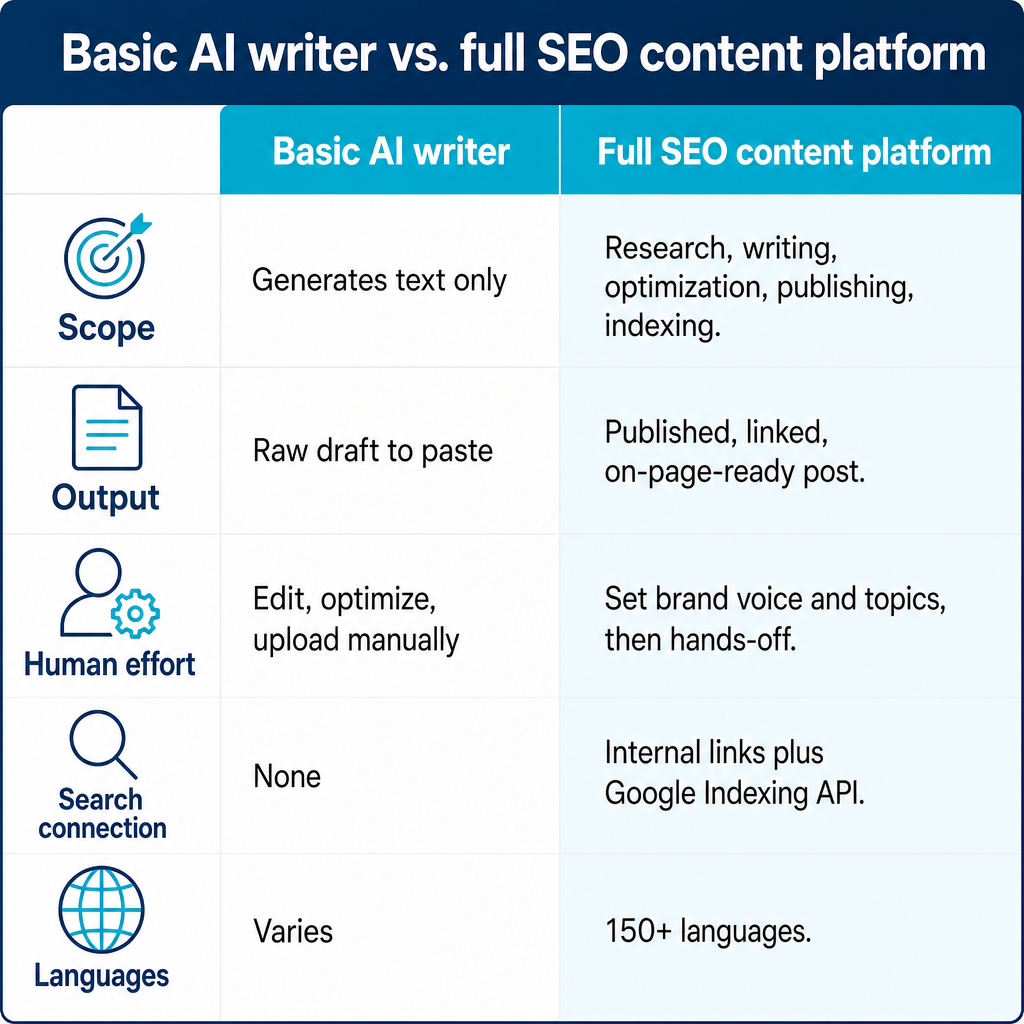
Understanding where a tool sits on that spectrum is the single most important thing before you compare feature lists. If you buy an editor-only assistant expecting a content engine, you'll be disappointed. If you buy a full platform expecting to still write everything yourself, you'll have paid for capacity you never use. Knowing which problem you're solving is half the decision.
Where it fits in your growth workflow
Organic growth is a chain of tasks, and every link has to hold. A typical SEO content workflow runs through topic and keyword research, briefing, drafting, editing and on-page optimization, uploading, and finally publishing and indexing. That's six or seven distinct jobs, and in most small teams they're spread across five or more separate tools plus at least one human juggling logins.
That fragmentation is where momentum dies. Each handoff is a chance for something to get dropped: the keyword that never made it into the brief, the meta description nobody wrote, the internal link that was supposed to point at last month's post. The more tools in the chain, the more coordination overhead you carry, and coordination overhead is invisible until it quietly eats your publishing schedule.
This is the practical argument for consolidation. When you automate your SEO content workflow from start to finish, the handoffs disappear because there's nobody to hand off to — the same system that found the keyword also writes the draft, adds the links, and pushes it live. Our own platform publishes original, brand-voice blog content daily on autopilot precisely so the chain never breaks between research and a live URL.
That doesn't make the individual steps less important. It means the software has to be genuinely good at all of them rather than excellent at one and absent from the rest. A tool that writes beautifully but can't publish still leaves you doing manual uploads. A tool that optimizes on-page elements but can't research topics still leaves you staring at a blank keyword list. The value of an integrated approach is only real if each stage actually pulls its weight.
The features that decide whether you rank
Once you know you want more than a text generator, the question becomes which capabilities separate software that produces content from software that produces traffic. These are the areas worth scrutinizing, and for each one it helps to ask not just "does the tool do this?" but "does it do it well enough to matter for rankings?"
Research and topic strategy. Ranking starts before a single word is written. Keyword and topic research determines whether you're targeting demand that exists and intent you can actually satisfy. Weak research produces well-written posts about things nobody searches for. Look for software that surfaces topics tied to your business goals, not just high-volume keywords in a vacuum. Our platform runs keyword research and content planning as its first step so every article aims at real search demand rather than a guess.
Writing quality and brand voice. Depth and originality are what separate content that earns links and rankings from generic AI filler. Google's guidance is consistent here: it rewards helpful, reliable, people-first content regardless of whether a human or AI produced it, but low-quality or spammy output can still fall foul of spam policies. That's why fact-checking and voice control aren't luxuries. Content that reads like every other AI post won't build the trust or authority that ranks. We generate original, brand-voice content and run fact-checking as part of the pipeline, because "fast" is worthless if the output is thin.
On-page SEO and internal linking. Internal links help search engines discover new pages and understand how your site is organized, and a strong internal structure supports the topical authority that lifts rankings across a cluster of related posts. Many tools leave linking as a manual afterthought. When linking is automated and contextual, every new article strengthens the ones already published instead of sitting on an island. Our system adds internal links automatically and handles the on-page SEO elements as it writes.
Publishing and indexing. A finished draft that lives in a document isn't earning anything. Google offers an Indexing API that lets site owners notify Google directly about new or updated URLs so they can be crawled sooner. Software that publishes straight to your CMS and then requests indexing compresses the gap between "written" and "discoverable" from weeks to hours. We auto-publish to your site and auto-index through the Google API, which is also what puts fresh content in front of AI assistants like ChatGPT, Claude, Perplexity, and Gemini that increasingly cite indexed pages.
Multi-language and global reach. If you serve more than one market, language coverage is a hard constraint, not a nice-to-have. A tool that only writes English caps your addressable audience the moment you cross a border. Our platform supports 150+ languages, so a multilingual content program doesn't require a separate stack for each locale.
Run any tool you're considering against these five. A product that's strong on writing but silent on publishing, or great at optimization but blind to internal linking, is telling you exactly where you'll still be doing the work by hand.
Inside AymarTech: software that runs the whole engine
We describe the platform as an AI-powered SEO engine rather than a writing assistant because the writing is only one stage of what happens. Here's the actual sequence when the platform is running on your site.
1. Connect your site and set your voice. You link your CMS — WordPress, Shopify, Webflow, Wix, and more — and define your brand voice, topics, and target languages. This is the only part that needs you, and it happens once.
2. Automated research and planning. The platform runs keyword research and builds a content plan aligned with your goals, so you're not the one deciding what to write about every week.
3. AI writing with fact-checking. It drafts long-form, SEO-optimized articles in your brand voice and fact-checks the output, rather than shipping the first thing a model produces.
4. Internal linking and on-brand images. Each article gets contextual internal links to relevant pages and on-brand images, so posts arrive finished rather than as bare text needing assembly.
5. Auto-publishing. Completed articles publish directly to your connected CMS. No copy-paste, no formatting cleanup, no forgotten upload.
6. Indexing and AI visibility. Published URLs are auto-indexed via the Google API so they can surface in search faster and be picked up and cited by major AI assistants.
The throughline is that content goes live daily on autopilot, without hiring writers or juggling separate SEO tools. That's the difference between software that helps you make content and software that runs the content function for you. If you want a wider view of the tool category before deciding, our breakdown of AI SEO writing tools and how to pick the right one walks through the same criteria applied more broadly.
What we deliberately don't do is overstate the pieces we can't quantify for you here. Cadence, review options, and plan details are best confirmed against your specific setup, because the right configuration for a solo founder posting a couple of times a month is different from an agency running dozens of client sites.
AymarTech
See what a fully automated SEO content engine looks like on your site
Walk through the exact research-to-publish workflow so daily, optimized, brand-voice posts go live without you stitching tools together.
See the automated workflowHow to choose the right tool for your business
The honest answer to "which is the right SEO content writing software?" is that it depends on how much of the work you want to keep. Start by placing yourself in one of three rough profiles, because each one points at a different kind of product.
Solo founders and small teams usually need consistency more than volume — a steady stream of quality posts without a full-time content hire. The failure mode here is starting strong and then going silent for two months because life got busy. Automation solves that specific problem: the schedule doesn't depend on your bandwidth. If that's you, prioritize software that publishes on its own and doesn't require you to babysit each post.
SaaS and startup founders are typically building topical authority to own a category before competitors do. That calls for depth, internal linking that connects related posts into clusters, and enough throughput to cover a topic properly. A tool that produces isolated, well-written one-offs won't build the interconnected library that authority requires. Prioritize research quality, automatic internal linking, and the ability to sustain output.
Marketing teams and agencies need scale without a proportional increase in headcount, often across multiple sites, brands, or languages. Here the deciding factors are multi-CMS publishing, brand-voice control that holds across accounts, and language coverage. A tool that can't publish to every client's platform or match distinct brand voices creates more work than it removes.
Whichever profile fits, put every candidate through the same short interrogation before you buy. Does it actually publish, or just draft? Can it match my brand voice, or does everything sound the same? Does it research topics, or expect me to supply them? Does it handle internal linking and indexing, or stop at the text? Will it work in my languages and my CMS? The answers usually collapse a long shortlist fast.
Weigh all of that against the real alternative, which is rarely "do nothing." It's usually hiring writers and an SEO specialist, or licensing separate tools for research, writing, optimization, and publishing and stitching them together yourself. Both routes carry cost and coordination that a single automated platform is designed to absorb. When you're specifically after hands-off growth across one or many sites and languages, that's the case we built our platform to make. For a deeper look at judging tools by outcomes rather than features, our guide to AI SEO writing tools that actually grow traffic is a useful companion to this one.
Frequently asked questions
Is SEO content writing software safe to use for Google rankings?
Yes, when the output is genuinely helpful. Google's position is that it rewards people-first, reliable content regardless of whether a human or AI produced it — what it penalizes is low-quality or spammy content. So the safety of any tool comes down to quality, not the presence of AI. That's why fact-checking and originality matter so much in evaluation. Software that ships thin, generic text carries risk; software that produces accurate, useful, well-structured articles is aligned with what Google says it wants.
How is AymarTech different from a generic AI writer?
A generic AI writer generates a draft and hands it back to you. Our platform runs the full pipeline: keyword research, writing in your brand voice, fact-checking, internal linking, on-brand images, auto-publishing to your CMS, and auto-indexing through the Google API. The output isn't a document you still have to optimize and upload — it's a finished, linked, published article. That end-to-end scope is the practical difference between producing words and producing traffic.
Do I still need human writers or an agency?
Our platform is built for businesses that want organic traffic and AI visibility without hiring writers or juggling SEO tools, so for many teams it replaces that ongoing production cost. Whether you keep humans in the loop for strategy, flagship pieces, or highly specialized content is a business choice. The point of automation here is to remove the repetitive research-to-publish grind, not to forbid human involvement where it adds real value.
Does it support content in languages other than English?
Yes. The platform supports 150+ languages, which makes it suitable for global sites and businesses serving multiple markets from one system rather than assembling a separate toolset for each locale.
Which content platforms can it publish to?
We publish directly to WordPress, Shopify, Webflow, Wix, and more. Because publishing is native, articles go live on your site automatically instead of requiring manual copy-paste and formatting cleanup for each post.
What if my niche is complex or heavily specialized?
Depth and accuracy are exactly where fact-checking and brand-voice control earn their place. The safest way to judge fit for a demanding niche is to tell us the specifics of your topic area, audience, and quality bar so we can show how the platform handles it on your own domain rather than in the abstract.
The real test of any SEO content writing software isn't how it reads in a feature list — it's what your site looks like ninety days after you turn it on. If you want to see fresh, optimized, brand-voice articles publishing to your own domain on a daily cadence and getting indexed automatically, the next step is to run it against your actual site and topics.