
Autopilot Blog Content Vs Freelance Writer
Deciding between autopilot blog content vs freelance writer usually comes down to a tension most teams feel but rarely name: do you want predictable SEO output that runs without you, or bespoke human craft that demands your attention? Both can grow organic traffic. They just carry different costs, risks, and ceilings. Before you commit a budget to either, it helps to see what each approach actually does, where each one breaks down, and the specific situations where one clearly fits better than the other.
Table of contents
- • The decision and the real alternatives
- • What autopilot blog content means with AymarTech
- • What working with a freelance writer looks like
- • Criteria that actually separate the two
- • When autopilot content is the better fit
- • When a freelance writer is the better fit
- • When neither option alone is enough
- • How to evaluate the choice for your site
- • Frequently asked questions
The decision and the real alternatives
For ongoing blog production, you are really choosing between three paths, not two. The first is autopilot blog content through an AI-powered SEO platform like ours at AymarTech. The second is hiring one or more freelance writers on a project or retainer basis. The third is a hybrid or deliberate "neither" setup, where you keep high-stakes pieces in-house or paused and automate the rest.
None of these is universally better. Each solves a different problem and introduces a different risk. A platform removes operational drag but needs guardrails. A freelancer brings human judgment but needs management. The right answer depends on your volume, your SEO ambition, your tolerance for review, and how much time you can actually spend running a content operation.
If you want the broader framing before the comparison, our explainer on what autopilot content marketing is covers the model itself. This piece stays focused on the head-to-head.
What autopilot blog content means with AymarTech
An autopilot platform connects directly to your site and runs the blog pipeline end to end, so you are not briefing writers or stitching tools together. Once your site is connected and your business profile is set, our system studies your site and niche, identifies search-demand keywords and topics instead of relying on generic prompts, and drafts original, fact-checked, SEO-optimized articles in a tone aligned with your brand voice.
From there the work continues without hand-offs. We add internal links that connect new posts to existing pages and product content to strengthen topical authority, generate on-brand images, and fill the on-page elements that usually get skipped: titles, headings, meta descriptions, and alt text. Publishing goes straight to WordPress, Shopify, Webflow, Wix, and similar systems on the content calendar you set.
Two details matter for this comparison specifically. We trigger indexing through the Google Indexing API so content is discoverable faster and eligible to be cited by assistants like ChatGPT, Claude, Perplexity, and Gemini. And we support production in over a hundred languages, which makes localized, multi-market coverage a configuration choice rather than a hiring project. The result is a self-learning workflow that runs with minimal manual intervention once the initial guardrails are in place.
What working with a freelance writer looks like
A freelance blog writer is typically an individual, or a small group, you hire to research, draft, and sometimes optimize posts manually. The arrangement follows a recognizable shape. You or your team define the content strategy, keyword targets, and topic list. You create briefs, supply source materials, and clarify brand voice. The writer researches, drafts, and revises through feedback rounds.
The parts that often surprise newer teams sit on your side of the line. You usually own the SEO tooling, keyword research, content audits, internal linking, and the CMS publishing itself. Communication runs through email, Slack, or a project tool, alongside the quiet but constant work of managing quality and deadlines. This path can be deeply customized, but nearly every step depends on people and process rather than automation, which is both its strength and its ceiling.
Criteria that actually separate the two
The fairest way to compare is criterion by criterion, without pretending one approach wins every row. Each has rows it owns.
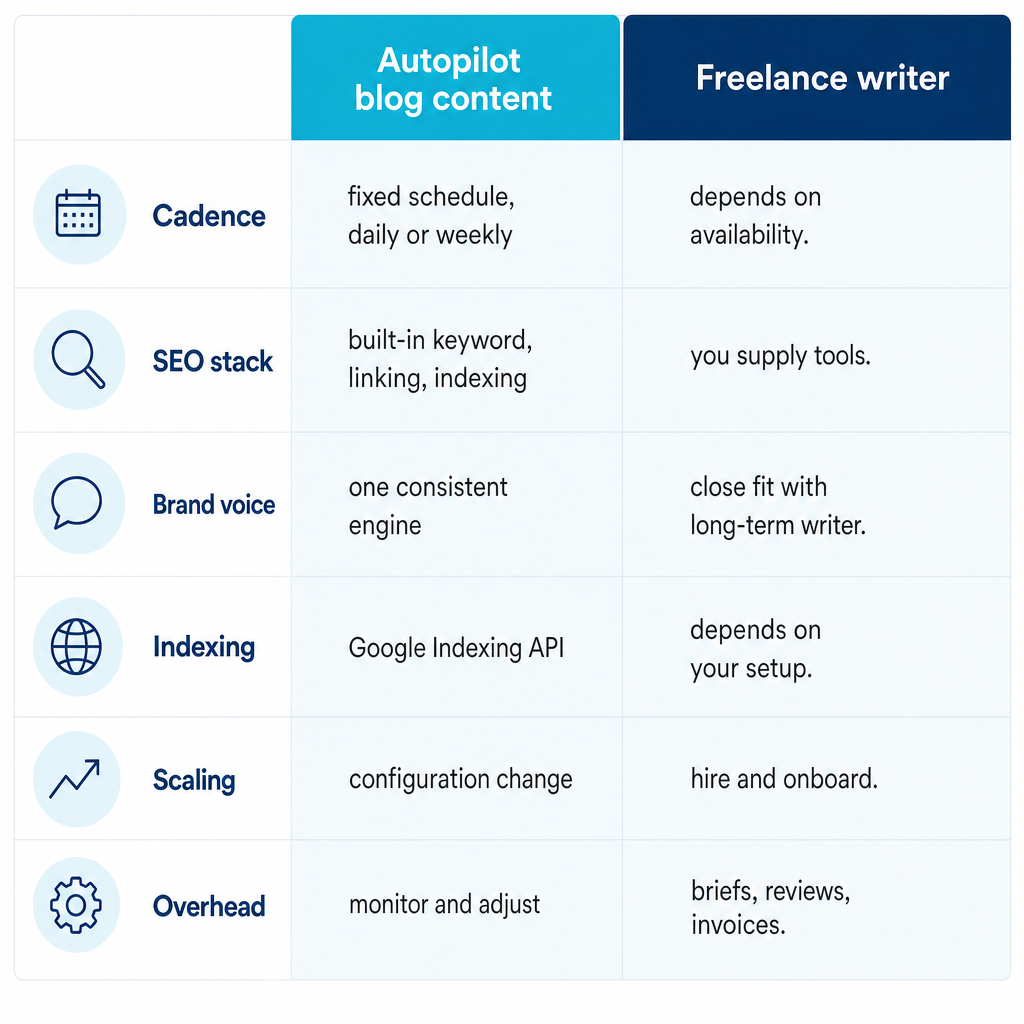
Content quality and subject expertise. Our platform grounds articles in real-time research, applies fact-checking against current sources, and scores drafts on readability, heading hierarchy, and meta fields. That tends to produce consistent, technically solid articles for SEO and informational intent, especially on well-documented topics. A strong freelancer brings domain depth, nuanced industry knowledge, and original perspective, though quality rides heavily on the individual and the strength of your editorial process.
Brand voice and consistency. We learn your voice by analyzing existing site content and apply those patterns across every new article, so tone stays stable at scale because one engine writes everything. A single long-term freelancer can mirror your voice closely through ongoing collaboration, but a rotating pool of writers tends to drift, and holding the line requires active editing and clear guidelines.
SEO depth and implementation. We bundle keyword discovery, intent-matched planning, on-page optimization, internal linking, and SEO scoring into one pipeline, then publish with structured headings, meta tags, and links pointing to product and collection pages. Many freelance writers understand on-page basics, but few own the full technical stack, so you usually remain responsible for tools and implementation or hire an SEO strategist separately.
Visibility in AI assistants and indexing. Beyond publishing, we trigger Google indexing via API, which helps posts surface faster and makes them eligible for citation inside assistants like ChatGPT, Perplexity, Claude, and Gemini. A freelancer can write excellent content, but fast indexing and assistant visibility then depend on your own technical setup and monitoring.
Volume, cadence, and scalability. The platform is built to publish on a fixed, predictable schedule without burning people out or slipping deadlines, and moving from a few posts a month to dozens is largely a settings change. A freelancer's cadence tracks their availability, and scaling usually means hiring more writers and running a larger editorial operation.
Operational overhead. After setup, you mainly monitor performance and occasionally adjust strategy while we handle research, drafting, optimization, linking, and publishing, with no invoices or contractor onboarding to manage. Freelance work carries ongoing effort across sourcing, negotiating, briefing, reviewing, and scheduling, and that overhead grows as production grows.
Flexibility for high-stakes content. Autopilot excels at evergreen SEO articles, product-adjacent education, and structured informational content. For highly opinionated thought leadership, complex narratives, interviews, or regulated topics needing legal review, human oversight and sometimes manual drafting remain valuable, and that is where a skilled writer's judgment earns its keep.
Risk and reliability. Our fact-checking and real-time research reduce the chance of outdated claims and obvious inaccuracies, though automated systems can still err, so regulated fields should keep a review step. Human writers can also introduce bias or lean on stale sources without rigorous standards, but they can be briefed explicitly on legal constraints and house rules.
When autopilot content is the better fit
Autopilot blog content tends to win when the problem is scale and consistency rather than bespoke craft. It fits when you need a steady stream of SEO articles, daily or weekly, without expanding headcount. It fits when your priority is hands-off organic growth and AI-assistant visibility rather than editorial experimentation.
It also fits when you want one platform to handle keyword research, writing, optimization, internal linking, and publishing to WordPress, Shopify, Webflow, or Wix, instead of coordinating separate vendors and tools. Teams running multiple languages or markets lean this way for the same reason: localized content streams are hard to manage by hand. And if your marketing team is small, overstretched, or focused on campaigns rather than running an in-house newsroom, automation closes a gap you would otherwise have to hire into.
When a freelance writer is the better fit
A freelance writer is usually the stronger choice when the value lives in distinctiveness. If your strategy leans on original reporting, narrative case studies, or signature thought leadership, a human's perspective is hard to replace. The same holds in a narrow, complex niche where lived expertise and interviews matter more than a high volume of keyword-driven posts.
A freelancer also fits cleanly when you already run strong internal SEO processes and only need tailored prose to drop into existing briefs. If you value real-time collaboration, brainstorming angles, adjusting tone in conversation, and building a long creative relationship, that is human territory. And when your cadence is modest, roughly two to four posts a month, the overhead of managing one or two writers stays comfortable rather than consuming.
When neither option alone is enough
Plenty of teams land in the middle on purpose. A common hybrid uses autopilot content for baseline SEO coverage, then has an in-house marketer or editor review, adapt, or expand the highest-value posts before they go live, which is sensible in regulated or high-stakes topics.
Another split lets autopilot handle ongoing educational and product-adjacent content while a freelancer or internal team owns flagship work: major launches, founder essays, deep industry analysis. There is also a valid pause case. If your positioning is shifting fast, or you lack a clear ideal customer profile and keyword strategy, investing in strategy first beats scaling either path into an unclear target.
How to evaluate the choice for your site
The cleanest way to decide is to benchmark autopilot output and effort against your current or planned freelance setup, using concrete references rather than assumptions. Three steps make that comparison honest.
Start by reviewing our live blog examples to see how autopilot articles read across different industries and CMS setups, so you are judging real output, not a pitch. Then read the how it works overview to understand connection, scheduling, and the guardrails you keep control of. Finally, weigh what each path costs against your goals; if you want to dig into that side specifically, our breakdown of AI content automation cost frames the trade-off without turning into a line-item invoice.
From there, the decision gets practical. Match your desired volume, SEO ambition, risk tolerance, and appetite for ongoing management to the path, or the blend, that fits all four at once. If you are unsure which cadence and scope make sense for your niche, tell us your site, your target markets, and how many posts a month you are aiming for, and we can map a realistic plan to it.
Frequently asked questions
Will autopilot blog content replace my freelance writers entirely?
Not necessarily. Many teams use autopilot for ongoing SEO coverage and keep one writer or editor for brand-critical and complex pieces. It reduces dependence on freelancers for routine articles without eliminating the need for human storytelling and oversight.
Can autopilot content match my brand voice as well as a good writer?
We analyze your existing site and content to learn tone, style, and positioning, then apply that profile across new articles. A long-term freelancer can mirror your voice closely too, but autopilot delivers more consistency across dozens or hundreds of posts with less training time.
How does autopilot content affect SEO compared to a freelancer?
Because we integrate keyword discovery, planning, fact-checked drafting, on-page SEO, internal linking, and fast indexing via Google's API, posts align with search demand and technical best practices by default. Freelancers can write strong content, but matching that implementation usually needs separate tools and processes your team manages.
Is autopilot blog content safe for regulated or sensitive industries?
Autopilot reduces some risk by grounding content in current research and fact-checking, but regulated sectors like finance, healthcare, and legal should still enforce human review before publication. In those cases autopilot can draft and structure content while compliance teams approve final versions.
How fast can autopilot start publishing compared to hiring a freelancer?
Once the platform is connected to your site and your profile is configured, it can begin researching and publishing on a schedule shortly after. Hiring and ramping freelancers typically involves sourcing candidates, negotiating terms, and iterating on samples before you reach a reliable cadence.