
What Is Autopilot Content Marketing?
Autopilot content marketing is a system that continuously researches, writes, optimizes, and publishes blog content for your brand with minimal manual involvement — so your site keeps growing while your team works on higher-value things. If you have been asking what is autopilot content marketing, the short version is this: instead of a human pushing every post through research, drafting, editing, SEO, uploading, and indexing by hand, a connected AI workflow owns most of that pipeline once you set the strategy and guardrails.
That single shift — from manual handoffs to an always-on engine — is what separates "autopilot" from simply writing faster. Below, we define the model, explain how the pieces actually work, map your real options, and give you the criteria that matter when you decide whether to run your blog this way.
Table of contents
- • The decision behind autopilot content marketing
- • How autopilot content marketing works in practice
- • Manual, semi-automated, and full autopilot
- • Decision criteria for choosing a platform
- • Risks and how to manage them
- • Where AymarTech fits
- • Frequently asked questions
The decision behind autopilot content marketing
The real question is not "is AI good at writing?" It is whether you want content marketing to stay a manually managed workflow or become a semi- or fully automated pipeline that runs without a human at every step.
In a manual model, people decide what to write, brief writers, draft, edit, optimize, upload into the CMS, and request indexing for every single post. That gives maximum control, but it is slow, expensive, and hard to scale past a handful of articles a month. Autopilot flips the default: the system handles execution, and people define audience, voice, and strategy.
For a small business owner, a SaaS founder, or a lean marketing team, the decision usually comes down to three honest questions:
- Do we want consistent, search-optimized blog content without hiring a full content team?
- Are we comfortable letting a system research, write, and publish under our brand voice, as long as we set the rules and can review?
- Do we care about being cited by AI assistants like ChatGPT, Claude, Perplexity, and Gemini, not just ranking on Google?
If your answers lean toward yes, autopilot content marketing is worth evaluating seriously. If you need line-by-line human control over every sentence for legal or brand reasons, a lighter, semi-automated setup may fit better. Our own explainer on what an AI-powered SEO tool actually is walks through where these tools sit in a modern stack.
How autopilot content marketing works in practice
Implementations differ, but mature autopilot systems share the same underlying mechanisms. The point is not one clever feature — it is that the steps are connected, so content flows from idea to indexed post without a person carrying it between tools.
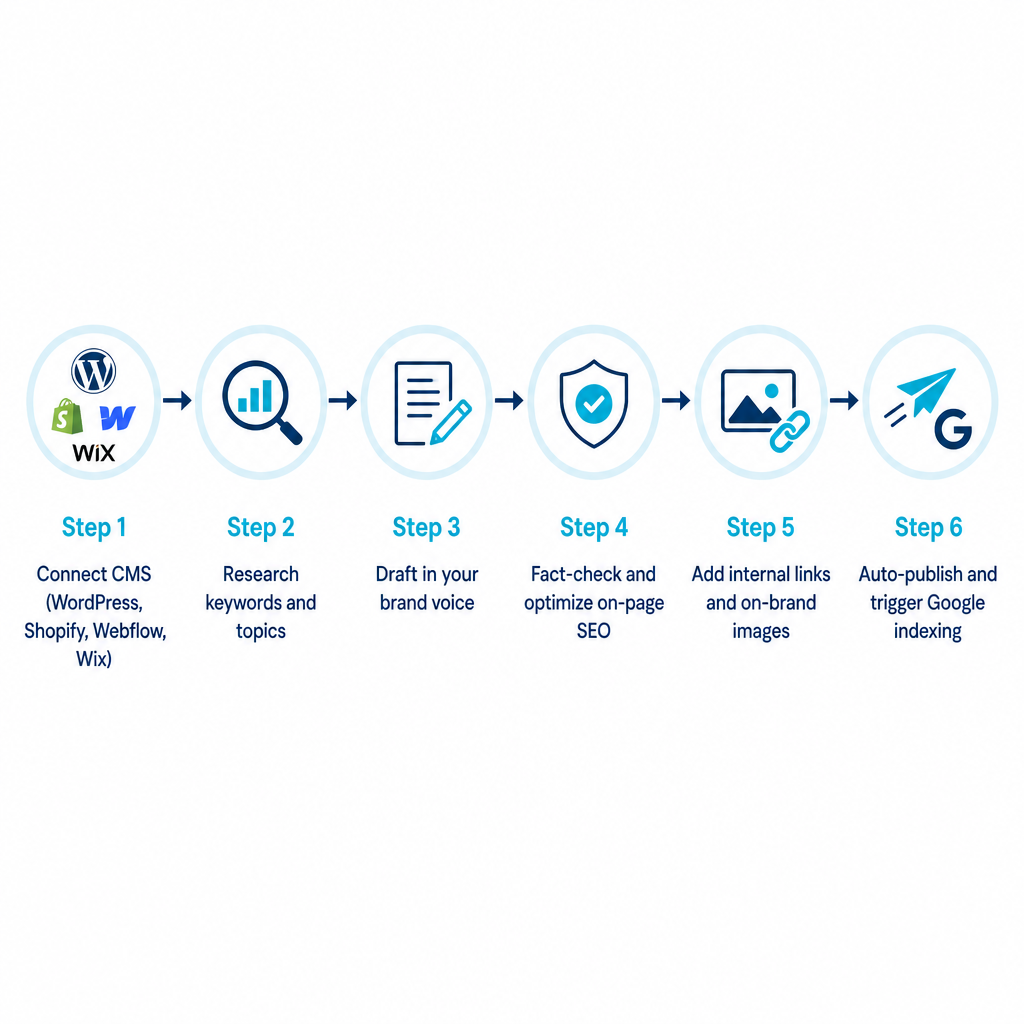
It connects to your website and content stack. An autopilot platform integrates directly with your CMS — WordPress, Shopify, Webflow, Wix, and others — so it understands your existing content, site structure, and publishing workflow. That connection is what lets it manage drafts, schedule publications, and ship finished articles without anyone copying and pasting. At AymarTech, we use that same integration to publish completed posts on a schedule you define.
It finds opportunities through ongoing research. Rather than waiting for you to hand it a topic, the system performs continuous keyword and topic research to surface queries your business can realistically rank for. We combine search data with AI to target low-competition keywords and topical clusters aligned to your business profile, so content is demand-driven instead of arbitrary.
It drafts in your brand voice. The models work from your brand inputs — tone, positioning, guidelines — to produce original articles that match your voice and the intent behind the target query. You define the voice once; the system applies it to every article rather than churning out generic filler.
It fact-checks and optimizes. Quality autopilot layers research, citations, and on-page optimization on top of the raw draft: checking claims against current sources, structuring headings, tuning keyword use, and applying titles and meta descriptions. Our pipeline pairs real-time research and fact-checking with on-page SEO so a post is search-ready when it lands.
It adds internal links and on-brand images. Thoughtful internal links reinforce your site's topical authority, and visuals keep posts from becoming a wall of text. We add smart internal links and generate on-brand images as part of each post, so content looks finished the moment it reaches your CMS.
It publishes and triggers indexing. The defining feature is hands-off publishing. Once an article clears whatever review you set, the platform publishes it and notifies search engines. We auto-publish to WordPress, Shopify, Webflow, Wix, and other supported systems, then use the Google Indexing API so new posts can enter search results faster and be discovered by AI assistants like ChatGPT, Claude, Perplexity, and Gemini. If you want a deeper look at the plumbing, our guide on how AI SEO automation works breaks each stage down further.
Manual, semi-automated, and full autopilot
Understanding autopilot also means seeing where it sits among your options. Most teams fall into one of three models, and the difference is mostly about how much human effort moves content between stages.
| Model | Who runs the pipeline | Control | Scalability |
|---|---|---|---|
| Manual | A human team owns every step | Highest | Low, cost-bound |
| Semi-automated | Point tools stitched together by people | Medium | Medium, coordination-heavy |
| Full autopilot | One system owns research to publishing | Strategy-level | High |
In the manual model, a team handles strategy, briefs, writing, editing, SEO, publishing, and analytics. You get maximum control at the cost of speed and scale.
In the semi-automated model, you assemble point tools — keyword research software, an AI writing assistant, an SEO plugin, CMS scheduling. Automation exists inside each tool, but a person still coordinates the handoffs and carries drafts from one stage to the next.
In full autopilot, a single system owns the pipeline from research through publishing and indexing, while people focus on strategy, brand inputs, and periodic review. In practice, that looks like a platform that researches keywords, drafts in your voice, optimizes, adds links and images, and publishes on a set cadence. AymarTech sits in this full-autopilot category — a content operating system that automates the whole SEO content lifecycle, not just the writing step.
Decision criteria for choosing a platform
When you evaluate autopilot content marketing, a few criteria matter more than any headline feature list.
Scope of automation. Look for systems that genuinely cover research, drafting, optimization, internal linking, images, publishing, and indexing — not just one or two of those. Partial automation still leaves you doing the tedious middle steps.
Brand-voice fidelity. Your blog is part of your brand, so the platform should let you define tone, positioning, and guidelines and then honor them in every article. We capture your brand voice during onboarding and apply it to daily article generation, so output stays recognizable even at machine scale.
Quality and fact-checking. Not all AI content is equal. Evidence of structured research, fact-checking, and current sources is essential, especially in technical or regulated fields. Our workflow emphasizes real-time research and fact-checking, and independent coverage has described the platform as producing research-backed, SEO-optimized articles without manual effort.
SEO performance and internal linking. Good autopilot strengthens topical authority rather than just adding word count. Demand-driven keyword targeting, deliberate internal links, and clean on-page optimization are non-negotiable. We research low-competition keywords, structure content around search intent, and add internal links that reinforce key themes across your site.
Integrations with your stack. Native support for your CMS decides how "autopilot" the experience actually feels. Direct publishing to WordPress, Shopify, Webflow, and Wix removes the manual copy-paste that quietly eats hours.
Language and market coverage. If you sell across regions or plan to expand, language support matters. Our platform supports 150+ languages, so you can run a multi-language content strategy from one system instead of duplicating tools per market.
Governance and review options. Even on autopilot, you may want approval steps or periodic audits. A good platform lets you set publication cadence, choose review modes, and keep sensitive topics inside guardrails. We let businesses define cadence and parameters so automation stays inside your comfort zone. If budget is part of your decision, our breakdown of what SEO content automation costs per month puts real numbers next to the trade-offs.
Risks and how to manage them
Autopilot content marketing brings specific risks worth naming honestly, because the mitigation is usually straightforward once you know what to watch for.
- Generic or off-brand content when the system is not properly configured with your voice and positioning.
- Outdated or incorrect information when there is no fact-checking layer or the tool relies on stale data.
- SEO bloat from publishing too often on low-value topics, which can dilute rather than build authority.
- Over-reliance on automation that lets you miss a strategic pivot or a messaging change.
Managing these comes down to a few habits: invest real time upfront defining brand voice and strategy, choose a platform that builds in research and fact-checking, set a sensible publication cadence instead of maximizing volume, and keep human oversight on sensitive or regulated topics. Our focus on research-backed drafting, fact-checking, internal linking, and Google API indexing is meant to keep autopilot output tied to real search demand and factual accuracy — not just "more content."
Where AymarTech fits
AymarTech is an AI-powered SEO platform built to put your blog content marketing on autopilot while targeting both Google rankings and visibility inside AI assistants. Once your site is connected, we:
- Research low-competition, high-intent keywords and topics relevant to your business
- Write original, brand-voice articles aimed at organic traffic rather than filler
- Fact-check content and apply on-page SEO, including titles, headings, and meta fields
- Add smart internal links and on-brand images
- Auto-publish finished articles to WordPress, Shopify, Webflow, Wix, and more
- Trigger Google indexing so posts are discoverable quickly and can be cited by tools like ChatGPT, Claude, Perplexity, and Gemini
— all on a consistent, pre-defined schedule. For small businesses, SaaS products, and marketing teams, that means running a professional SEO content program with daily, research-backed posts in 150+ languages, without hiring writers or juggling separate SEO tools.
Frequently asked questions
What is autopilot content marketing in one sentence?
It is a system that continuously researches, writes, optimizes, and publishes content for your brand with minimal manual effort, using AI and automation to run the pipeline end-to-end.
How is it different from using an AI writing assistant?
An AI assistant helps you draft faster but still relies on you for topics, SEO, and publishing. An autopilot system identifies what to write, drafts in your voice, optimizes, and publishes directly to your site, often triggering search indexing automatically.
What does AymarTech automate specifically?
We automate keyword and topic research, brand-voice drafting, fact-checking, internal linking, image generation, on-page SEO, publishing to major CMSs, and Google API indexing, so content enters search and AI ecosystems quickly.
Do I lose control if my content is on autopilot?
No. You define your brand voice, topics, publication schedule, and review preferences, so the system handles execution while you stay in charge of strategy and guardrails.
Is autopilot content marketing safe for regulated industries?
It can be, but only if you choose a platform with strong fact-checking, current data, and configurable review workflows, and you keep human oversight on sensitive topics. Our emphasis on research and fact-checking is designed to support this kind of careful use.