
How To Rank In Ai Search Engines
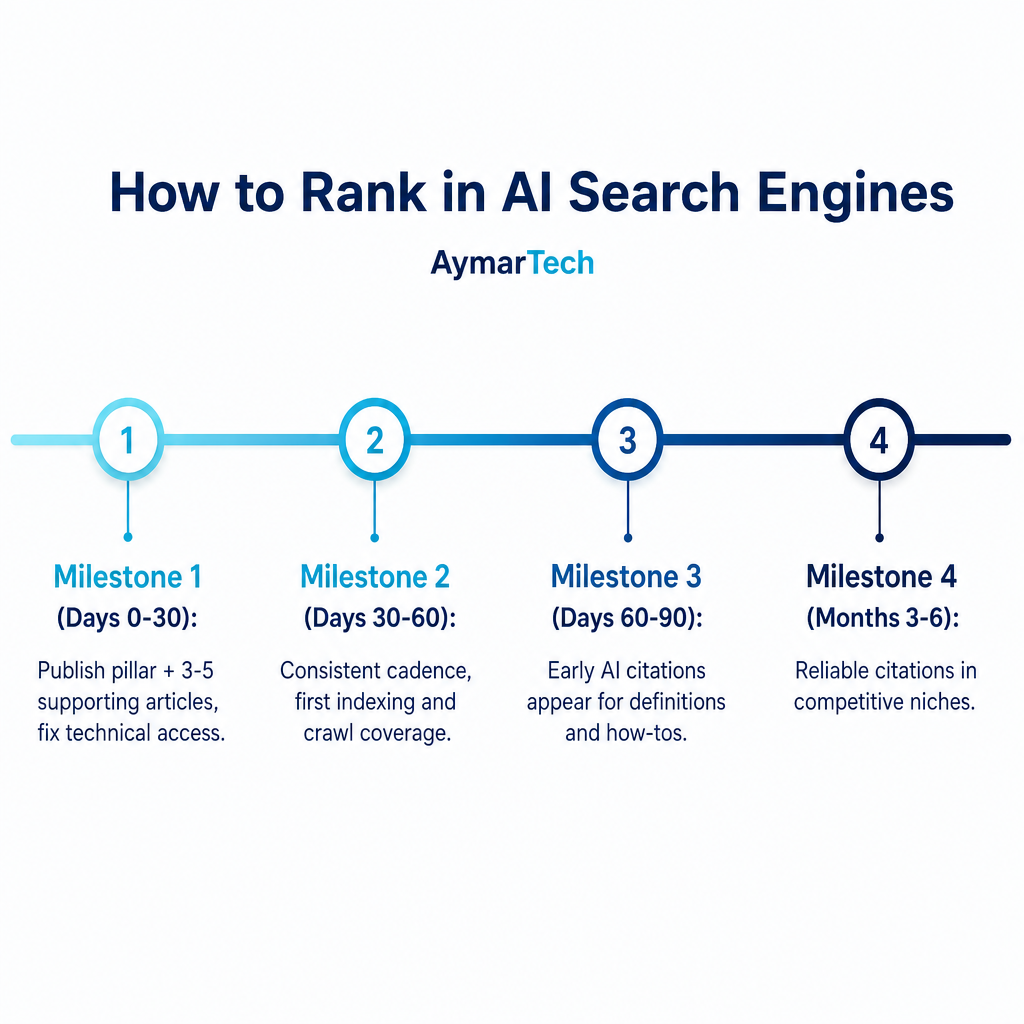
Ranking in AI search engines means your pages get quoted, summarized, and recommended inside AI-generated answers from assistants like ChatGPT, Gemini, and Perplexity — not just listed as blue links. If you want to know how to rank in ai search engines, the honest answer is that it takes a repeatable publishing system, roughly 60–90 days of consistent work before reliable citations show up, and a cost that starts at your own time or around $99/month if you automate it with us at AymarTech. More competitive niches can stretch to three to six months. This guide walks the practical workflow end to end: what you need before you start, the ordered steps, the mistakes that quietly kill results, and when it makes sense to hand the production off.
Table of contents
- • What you actually get, how long it takes, and what it costs
- • Prerequisites: the checklist before you try to rank
- • The step-by-step GEO workflow
- • Common mistakes and how to fix them
- • DIY or hand it to us: the decision point
- • Frequently Asked Questions
What you actually get, how long it takes, and what it costs
When generative engine optimization (GEO) works, it produces three things worth naming so you can measure them. First, your pages appear as inline source references inside an AI answer. Second, your brand gets mentioned by name when someone asks a category or "best tool" question. Third, your content gets synthesized into the step-by-step responses and definitions the assistant generates.
The timeline is the part most people underestimate. Expect 60–90 days of steady publishing before citations become reliable, and plan for three to six months in crowded categories. There is no shortcut that compresses this, because the mechanism is accumulation: more structured, trustworthy pages across a topic give the model more reasons to reach for you.
Cost splits cleanly into two paths. The manual path costs internal time — planning, writing, technical cleanup — plus whatever tools you already pay for. The automated path replaces that labor with a flat fee; our own SEO content automation runs at a documented $99/month as of September 2026, which usually lands below the combined cost of a writer plus a stack of separate SEO tools. If you want the conceptual background on why AI-focused optimization differs from classic search, our explainer SEO But for AI: How to Optimize Content for AI Search Engines covers the "why" so this guide can stay on execution.
Prerequisites: the checklist before you try to rank
Skipping the baseline is the most common reason GEO effort returns nothing. AI engines may still crawl you, but they won't select an unreliable or inaccessible page when the answer has to be trustworthy and easy to extract. Confirm these before you write a single new article:
- Your domain and CMS are live, crawlable, and mobile-friendly.
- Core SEO hygiene is in place: SSL, clean URLs, logical navigation, a current XML sitemap, and a robots.txt that doesn't block major crawlers.
- You already have a handful of original articles relevant to your product or service.
- Brand positioning and voice guidelines exist so content stays consistent.
- You have analytics access — Google Analytics, Search Console, or equivalents — to track traffic and indexing.
- Named authors with real bios and a company About page support E-E-A-T (experience, expertise, authoritativeness, trustworthiness).
- For regulated topics such as health, finance, legal, or safety, you have disclaimers, citations to official sources, and review by qualified people.
- You have a content workflow — manual or automated — that can realistically ship at least 8–16 articles per month to sustain visibility.
The cadence requirement is the one that trips up lean teams. A single burst of posts rarely holds. If producing 8–16 articles monthly sounds unrealistic by hand, that constraint alone often decides the DIY-versus-platform question later in this guide.
The step-by-step GEO workflow
Step 1: Map AI-style demand around your business
Generative engines answer conversational, natural-language questions, not bare keyword strings. Start by listing the real questions customers raise in sales calls, support tickets, and emails. Then translate them into the query shapes AI engines see constantly: "What is…?", "How does … work?", "How to … step by step", "Best [tool] for [audience]", and "Is [solution] worth it for [who]?" Group those into topic clusters — for example AI SEO automation, content automation cost, and AI visibility for brands — because clustering mirrors how language models understand relationships between topics. Finally, tag each cluster's intent as informational, comparison, or transactional, since GEO performs best when a page aligns cleanly with one of them. For the broader planning layer, our guide AI and SEO Strategy: How to Build a Winning Content Engine in 2026 connects clusters to a content engine.
Step 2: Design an architecture AI can pull from
GEO rewards clarity and structure so a model can break your article into answerable pieces. For each cluster, build one pillar article that defines the concept, then surround it with supporting pieces: how-to guides with numbered steps, focused FAQs, and cost or comparison pages. Inside every article, write for extraction — descriptive H2 and H3 headings that mirror real questions, short scannable paragraphs, clear definitions, and explicit step sequences. Where it fits, add FAQPage and HowTo structured data so answer engines can identify question-answer pairs and procedures directly.
Step 3: Make your pages technically accessible to AI crawlers
Most AI search engines still rely on conventional crawling plus extra ranking logic, so the technical floor matters. Confirm robots.txt allows major search and AI crawlers except where privacy or compliance demands a block. Keep XML sitemaps current as you publish, use canonical tags to prevent duplicate-content confusion, and hold page load times fast with solid mobile rendering — slow or broken pages rarely get used as sources. Keep titles, descriptions, and headings descriptive and tied to conversational queries rather than terse keyword fragments.
Step 4: Strengthen trust, E-E-A-T, and compliance signals
Answer engines increasingly weigh credibility signals, especially on sensitive topics. Use real author names with qualifications and links to professional profiles where appropriate, keep a transparent About and Contact page, and cite authoritative first-party sources — government sites, peer-reviewed work — for scientific, medical, financial, or legal claims. Add disclaimers when content touches health, finance, safety, or legal decisions, and stamp sensitive pages with update dates and version notes, since fresh, maintained content tends to be favored. CDC's GEO guidance emphasizes accurate, clearly sourced content specifically to prevent unsafe AI outputs, which is why these safeguards are not optional in regulated spaces.
Step 5: Write for answer extraction, not keyword density
A model needs content it can summarize into a direct answer. Open each article with a one- to two-sentence direct answer that states the question and the outcome. Follow with clearly labeled sections — definitions, steps, pitfalls, FAQ — under descriptive H2 headings. For how-to topics, use numbered steps and concise, action-oriented language. Close with FAQs that address the natural variations of the main query, such as timeline, cost, and DIY versus platform, because that matches how engines bundle related questions. Replace vague phrasing with concrete thresholds and examples so a model can lift precise facts instead of guessing.
Step 6: Build authority beyond your own site
AI engines triangulate — they weigh how your brand appears across the wider web, not just on your domain. Pursue genuine mentions and backlinks from credible sites in your niche, contribute expert quotes or guest articles on the topics you want associated with your brand, and keep your name, logo, and core messaging consistent across your site, social profiles, and major platforms. Steer clear of manipulative link schemes; the GEO literature consistently favors real authority and relevance over manufactured signals.
Step 7: Verify that you are actually ranking
GEO isn't theoretical, so build a verification loop. Run your target questions directly in the assistants: in ChatGPT with web search enabled, inspect the citations panel to see which sources are referenced, and in answer engines like Perplexity, check the inline sources under each answer for your domain. Track patterns — whether you're cited for definitions, how-tos, or comparisons, and which structures get reused. Keep watching conventional SEO metrics too, since GEO extends search rather than replacing it, then expand the winning articles to deepen coverage where citations already appear. OpenAI's documentation on searching the web with ChatGPT confirms those web answers include inspectable citations, which makes it a practical verification channel.
Step 8: Scale with automation instead of manual hustle
Once the workflow is proven, the constraint becomes capacity — consistent, accurate publishing is what compounds AI visibility. This is where we fit for the audiences this guide serves. For small business owners, we research, write, fact-check, and publish original brand-voice content daily, connecting to WordPress, Shopify, Webflow, and Wix and auto-indexing via the Google API so pages are discoverable by both Google and AI assistants. For SaaS and startup founders, we replace the tool stack of keyword research, drafting, manual internal linking, and indexing with an autopilot pipeline, leaving you on review and strategy. For marketing teams and agencies, we deliver GEO-ready content across multiple clients without new hires. If you want the mechanics first, our piece How to Get Cited by ChatGPT goes deeper on citation specifics.
Common mistakes and how to fix them
Treating GEO as keyword stuffing for AI. Sprinkling "ChatGPT" or "AI search" across a page does nothing for citations. Fix it by focusing on clarity, structured answers, and matched intent — questions, steps, and FAQs instead of repeated phrases.
Publishing thin or generic AI-written content. Answer engines are increasingly tuned to skip vague, unoriginal material. Insist on fact-checked, original examples and brand-specific insight in every article. Our platform embeds research and verification into the pipeline rather than simply generating text.
Ignoring E-E-A-T and safety on regulated topics. Unverified claims in health, finance, or legal content can remove your site from consideration as a trusted source entirely. Add citations to official sources, clear disclaimers, and qualified review, and never promise outcomes you can't substantiate.
Running no verification loop. Many teams "optimize for AI" and never check whether any engine uses their content. Make testing in ChatGPT, Perplexity, and Gemini a monthly ritual, track which pages get cited, and adjust topics and structure from what you learn.
Treating GEO as a one-off campaign. Freshness and coverage are rewarded, so a handful of posts rarely sustains visibility. Commit to a cadence — one to three articles per week is a workable floor — and lean on automation to keep that realistic for a small team.
DIY or hand it to us: the decision point
The choice is less about ambition and more about volume, risk, and available time. Use these thresholds.
| Decision factor | DIY fits when | A platform like AymarTech fits when |
|---|---|---|
| Monthly volume | Fewer than 4–8 articles | 8–30+ GEO-ready articles |
| Topic risk | Simple, low-risk, non-regulated | Competitive niches needing steady quality |
| Internal capacity | You have SEO and content expertise in-house | No time for research, writing, publishing, indexing |
| Pipeline | You're fine building and testing manually | You want citations without building a pipeline |
A sensible middle path is to run a small pilot — one or two topic clusters — to prove that AI visibility correlates with leads and revenue. Once that link is validated, move to automation so cadence stops depending on anyone's spare hours. If you'd rather not estimate the trade-off blind, tell us your target topics, current publishing volume, and CMS, and we'll map a realistic plan to it.
Frequently Asked Questions
How long does it realistically take to see AI citations?
Most brands see early citations after 60–90 days of consistent, GEO-style publishing, with competitive categories taking closer to three to six months.
How is ranking in AI search engines different from ranking in Google?
Classic SEO aims to appear in search results pages. GEO aims to get your content quoted, summarized, or recommended inside AI-generated answers across tools like ChatGPT, Gemini, Perplexity, and AI overviews.
How can I tell if my site is being used by ChatGPT?
Run your target questions in ChatGPT with web search enabled and inspect the citations and sources section; your domain appears when your pages are used.
Do backlinks still matter for AI search rankings?
Yes. Authoritative mentions and backlinks remain credibility and relevance signals that influence whether generative engines select your content.
Can small local businesses rank in AI search engines?
Yes. Local and niche businesses earn citations by answering specific, location-based questions with clear, trustworthy content while keeping local SEO fundamentals solid.