
How To Get Cited By Chatgpt
Getting cited by ChatGPT comes down to three things working together: your content has to be discoverable through search, it has to answer a real question clearly, and it has to look trustworthy enough that ChatGPT's web search layer chooses it as a source when it builds an answer. There's no secret tag, no backdoor, and no one-off hack. Learning how to get cited by chatgpt is really about becoming the kind of source an AI assistant reaches for when a user asks something in your niche — which, for most small businesses and SaaS teams, means running a consistently indexed, well-structured content program instead of chasing a single trick.
At AymarTech, we build that content engine on autopilot, so the same articles that rank on Google are also the ones eligible to be cited inside assistants like ChatGPT, Claude, Perplexity, and Gemini. Below, we break down what citation actually means, how source selection works, and how to decide whether this is worth your attention right now.
Table of contents
- • What "getting cited by ChatGPT" actually means
- • Why ChatGPT citations matter for growth
- • How ChatGPT chooses its sources
- • Turning your site into a ChatGPT-friendly source
- • Where AymarTech fits into the decision
- • Deciding whether to chase AI citations now
- • Risks and limitations to keep in mind
- • Frequently asked questions
What "getting cited by ChatGPT" actually means
When people talk about getting cited by ChatGPT, they usually mean one of two outcomes. The first is your page appearing as a clickable source under a ChatGPT Search answer. The second is your brand being mentioned inside responses from assistants like ChatGPT, Claude, Perplexity, and Gemini.
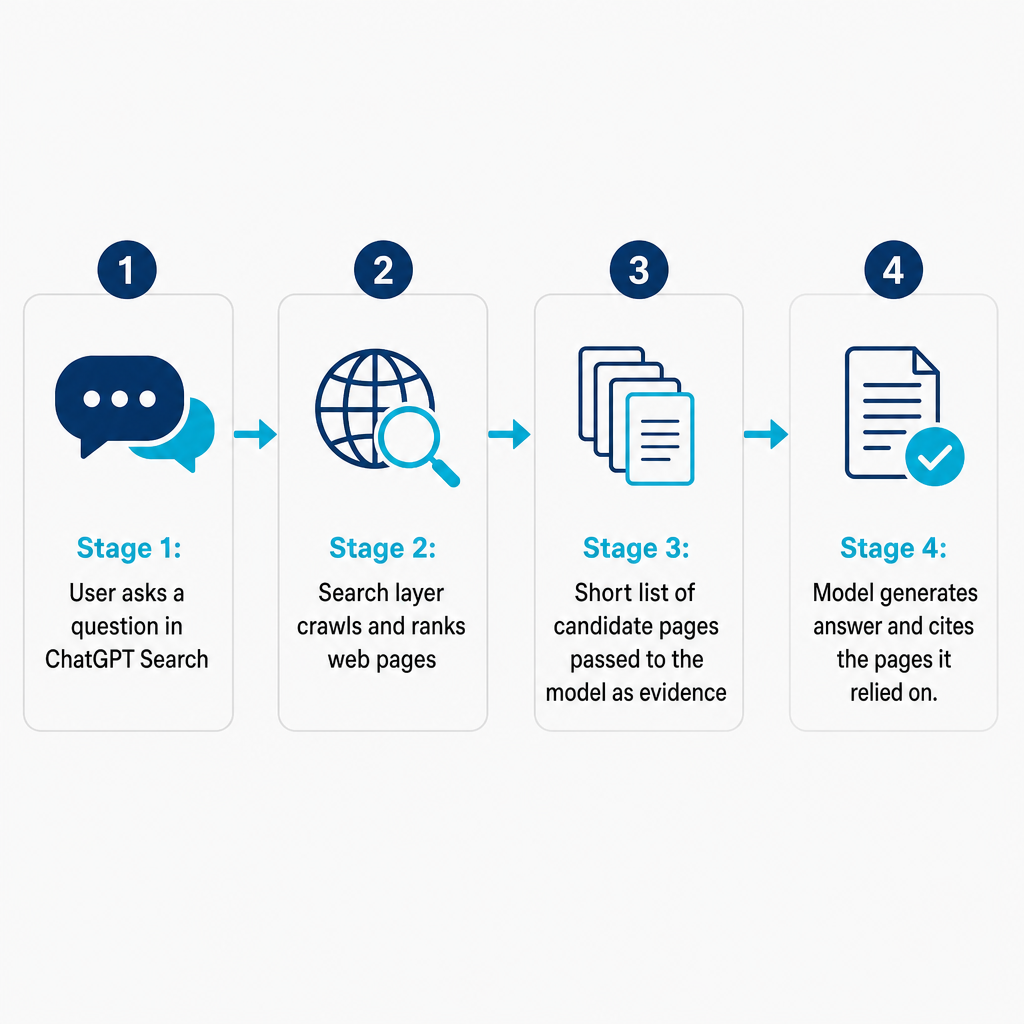
ChatGPT Search now surfaces web sources alongside its answers and lets users open a "Sources" view to see the underlying pages. Those citations are chosen by an integrated search system that crawls the web, ranks pages for a given query, and passes a short list of candidates into the model as evidence. If your page is on that short list and genuinely fits the question, it can show up as a cited source.
The practical takeaway is that a citation is a new discovery channel. A user sees your brand directly inside an AI assistant, then clicks through to your site — much like clicking an organic result in Google. We treat this second surface as a real acquisition channel, not a novelty, and it's driven by the same thing that drives Google visibility: original, indexed content.
Why ChatGPT citations matter for growth
For small business owners, SaaS founders, and marketing teams, being cited inside AI assistants matters for reasons that compound over time.
The first is direct traffic and leads from AI-native searchers. A growing share of queries never leave tools like ChatGPT, Perplexity, Gemini, or Google's AI Overviews. The user asks a question, reads the synthesized answer, and only clicks if a cited source looks relevant and credible. Modern assistants read across the web, synthesize an answer, and cite the sources they leaned on — so being one of those sources is how you stay in the buying conversation.
The second is brand authority through repeated exposure. When users keep seeing the same brands cited underneath AI answers in a niche, familiarity builds — comparable to owning several top positions in a search results page. Analyses of ChatGPT's citations show that domains like Wikipedia, Reddit, and major publishers dominate because they've accumulated topical depth and authority over years, not weeks.
The third is the backlink loop. When your content appears in AI-generated answers, other sites sometimes reference and cite your source material in their own articles, which produces organic backlinks. Those backlinks feed back into your domain authority, which improves both your search rankings and your future odds of being cited again. It's a reinforcing cycle rather than a single win.
The strategic question isn't whether AI citations are nice to have. It's whether you treat them as a core part of your content plan alongside Google rankings. For most US-based small businesses and SaaS tools, the same content investment benefits both surfaces, which is why the answer increasingly leans toward core channel.
How ChatGPT chooses its sources
No one outside OpenAI sees the full ranking formula, but there is enough public first-party and independent evidence to understand the patterns that matter.
ChatGPT runs on a web search layer. OpenAI confirms that when ChatGPT searches the web, it sends a query to a search service, retrieves relevant pages, and includes citations so users can inspect the underlying sources. That single fact carries a lot of weight: classic search fundamentals — crawlability, indexability, relevance, and authority — still decide whether you're even eligible.
Authority and trust signals do most of the sorting. Independent analyses of ChatGPT's citations show a small group of domains capturing a large share of mentions. The pattern mirrors traditional SEO, where sites with strong backlink profiles, clear topical focus, and consistent publishing get favored.
Topical relevance and depth are the tie-breakers. ChatGPT needs pages that directly answer specific questions, so it leans toward content that covers a topic thoroughly, with clear headings and explanations tied to real search intent. That's exactly why we research low-competition, intent-aligned keywords and write fact-checked articles around them — the same depth that ranks on Google is what makes a page a clean answer for an assistant.
Structure and clarity affect whether your page is recognized as a good answer at all. Clean HTML, descriptive headings, logical sections, and plain language make a page easier for both crawlers and models to parse. We build our articles with proper structure, internal links, and external references for precisely this reason.
Freshness matters for anything time-sensitive. OpenAI highlights that web-based answers draw on current data rather than only training-set information, and systems that pair search with a language model tend to favor newer or regularly updated pages when a topic changes over time. That's why our workflow includes scheduled publishing and automatic indexing via the Google API — to shorten the lag between writing something and it becoming discoverable.
Put together, getting cited is less about one clever move and more about meeting all of these conditions consistently across a body of content.
Turning your site into a ChatGPT-friendly source
You don't need a rigid checklist to align with how source selection works. You need to hit a handful of mechanisms reliably.
Anchor content to real questions. Map your audience's actual queries to specific topics and intents — phrases like "how to get cited by chatgpt," "best AI SEO tools for small businesses," or "what is autopilot content marketing." We automate this research and focus on low-competition keywords where smaller brands can realistically win both organic rankings and AI citations. If you want the deeper background on why intent mapping matters, our explainer on what an AI-powered SEO tool actually does walks through it.
Publish original, evidence-backed articles. Assistants are more likely to cite pages that add something new — original explanations, data, or synthesized expertise — over near-duplicates of what already exists. We write fact-checked articles in your brand voice and cross-check claims against multiple web sources before anything publishes. Originality plus verification is what earns the trust that leads to citation.
Make your site easy to crawl and index. If a page isn't indexed, it can't be surfaced in search, and it can't be used as a citation. We connect to CMS platforms like WordPress, Shopify, Webflow, and Wix, auto-publish finished posts, and trigger indexing via the Google API so new content enters search quickly. That technical layer — clean URLs, sitemaps, fast indexing — supports both Google rankings and the assistants that rely on search indices.
Use internal linking and coherent structure. Search systems and AI assistants understand your site better when related content is interlinked, headings reflect a clear hierarchy, and each article owns a distinct niche. We add internal links and structure articles so algorithms read your domain as a topical hub rather than a scattered pile of posts.
Keep a consistent publishing cadence. The high-authority domains in ChatGPT's citation data publish continuously and keep pages current. Our autopilot model is built on that insight, delivering a steady stream of original, indexed articles — often daily — so your domain gradually accumulates the topical depth and authority that source selection rewards.
Underneath all of it is one idea: you want your site to look, to both Google and ChatGPT's search layer, like the most natural answer to the questions your customers ask.
Where AymarTech fits into the decision
The real question for a US-based business isn't how to trick ChatGPT into citing you. It's how to build a content engine that ranks, gets indexed fast, and is credible enough to be cited by AI assistants. Our offer is built around that combined goal.
We connect to your existing website and CMS, research low-competition keywords, and build a content calendar targeting queries your audience actually searches. From there, we write fact-checked SEO articles in your brand voice, add on-brand images, incorporate internal links, and hand over finished posts rather than raw drafts.
We auto-publish to platforms like WordPress, Shopify, Webflow, and Wix and trigger indexing via the Google API, shortening the delay between "article written" and "article discoverable." And we produce original, structured content in 150+ languages, designed to rank on Google and be eligible for citation by ChatGPT, Claude, Perplexity, and Gemini.
If you want to see how the pieces connect end to end, our walkthrough of autopilot content marketing covers the full workflow, and our guide to choosing AI SEO software for small businesses helps you weigh the trade-offs. The short version: instead of manually juggling keyword tools, writers, editors, and technical SEO, we run a single system that produces the kind of content ecosystem a search layer wants to cite.
Deciding whether to chase AI citations now
How much you invest in AI visibility depends on a few practical factors. Use these to gauge where you stand.
| Decision factor | Lean in now if... | Hold or go slow if... |
|---|---|---|
| Audience search behavior | Your buyers already ask questions inside ChatGPT and similar tools | Your customers rarely use AI assistants for research |
| Content baseline | You have some indexed content to build on | You have little or no indexed content yet |
| Internal capacity | Manual keyword, writing, editing, and indexing work is stretching your team | You have a full content team with spare bandwidth |
| Brand and compliance needs | You need original, on-brand, fact-checked output at scale | Every page requires slow manual legal review |
A few notes on reading that table. Consistent topical coverage over time is what earns visibility in ChatGPT's most-cited domains, not one or two isolated posts — so if your content baseline is thin, building a stable foundation comes before chasing citations. And the full manual workflow (research, briefs, writing, editing, fact-checking, technical SEO, publishing, indexing) is resource-heavy, which is exactly the gap an autopilot approach is meant to close for teams that want hands-off organic growth.
If your audience is shifting toward AI search and you lack the time or team for a disciplined program, investing in a system that produces indexable, citation-ready content is usually the more resilient move.
Risks and limitations to keep in mind
Optimizing for ChatGPT citations isn't risk-free, and being honest about the limits keeps expectations realistic.
There are no guarantees. Even with strong content and fast indexing, you cannot force ChatGPT to cite your site. Source selection runs on proprietary algorithms that can change over time.
Models can misinterpret. An assistant may summarize or paraphrase your content imperfectly. Clear structure and plain language reduce this, but they can't eliminate it entirely.
Over-indexing on one channel is fragile. Relying only on AI citations while neglecting classic SEO, email, or social makes your acquisition brittle if ranking behavior shifts. We deliberately build for both Google rankings and AI visibility so the same content asset works on multiple surfaces.
Low-quality automation backfires. Cheap, unstructured, unchecked AI content can hurt how your domain is perceived and lower your odds of being used as a source. Our process includes live research and fact-checking specifically to avoid that trap.
The healthiest framing is to treat getting cited by ChatGPT as a byproduct of doing content marketing well for the AI era — not as an isolated tactic you can force.
Frequently asked questions
What does my site need before ChatGPT can cite it?
Your pages must be crawlable, indexed in search engines, and clearly answer specific user questions with trustworthy, well-structured content. If a page isn't indexed, it can't be surfaced or cited.
Can small, low-authority sites still get cited?
Yes — especially on niche topics with lower competition. You need consistently original, well-optimized content and reliable indexing, which is exactly what our autopilot approach is designed to help smaller domains achieve.
Does publishing more often increase my chances?
Regular, high-quality publishing builds topical depth and freshness signals that help both search rankings and AI source selection. That's why we emphasize ongoing content rather than one-off posts.
Is there a "ChatGPT markup" or special tag I should add?
No. There is no public, special markup just for ChatGPT. The reliable path is solid technical SEO, fast indexing, and clear, evidence-backed content that matches user intent.
How does AymarTech specifically help with getting cited by ChatGPT?
We research keywords, write fact-checked articles in your brand voice, structure them for SEO, auto-publish to your CMS, and trigger indexing via the Google API — so your site steadily becomes a natural, trustworthy source for both Google and AI assistants.