
Is AI SEO Software Worth the Money?
Here is the honest version of the question most buyers actually ask: is AI SEO software worth the money when the real cost isn't just the subscription? For a U.S. buyer looking at AymarTech, our published price is $99 per month, tax included (as shown on our current offer). That number is easy to quote. What it replaces in your workflow, and whether you'll publish what it produces, is the part that decides value — and that part depends on inputs only you can supply.
So instead of a tidy savings promise, this piece walks through the real price drivers, what the fee does and doesn't cover, how to compare it against your actual alternatives, and the exact things to confirm before you commit.
Table of contents
- • What $99 a month buys — and what it doesn't promise
- • When the subscription actually pays off
- • Compare the offer against your real alternatives
- • The cost drivers to check before you buy
- • The quality-control cost nobody prices in
- • Frequently asked questions
What $99 a month buys — and what it doesn't promise
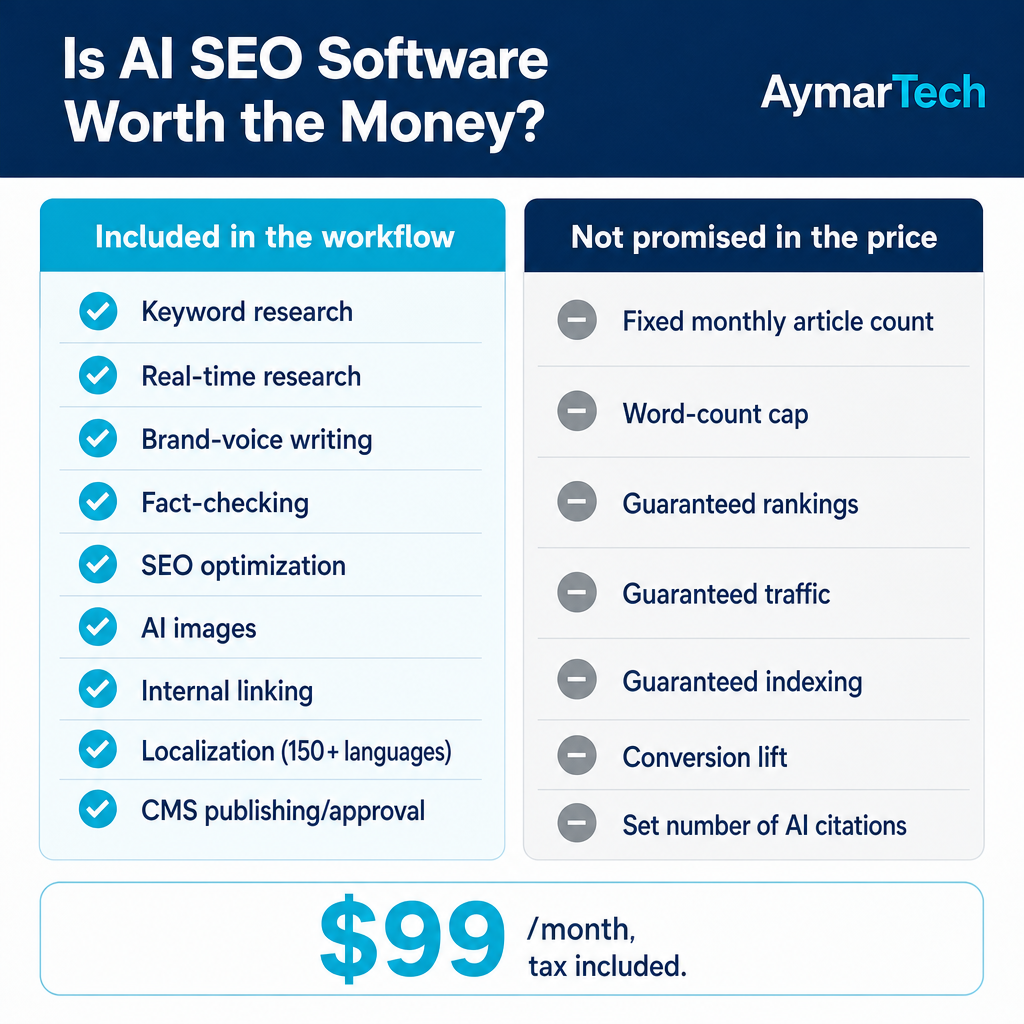
Our $99/month plan bundles a connected content workflow: keyword research, real-time research, writing in your brand voice, fact-checking, SEO optimization, AI-generated images, internal linking, localization, and publishing or approval-based delivery through supported CMS integrations. We support WordPress, Shopify, Webflow, Wix, Notion, plus API and webhook options, and we produce content in 150+ languages.
We describe this as a daily cadence, but the public offer does not pin a fixed monthly article count or a word-count cap to that cadence. That matters for budgeting. If you plan to divide $99 by an assumed number of posts to get a price per article, stop — the inputs to that math aren't published, so any per-article figure you calculate would be a guess, not a quote. Treat "daily" as the stated rhythm and confirm the exact volume and limits that apply to your account before you build a production plan around it.
Just as important is what the price does not promise. The subscription does not come with a guaranteed ranking, a guaranteed traffic increase, a specific indexing result, a conversion lift, or a set number of AI citations. If you're buying on the expectation that a monthly fee locks in those outcomes, this isn't a sound purchase on those terms. If you're buying original, useful pages that you'll review before they go live, the economics get far more interesting.
When the subscription actually pays off
The cleanest way to judge value is against your own workflow, not a hypothetical. Add up what you currently spend each month on writing, keyword research, image creation, editing, internal linking, and publishing. Then add the staff time it takes to coordinate those steps — the briefing, the chasing, the formatting, the final push to live.
From there, a simple break-even test does the work:
Monthly value needed to justify the subscription = $99 + any added review or cleanup cost.
That is a decision rule, not a claim that the platform saves a specific number of hours. The logic cuts both ways. If your team already runs a cheap, effective process that someone enjoys owning, a new subscription may add expense rather than remove it. If content production is stalled because nobody has time to research, draft, and publish, a connected workflow can be worth it even when you still review every post — because the bottleneck, not the writing, is what's costing you.
One comparison worth naming carefully: our homepage frames the offer against roughly $500+/month in scattered subscriptions. That's our own framing, not an independently verified market benchmark, so treat it as context rather than proof. Your actual tool invoices are the honest like-for-like baseline — pull them up and compare line by line.
Compare the offer against your real alternatives
Most "worth it" debates collapse because people compare a flat fee to a headline freelancer rate without matching scope. Match the deliverable first, then compare cost.
| Option | What to compare | Likely fit |
|---|---|---|
| AymarTech: $99/month, tax included | Bundled research, writing, fact-checking, optimization, images, internal links, and CMS publishing; exact article quota and word count are not published. | A business that wants a connected content workflow and will review the output. |
| AI writing tool plus your own process | Subscription(s), research tools, editing time, image work, link insertion, publishing effort — total it from your invoices and staff hours. | A team with someone who can manage quality and move drafts through production. |
| Freelance or in-house writing | Your real per-piece or salary cost, plus briefing, SEO research, edits, and publishing. Compare equivalent deliverables, not headline rates. | Content needing deep subject expertise, interviews, original reporting, or tight editorial control. |
There is no honest universal price-per-article comparison without a defined scope, word count, quality standard, and confirmed monthly output. Because our public page doesn't specify those inputs, the right move is to confirm them for your account rather than divide the fee by an assumed post count. If you want a deeper economic breakdown of automation versus hiring a person, we walk through it in Autopilot Blog Content vs. Freelance Writer, and the broader structure of these fees in how much AI content automation costs.
The cost drivers to check before you buy
These are the details that decide whether a flat monthly fee is genuinely comparable to your current approach. Run them as questions before you subscribe:
- Published volume. Ask how many finished posts your plan produces in a typical month, and whether the daily cadence is guaranteed or subject to setup, approvals, or topic availability.
- Content scope. Confirm expected length, research depth, citations, and whether specialized or regulated topics get additional review.
- Human review. Pin down what "fact-checked" means operationally, and decide who owns final accuracy for claims, titles, metadata, and images.
- Publishing setup. Check whether your CMS is directly supported, whether you can approve drafts before they publish, and what happens if a custom integration is needed.
- Taxes and billing. The displayed amount is tax included, but confirm the exact amount and billing terms shown at checkout for your account.
- Results measurement. Decide in advance how you'll judge progress — published pages, qualified organic visits, leads, or conversions — without treating rankings or AI mentions as guaranteed deliverables.
The public offer does not disclose a fixed article quota, a word-count cap, or a separate U.S.-specific pricing policy, and it does not promise a particular SEO result. That absence isn't evidence the service lacks a feature or a limit — it simply means these are items to confirm with us for your account before you lean on the subscription for a fixed production plan. You can review the current terms, cadence, and setup on our pricing and offer page.
The quality-control cost nobody prices in
Automation lowers the effort of producing content; it does not remove the need for editorial judgment. Google is explicit that AI-assisted content must meet its Search Essentials and spam policies, and that producing many pages without adding value can run into its scaled-content-abuse policy. Google also states that AI-generated content should be manually reviewed and fact-checked for accuracy and trustworthiness before publication. You can read the primary guidance in Google's notes on AI-generated content and its spam policies.
So review time belongs in your cost calculation, not outside it. A draft that needs extensive correction may not save you much; a useful, accurate draft that fits your brand and needs only a focused read-through can change the math entirely. The only reliable way to tell which you'll get is to test it on your own topics. We advertise a two-day/article free trial with a free keyword calendar, cancellation anytime, and a three-day money-back guarantee after the first paid charge — enough room to inspect the research, check the claims, and run a real CMS workflow before you make the software responsible for routine publishing.
Use that trial as a cost experiment, not a demo. If you'd like a tailored read on whether the subscription replaces more work than it adds, tell us your current content volume, the topics you need covered, your CMS, and who reviews posts today — that's what turns a $99 price tag into an actual value estimate for your business.
Frequently asked questions
How much does AymarTech cost in the U.S.?
We display a price of $99 per month, tax included. The offer also includes a two-day/article free trial, a free keyword calendar, cancellation anytime, and a three-day money-back guarantee after the first paid charge. Confirm the terms at checkout before subscribing.
Does $99 guarantee a certain number of articles?
No specific monthly article count or word-count limit is stated on the public pricing page. We describe a daily cadence, but confirm the exact volume and any applicable limits for your account before you plan around it.
Will AI SEO software guarantee rankings or traffic?
No. We do not publish a guarantee of rankings, traffic, indexing, conversions, or AI citations. Google's guidance emphasizes useful, accurate content and warns against scaled production that adds little value, so treat results as earned over time, not bought with a subscription.
Is the software worth it for a small business?
It can be, if content production is a genuine bottleneck, the included workflow replaces work or tools you already pay for, and the output passes your review. Compare the $99 subscription plus your review time against your current total cost, and don't assume time or traffic savings you haven't measured.
What should I test during the free trial?
Check whether the proposed topics fit your business, whether the research and facts hold up, how much editing each draft needs, whether the brand voice is acceptable, and whether publishing works on your CMS. Those observations give you a sharper value estimate than the price alone.