
What Is AI Content Automation? A Simple Explainer
AI content automation is the use of AI and connected software to run multiple stages of the content lifecycle — topic research, drafting, optimization, fact-checking, publishing, and performance monitoring — as one repeatable workflow instead of a pile of disconnected tools. A basic writing tool turns a prompt into a draft. An automation platform takes the next steps: it chooses the topic, researches it, writes in your brand voice, adds internal links, generates images, and sends the finished post to your CMS. The point isn't to spray out as many AI articles as possible. It's to remove repetitive production work while still producing accurate, useful, original content for a specific audience.
That distinction shapes everything that follows, so we'll define the category clearly, explain how the pieces connect, weigh the real benefits against the real risks, and give you a practical way to judge any platform — including ours.
Table of contents
- • AI writing versus AI content automation
- • How the workflow actually connects
- • The benefits worth paying for
- • The risks you have to manage
- • When it fits your business and when it doesn't
- • How to evaluate a platform
- • How we approach AI content automation
- • Frequently asked questions
AI writing versus AI content automation
People use these terms as if they mean the same thing. They describe different levels of automation, and the gap between them is where most money gets wasted.
| Category | What it usually does | What stays manual |
|---|---|---|
| General AI chatbot | Generates text from a prompt | Research, editing, SEO, publishing, fact-checking |
| AI writing assistant | Drafts, rewrites, or expands content | Topic selection, review, formatting, distribution |
| SEO content tool | Keyword research and optimized drafts | Editorial approval, CMS publishing, quality control |
| AI content automation platform | Connects research, writing, optimization, review, and publishing | Strategy, accountability, sensitive claims, final oversight |
Ask a chatbot to "write a blog post about accounting software" and you get a draft. An automation platform instead analyzes your site, spots an opportunity, researches the subject, writes it in your voice, adds relevant internal links, and delivers the finished post to your CMS. That gap matters because content production has several separate bottlenecks. Faster drafting does nothing for poor topic selection, inaccurate claims, weak structure, or a publishing cadence that stalls every time someone gets busy. Automation earns its keep by connecting those stages, not by typing faster.
How the workflow actually connects
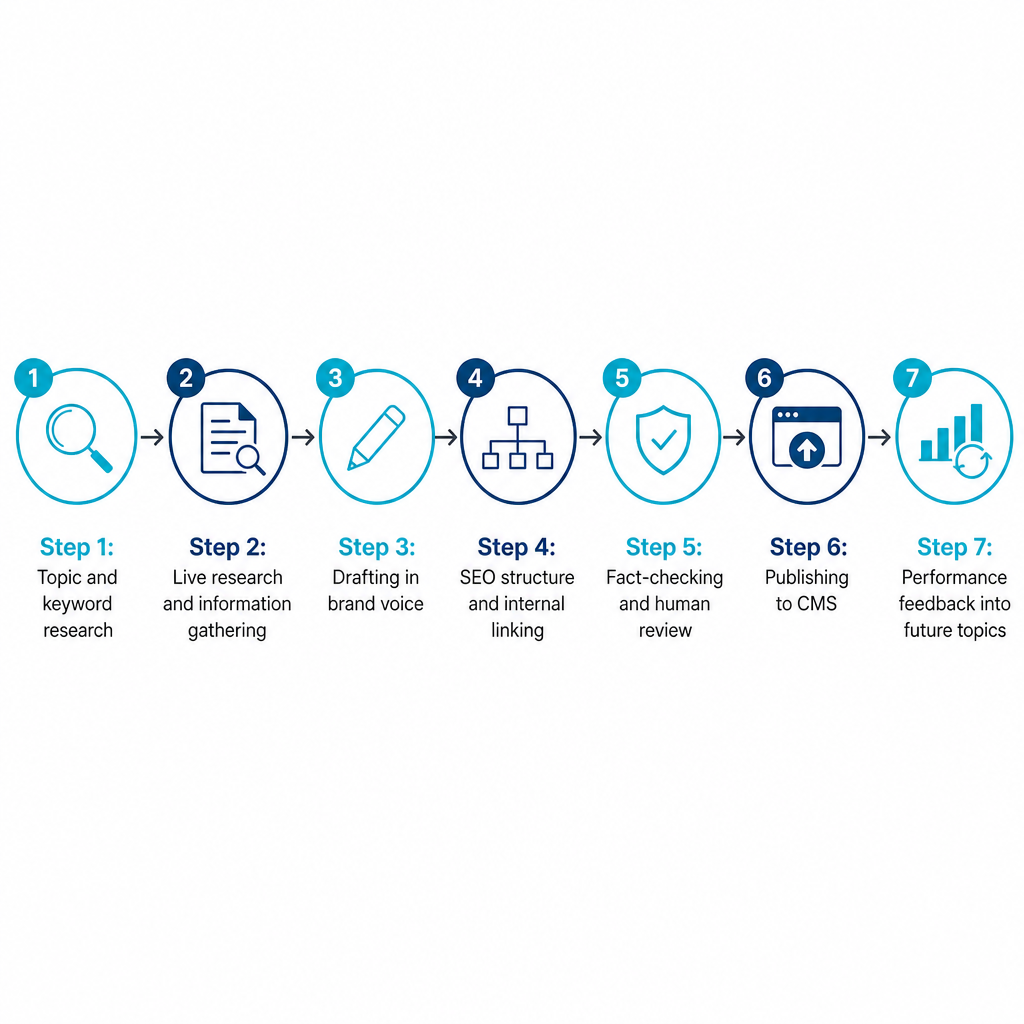
Platforms vary, but most end-to-end systems chain together the same core functions. Seeing how they hand off to each other explains why the category exists.
Topic and keyword research comes first. The system reads your business, your site, competing pages, and candidate search queries, then weighs search intent, topic relevance, competition, existing coverage, and commercial value. The output is usually a content calendar, not one isolated article. A strong system picks topics that make sense for the business rather than chasing volume — a local service firm often gains more from a focused guide to a customer problem than from a broad, brutally competitive keyword.
Research and information gathering runs before drafting. Better platforms pull from live or recent sources instead of leaning only on a model's training data. This step matters because language models predict likely text; they do not automatically confirm whether a statement is current or true. Google specifically recommends manually fact-checking AI-generated content before publication, including titles, meta descriptions, structured data, and image alt text.
Drafting and brand-voice adaptation turns research into an article. Voice controls draw on existing site copy, sample articles, preferred terminology, tone guidance, and words or claims to avoid. Consistency improves, but brand-voice automation does not replace editorial judgment — you still check that the piece sounds like you and makes claims you can support.
SEO structure and internal linking organize the article around intent and apply on-page basics: descriptive titles, logical headings, concise openings, structured metadata, and internal links. Linking is most useful when the system understands your existing content, so a reader can move from a general explanation to a deeper resource. If you want the mechanics behind the pipeline, you can learn how AI SEO automation works, and if you're weighing operating models, compare AI content platforms versus writing agencies.
Fact-checking and quality control compare claims against sources and flag statements that need human eyes. Treat this as a layer, not a guarantee. Human review stays essential for medical, legal, financial, and safety advice, statistics, product specifications, pricing, regulatory information, and anything about competitors or customer results.
Publishing and distribution send approved content to your CMS, with options for automatic publishing, approval queues, scheduling, and integrations. Publishing automation removes repetitive copying and formatting. It does not make a weak article valuable, and it cannot force Google to index or rank a page.
Performance feedback closes the loop. Systems that read search performance data can shape future topics — which pages earn clicks, which queries reveal a content gap, which articles need stronger internal links, and which pages are due for an update.
The benefits worth paying for
The honest case for automation is operational, not magical. It lowers production overhead by cutting the hours spent on repetitive research, outlining, formatting, linking, and publishing — useful when a business can't justify a full content team. It supports a consistent publishing schedule, because the team doesn't restart the entire process for every article. It makes the brand experience more repeatable when it uses approved examples and style guidance across articles and channels.
It also closes a gap most teams underrate: the handoff problem. Separate tools create friction when one finds keywords, another drafts, and a human still has to move everything into the CMS. Connecting those stages reduces manual coordination and the errors that creep in between them. And for teams expanding beyond one market, multilingual publishing can generate content in many languages — though localization still needs review, since direct translation misses regional terminology, cultural context, and search behavior.
One caveat runs through all of this: consistency alone is not a ranking strategy. Publishing more pages helps only when those pages are genuinely useful and relevant.
The risks you have to manage
Every benefit has a failure mode, and pretending otherwise is how businesses get burned.
Inaccurate information is the first. AI can produce plausible but wrong claims, and the risk climbs when an article cites current facts, statistics, or named sources. The safeguard is source-based research followed by human review of important claims; Google says AI-generated content should be checked for accuracy and trustworthiness before it goes live.
Generic content is the quieter danger. A page can be grammatically polished and still add nothing a reader can't find elsewhere. Useful content contributes something concrete — original examples, first-hand experience, clear decision criteria, local context, product-specific knowledge, or transparent limitations.
Search-policy problems follow from both. Google's scaled content abuse policy focuses on the purpose and value of content, not whether a human or AI made it. The policy specifically lists using generative AI to create many pages without adding user value as an example of abuse, and that can lead to lower visibility or removal from Search. The safer principle is blunt: automate production work, not usefulness.
Brand and compliance risk is the one that reaches the legal team. An automated article can promise something the business can't deliver, misrepresent a product, strike the wrong tone, copy source language too closely, or give regulated advice without the right qualification. Define in advance which topics, claims, and content types always require human approval.
Over-publishing rounds out the list. Daily output becomes a liability when it produces overlapping, thin, or outdated pages. A smaller set of strong articles usually beats a large archive of near-duplicates.
When it fits your business and when it doesn't
The real question is never "AI or humans." It's which parts of production should be automated and which decisions stay human-owned.
Automation tends to fit when you have a clear audience and subject area, when organic search is a long-term acquisition channel, when production is inconsistent or too expensive, when your site already holds enough content to establish a voice, and when someone can review high-risk or high-value pieces before they publish.
It's a poor fit when the business has no defined positioning, when every article demands specialist first-hand expertise, when content is heavily regulated, when nobody can review important claims, or when the goal is simply to flood search results with minimal editing. If that last description sounds like the plan, automation will accelerate the problem rather than solve it.
How to evaluate a platform
Judge the workflow, not the demo article. A polished sample proves the tool can write one good page; it says nothing about research quality, controls, or publishing reliability. Work through these dimensions instead.
- Research quality: Does it use current sources, identify search intent, and produce evidence an editor can actually review?
- Editorial controls: Can you approve, revise, pause, or reject content before it publishes? Automatic publishing should be optional when risk is high.
- Brand-voice controls: Can you provide examples, terminology, audience details, and prohibited claims — and does it hold up across several real topics, not just the vendor's showcase?
- SEO functionality: Does it handle topic selection, structure, internal linking, metadata, image alt text, and updates, or only keyword insertion?
- CMS compatibility: Does it connect to the system you actually publish on?
- Fact-checking and source transparency: How does it flag claims, present sources, and handle uncertainty? "Fact-checked" is a feature to investigate, not a reason to skip review.
- Measurement: Can you track indexed pages, impressions, clicks, rankings, qualified traffic, and conversions? Traffic alone means little if visitors don't match your audience.
How we approach AI content automation
We built AymarTech as an end-to-end AI SEO content platform rather than a standalone text generator. We connect to your website, research keywords, write fact-checked articles in your brand voice, generate images, add internal links, and publish on a schedule — so the pipeline runs from opportunity to published page with fewer manual handoffs.
In practice, that covers research and keyword selection, content calendars, real-time research, fact-checking, SEO optimization, internal linking, AI-generated images, and CMS publishing. We support publishing to WordPress, Shopify, Webflow, Wix, and more, along with API and webhook delivery, and we generate content in more than 150 languages. Our pipeline also learns from Google Search Console data, so performance informs future topics instead of every article starting from zero.
The design intent matters more than the feature list: we're aimed at founders, solopreneurs, and lean teams that want a controlled content engine, not unrestricted autopublishing. You keep strategy, accuracy, and accountability in human hands while we take over the repetitive work. You can review our content examples or walk through how AymarTech works to see the workflow end to end. Commercial terms change, so check the live plan before you commit.
Frequently asked questions
Does Google penalize AI-generated content?
No, not because AI was used. Google's concern is unoriginal, low-value pages built mainly to manipulate rankings, which can fall under its scaled content abuse policy. Helpful, accurate, original content is judged on its value, not its authorship.
Can AI content rank on Google?
Yes, AI-assisted content can appear in Search when it's helpful, accurate, original, relevant, and aligned with Google's quality and spam policies. No platform can guarantee rankings or indexing.
Should every AI-generated article be reviewed by a person?
For most businesses, yes — especially when articles include factual claims, regulated advice, product details, statistics, or recommendations. Human review also protects brand voice and originality.
Is AI content automation the same as an AI writer?
No. An AI writer mainly produces text. AI content automation connects that writing with research, SEO, review, internal linking, CMS publishing, and measurement, moving content from opportunity to publication with fewer manual steps.
Is AI content automation the same as autopilot marketing?
Not necessarily. Automation describes the technology and workflow; "autopilot" describes how much human involvement remains. A responsible system can automate production while still requiring approval for sensitive or strategic content.