
How To Appear In Chatgpt Answers
There is no submit button for ChatGPT, no secret toggle, and no vendor who can truly promise it. The honest route to appear in ChatGPT answers is narrower and more durable: make your pages crawlable by ChatGPT's search bot, publish content that answers real questions better than the generic alternatives, and give the system enough clarity about your business to reference you with confidence. Eligibility is the floor, not the finish line. OpenAI is explicit that allowing its crawler makes a page eligible, but placement and citation are decided by relevance and reliability, not by a submission process.
This guide is the hub for that work. It defines what "appearing" actually means, explains the mechanisms ChatGPT uses to find and choose sources, and gives you decision criteria for the choices that matter. Where a neighbouring topic deserves its own deep dive, we point you there instead of repeating it.
Table of contents
- • What appearing in ChatGPT answers actually means
- • How ChatGPT finds and chooses sources
- • The eligibility floor: crawler access and public pages
- • The content that gets chosen
- • Tactics that do not reliably work
- • How to measure whether you are appearing
- • Deciding between manual production and an automated platform
- • Frequently asked questions
What appearing in ChatGPT answers actually means
"Appearing" is not a single outcome, and treating it as one leads to the wrong metrics. A business can show up in ChatGPT in several distinct ways: a page cited as a source inside a web-search answer, the brand named in a response about products or local providers, a link offered as further reading, the company used as an example while ChatGPT explains a category, or simple referral traffic from users who click through.
These are related but not interchangeable. A page can be fully visible to search systems yet go uncited for a particular prompt, because the user's exact wording, location, freshness needs, and the strength of competing sources all shift the result. The same page might be cited for one question and omitted for a closely related one. That variability is the core reason AI visibility is a program, not a one-time task.
The useful mental model: your job is not to "rank" for a phrase but to become a source an answer engine can find, understand, trust, and confidently reference. Everything below serves that goal.
How ChatGPT finds and chooses sources
When ChatGPT uses web search, it retrieves information from publicly available pages and selects what looks relevant to the question. OpenAI states plainly that search-result placement is determined by multiple factors and is not guaranteed. That single fact reframes the whole effort. This is a source-quality and discoverability problem, not a keyword-density problem.
In practice, a page has to clear several conditions in sequence. ChatGPT must be able to access it. A search system must be able to understand its topic. The page must give a useful answer to a specific question. The information has to read as credible, current, and relevant. And the business has to be clearly associated with the topic or service in question. Miss one, and the later conditions never get a chance to matter.
The encouraging part is overlap. The same foundations help with Google's AI features, where the guidance favours crawlable, indexable pages and helpful, people-first content, while also warning that meeting the requirements never guarantees crawling, indexing, or serving. You are not building two separate machines. You are building one credible, accessible source and pointing it at both systems.
For a closer look at the citation mechanics specifically, our guide on how ChatGPT chooses and cites sources goes deeper than we will here, and how to rank in AI search engines covers the broader workflow across answer engines.
The eligibility floor: crawler access and public pages
Before content quality matters at all, the page has to be reachable. The most important technical requirement is allowing OAI-SearchBot to crawl your site. OpenAI also advises that publishers confirm their host or CDN permits traffic from OpenAI's published searchbot IP addresses, because a permissive robots.txt means nothing if a firewall or bot-management layer blocks the request upstream.
Start with robots.txt and confirm it does not block the bot. A permissive block for the crawler simply looks like allowing OAI-SearchBot across the paths you want discovered; your configuration may differ if you intentionally restrict sections of the site. Then audit the layers that quietly deny bots without touching robots.txt: the CDN, firewall, hosting rules, bot-management software, login walls, geographic restrictions, rate limits, and server response codes. Any one of them can make an otherwise excellent page invisible.
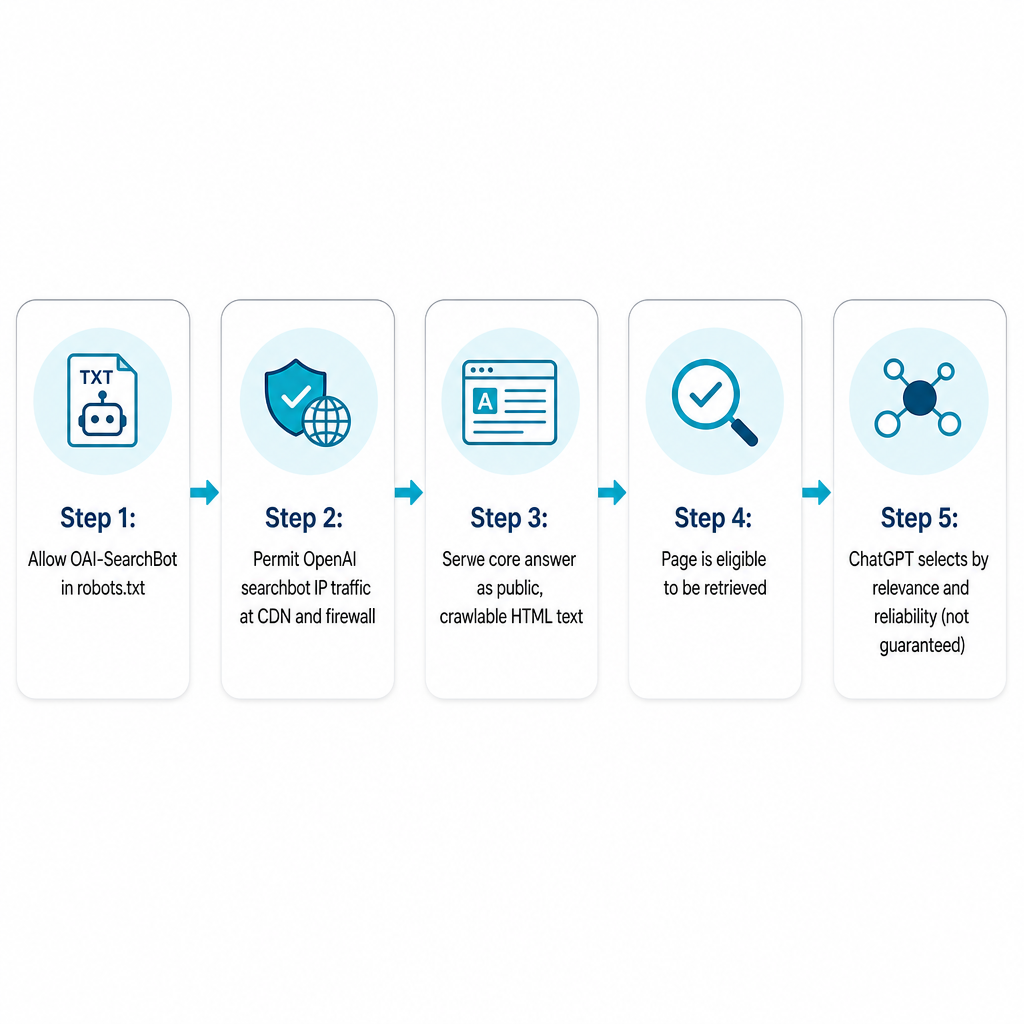
Accessibility also means the useful information is actually public. A page rarely appears in an answer when its substance sits behind a login, a form, a paywall, an image with no text alternative, client-side code that fails to render, a blocked script or stylesheet, or a temporary server error. Serve the core answer in normal, accessible HTML, and keep the important facts in visible text rather than locking them inside images, videos, downloads, or interactive widgets. Allowing the crawler and exposing the text makes a page eligible. It does not force ChatGPT to cite it.
The content that gets chosen
Eligibility gets you into the pool. Being chosen is about answering a specific question better than the competing sources. ChatGPT users ask questions, not bare keywords, so content built around a clear question is far easier to match to an answer. A page titled "Our Marketing Expertise" has nothing to grip; a page answering "how much does local SEO cost for a small business" or "what belongs in a SaaS content brief" gives the system a concrete passage to lift.
The strongest answer pages do the same work near the top: they state the answer in plain language, define the terms that matter, identify who the advice applies to, name the exceptions and limits, support the important claims with evidence, and offer a practical example. That structure helps a human skim and gives a search system clean passages to interpret.
Originality is the second lever, and it is where most pages fail. AI systems already hold enormous amounts of repetitive content, so re-stating the same definition found on dozens of sites gives yours no reason to be selected. Add what only you can: workflow examples, documented customer outcomes, process explanations, proprietary benchmarks, before-and-after results, honest failure cases, data from your own operations. For a small business this does not mean a weekly 5,000-word report. A concise page with one specific, well-supported answer beats a long article full of generalities.
Trust signals turn a useful page into a citable one. Make it easy to answer basic questions about who wrote this and who stands behind it: a named author with relevant credentials, an About page, a contact page, a service area where it applies, visible publication and update dates, sources for statistics, and consistent business details across the web. For regulated or high-stakes subjects such as health, finance, law, and safety, use qualified reviewers and authoritative primary sources, and never present generated text as professional advice.
Two more moves matter at the structural level. First, keep your business entities unambiguous so ChatGPT understands what you are, where you operate, and what you offer: one consistent brand name, a one-sentence description, a dedicated page per important service, named markets, and a clear ideal customer. A SaaS company should keep its main platform, individual features, integrations, free tools, and support documentation distinct rather than blurred together. Second, use structured data correctly but not as a shortcut. Google notes there is no special schema or separate AI file required to appear in its AI features, and that structured data should match the visible content. Markup clarifies what readers can already see; it must never smuggle in claims they cannot.
Freshness and verifiability close the loop. Pages about pricing, features, laws, availability, and statistics drift out of date, so review them after a real change and add a genuine "last updated" date only when you have actually reworked the page. Make claims easy to verify by separating facts from opinion, company claims from independent evidence, and estimates from measured results. Link to primary sources, give statistics their date and context, and if you report an internal result, label it as one and describe the sample or timeframe.
None of this lives in isolation. One article rarely builds strong topical relevance for a competitive subject, so connect related pages into a cluster with descriptive internal links, each page carrying a distinct purpose. Our companion pieces on best practices for AI-citable content and getting cited by Google AI Overviews extend this cluster without repeating it.
Tactics that do not reliably work
Several popular moves are either insufficient alone or actively risky, and they waste the effort you could spend on the fundamentals above.
Repeating the target phrase is the oldest reflex. Using "how to appear in ChatGPT answers" dozens of times does not make a page authoritative; comprehensively answering the underlying question does. Flooding a site with low-value automated pages is a related trap: volume does not substitute for originality or accuracy, and a sprawl of generic pages can dilute quality and make maintenance harder. Hidden text and misleading schema fail for the same structural reason as paywalls, since search and AI systems should receive the same essential information as human readers. Copying or lightly rewriting competitor explanations offers little information gain and invites copyright, quality, and brand-trust problems.
The most important thing to refuse is a guarantee. No vendor can promise that ChatGPT will cite a page for every relevant query, because OpenAI itself says placement is not guaranteed. Treat "guaranteed ChatGPT citations," "instantly ranked in every AI answer," or "a secret trick that forces a mention" as disqualifying claims. Evaluate any provider by its process, evidence, technical controls, and reporting, not by unverifiable promises.
How to measure whether you are appearing
Because answers vary by prompt and moment, treat AI visibility as a set of signals rather than a single ranking position. On the analytics side, OpenAI says publishers who allow OAI-SearchBot can track referral traffic from ChatGPT, and that ChatGPT referral URLs include the utm_source=chatgpt.com parameter, which makes attribution cleaner. Watch ChatGPT referral traffic and its landing pages, assisted conversions, branded searches after AI exposure, and leads that mention ChatGPT or AI search, alongside your normal organic impressions and clicks.
Analytics only shows clicks, so pair it with deliberate manual testing. Run a consistent prompt set and log, for each test, the exact prompt, the date, the location, whether web search was enabled, the sources cited, the answer wording, whether your brand appeared, and whether the result linked to your site. One prompt proves nothing; the pattern over time is the signal. If you want to verify facts inside your own pages before they ship, our guide on fact-checking AI content automatically covers the verification side of the workflow.
Deciding between manual production and an automated platform
The real decision is rarely "AI or not." It is how much consistent execution you can sustain against how much control each page demands. An AI SEO platform earns its place when the bottleneck is steady output rather than a shortage of ideas, covering topic research, briefs, drafting in a defined brand voice, fact-checking workflows, internal linking, image work, CMS publishing, indexing support, and performance monitoring in one loop.
An automated workflow tends to fit when you need regular publishing, your team has limited writing capacity, your topics are repeatable, you want one path from research to publishing, and you can define review rules and quality standards up front. Manual production or specialist review fits better when content carries significant legal, financial, medical, or safety risk, when each article needs original interviews or field research, when a handful of high-value pages matter more than frequency, or when subject-matter experts must sign off.
We built AymarTech for the first situation. We handle automated research, writing, fact-checking, internal linking, brand-voice content, and publishing across platforms including WordPress, Shopify, Webflow, and Wix, with automatic indexing support and production in more than 150 languages. If you want to see the output before committing, our content examples and how it works show the workflow end to end. Automation should support judgment, not replace it; the strongest operating model is automated production with human review on anything that could affect customers, reputation, or compliance.
Frequently asked questions
Can any website appear in ChatGPT answers?
Any public website may be eligible, as long as ChatGPT's search crawler can reach it. OpenAI advises allowing OAI-SearchBot and ensuring your host or CDN permits its traffic. Eligibility does not guarantee placement or citation.
Do I need a special ChatGPT sitemap or AI schema?
No. Google says there is no special AI markup or separate AI file required for its AI features. Standard technical SEO, crawlability, accurate structured data that matches your visible content, and genuinely helpful pages remain the foundation.
Does ranking on Google guarantee a ChatGPT citation?
No. The two share technical and quality foundations, but they are different systems. A page can rank on Google and still be left out of a particular ChatGPT answer.
Does AI-generated content prevent ChatGPT citations?
Not automatically. What matters is whether the content is accurate, useful, original, transparent, and properly reviewed. Publishing low-value automated pages at scale is the actual risk, because such pages give little reason to be chosen.
How long does it take to appear in ChatGPT?
There is no fixed timeline. The page must first be crawlable and discoverable, after which visibility depends on relevance, reliability, competition, freshness, and the exact query. Treat it as an ongoing program, not a one-time submission.