
Ai Content Platform Vs Writing Agency
Most teams land on the same question once the blog becomes a bottleneck: do you plug in software that researches, writes, and publishes SEO content for you, or do you hire humans to plan and write it? The honest answer to ai content platform vs writing agency is that they solve different problems. One is built to make steady, search-optimized publishing automatic. The other is built to pair human judgment with bespoke content and strategy. Picking well starts with naming your actual bottleneck — volume, nuance, strategy, or compliance — rather than defaulting to whichever model sounds more impressive.
Table of contents
- • What each model actually is
- • Where the two models diverge
- • Criteria that decide the call
- • When an AI content platform fits
- • When a writing agency fits
- • When neither is the right move yet
- • Your next decision
- • Frequently asked questions
What each model actually is
An AI content platform is software that runs the full SEO blog pipeline once it's connected to your site: keyword research, drafting, fact-checking, internal linking, image generation, publishing, and indexing. The point is to grow organic and AI-driven traffic with far less manual work. We built AymarTech on this model. After you connect your website, we research low-competition keywords, write original articles in your brand voice, add internal links and on-brand images, then auto-publish to platforms like WordPress, Shopify, Webflow, and Wix on the schedule you set. We also trigger indexing through the Google indexing API so new posts enter search faster and can be surfaced and cited by assistants such as ChatGPT, Claude, Perplexity, and Gemini.
A writing agency is a service business organized around people — writers, editors, and strategists who plan topics, map keywords, draft and revise, and deliver blog posts alongside SEO guidance and campaign support. Their editorial workflows usually include keyword and intent analysis, content roadmaps, human editing, and on-page optimization across blog posts, landing pages, and other formats. Many now add AI-assisted outlining or drafting, but the core product stays the same: managed access to human expertise and creative judgment.
Neither is better in the abstract. They attack different bottlenecks in content marketing, and that distinction is the whole decision.
Where the two models diverge
Before the criteria, it helps to see the two operating models side by side. The split below is structural, not a scorecard — it describes how each model is built, not which one wins.
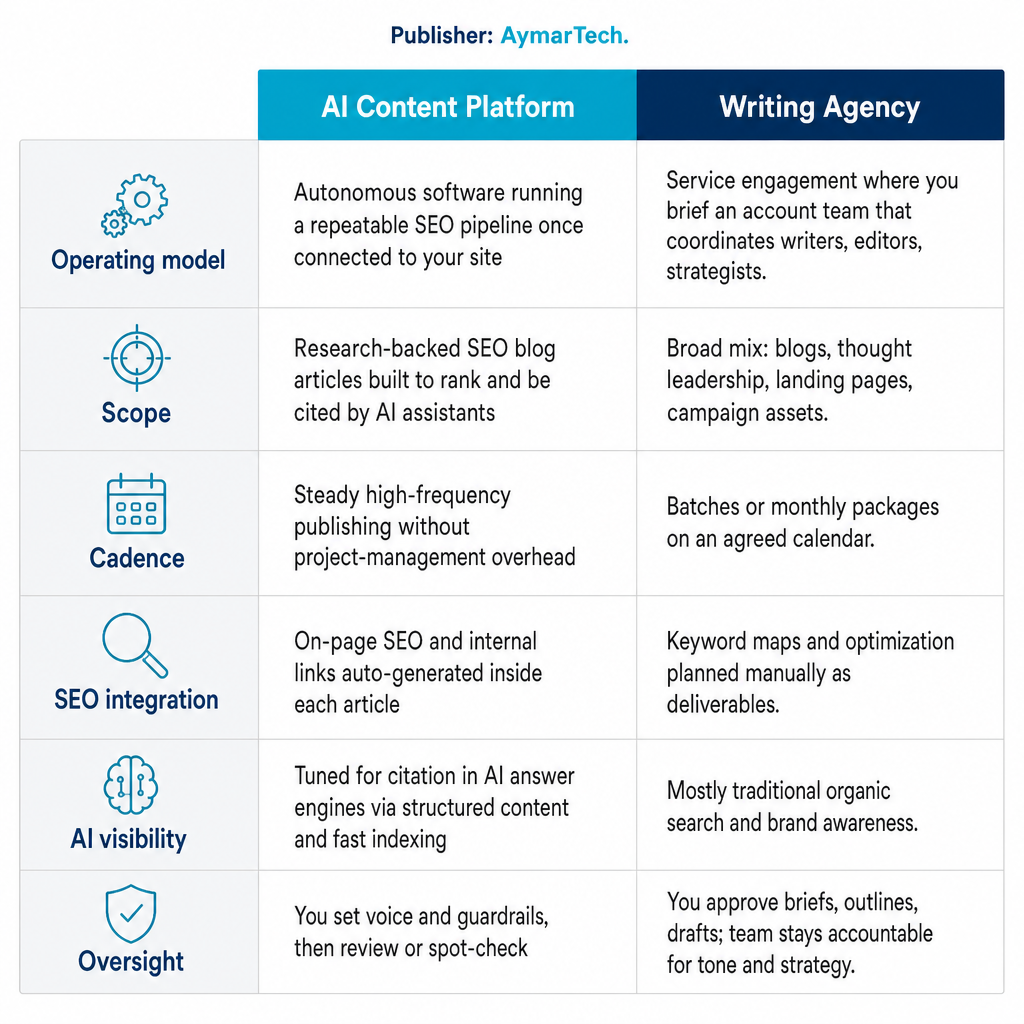
| Dimension | AI content platform (e.g., AymarTech) | Writing agency |
|---|---|---|
| Operating model | Autonomous software that runs a repeatable SEO pipeline once connected to your site | Service engagement; you brief an account team that coordinates writers, editors, and strategists |
| Scope of work | Research-backed, SEO-optimized blog articles built to rank and be cited by AI assistants | Broad mix: blogs, thought leadership, landing pages, and campaign assets tied to wider goals |
| Cadence & volume | Steady, high-frequency publishing without project-management overhead | Batches or monthly packages on an agreed editorial calendar |
| SEO integration | On-page elements and internal links auto-generated inside each article | Keyword maps and on-page optimization planned manually as deliverables |
| AI visibility | Tuned for citation in AI answer engines via structure and fast indexing | Mostly traditional organic search and brand awareness |
| Oversight | You set voice and guardrails, then review or spot-check | You approve briefs, outlines, and drafts; the team stays accountable for tone |
Criteria that decide the call
The table shows structure; these criteria show where the trade-offs actually bite. Read each threshold against your own constraint.
Content volume and cadence
An AI content platform publishes on a consistent, high-velocity schedule with minimal input once your voice and topics are set. We keep researching keywords, writing articles, and pushing them live at your chosen cadence — which is what builds topical authority and compounds organic traffic without adding headcount. Agencies work in planned cycles: calendars, assigned writers, revision rounds, delivery in sprints or monthly batches. That rhythm supports considered campaigns, but it can create a bottleneck when you need dozens of SEO posts a month or fast reaction pieces around emerging demand.
If your core constraint is simply publishing enough search-optimized content reliably, software usually clears that bottleneck more directly than an agency's project-based capacity.
SEO depth and integration
We fold SEO into every stage: discover demand-driven topics, match intent, build outlines, draft, embed internal links, and generate on-page elements like titles, meta descriptions, headings, and image alt text automatically. Each article is checked against SEO and readability criteria before it publishes, and performance data from tools like Google Search Console feeds back into topic selection. Agencies tend to layer SEO on top of human editorial work — keyword research, SERP analysis, topic clustering — then brief writers to weave those signals in, with keyword maps and checklists keeping everyone aligned.
Choose the platform when you want SEO baked into the production engine itself. Choose an agency when you need custom, multi-channel SEO strategy that reaches well beyond the blog.
Brand voice and quality assurance
We train on your samples and guidelines so articles come out in your brand voice at scale while staying original and avoiding templated filler. Every article runs through a fact-checking layer that grounds key claims in live research instead of static training data, which lowers the risk of hallucinations before anything goes live. Agencies lean on human writers and editors who can interpret nuanced positioning, interview subject-matter experts, and shift tone across formats; their QA often stacks multiple edit passes, style guides, and stakeholder reviews that can catch subtle messaging misses.
If you need tight control over sensitive messaging or complex thought leadership, human-led review is still often the safer bet. If you mainly need accurate, consistent SEO content in a stable voice, a platform now covers that ground well.
Operational overhead and workflow
Once AymarTech is connected to your CMS, a multi-step workflow — research, drafting, editing, formatting, uploading, indexing — collapses into configuration and light oversight. No recurring copy-paste into WordPress or Shopify, no manual image uploads, no stitching together separate tools for research, writing, and publishing. An agency engagement reintroduces coordination: you manage briefs, give feedback, align calendars, and review drafts across email, project tools, and calls. Agencies absorb much of the day-to-day editorial management, but your team still owns approvals and integration with the rest of marketing.
For a founder short on time, a platform minimizes ongoing overhead. For a marketing team that values collaborative planning and creative iteration, an agency's process is a feature rather than friction.
Strategic support and flexibility
A platform is strongest when the strategy is already clear: grow organic traffic and AI visibility through steady, search-optimized publishing that compounds. We adapt topics based on performance data and emerging demand, but we're not built to run brand-positioning exercises, invent campaign concepts, or decide your channel mix. Agencies offer broader strategic range — defining content pillars, tying blogs into email, paid media, and sales enablement, and building campaigns around launches or seasonal demand — and they can pivot format quickly, from long-form guides to case studies or scripts.
Pick the platform when the goal is an always-on SEO and AI visibility engine. Pick an agency when content has to interlock with wider brand and demand-generation strategy.
Risk, compliance, and control
Our real-time research and fact-checking reduce the risk of incorrect claims by grounding content in current sources, and articles can be reviewed or spot-checked before release; auto-indexing and structured on-page elements help search and AI engines read accurate information about your business. Agencies manage risk through human judgment — editors flagging sensitive topics, aligning messaging with legal or compliance teams, and tailoring content to industry-specific rules, especially in regulated sectors like finance or healthcare. They can also bolt on steps such as mandatory SME review for higher-risk content.
Platforms are generally safe for evergreen SEO, product education, and non-regulated topics. In heavily regulated industries or high-stakes claims, keeping human compliance workflows in the loop may stay non-negotiable.
AI visibility and future-readiness
We optimize content not only for Google rankings but for AI visibility — how often assistants like ChatGPT, Claude, Perplexity, and Gemini mention, cite, and recommend you. We structure articles and accelerate indexing so your site is more likely to be in the corpus those tools draw from when they answer. Traditional agencies, even those experimenting with AI internally, are still mostly oriented around human readers and conventional search metrics. AI visibility is entering their strategic conversations, but it's rarely engineered into their production systems to the same degree.
If being cited inside AI assistants is a priority, a platform purpose-built for that outcome gives you more direct leverage than an agency-only model.
When an AI content platform fits
A platform like AymarTech tends to be the right call when several of these are true:
- You want your blog to publish high-quality, SEO-optimized posts on autopilot without hiring and managing a writing team.
- Your main objective is organic traffic and AI visibility from consistent, research-backed educational content.
- Your product and positioning are already clear, but you lack the bandwidth to turn that into a steady stream of articles.
- You'd rather run one system for keyword research, drafting, internal links, images, publishing, and indexing than juggle separate tools.
- You're happy reviewing or spot-checking output without running full editorial operations in-house.
If that pattern sounds familiar, our walkthrough of how the autopilot publishing model actually works explains the end-to-end pipeline in practical terms. You can also see current examples of what the platform publishes to judge quality before committing.
When a writing agency fits
An agency usually fits better when:
- You need content across many formats — blog posts, whitepapers, scripts, landing pages, thought leadership — all orchestrated under one strategy.
- Your stories depend on internal interviews, proprietary data, or complex narratives that benefit from writers embedded in your brand.
- You want a partner that owns not just production but positioning workshops, campaign concepts, and multi-channel planning.
- You operate in a highly regulated industry and require human compliance review in every content workflow.
- You have the internal capacity to brief, collaborate, and iterate with an external editorial team on an ongoing basis.
The shared thread: an agency earns its premium when judgment, breadth, and collaboration matter more than raw publishing velocity.
When neither is the right move yet
Sometimes the honest answer is "not yet." Hold off on either model if:
- Your product, messaging, or target audience is still undecided — any content engine will only amplify that confusion.
- You don't yet have a live website or basic analytics; both models assume you can publish and measure.
- You're facing urgent, non-content constraints like product issues or a broken sales process that matter more than traffic right now.
- You operate in a niche where a few high-touch, expert-written pieces will outperform any volume strategy, and in-house experts can produce them occasionally.
Fixing these first protects whatever you later invest in content, whichever direction you choose.
Your next decision
If you're leaning toward the AI route and want to understand investment levels and value, the natural sibling read is our breakdown of how much AI content automation costs, which focuses on pricing models and ROI without forcing you to compare dozens of tools. If you're still weighing whether automation suits your situation at all, our overview of whether AI content is worth it for a small business frames the decision around practical criteria rather than hype. The cleanest path forward is to name your bottleneck first, match it to the model that resolves it, and only then compare specifics.
Frequently asked questions
Will an AI content platform replace my marketing team?
No. We replace the manual research-write-publish treadmill for SEO blogs, but your team still owns brand strategy, product positioning, and high-level oversight. Results tend to be strongest when marketing owns direction and the platform owns execution.
Can AI-generated content rank on Google and get cited by AI assistants?
Yes, when it's research-backed, original, well structured, and properly indexed. We produce search-ready, fact-checked articles, auto-publish them to your CMS, and trigger indexing via the Google API so they can rank and be surfaced as sources in tools like ChatGPT, Claude, Perplexity, and Gemini.
How much control do I have over brand voice?
You define the voice through samples and guidelines, and we generate articles to match that style consistently across posts. You can review, request adjustments, or refine the inputs over time, much like coaching a new writer.
What if my compliance requirements are strict?
Real-time research and verification reduce factual errors, but in heavily regulated sectors you'll usually pair the platform with human review from your legal or compliance teams before publishing. In some industries, an agency with established compliance workflows may remain the primary content partner.
Can I use both a platform and an agency?
Yes. Many businesses run their always-on SEO blog engine on a platform while partnering with an agency for campaigns, complex assets, and brand storytelling beyond the blog. That hybrid keeps core acquisition content on autopilot and reserves human collaboration for high-impact projects.