
Is AI Content Worth It for Small Business?
If you run a small business, the honest answer to whether AI content pays off is this: it works when it brings you consistent, accurate, search-ready articles that pull in qualified traffic and leads — and it fails when it just adds generic filler to your blog. That is the real split behind the question is ai content worth it for small business, and it has almost nothing to do with the fact that a machine wrote the words. It has everything to do with what the content is built to do.
Google's own guidance backs this up. AI-generated content is allowed in Search as long as it meets the same quality, relevance, and helpfulness standards as anything written by a person, and Google evaluates whether content was made to help people or simply to game rankings. So the deciding factor is not the tool. It is the strategy, the accuracy, and the workflow around it. We built AymarTech to sit exactly at that dividing line, and this guide walks through how to tell which side your content would land on.
Table of contents
- • The real decision you're actually making
- • How AI content actually works for small business SEO
- • When AI content is worth it, and when it isn't
- • How AymarTech fits into the decision
- • Practical decision criteria for your business
- • Frequently Asked Questions
The real decision you're actually making
You are not simply deciding whether to "use AI." You are choosing between three very different production models, and the value of AI content changes dramatically depending on which one you pick.
The first is manual content: hiring writers or doing it yourself, planning topics, drafting, editing, designing images, publishing, and tracking results by hand. It can be excellent, but it is slow and expensive. The second is a DIY stack of general AI writing tools plus separate SEO tools, where you manage prompts, fact-checking, editing, and publishing yourself. It looks cheap until you count the hidden hours in quality control and workflow juggling. The third is end-to-end AI content automation, where a single platform handles keyword research, SEO, writing, images, internal links, and publishing on autopilot.
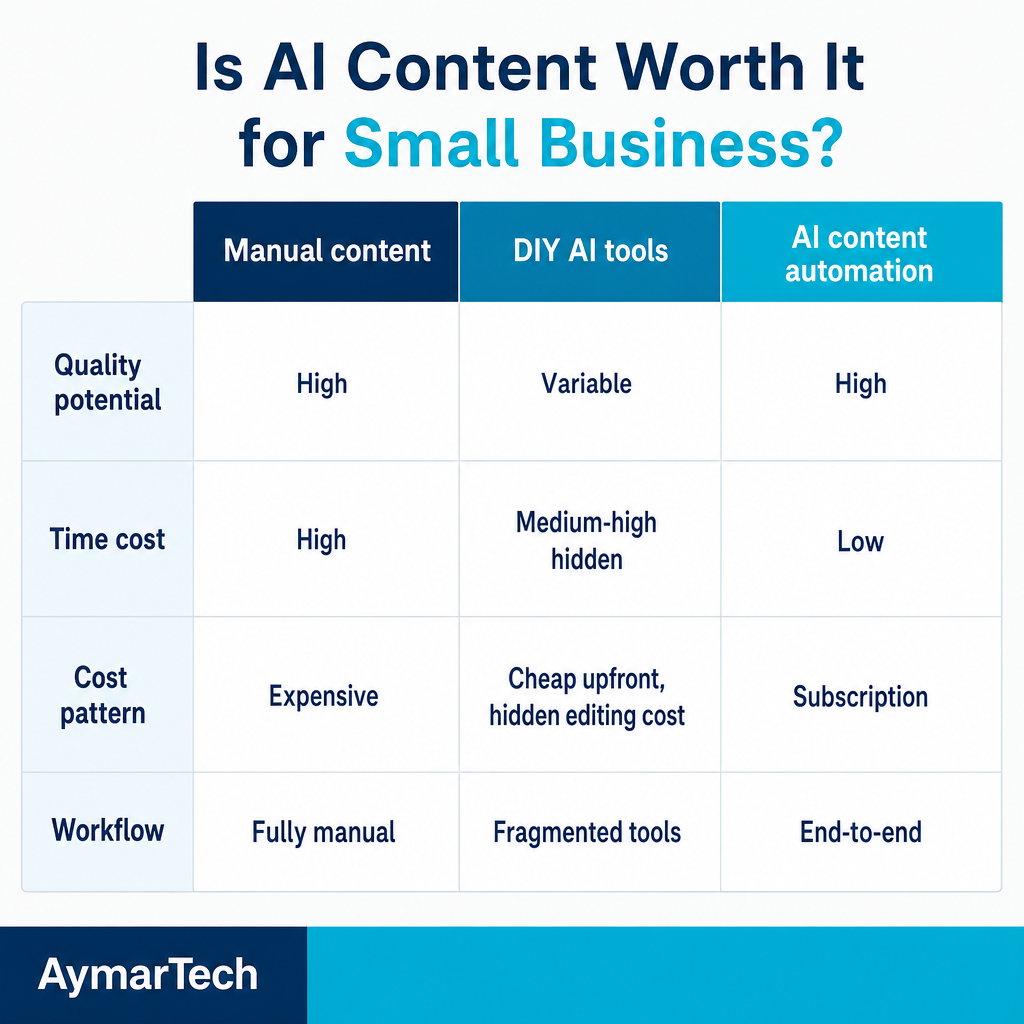
The practical takeaway is that "is AI content worth it" depends less on AI and more on how much of the production chain you can keep both fast and high quality. That is the tension the rest of this guide unpacks.
How AI content actually works for small business SEO
Content only earns its keep when it moves through a full pipeline, not when a model spits out paragraphs. Here is what that pipeline looks like in practice and why each stage matters for return on investment.
From search demand to topics
Effective AI content starts with demand-driven keyword research: finding low-competition, high-intent searches your ideal buyers are already typing into Google. We automatically analyze your niche, competitors, and product catalog to build a content calendar around those real opportunities instead of generic "AI-written" topics. Ranking for the right keywords is what makes content revenue-generating rather than noise.
Drafting in your brand voice
Generative models can now adapt to brand voice and style guidelines, producing articles that read like your company rather than an anonymous bot. We connect to your website, learn from your existing content, and use that context to generate SEO-optimized drafts matched to your tone. This step is where a lot of "cheap AI content" quietly becomes expensive: heavy editing eats the savings. Getting voice right up front removes most of that burden.
Fact-checking and compliance
Google's guidance on generative AI stresses accuracy and reliability, especially for automatically generated content and metadata. Poorly checked AI content erodes trust with both readers and search engines. Our workflow emphasizes real-time research and fact-checking rather than generating text from a bare prompt. That difference — research-backed versus purely synthetic — is decisive for long-term SEO value.
On-page SEO and internal linking
High-value content is more than paragraphs. It needs clean headings and structure for readability, meta titles and descriptions aligned with search intent, and internal links pointing to your key product, service, and resource pages. We automatically add internal links to relevant pages, generate structured headings, and optimize on-page elements when publishing to CMS platforms like WordPress, Shopify, Webflow, and Wix. That turns each article into an acquisition asset instead of an isolated post.
Publishing and indexing
A hidden cost of content is simply getting it live and discovered. Google's guidance highlights accurate metadata, titles, descriptions, and structured data because those elements can surface directly in Search. We integrate with your CMS and use the Google Indexing API to publish and request indexing for new articles, helping them appear in search faster. This end-to-end handling is what moves AI content from "interesting" to genuinely ROI-positive for teams without full-time SEO staff.
Visibility beyond Google
Our positioning covers not only traditional SEO but AI visibility: getting your content cited by assistants like ChatGPT, Claude, Perplexity, and Gemini. Because those systems often draw from indexed web content, consistently publishing well-structured, fact-checked articles raises the chance your brand shows up in AI-generated answers. For a small business, that means content can influence both classic search traffic and how often you appear when customers ask an AI tool for a recommendation.
When AI content is worth it, and when it isn't
The fair answer is that AI content is not universally good or bad. It is situational, and knowing your situation is most of the decision.
It tends to deliver strong returns when you need consistent, frequent publishing but have limited in-house writing or SEO capacity; when your niche has clear informational search demand like how-to guides, product education, and comparisons; and when your site can convert organic visitors into leads or sales. Research on small businesses using AI for content and marketing tasks points to savings of hundreds of hours and several thousand dollars a year — time you can redirect into sales, product, or customer success, the areas that actually grow revenue. When an automation platform absorbs the repetitive SEO workload, that value compounds: more content, more qualified traffic, and more chances to convert without adding headcount.
It is likely not worth it — or needs heavy human involvement — in a few clear cases. Highly regulated fields such as medical, legal, or financial advice require expert review. Brands that live on distinctive founder storytelling or strong editorial opinion need those voices to come from real people. And no amount of content will rescue a weak offer, an inconsistent website, or a broken funnel. Google's spam policies still apply: if automation is used mainly to manipulate rankings with low-value articles, that content can be treated as spam. In those scenarios AI content is not just low ROI — it becomes a liability for your long-term search performance.
How AymarTech fits into the decision
We designed AymarTech to make AI content worth it by handling the entire lifecycle rather than one slice of it. That means keyword research focused on low-competition opportunities in your niche, research-backed drafting in your brand voice with on-brand images, automatic internal linking to your product and service pages, SEO-friendly structure, direct publishing to your CMS across WordPress, Shopify, Webflow, Wix and more, and auto-indexing via the Google API.
We operate as a subscription platform meant to replace a stack of separate SEO and writing tools, publishing SEO-optimized blog articles on a daily cadence so your organic presence grows on autopilot. We support 150+ languages, which helps US businesses that sell internationally or serve multilingual communities. If you want to see the mechanics in detail, our how it works overview walks through the pipeline, and our published examples show the kind of output this produces. For a broader look at what AI-assisted tooling covers, see our guide to the best AI SEO software for small businesses.
The point of combining research, writing, optimization, and publishing in one place is to turn AI content from a tactical experiment into a repeatable growth engine — one that keeps running whether or not you have a marketing hire that week.
Practical decision criteria for your business
Instead of asking whether AI is good, ask four sharper questions about your own situation.
Can you clearly define what success looks like? If you can tie content to a measurable outcome — organic traffic growth, lead form submissions, email signups, store visits — then it has a concrete job. If "success" just means "more content," the return will be just as vague.
Can you sustain quality without automation? Manual content demands time for research, writing, editing, SEO, and publishing. If your team can't hold that cadence, a platform that handles the mechanics is often the difference between sporadic posts and a functioning content strategy.
Are you prepared to uphold Google's standards? AI content must meet Search Essentials and spam policies: helpfulness over manipulation, accuracy over keyword stuffing, and clear alignment with user intent. Embedding research, fact-checking, and structured SEO into the workflow is how you keep that standard consistently, and it's how our platform is built.
Does your website actually convert traffic? If your site can't turn visitors into leads or sales, even excellent content underperforms. Make sure your product pages, calls to action, and analytics are in place first, so content becomes a growth asset rather than a cost center. This ties into a wider shift worth understanding — what AI visibility for brands means as buyers increasingly ask AI tools for recommendations.
If you can answer yes to those four, investing in AI content — particularly through an automation platform — has a strong chance of paying off. If several are still "no," fix those foundations before scaling production.
Frequently Asked Questions
Is AI content bad for SEO?
No. Google explicitly allows generative AI content as long as it meets quality and spam guidelines and is created to help users rather than manipulate rankings. The tool is not the issue; low-value, manipulative content is.
Can AI content rank on Google for competitive keywords?
Yes, but ranking depends on relevance, quality, and links — not the fact that content is AI-generated. Content that starts from real search demand and optimizes on-page elements is far better positioned than output from a generic AI writer.
How much time can AI content save a small business?
Recent data suggests small business owners can save well over 100 hours a year by using AI for content-related tasks alone, with cost savings in the thousands. End-to-end automation reduces time further by handling research, formatting, and publishing too.
Will customers notice if my content is AI-generated?
They notice generic, inaccurate, or off-brand content. When AI is paired with strong research, fact-checking, and brand-voice controls, readers mainly notice usefulness rather than the tool behind the words.
Where does AymarTech fit alongside my existing marketing stack?
We are designed to replace the usual mix of SEO tools, freelance writers, and manual publishing with one platform that continuously researches, writes, optimizes, and publishes blog content to your site — making AI content a core driver of hands-off organic growth rather than a side experiment.