
Best Writing Software: The Best Writing Software in 2026: Tools That Actually Grow Your Traffic
The best writing software in 2026 for growing traffic isn't the tool that drafts fastest — it's the one that researches a topic against live sources, fact-checks its own claims, structures the piece for search, and actually publishes it where both Google and AI answer engines can find it. Fast typing was never the bottleneck. Getting research-backed, publishable content live and discoverable is. That shift is the whole story of what "best writing software" now means.
We build AymarTech around that exact definition: an AI-powered SEO platform that researches, writes, fact-checks, and publishes original brand-voice blog content to your site daily, on autopilot. So this guide explains the category the way a buyer needs to understand it — what modern writing software really is, how the variants differ, and what to weigh — before you decide which job you actually need done.
Table of contents
- What "writing software" actually means in 2026
- The three variants, and what separates them
- Why this matters more now than it did two years ago
- What to weigh before you commit
- Where your decision goes from here
- Frequently asked questions
What "writing software" actually means in 2026
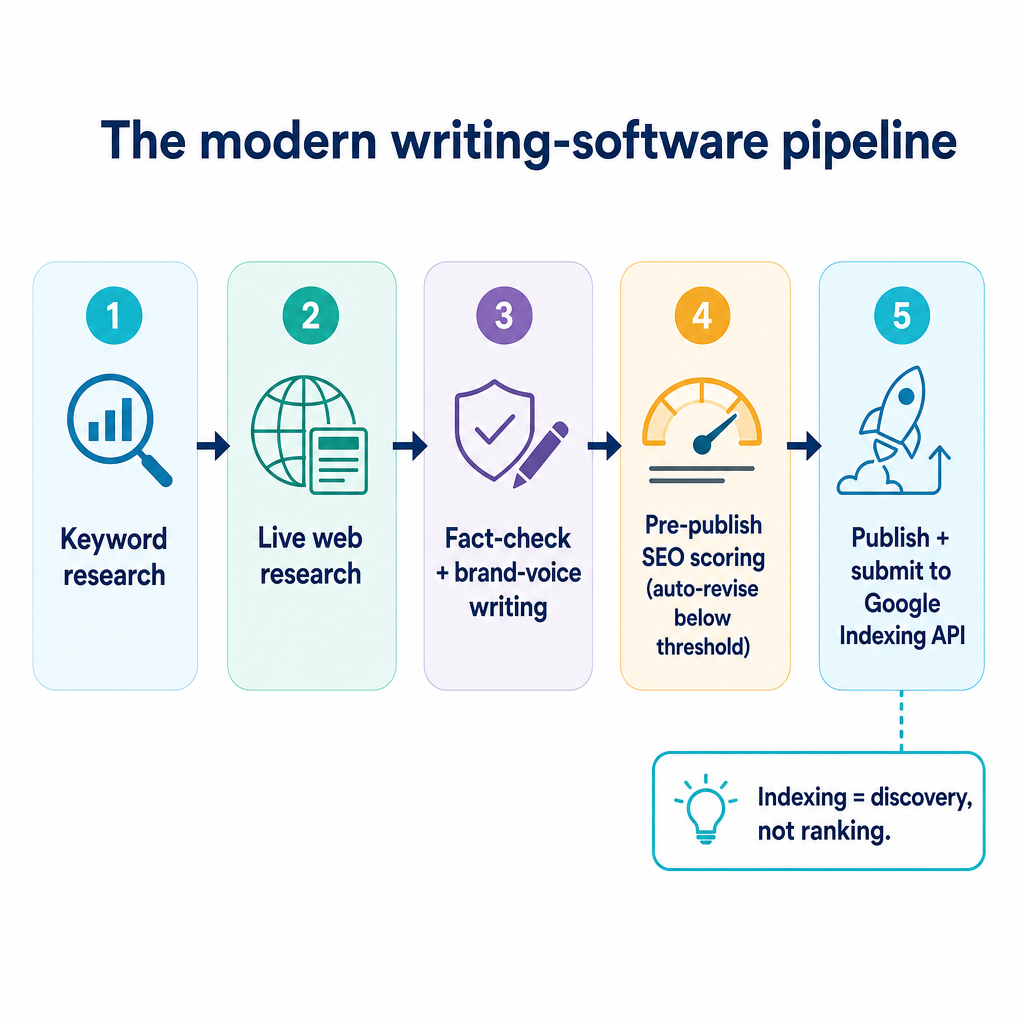
A few years ago, "writing software" meant an editor that helped you type: grammar checks, tone suggestions, maybe an outline generator. In 2026 the meaningful category is narrower and more demanding. The software that moves traffic runs an end-to-end pipeline: keyword research, real-time web research, fact-checking against current sources, brand-voice writing, image generation, internal linking, and direct publishing — with no manual handoff at any step.
The mechanism matters because it's where quality is won or lost. Most AI writers generate an article from the model's training data — knowledge frozen at some past cutoff. That produces text that reads plausibly but is often vague, dated, or subtly wrong, and sounds like every other tool doing the same thing. A research-first pipeline works differently: it pulls current information from the live web, verifies claims across multiple sources, then writes. On our platform that's the deliberate design choice — we run live research using tools like Claude and Perplexity, which costs meaningfully more per article in API usage than paraphrasing stale model memory, precisely because the freshness is the point.
There's a second half most people underestimate: publishing and discovery. Writing an article is only useful if it goes live, gets found, and holds up to scrutiny. Before anything publishes, our built-in SEO scoring system checks readability, keyword usage, meta descriptions, and heading hierarchy; anything below the quality threshold gets revised automatically rather than shipped. Then content publishes directly to the site and is submitted through Google's Indexing API so Google is notified the page exists. The Google Indexing API is a free service that lets a site owner tell Google directly when a page is added, instead of waiting for discovery through sitemaps or backlinks.
One honest caveat that separates accurate vendors from hype: indexing is not ranking. As the maintainers of a widely used open indexing tool put it plainly, submitting a page through the Indexing API only tells Google the page exists — it doesn't make the page rank. Faster discovery accelerates the clock; the content still has to earn its position on merit.
The three variants, and what separates them
Buyers get confused because three quite different products all get filed under "best writing software." They solve different jobs, and picking the wrong variant is the most common way people waste a budget.
General-purpose AI writers. These generate text on demand from a prompt — blog drafts, emails, social captions, product copy. They're flexible and fast. The limit is that they typically write from training data, they stop at a draft, and quality, accuracy, optimization, and publishing are left to you. If your bottleneck is a blank page, they help. If your bottleneck is traffic, they hand you the raw material and none of the distribution.
SEO drafting and optimization tools. These focus on the search layer: keyword suggestions, competitor analysis, content scoring, and briefs that tell you what to add. They sharpen a piece you're already writing. But they still assume a human sits in the middle doing the research, the writing, the editing, and the actual publishing. They optimize the work; they don't remove it.
Full autopilot content platforms. This is the category we operate in. Instead of a tool you sit down to use, it's a system that runs the whole pipeline — analyzing your website, industry, and competitors to find high-value keyword opportunities, then researching, writing, fact-checking, illustrating, internally linking, and publishing on a schedule. The buyer's job shifts from producing content to setting direction and reviewing output.
The cleanest way to separate them is by where each one stops. A drafting tool stops at text you must finish. An optimization tool stops at a scored recommendation you must act on. An autopilot platform stops at published, indexed content on your live site. That end point is the real product difference — and it's the one that determines whether "writing software" produces documents or produces traffic. For a closer look at how these categories stack up on outcomes, our companion explainer on the best AI writing tools for growing traffic goes deeper on the trade-offs.
Why this matters more now than it did two years ago
Two things changed the stakes. First, Google clarified — repeatedly — that it judges outcomes, not production method. Its guidance states that using automation, including AI, to generate content whose primary purpose is manipulating search rankings violates its spam policies; but its ranking systems aim to reward original, high-quality content that demonstrates E-E-A-T, no matter how it is made. In other words, "AI content" isn't penalized as a category. Thin, purpose-built-for-ranking content is. That distinction is why a research-and-fact-check pipeline beats a raw generator even when both use AI.
Google frames the test as a single question: the "why." Content created primarily to help people is what its systems reward; content created primarily to pull in search visits is not. Good writing software has to be built to pass that test, not to game it.
Second, search itself moved. A growing share of queries now gets answered inside AI assistants — ChatGPT, Perplexity, Gemini, and Google's AI Overviews all read across the web, synthesize an answer, and cite the sources they leaned on. Crucially, there's no separate AI index or special markup to chase: the same high-quality, people-first content and structured data that earns organic rankings is what these answer surfaces draw from. That's the practical reason one quality pipeline now serves two audiences at once — human searchers and the AI systems that increasingly sit between them and your site. Content built to be researched, accurate, and well-structured is what gets cited; content built to fill a word count doesn't.
What to weigh before you commit
There's no universally "best" tool — there's the right variant for your bottleneck. These are the criteria worth pressing any on, framed as judgment rather than a checklist to march through.
- Research freshness versus recall. Ask whether the tool researches live sources or paraphrases training data. This is the single biggest quality split in the category, and it's the difference between an article that holds up and one that reads generic.
- Does it publish, or just draft? Your real job is usually traffic, not documents. Decide whether you need something that produces a first draft you'll finish, or a system that takes work all the way to a live, indexed page.
- Is there a quality gate before publish? A tool that scores and auto-revises content below a threshold protects you from shipping weak pages at volume. Ask what happens to an article that doesn't meet the bar.
- How does it handle discovery — honestly? Indexing support speeds up how fast Google learns a page exists. Be skeptical of any that implies indexing equals ranking; the credible answer pairs faster discovery with a commitment to content quality.
- Does it fit your stack? Practical compatibility matters. We publish directly to WordPress, Shopify, Webflow, Wix, and more, in 150+ languages, so the pipeline fits the site you already run rather than forcing a migration.
The reason these criteria matter more than a feature comparison is that they map to your outcome, not to a spec sheet. A tool can score well on features and still stop at a draft you don't have time to finish — which means, for your goal, it did nothing.
Where your decision goes from here
If your bottleneck is the blank page and you enjoy the editing and publishing, a general-purpose writer or an optimization tool may be all you need. If your bottleneck is that content never consistently ships and gets found, the autopilot variant is the honest fit — and that's the specific job we built AymarTech to do end to end.
The fastest way to judge whether that fits your situation is to look at real output and the mechanics behind it rather than a claims list. See how the AymarTech pipeline works to understand the research-to-publish flow, and if you want the ranking-focused view of how AI-written content actually moves positions, our explainer on how AI SEO writing tools move rankings is the natural next read. Tell us your site, niche, language mix, and current CMS, and we'll tailor a recommendation to your goals instead of a generic pitch.
Frequently asked questions
What is the best writing software for growing traffic in 2026?
It depends on your bottleneck. For traffic specifically, the useful category is software that researches live, fact-checks, optimizes, and publishes, rather than tools that stop at a draft you still have to finish and post.
Does Google penalize content written by AI?
Google does not penalize AI content as a category. Its guidance is that it rewards original, high-quality, people-first content and penalizes content whose main purpose is manipulating rankings, whether that content is written by a person or by an AI.
Does publishing through the Google Indexing API make my page rank?
The Indexing API notifies Google that a page exists, which speeds up discovery. Ranking still depends on the quality and helpfulness of the content itself, so faster indexing accelerates the timeline without guaranteeing a position.
How is autopilot content software different from a normal AI writer?
A general AI writer generates text from a prompt and stops at a draft. An autopilot platform runs the full pipeline — keyword research, live research, fact-checking, writing, internal linking, and direct publishing — so the output is live, indexed content rather than raw copy.
Will AI writing software help me get cited by ChatGPT or Perplexity?
AI assistants cite the same high-quality, well-structured content that ranks in organic search, drawn from the same index. Software built to research and fact-check improves your odds of being that citable source, though no tool can guarantee a citation.