
How Ai Does Keyword Research
Ask how AI does keyword research and the short answer is this: modern systems blend real search data with machine learning to predict which phrases and topics will bring qualified traffic to a specific site, then expand, score, and cluster those terms far faster than a person working through spreadsheets. Instead of brainstorming keywords one by one, the software starts from seed topics, your existing pages, or search trends and grows them into semantically related terms, questions, and long-tail variants — while inferring intent and estimating how hard each one is to rank for. At AymarTech, that research isn't an isolated step; it's the front end of an automated pipeline that carries a topic through outlining, drafting, internal linking, image generation, and publishing.
The deeper question most teams are really asking isn't just "how does the machine find keywords?" It's "how much of this should we hand over, and where do humans still need to sit in the loop?" This guide answers both.
Table of contents
- • What "AI keyword research" actually means
- • How AI finds and evaluates keywords
- • How we approach keyword research at AymarTech
- • Should AI own your keyword research or should you keep it manual?
- • Decision criteria for using AI keyword research
- • Risks and limits worth knowing
- • Frequently asked questions
What "AI keyword research" actually means
AI keyword research is software-driven discovery of search terms using techniques such as large language models, machine learning, and statistical modeling, layered on top of real search and content data. The distinction matters. A basic keyword tool returns volume and difficulty numbers for terms you already thought of. An AI system reads your seed input, understands the entities and intent behind it, and generates terms you would never have brainstormed on your own.
That shift changes the output. Modern platforms don't just list keywords — they infer whether a query is informational, transactional, or navigational, estimate ranking difficulty and opportunity, and group related terms into coherent topic clusters. Those clusters are what turn a raw keyword list into an actual content calendar: a pillar page plus the supporting articles that reinforce it, rather than a pile of disconnected posts competing with each other.
For us, keyword research is the first stage of an end-to-end pipeline. When a business connects its site, we identify low-competition, demand-driven topics and then carry each one through outlining, writing, optimization, image generation, internal linking, and auto-publishing to platforms like WordPress, Shopify, Webflow, and Wix.
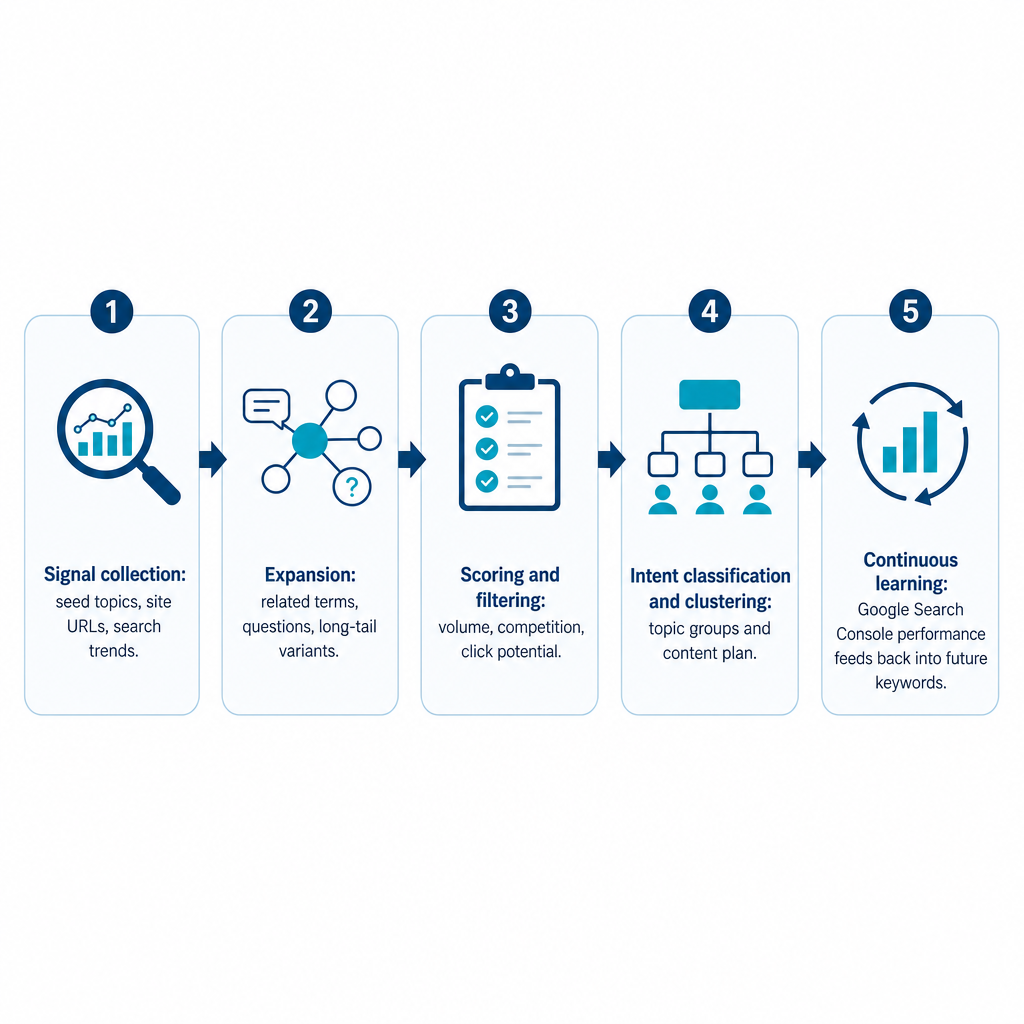
How AI finds and evaluates keywords
Underneath the marketing language, "how AI does keyword research" breaks into a handful of mechanisms that work together. Understanding them helps you judge where the output can be trusted and where it needs a human check.
Signal collection and seed understanding. Every run starts with inputs: topics you provide, your existing URLs, product data, or public search trends. The system parses these using natural language processing to understand the entities, relationships, and intent behind them — not just the literal words. A seed like "running shoes" is understood as a product category with buyer questions, comparison intent, and use-case variations attached.
Expansion into related keywords and questions. From that seed, the model generates synonyms, semantically related phrases, and question-based queries learned from large corpora of search data and web content. This is where long-tail phrases with lower competition, "people also ask" style questions, and localized variants surface — the terms that are difficult to uncover at scale by hand.
Data-driven scoring and filtering. AI keyword tools fold traditional SEO metrics — search volume, competition indicators, click potential — together with model-driven predictions about topical relevance and user value. The algorithm's real job here is subtraction: filter out irrelevant or impossible-to-rank noise and surface terms that balance realistic difficulty against meaningful traffic.
Intent classification and topic clustering. Machine learning models tag each keyword with a likely intent, which decides whether a term deserves a blog post, a product page, or support documentation. Clustering then groups related keywords into topics and subtopics so you build pillar pages and supporting articles instead of redundant, overlapping posts.
Continuous learning from performance data. The strongest systems don't stop at prediction. They feed real performance — impressions, clicks, rankings — back into their models so recommendations sharpen as the site grows. Our platform is self-learning from real Google Search Console data, which means future keyword choices are shaped by which topics actually performed for each connected site.
The practical takeaway: AI keyword research isn't a one-time brainstorm. It's a loop where the model proposes topics, content ships, and real search behavior reshapes the next round of decisions.
How we approach keyword research at AymarTech
We built AymarTech as an AI-powered SEO content platform, not a standalone keyword tool, so research is tightly wired to everything that comes after it. Once a business connects its website, we handle demand-driven keyword research, build a content calendar, write fact-checked articles in the brand's voice, and auto-publish them to common CMS platforms. Each article ships with on-page SEO elements, internal links, meta tags, and structured headings, so keyword targeting shows up directly in the finished post rather than sitting in a separate dashboard.
A few things shape how our research behaves in practice:
- We prioritize low-competition keywords tailored to a site's niche and audience — the phrases where smaller brands can realistically win visibility instead of fighting incumbents for head terms.
- We use real Google Search Console data to refine topic choices over time, shifting production toward themes that already show traction for that specific domain.
- We connect keyword research to AI visibility, favoring topics likely to be surfaced and cited by assistants such as ChatGPT, Claude, Perplexity, and Gemini — not just ranked on Google.
- After publishing, we trigger indexing via the Google Indexing API so posts enter search faster and start generating the performance data that feeds the next round of keyword decisions.
Because research, writing, optimization, and publishing all live in one place, small teams avoid the usual fragmentation between an SEO tool, a writer, and a CMS. If you want to see how those stages connect end to end, our explainer on autopilot content marketing walks through the full loop.
Should AI own your keyword research or should you keep it manual?
The real decision isn't whether AI can do keyword research — it clearly can. It's how much of the process should belong to the machine for your particular business.
Manual research still earns its keep when a team has deep subject-matter expertise and the time to interpret nuanced intent in a narrow domain, or when compliance and editorial constraints demand human review at every step. In those cases, a person's judgment about what a query really means is worth the hours.
AI-driven research, especially inside an autopilot setup, becomes the stronger choice when a business needs consistent, high-volume content without hiring a full SEO and writing team; operates across multiple languages or regions where running separate research processes per market isn't realistic; or wants search data and content production tied together so keywords move straight from research to published, indexed articles.
For the audiences we build for — small business owners chasing hands-off organic growth, SaaS and startup founders focused on content marketing, and marketing teams or agencies scaling production — the goal is to take keyword research off the daily to-do list and turn it into an automated pipeline. If you're weighing the trade-offs against a hire, our comparison of an AI SEO writing tool versus hiring a writer lays out the cost and control differences in detail.
Decision criteria for using AI keyword research
When you're deciding whether to lean on AI for keyword research — and whether to centralize it inside one platform — a few criteria carry most of the weight.
| Criterion | Why it matters | How we handle it |
|---|---|---|
| Volume and consistency | A steady stream of optimized articles is hard to sustain by hand | We produce scheduled SEO articles and content calendars for connected sites |
| Data feedback loops | AI is most useful when it sees the same clicks and rankings a human SEO would | We use Google Search Console data plus auto-indexing via the Google API |
| Brand voice and control | Handing over research shouldn't mean losing your tone | We write in each brand's voice and let teams review calendars and drafts |
| Publishing integration | Research trapped in a separate dashboard loses most of its leverage | We publish to WordPress, Shopify and more, adding internal links and meta tags |
| Budget and team size | Full in-house content teams are costly and often impractical | We run on a flat monthly subscription with a free trial and money-back guarantee |
A couple of those rows deserve emphasis. On brand voice, the common fear is that automated research disconnects content from how a company actually sounds. Because our system generates outlines and drafts tied to keyword intent, teams no longer have to translate a keyword list into article plans by hand — but they can still review and edit whenever they want. And on budget, our platform is currently listed at $99 per month, tax included, with a free trial and a money-back guarantee, which makes cost predictable compared with staffing strategists, writers, editors, and CMS operators separately.
Risks and limits worth knowing
AI keyword research is powerful, not infallible. Setting expectations early prevents disappointment later.
- Data bias and blind spots. Models learn from historical search and content data, which can overrepresent established niches and underrepresent emerging or regulated topics. New categories may simply have thin signal.
- Over-automation. Treating every AI suggestion as gospel can push a business toward topics that don't match its actual product positioning or customer needs.
- Intent misclassification. Ambiguous queries get misread, producing content that answers the wrong question or pulls in traffic that never converts.
- Regulatory and compliance concerns. Highly regulated industries often need human review of both keyword choices and finished content, even when AI handles the initial research.
We reduce some of this by tying research to actual site performance data and focusing on demand-driven, low-competition topics for each connected domain. But the responsibility isn't one-sided: decision-makers should supply a clear business profile, review early outputs, and stay ready to adjust content goals as they watch how the strategy performs. As a concrete example, an online store connected to our platform gets keyword ideas built around its products and buyer questions, then receives posts with internal links to product pages — and as those posts index and earn traction, the system leans harder into the terms that are actually working. A SaaS founder, by contrast, might see us prioritize low-competition informational queries around pain points rather than feature names, building an educational calendar that supports both search rankings and AI visibility.
Keyword research stops being a spreadsheet you dread updating and becomes a continuous engine that turns search data into live, optimized content. If that's the shift you're after, the most useful next move is to connect a site and let the research run against your real audience — see how it works or browse live content examples to judge the output against your standards first.
Frequently asked questions
Is AI keyword research accurate enough for small businesses that rely on every lead?
AI tools combine real search and performance data with machine learning to prioritize terms that are both relevant and realistically rankable, which tends to be more systematic than ad-hoc manual research. It still benefits from a quick human sanity check against your product and audience.
Do I lose control over my topics if we handle your keyword research?
No. We use your business profile, site niche, and performance data to propose topics, but you can review content calendars and articles and adjust goals whenever you want.
How is this different from a generic AI writer?
A generic AI writer starts from a topic you supply and returns a draft. We automate the full lifecycle: demand-driven keyword and topic research, intent-matched outlines, fact-checked drafting, internal linking, images, auto-publishing, and auto-indexing.
Can keyword research run in multiple languages?
Yes. We support well over 120 languages across the content pipeline, including keyword research and article generation, which is especially useful for businesses operating in several markets.
What happens to keyword research if I pause publishing?
Because keyword decisions are tied to live performance data and content calendars, pausing slows the feedback loop — but the system resumes researching and publishing once you reactivate your schedule.
Is there a low-commitment way to try it?
Yes. We offer a free trial and a short money-back guarantee period after the first paid charge, so you can test the keyword research and autopilot content capabilities before committing.