
What Is Answer Engine Optimization?
If an AI assistant answered your customer's question right now, would it quote your page — or someone else's? That single question is what answer engine optimization is built to control. In plain terms, what is answer engine optimization? It's the practice of structuring and verifying your content so AI systems like Google AI Overviews, ChatGPT, Gemini, Claude, and Perplexity can confidently extract, cite, and reuse it as a direct answer — not just list it below the fold. Traditional search still ranks pages in a list. Answer engines generate one conversational response by summarizing and citing several sources at once, and AEO is how you earn a spot inside that response.
We built this guide as the hub for how we think about AI search at AymarTech, so it stays definitional and decision-focused. If you want the hands-on ranking playbook, the keyword mechanics, or the budget math, we link out to those along the way instead of repeating them here.
Table of contents
- • What answer engine optimization actually means
- • Do you actually need AEO right now?
- • How answer engines find and use your content
- • The AEO levers you can actually control
- • How AEO relates to GEO and AI SEO
- • When AEO belongs in your strategy
- • Risks and failure modes to watch
- • How we handle AEO at AymarTech
- • Frequently asked questions
What answer engine optimization actually means
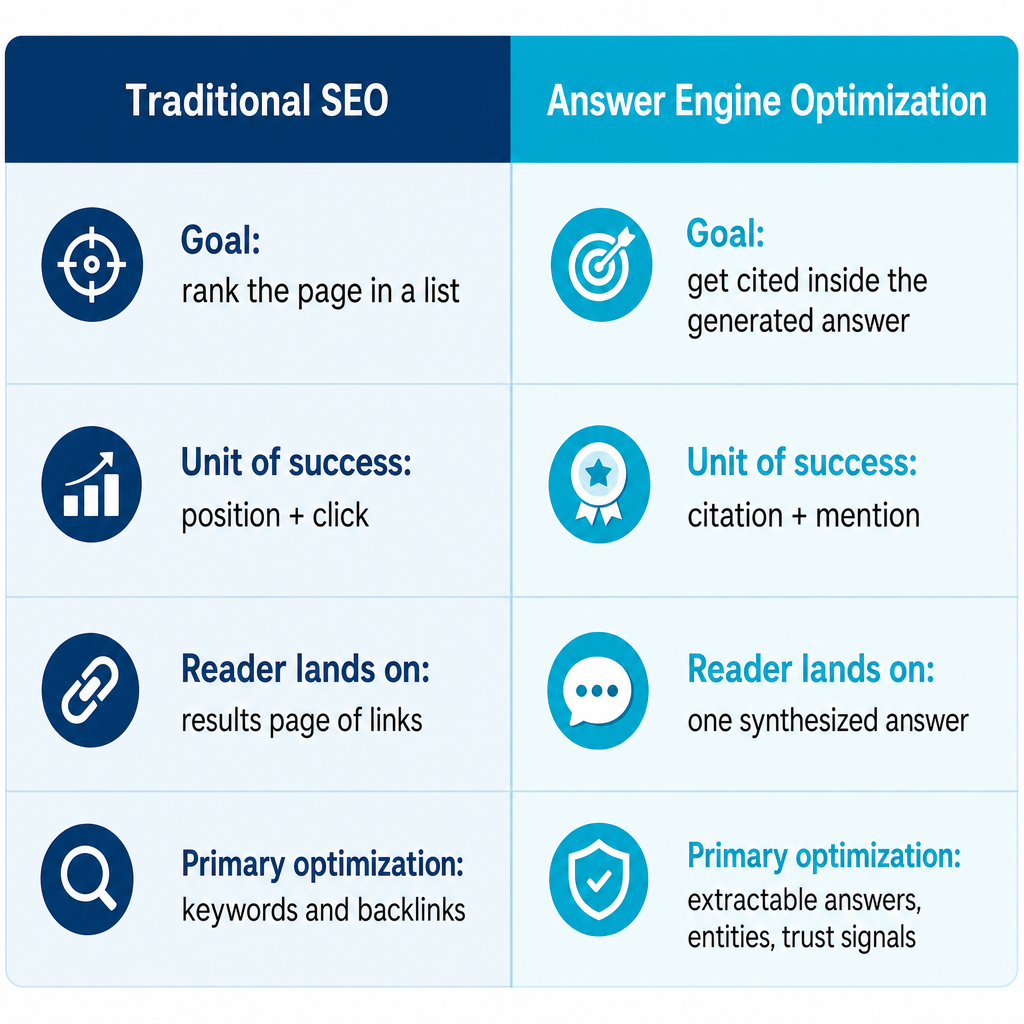
Traditional SEO optimizes a page so a search engine ranks your site in the results list when someone types a query. Answer engine optimization shifts the target: it focuses on AI systems that generate a response by interpreting the question, pulling passages from multiple sources, and assembling them into one answer, sometimes with citation cards and sometimes without.
Across definitional guides and enterprise platforms, AEO lands on three consistent ideas. First, structuring and presenting content so AI answer engines can easily find, understand, and trust it as a source. Second, making your information machine-readable, verifiable, and organized around clear questions and answers. Third, optimizing for citations and presence inside AI answers, not only for clicks and rankings.
The mental shift is concrete. You stop asking only "How do I rank for this keyword?" and start also asking "If an AI engine answers this question, what would it quote — and is that passage on my page?" When the extractable answer lives on your site, phrased cleanly and backed by evidence, you become the building block the model reaches for.
Do you actually need AEO right now?
For small business owners, SaaS founders, and lean marketing teams, AEO becomes a real decision the moment AI answers start absorbing the click that your classic SEO used to win. The decision itself is simple to state: do we keep optimizing only for traditional rankings, or do we also optimize so AI engines can safely cite us as the answer?
Three conditions push AEO up the priority list. Your audience increasingly uses AI tools and AI Overviews instead of scrolling ten blue links. You rely on informational content — blogs, guides, FAQs — to drive demos, appointments, or inbound leads. And you care about being named and cited, not just about anonymous traffic.
If your growth depends on organic discovery and category authority, delaying AEO usually means letting a competitor's content become the default source of truth inside the AI answers your customers already see. If your traffic is mostly direct, referral, or paid, AEO can be a second-wave priority — but the shift toward AI-mediated search is accelerating, especially in the US market, so "later" is getting shorter.
How answer engines find and use your content
Answer engines sit on top of search and content in a new way. AI Overviews and LLM-powered search synthesize multiple sources into a single answer. Chat assistants like ChatGPT, Gemini, Perplexity, and Claude generate conversational responses by scanning and summarizing web content and curated sources. Voice interfaces read out an answer that often names only one or two sources explicitly.
Underneath, the workflow is consistent: the engine interprets the query and its intent, locates relevant and trustworthy content, extracts the key passages and data points, then summarizes them into a coherent answer with optional citations. AEO aligns your pages with that "extract and summarize" step so it lands on your content instead of someone else's.
Leading AEO and GEO resources point to five broad signals these systems reward. A clear question–answer structure, where explicit questions and concise definitions make reuse easy. Entity clarity, so the model can map your people, brand, products, and concepts consistently and know who, what, where, and why. Trust signals rooted in experience, expertise, author transparency, and credible references. Structured data and clean technical hygiene — schema markup, descriptive headings, accessible layout — so engines can reliably identify answers, dates, and entities. And freshness, meaning up-to-date information that corroborates reputable sources and official guidance.
The cost of ignoring these is quiet but real: content with buried answers, inconsistent headings, and vague claims gets skipped — or used without attribution. AEO makes your best content the obvious choice for extraction and citation.
The AEO levers you can actually control
Most practical frameworks converge on a short list of controllable moves, and the useful part is that they are editorial, not mysterious.
Lead with the answer. Put the definition or core response in the first lines of a section, then expand with context, examples, and options. This mirrors how answer engines want to present information, so your opening lines become the quotable unit. Cluster questions around real intent by grouping the what, why, how, risks, and alternatives into coherent sections, so one page can satisfy several adjacent prompts. Format for machines as well as readers, using descriptive headings, short paragraphs, and explicit labels so models can reliably locate each section.
Two deeper levers separate durable AEO from surface tweaks. Verified, source-backed claims — referencing authoritative sources, standards, or data, especially in regulated or technical topics — signal that your content is safe to reuse. And brand and entity consistency, keeping names and key facts identical across pages, helps engines attach your content to a stable entity graph rather than treating each page as an orphan.
These overlap heavily with modern SEO. The difference is weighting: AEO prizes extractability and answer clarity far more than raw keyword density. A page can rank adequately and still be invisible inside AI answers if its best point is never stated as a clean, standalone claim.
How AEO relates to GEO and AI SEO
The terminology gets muddy fast, so it helps to separate the layers. Generative Engine Optimization (GEO) is the broader strategy of optimizing content for AI-powered search and answer engines overall — structuring content so generative engines can interpret, summarize, and cite it accurately, and shifting the goal from ranking in search results to being referenced inside AI answers.
Within that, AEO is the narrower, sharper lens. It focuses specifically on answer engines and the direct answer: what actually gets quoted, linked, or attributed when the system replies. GEO wraps AEO together with technical setup, data infrastructure, and broader AI search visibility across Overviews, chat interfaces, and emerging LLM-driven products. Our companion explainer on how AI SEO automation works maps those technical layers in more depth, and how AI does keyword research covers the intent-matching stage that feeds both.
Many industry resources treat AEO, GEO, and "AI SEO" as partly overlapping views of one challenge: making your content the trusted building block for AI-generated responses. The practical takeaway for our audience is unglamorous but freeing — if you're already investing in GEO or AI SEO, you're making AEO decisions whether you name them or not.
When AEO belongs in your strategy
Rather than treating AEO as a blanket mandate, weigh it against a few criteria and let the answers set your urgency.
| Criterion | Treat AEO as near-term | Treat AEO as second-wave |
|---|---|---|
| Audience search behavior | Already uses AI Overviews, chat, or voice to research | Mostly direct, referral, or paid discovery |
| Content's role in pipeline | Blogs and guides drive demos, trials, leads | Content is peripheral to sales |
| Brand authority goal | Want to be the named expert, cited by engines | Authority is a nice-to-have |
| Topic sensitivity | Health, finance, legal, safety require accuracy | Low-risk, low-regulation niche |
Team capacity is the quiet fifth factor. If your in-house team can't reliably ship answer-ready content every week, pairing AEO strategy with automation is usually more realistic than hand-optimizing at scale. When several of these criteria point the same way, AEO stops being a future trend and becomes a pragmatic extension of the SEO you already run.
Risks and failure modes to watch
AEO opens opportunity, but it carries failure modes worth naming before you commit. Content can be summarized without credit when it's poorly structured — used as background inspiration rather than cited explicitly. Making your answers and entities unmistakable is the main defense.
Outdated or inconsistent statements are a second trap. When your pages contradict current consensus or official guidance, answer engines may down-rank or ignore them, and the penalty is steepest in sensitive topics. There's also the risk of over-optimizing for machines: content that reads as rigid, jargon-heavy, or repetitive can technically be extractable while quietly tanking conversion with the humans who actually buy.
The last risk is measurement. Traditional analytics don't always reveal when your brand is cited inside an AI answer, which makes ROI harder to track without dedicated monitoring and deliberate experimentation. Durable strategies keep the human reader central and treat answer engines as one more distribution channel — not the only scoreboard.
How we handle AEO at AymarTech
We built AymarTech for businesses that want classic SEO rankings and AI answer visibility without hiring writers or stitching tools together. Once we connect to your website, we research low-competition, intent-matched keywords for your niche, then write fact-checked, SEO-optimized articles in your brand voice.
From there, the pipeline carries the work AEO usually demands by hand. We generate on-brand featured images, add internal links and metadata aligned with your site architecture, and publish finished posts directly to WordPress, Shopify, Webflow, Wix, and other platforms on a schedule you set. We also auto-index content through the Google Indexing API so it can rank and stay discoverable to the AI assistants that lean on web indexes.
Because our workflow structures content, entities, and technical setup so generative engines can safely quote and recommend your brand, AEO stops being a separate manual checklist. It becomes part of an autopilot pipeline that continuously ships answer-ready, machine-readable content tied to your brand profile. If you want to see which tool choices matter most before committing, our guide to the best AI SEO software for small businesses lays out the criteria we hold ourselves to.
The honest next step depends on your inputs: your CMS, your niche, your current content volume, and how aggressively your audience has already moved to AI search. Tell us those and we can map a realistic AEO cadence instead of a generic checklist.
Frequently asked questions
What is answer engine optimization in one sentence?
It's the practice of structuring and verifying your content so AI systems like Google AI Overviews, ChatGPT, Gemini, and Perplexity can easily extract, cite, and reuse it as a direct answer inside their generated responses.
How is AEO different from traditional SEO?
SEO works to rank whole pages in a results list, while AEO works to make specific, trustworthy answers within those pages easy for AI engines to understand and quote inside a generated reply. The weighting shifts from keywords and links toward extractable, clearly stated answers.
Is AEO the same as generative engine optimization (GEO)?
No — AEO is a subset of GEO. GEO covers optimization for all generative search and answer experiences plus the technical and data layers behind them, while AEO focuses specifically on answer engines and the content they directly reuse and cite.
Who should care most about AEO right now?
Brands that depend on educational content to drive leads, especially in competitive US markets, and those whose audiences already use AI assistants or AI Overviews to research vendors. For them, AEO is a near-term priority rather than a future experiment.
Can an automated platform realistically handle AEO for us?
Yes. We embed keyword research, answer-first structuring, fact-checking, internal linking, publishing, and Google API indexing into one pipeline, which turns AEO and GEO into part of your daily content output instead of a manual side project.