
In-house Content Team Vs Ai Automation
If your business needs more organic traffic, the real question behind in-house content team vs AI automation isn't whether a model can write a decent paragraph — it's where human attention actually earns its keep. Most lean teams face the same squeeze: too many topics worth covering, not enough hours to research, draft, optimize, and publish them consistently. Before you hire, outsource, or switch on an automated pipeline, it helps to see what each model genuinely does well, where each one breaks, and which decision thresholds tell you to pick one over the other.
There are three realistic routes, not two. You can build an in-house content team, run AI automation across the research-to-publish workflow, or combine them so machines handle production and people own expertise and final judgment. The right answer depends on first-hand expertise, publishing volume, regulatory control, brand consistency, and speed — not on hype about what AI can or can't do.
Table of contents
- • What an in-house content team actually owns
- • What AI content automation covers end to end
- • Criteria that separate the two models
- • When an in-house team is the better call
- • When AI automation fits better
- • When neither option solves the problem
- • A hybrid model most businesses can run
- • A five-question test to pick your model
- • Frequently asked questions
What an in-house content team actually owns
An in-house content team is a group of employees who own both strategy and production. Depending on the company, that can mean a content strategist, SEO specialists, writers, editors, subject-matter experts, designers, and content operations staff — or one or two people wearing all of those hats.
The defining advantage is proximity. The team can interview employees, sit in on customer calls, consult product specialists, develop original points of view, and adjust priorities as the business shifts. That closeness gives tight control over brand positioning, editorial standards, subject-matter accuracy, legal and compliance review, original examples, and distribution.
The cost is coordination. Keyword research, briefs, drafting, editing, image creation, CMS formatting, internal linking, and reporting all consume time and management attention. Every article competes for a writer's research hours, an editor's review, and an expert's availability — which caps output and makes volume a hiring problem rather than a workflow problem.
What AI content automation covers end to end
AI content automation uses software to complete some or all of the content workflow: keyword research, topic selection, content calendars, real-time research, drafting, brand-voice adaptation, claim checking, search optimization, internal linking, image generation, CMS publishing, and performance feedback.
We built AymarTech for this full pipeline rather than for isolated drafts. We research a site's market, identify keywords, build a content calendar, research each article in real time, write in the customer's brand voice, check key claims, add internal links and images, and publish automatically or after approval. We publish to WordPress, Shopify, Wix, Webflow, and Notion, and deliver through API and webhook for platforms that aren't directly supported. We generate content in more than 150 languages, which removes much of the operational burden of localizing for several markets at once.
The point of automation isn't to pretend a prompt replaces expertise. It's to take the repeatable operational load off a small team so the people involved spend their time on judgment, not on moving posts through production.
Criteria that separate the two models
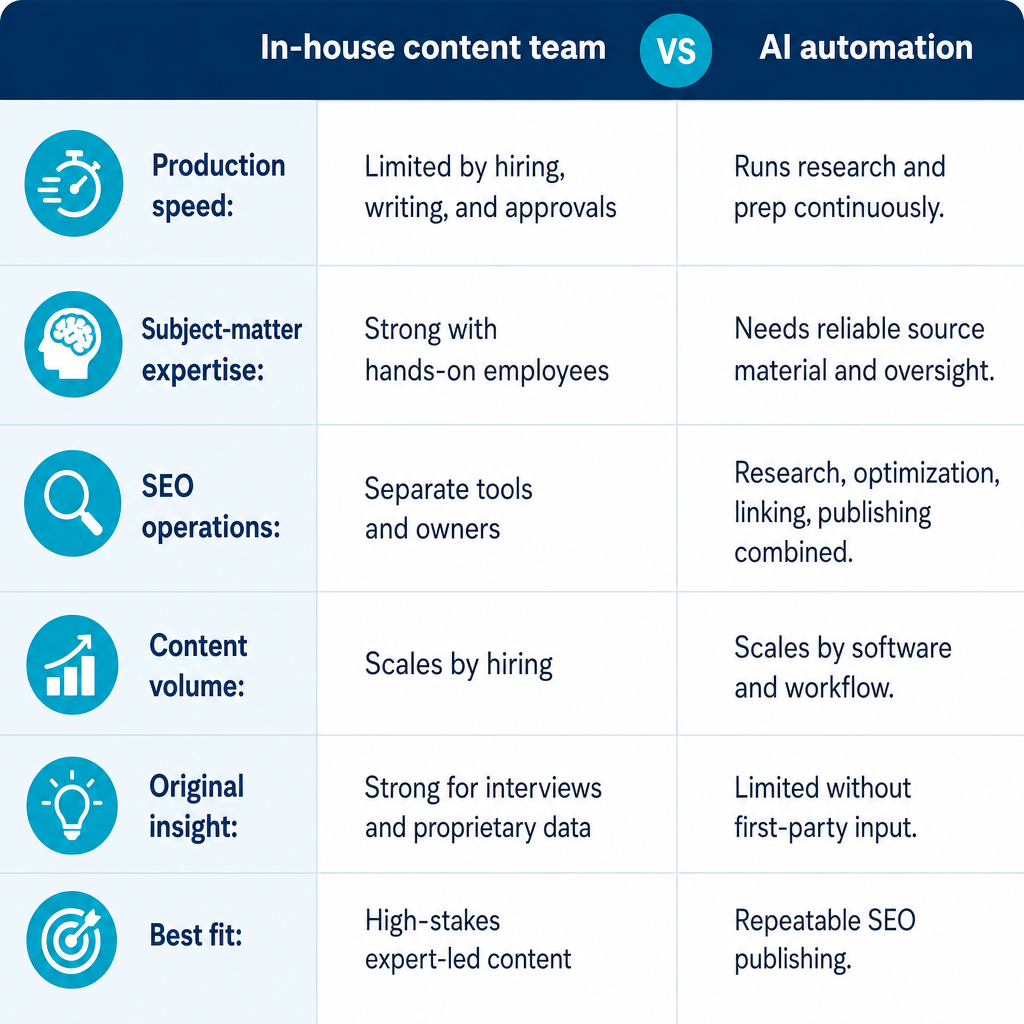
The models rarely win or lose outright. They diverge criterion by criterion, and the differences map cleanly onto how your business is structured.
| Decision criterion | In-house content team | AI automation |
|---|---|---|
| Production speed | Capped by hiring, writing, editing, approvals | Researches and prepares content continuously |
| Subject-matter expertise | Strong with hands-on employees | Needs reliable sources and oversight for specialist topics |
| Brand voice | Learned through collaboration and editing | Learned from examples and clear instructions |
| SEO operations | Separate processes, tools, owners | Combines research, optimization, linking, publishing |
| Original insight | Strong for interviews, data, customer stories | Limited unless fed original business information |
| Fact-checking | Editors and experts validate directly | Automated checks flag claims; high-impact content still needs review |
| Compliance handling | Easier to assign accountability | Needs documented rules and approval gates |
| Cost structure | Salaries, benefits, management, tools | Subscription plus oversight and any required expert review |
Two criteria deserve more than a table cell: expertise and accuracy, because they carry the most risk.
Google's guidance emphasizes helpful, reliable, people-first content and asks whether a page demonstrates first-hand experience and depth of knowledge, with clear sourcing and author information, as set out in its guidance on creating helpful content. A team whose members have used the product, served the customer, or run the process has a genuine edge here. AI can organize and express that knowledge, but it cannot manufacture first-hand experience from a prompt. If an article must contain proprietary knowledge or lived experience, keep an expert involved even when automation handles the first draft.
Accuracy follows the same logic. We research articles in real time and check key claims before publishing, which lowers the risk of relying on stale or generic material — but it does not remove the need for judgment on high-stakes topics. Google is explicit that AI-generated content should be manually fact-checked and reviewed for accuracy and trustworthiness before publication. A workable rule: low-risk educational content can rely on automated research plus editorial sampling, while product, financial, medical, legal, security, and safety content needs qualified human review against approved first-party sources.
Brand voice sits in between. A system can reproduce a defined style from examples, which keeps a blog consistent. But voice matching is not strategic differentiation. A pipeline can sound exactly like your brand and still produce generic ideas unless it receives customer objections, product details, approved claims, original examples, and a clear point of view. Use automation for voice consistency; use people to decide what the brand should believe, emphasize, and avoid.
When an in-house team is the better call
An in-house team is usually the stronger option in a few recognizable situations.
When your industry is highly regulated — medical, legal, financial, insurance, safety, cybersecurity — qualified review and careful claims management are non-negotiable, and employees are easier to hold accountable. When your advantage is proprietary expertise, such as internal data, a unique methodology, or original research, employees should lead the work rather than review it. When every article carries a strategic point of view, as with thought leadership, executive commentary, or category creation, you need judgment that keyword coverage can't supply. And when content itself is a core product asset central to your reputation, building internal editorial capability can be worth the overhead.
The common thread: the more each article depends on expert judgment before it can safely go live, the more the balance tips toward people.
When AI automation fits better
Automation earns its place when the bottleneck is production, not thinking. You already know which topics matter, but your team can't research, draft, optimize, and publish them at a steady pace.
It also fits when organic growth depends on a regular stream of useful, search-focused content rather than occasional campaigns, and when your topics follow repeatable patterns — educational guides, product-category explanations, location pages, supporting articles, and common customer questions. A founder or small marketing team that can't justify separate writers, editors, SEO tools, and designers gets the most leverage here. So does a business operating across several languages or markets: we support more than 150 languages, which cuts the cost of localized content without hiring a translator per market. And because we support automatic publishing alongside approval-based publishing, API, and webhook delivery, you don't have to choose between full autopilot and fully manual work. For the mechanics behind this pipeline, see our explainer on how AI SEO automation works.
There's a boundary worth naming. The SEO risk isn't that AI was involved — Google states that appropriate use of AI is not against its guidelines. The risk is generating many pages with little value to manipulate rankings, which Google classifies as scaled content abuse regardless of whether a human, a machine, or both produced it, under its spam policies. Automation as a production system that researches, verifies, and publishes useful content supports a durable program. Automation as a volume tactic that spits out a page per keyword variation creates quality and trust problems.
When neither option solves the problem
Some gaps no operating model can close. If the business lacks a clear audience, a useful product, first-party knowledge, a defensible angle, a conversion path, a way to measure qualified traffic, editorial standards, or the willingness to update inaccurate content, both routes stall.
Automation can't make topics matter to customers who were never going to care. A team can't rescue a vague strategy by writing more carefully. Google also warns that spinning up a separate page for every search variation mainly to influence rankings or AI responses isn't a durable strategy — high page volume doesn't automatically make a site more useful. Fix the strategy and the inputs first; the production model is the second decision, not the first.
A hybrid model most businesses can run
For many lean teams, the most resilient setup divides labor by risk rather than by preference.
Let AI handle the repeatable layer: keyword discovery, topic clustering, content calendars, initial research, draft structure, first drafts, internal links, image creation, CMS formatting, publishing workflows, and routine updates. Keep people responsible for the layer where mistakes are expensive: business priorities, original insights, sensitive claims, first-hand experience, legal and compliance review, product accuracy, final approval of high-risk content, conversion strategy, and performance interpretation.
This split gives you publishing leverage without pretending every article carries the same risk. It also respects a practical governance point: NIST's AI risk framework lists trustworthy-AI characteristics including validity and reliability, safety, accountability, transparency, privacy enhancement, and fairness, as summarized in its AI Risk Management Framework FAQs. "Automatic publishing" should never be read as "no governance required" — sensitive topics, confidential data, and regulated claims still need an approval path.
A five-question test to pick your model
Answer these before committing to an operating model.
- How much first-hand knowledge must each article contain? More required experience favors in-house or hybrid.
- How many articles must you publish each month? Higher repeatable volume favors automation.
- How costly would an inaccurate claim be? Higher stakes demand qualified human review.
- Is your bottleneck thinking or production? Production bottlenecks favor automation; strategy or expertise gaps favor people.
- Can you supply examples, sources, and approval rules? If yes, automation is far easier to govern and keep on-brand.
The pattern is consistent across all five. Choose people where expertise, originality, compliance, and strategic judgment are the product. Choose automation where repetitive SEO operations are eating time your team could spend on customers and growth. Choose a hybrid when you need scale without removing expert oversight. If you're weighing outsourced production more broadly, our comparison of an AI content platform vs a writing agency covers the next decision. Tell us your target markets, monthly publishing volume, risk level, and the topics you need covered, and we'll prepare a tailored plan for a hands-off organic-growth workflow.
Frequently asked questions
Is an in-house content team better than AI automation?
Neither wins universally. An in-house team is stronger for original expertise, sensitive subjects, and tight editorial control. AI automation is stronger for repeatable SEO production and scaling without a large hire.
Can AI automation replace a content strategist?
It reduces manual research and production work but not business judgment. Someone still has to decide which audiences, products, claims, and priorities matter.
Does Google penalize AI-generated content?
Google does not prohibit AI assistance by itself. Content produced at scale mainly to manipulate rankings, especially with little or no value, can violate its spam policies.
Should AI-generated articles be reviewed by a human?
Yes — especially for factual accuracy, regulated topics, product claims, and anything affecting trust or safety. Google advises manual fact-checking and review of AI-generated content before publication.
Is AI-assisted content copyrightable in the United States?
Human contributions may be protected when the person determines sufficient expressive elements. The U.S. Copyright Office states that prompts alone generally don't provide enough human control for authorship.