
What Is AI Visibility for Brands?
Ask ChatGPT, Perplexity, or Google's AI Overviews "what's the best tool for X?" and you'll notice something: a handful of brands get named, linked, and recommended, while most stay invisible. That gap is exactly what is ai visibility for brands about — the degree to which your brand is mentioned, cited, and recommended inside AI search engines and assistants when customers are ready to decide. It's the same instinct as classic brand visibility, applied to generative systems: measuring how often and how prominently your brand shows up in AI-generated answers, and whether those answers link back to your site.
The shift matters because the buying journey is moving into conversational interfaces. When someone types "best CRM for startups" or asks an assistant "which accounting software should a small business use?", AI visibility decides whether your brand is the one that surfaces — or the one silently skipped.
Table of contents
- • What AI visibility actually measures
- • The strategic decision behind it
- • How AI systems decide which brands to show
- • Three ways to build AI visibility
- • When AI visibility deserves your focus
- • Risks, misconceptions, and guardrails
- • How we turn AI visibility into a default outcome
- • Frequently asked questions
What AI visibility actually measures
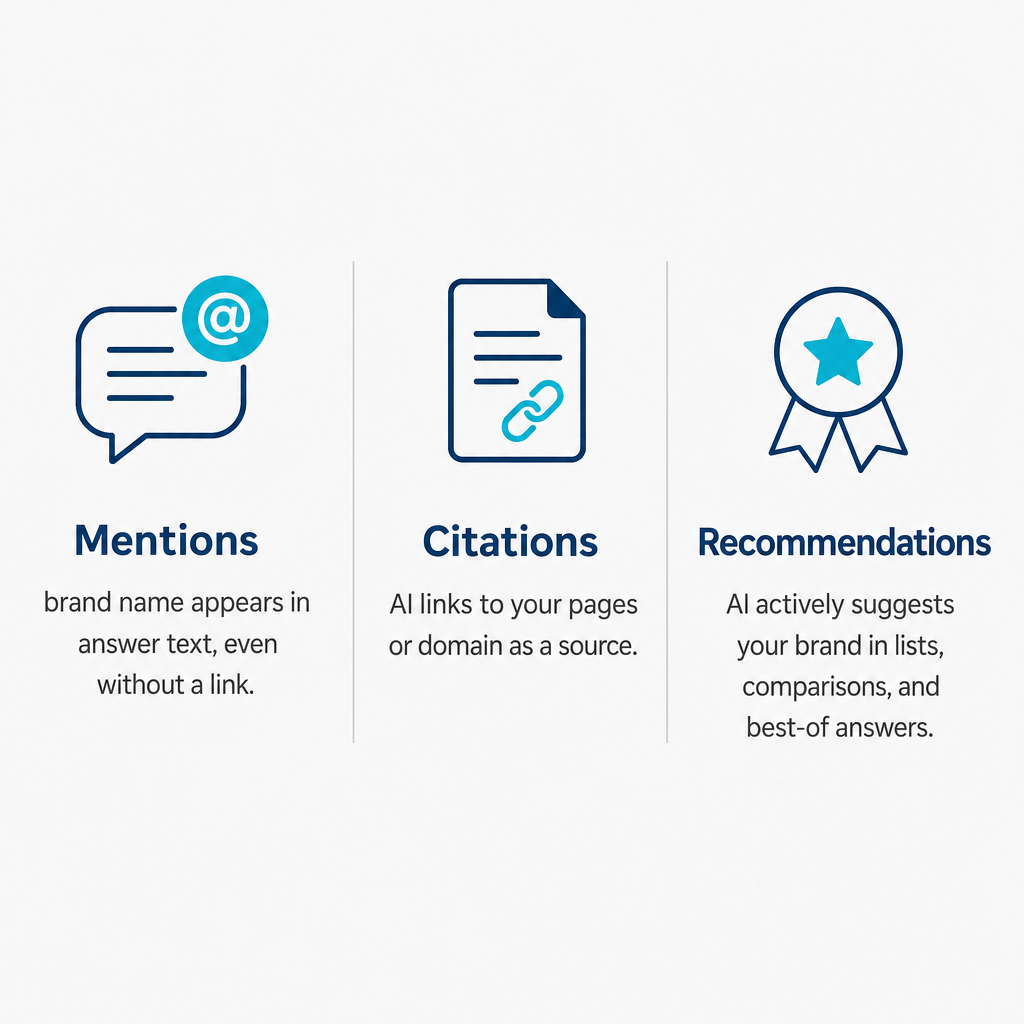
Traditional brand visibility tracks how often people see your brand across search, social, and media. AI visibility narrows that to a specific arena: how often and how prominently your brand appears inside AI-generated answers. Three output signals define it in practice.
- Mentions — how often your brand name appears in answer text, even without a link.
- Citations — how often AI links to your pages or domain as a source.
- Recommendations — how often AI actively suggests your brand in lists, comparisons, or "best tools" roundups.
These aren't abstractions anymore; they're counted at scale. Ahrefs Brand Radar measures AI visibility by running hundreds of millions of search-backed prompts through platforms like AI Overviews, ChatGPT, Perplexity, Gemini, and Copilot, then tallying mentions, citations, AI share of voice, and estimated impressions. Semrush's AI Visibility Toolkit similarly tracks how often domains get cited or mentioned across AI platforms over time.
The distinction from ordinary SEO is worth holding onto. Ranking well means a link sits in a results list a user still has to click. AI visibility means the answer itself talks about you — and that answer may be the only thing the customer reads.
The strategic decision behind it
Underneath the definition sits a choice: do you treat AI environments as a core discovery channel — on par with Google Search, social, and marketplaces — or leave your presence there to chance?
Consumer behavior is already tilting toward AI summaries and conversational search. Adobe's brand visibility research frames a brand as visible in AI when it shows up in the conversations consumers have with large language models. Semrush describes modern visibility as being present everywhere search happens, AI-powered search and recommendations included. EY, meanwhile, stresses technical readiness and crawlability so AI systems can actually ingest and understand your site.
For small businesses, SaaS products, and agencies, the abstract decision becomes three concrete questions:
- When customers ask AI tools about your category, does your brand show up at all?
- When AI tools cite sources, do they link to your pages — or to someone else's?
- Is your current SEO and content work built for both search engines and generative AI, or only for classic search?
If the honest answer to any of these is "not sure," AI visibility has quietly become a decision you need to make on purpose, rather than a metric you glance at after the fact.
How AI systems decide which brands to show
AI visibility runs on two layers of signals: input, which is what models can learn from, and output, which is what users finally see in answers.
Input signals you actually control
Generative models draw heavily on search indices, knowledge graphs, and the broader web when producing brand-related answers. Adobe's guidance on AI search engines points to three foundational first-party signals.
- First-party authority — strong SEO signals on your own site (relevance, quality, trust) so AI can treat you as an authoritative source.
- Discoverability — a presence across major platforms so AI can find corroborating evidence about you.
- Authenticity — consistent, accurate representation of your brand and offerings across channels, which helps AI validate and recommend you safely.
EY adds a technical layer that's easy to underrate: crawlability and integrations. You need pages that search and AI crawlers can navigate, structured data that describes your entities clearly, and basic technical hygiene so models understand what you do. Semrush emphasizes topical authority and content clusters — owning a set of related topics through comprehensive content — so your brand becomes the default reference in its niche. The more expertise your site demonstrates on a topic, the more likely AI is to surface you when that topic comes up.
Our platform is built around exactly these input signals. We connect to your site, research low-competition, demand-driven keywords, and write fact-checked, SEO-optimized articles in your brand voice — complete with internal links, meta tags, and structured headings. We then auto-publish finished posts to WordPress, Shopify, Webflow, Wix, and similar platforms, and index them through the Google indexing API so they enter the search ecosystem AI tools depend on. If you want the underlying mechanics of these systems, our explainer on how generative AI works unpacks it in plain terms.
Output signals users finally see
On the output side, AI visibility is measured by how often your brand is mentioned in responses, cited with URLs, and recommended in lists, comparisons, and best-of answers. Ahrefs Brand Radar quantifies this through Mentions, Citations, AI Share of Voice, and Estimated Impressions across hundreds of millions of prompts. Semrush's toolkit reports cited pages, mentions, and overall AI visibility across time. Adobe's generative engine optimization framework connects those output metrics back to the content and authority signals on your owned properties — showing how SEO and GEO reinforce each other.
The causal chain is blunt: if you don't have content that search engines index and treat as authoritative, AI assistants have little reason to mention, cite, or recommend you.
Three ways to build AI visibility
Brand leaders generally pick from three approaches, and they aren't mutually exclusive.
Manual, in-house optimization. Your team researches how the brand appears in AI platforms, runs buyer-intent prompts, and tracks where you're mentioned or cited. Adobe recommends building an "AI footprint" by testing prompts across ChatGPT, Perplexity, Claude, and Gemini, then tracking mentions, citations, and sentiment against competitors. From there you update site content, tighten technical SEO, build topical clusters, and earn third-party citations through PR — treating AI visibility as an extension of your existing SEO and brand program.
Agencies and point tools. A newer class of agencies focuses on generative search optimization and AI discovery signals. Dedicated AI search visibility platforms analyze a brand's presence across engines, surface keyword opportunities, and track competitors, while some established SEO suites now bundle AI visibility measurement so teams can monitor mentions and citations and adjust content accordingly.
Full-stack content automation. This is where we operate. We treat AI visibility as an outcome of consistent, high-quality, indexable content production rather than a separate task bolted on later. In practice that means we connect to your website and CMS, research low-competition keywords, build a content calendar aligned to buyer intent, write original fact-checked articles in your voice with internal links and on-brand images, then auto-publish and auto-index through the Google indexing API so pages start ranking and can be cited by AI systems. For a closer look at the trade-offs, our comparison of an AI SEO writing tool versus hiring a writer lays out where each path fits.
For lean SaaS teams and small businesses, that last option effectively turns AI visibility into a subscription outcome: you connect your site, set your profile, and the pipeline handles keyword discovery, content creation, internal linking, and publication.
When AI visibility deserves your focus
Because AI visibility extends search and brand visibility rather than replacing them, the real question isn't "AI or SEO" — it's how much and how fast. A few practical criteria help you calibrate.
| Decision driver | Lean toward heavy investment when… |
|---|---|
| Buyer behavior | Buyers research online and ask conversational "best X for Y" questions |
| Competitive landscape | Rivals already appear frequently in AI answers and you don't |
| Content capacity | A small team can't sustain research, writing, and technical upkeep |
| Brand control | Thin or outdated content risks AI misrepresenting your products |
| Budget and ROI | One platform beats assembling staff, tools, and agencies separately |
On buyer behavior, the more conversational the journey, the more critical AI visibility becomes, especially for SaaS, B2B services, and higher-consideration products. On the competitive front, Brand Radar and AI Visibility toolkits reveal how often competitors are mentioned and cited; if rivals appear while you're absent, you're ceding AI share of voice in your category. Semrush suggests watching both share of search and AI visibility together for a full read on your position.
Capacity is often the deciding factor. Manual GEO and AI visibility work demands sustained research, writing, optimization, and technical maintenance that small teams struggle to keep up. Brand control matters too: WSJ's Adobe program stresses that AI needs strong first-party authority and trust before it will confidently mention and cite a brand, and thin or inconsistent content raises the odds of hallucinated or garbled descriptions of your products. Investing in authoritative content and clear entity descriptions gives AI better material to rely on. Finally, the budget math comes down to whether you'd rather build a custom stack of staff, tools, and agencies, or standardize on one system that turns AI visibility into an operational output.
Risks, misconceptions, and guardrails
A few traps can undermine the whole effort.
- Chasing "being in AI" while neglecting human trust. Adobe and EY both frame authority and authenticity across owned and third-party properties as prerequisites; visibility without trust backfires.
- Treating it as a technical trick. Semrush and Adobe tie AI visibility to genuine topic authority and quality content, not keyword stuffing.
- Ignoring crawlability and integrations. EY names poor crawlability and missing technical integrations as core reasons brands fail to be used as reliable AI sources.
- Assuming outputs are fully controllable. Even with strong signals, AI answers can still omit your brand or phrase things unexpectedly. The realistic goal is to tilt the odds through consistent authority and discoverability, not to script the response word for word.
The practical guardrails follow directly: keep product information accurate, monitor how AI platforms describe your brand, and keep improving site structure and content quality over time.
How we turn AI visibility into a default outcome
Our model is to make being visible to AI the natural result of running your SEO content on autopilot — not a standalone project you have to staff and manage. Based on our public, first-party materials, the offer covers the full cycle.
- Full-cycle automation: keyword and competitor research, topic selection, outlining, drafting, fact-checking, styling in your brand voice, internal linking, images, and publishing.
- CMS-level integration: direct connections to WordPress, Shopify, Webflow, and Wix, with optional auto-publishing and scheduling.
- Technical SEO baked in: structured headings, meta tags, and internal links to product and category pages that improve both search and AI crawlability.
- Auto-indexing: the Google indexing API pushes new content into search indices promptly, raising the chance AI systems treat it as a source.
- Daily cadence and 150+ languages: consistent publishing across markets so global brands can hold topical authority in more than one language.
The logic behind it is the same causal chain from earlier: AI assistants lean on indexed, authoritative, well-structured content when they answer. The more high-quality, indexed pages your brand owns, the more often AI can confidently mention and cite you. If you want to make that citation behavior more deliberate, our guide on how to get cited by ChatGPT goes deeper on the signals that matter.
For US-based small businesses, SaaS products, and agencies, that reframes AI visibility from "another thing to worry about" into something a pipeline is designed to generate. The next move is straightforward: decide whether you'll build that pipeline yourself or connect a site and let it run.
Frequently asked questions
What is AI visibility for brands in simple terms?
It's how often your brand is mentioned, cited, and recommended when people ask AI search engines and assistants about your category or the problems you solve.
How is AI visibility measured today?
Platforms like Ahrefs Brand Radar and Semrush's AI Visibility Toolkit track brand mentions, citations, AI share of voice, and estimated impressions across prompts run through ChatGPT, Perplexity, Gemini, and other AI environments.
Is AI visibility different from traditional SEO?
SEO focuses on ranking in search results; AI visibility focuses on whether AI answers include and link to your brand. They share signals — authority, relevance, crawlability — but AI adds conversational and recommendation contexts.
Why does AI visibility matter for small businesses and SaaS startups?
When prospects ask AI tools "which service should I choose?" or "what's the best tool for X?", your presence or absence in those answers directly shapes discovery and trust, especially for digital-first businesses.
How does AymarTech help with AI visibility?
We automate the creation, optimization, publishing, and indexing of SEO articles in your brand voice, so your site builds topical authority and becomes a source AI platforms can safely cite and recommend.