
The ROI of Automated Content Marketing
The roi of automated content marketing is simplest to judge by one ratio: how much traffic, qualified leads, and revenue your content earns compared with what it costs to produce and maintain. Automation improves that ratio when it turns publishing into a predictable acquisition engine instead of an on-and-off expense that depends on whoever has time to write this week. At AymarTech, we built our platform around exactly this equation — connecting to your site, handling keyword research, writing fact-checked articles in your brand voice, adding internal links and on-brand images, and publishing on a schedule you set. This guide breaks down what that ROI actually consists of, the mechanisms that drive it, and when the math works in your favor.
Table of contents
- • What "ROI of automated content marketing" really measures
- • The real decision: manual, semi-automated, or full autopilot
- • How automation actually drives ROI
- • When automated content marketing makes financial sense
- • What ROI looks like in practice
- • Risks and limitations worth watching
- • Frequently asked questions
What "ROI of automated content marketing" really measures
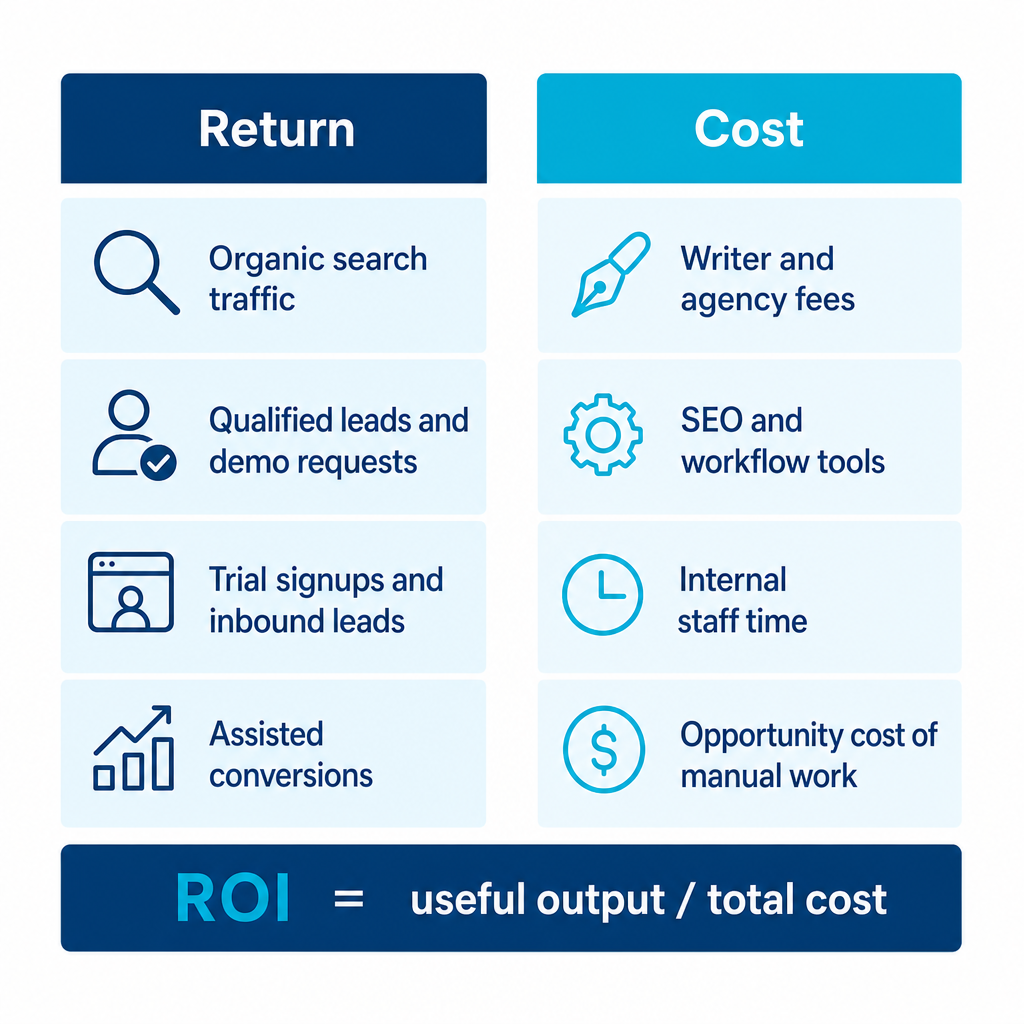
Strip away the jargon and ROI here answers three concrete questions. How much incremental traffic, leads, and revenue does the content generate? How much time and money does it take to produce and maintain? And is automation improving the ratio of useful output to cost, or just manufacturing more noise?
The return side blends performance and cost savings. Performance means the organic search traffic, qualified demo requests, trial signups, inbound leads, and assisted conversions you can trace back to content. Cost means writer fees, agency retainers, SEO tool subscriptions, internal staff time, and the opportunity cost of doing all of it by hand.
Automation is designed to push on both sides at once. Publishing consistently compounds organic traffic and visibility over months, while compressing the number of tools and people needed lowers the marginal cost of each new article. That dual effect is the whole point: a lower cost base paired with an asset that keeps working after it ships.
The real decision: manual, semi-automated, or full autopilot
For a small business owner, a SaaS founder, or a lean content team, the question is rarely whether to do content marketing. It is how much of the pipeline to automate.
A manual workflow means researching topics and keywords across separate SEO tools, briefing writers or an agency, reviewing and editing drafts for voice, manually adding internal links, images, titles, meta descriptions, and headings, then logging into the CMS to publish and waiting for search engines to find the page. It works, but it is slow, expensive, and entirely dependent on a few individuals staying available.
Semi-automated workflows drop AI writing tools into that chain yet still lean on people to set strategy, edit drafts for accuracy and tone, and handle on-page SEO and publishing. You save drafting time but keep most of the coordination overhead.
Full autopilot hands the whole production pipeline to one system — research, writing, optimization, linking, and publishing running continuously. That is the model we built. Once you connect your business profile and site, we analyze the website, industry, and competitors to find high-value keyword opportunities, cluster them into a content plan tied to real search demand, write original fact-checked articles in your brand voice, add internal links and on-page elements like titles, meta descriptions, headings, and image alt text, and publish finished posts straight to WordPress, Shopify, Webflow, Wix, or Notion on your chosen cadence. New articles are then auto-indexed through the Google Indexing API so they become discoverable quickly and eligible to be cited by assistants like ChatGPT, Claude, Perplexity, and Gemini.
Choosing autopilot trades hands-on control over dozens of micro-steps for a setup where your strategic oversight and brand guidance sit on top of a repeatable engine. If you want the trade-off spelled out against hiring help, our breakdown of autopilot blog content versus a freelance writer walks through where each option fits.
How automation actually drives ROI
The economics change in several specific ways, and each one maps to a line in your ROI calculation.
Lower cost per article. A traditional stack layers SEO software, project management tools, freelance or agency drafting, editing for fact-checking and voice, and internal time for publishing and indexing. Every additional article adds cost across several of those layers. We offer a flat subscription — quoted at $99 per month, tax included — that covers keyword research, editorial calendar generation, fact-checked drafting, and optional auto-publishing to connected sites. Because the core work is automated, you can publish several articles a month without spending more on writers, agencies, or extra tools.
Consistency and compounding. Content ROI depends heavily on steady output. Sporadic publishing makes it hard to build topical authority or cover enough keywords to move results. Our autopilot model removes the "who is writing this week" bottleneck by publishing on a pre-agreed cadence. Each new article can target additional keywords and questions in your niche, reinforce existing pages through internal links, and expand your topical clusters. Over months, that compounding can turn a modest blog into a primary discovery channel.
A stronger SEO foundation per article. Automation hurts ROI if it ships thin or poorly optimized pages, so we bake SEO into the pipeline. Real-time research and competitor analysis decide which topics and subtopics matter for ranking. Internal links connect new content to existing pages. On-page elements — titles, headings, meta descriptions, image alt text — are generated inside each article. A built-in SEO scoring system evaluates readability, keyword density, meta descriptions, heading hierarchy, and overall quality before publication. These checks make each article likelier to rank without a dedicated SEO specialist reviewing every post.
Lower risk of off-brand or inaccurate content. The common fear with automation is generic or wrong copy. We ground articles in real-time research, fact-check them against current sources before publishing, and draft explicitly against your brand voice and editorial standards rather than a generic template. That keeps automated content usable as a customer-facing asset.
Multi-language reach. For businesses targeting customers abroad, ROI often depends on reaching audiences in several languages without multiplying cost. We support content creation and publishing in over 120 languages, so you can run localized SEO across markets from one platform instead of standing up regional teams.
AI assistant visibility as an extra traffic layer. As assistants answer more search-like queries, being cited by ChatGPT, Claude, Perplexity, and Gemini adds visibility beyond the classic results page. Our auto-indexing through the Google Indexing API helps content get discovered fast, which raises the odds it gets surfaced in those answers. If assistant citations are a priority for you, our guide on how to get cited by ChatGPT goes deeper on the mechanics.
When automated content marketing makes financial sense
Whether the numbers work for your business comes down to a few honest questions.
Is content a core acquisition channel? Automation returns the most when your model relies on inbound discovery — SaaS, agencies, B2B services, e-commerce — and prospects routinely search for solutions related to your product. If organic traffic and AI visibility sit near the center of how customers find you, a predictable content engine justifies its subscription by stabilizing and accelerating output.
Is your current workflow bottlenecked or costly? Positive-ROI signals include leaning on expensive freelancers or an agency for every article, a time-strapped team that can't hold a cadence, and a pile of overlapping tools for research, briefs, editing, and publishing. Because we handle research, calendar generation, drafting, optimization, and publishing in one system for a flat fee, automation can replace several siloed expenses and free internal time.
Can you give clear positioning and guardrails? Automation performs best when you can define your target audience and value proposition, provide brand voice examples, and name the topics or products to emphasize or avoid. Our onboarding uses that input to make the output feel like an extension of your brand rather than filler.
Is there patience for organic results? Even automated, SEO content pays off over months, not days. Treat the subscription as an investment in a compounding asset — organic traffic and AI visibility — rather than a short burst. The return becomes visible when new articles consistently rank for long-tail queries, organic traffic grows month over month, and content-driven leads start to be a meaningful share of pipeline. For a full view of what you pay against what you get, our cluster hub on AI content automation cost lays out the numbers.
What ROI looks like in practice
Put the mechanisms together and a realistic story takes shape. A SaaS company connects its marketing site and sets a cadence. We analyze the domain, industry, and competitors to find low-competition, high-intent keywords and build a content plan. The platform starts publishing fact-checked, brand-aligned articles with internal links and SEO elements to WordPress, with no manual intervention. Each month the company pays a predictable $99 that covers the full pipeline rather than per-article invoices. Over time, analytics show rising organic traffic, more inbound demo requests and signups, and a growing share of customers who first found the company through an article.
In that picture, ROI is more than the savings against freelance rates. It is the net gain from an always-on engine producing assets that rank, get cited by AI assistants, and support the wider marketing strategy. The subscription is fixed; the content library and its traffic keep growing.
Risks and limitations worth watching
Automation reduces manual effort, not accountability. A few points deserve ongoing attention.
| Risk | Why it matters | How to keep ROI intact |
|---|---|---|
| Strategy misalignment | Efficient production of the wrong topics still wastes spend | Keep your ICP and positioning clear; lean on demand-driven keyword research |
| Quality complacency | Scoring and fact-checking reduce but don't remove the need for judgment | Spot-review key pieces for strategic fit and brand nuance |
| Single-channel dependence | Search and AI citations shift with algorithm changes | Treat automated content as a pillar, not the only pillar |
| Generic overproduction | More words is not the goal; differentiated help is | Monitor performance and feed back what converts |
Handled with that oversight, these risks stay manageable and are outweighed by the upside of consistent, fact-checked output at a predictable cost. The work that remains is strategic — telling the engine what matters — rather than the slow mechanics of producing each post.
Frequently asked questions
How quickly can automated content marketing show ROI?
Most businesses see meaningful organic traffic gains over several months, as search engines and AI assistants begin to surface new articles consistently. Automation speeds up production but does not bypass the natural SEO timeline.
What does the $99/month subscription include?
The flat subscription covers keyword research, content calendar generation, AI-written and fact-checked drafts, on-page SEO optimization, internal linking, on-brand images, and optional auto-publishing to connected sites like WordPress, Shopify, Webflow, and Wix.
Is there a way to test ROI before committing long term?
Yes. We offer a free trial of two days or two articles plus free keyword calendar generation, so you can see the workflow and initial content quality before committing fully.
How does automated content get cited by tools like ChatGPT or Perplexity?
By auto-indexing published articles through the Google Indexing API, we help content become discoverable quickly in search, which raises the likelihood that AI assistants surface and cite those pages in their answers.
Can automation support multilingual ROI strategies?
Yes. The platform supports content creation and publishing in over 120 languages, enabling localized SEO strategies across multiple markets from one automated system.
Is automated content safe for regulated or sensitive industries?
Our workflow fact-checks against current sources and aligns with your editorial standards, but regulated businesses should still keep human review for compliance-critical topics.