
What Is an AI-Powered SEO Tool? A Clear Guide
An ai powered seo tool is software that uses artificial intelligence to automate and improve the core work of SEO: keyword research, content optimization, competitor analysis, and performance tracking. Instead of juggling spreadsheets, separate writing tools, and manual CMS uploads, you get one data-driven system that can research topics, produce content, and measure results as an ongoing process. For a small business owner or a founder without a dedicated content team, that shift is the whole point — SEO stops being an occasional project and becomes something that runs continuously.
This guide explains what these tools actually do under the hood, when they earn their place in your stack, the different categories you'll encounter, and the criteria that separate a serious platform from a glorified text generator.
Table of contents
- • What an AI-powered SEO tool actually does
- • Do you actually need one?
- • How these tools work under the hood
- • The main categories you'll compare
- • Criteria that separate serious platforms from text generators
- • Where AymarTech fits
- • Frequently asked questions
What an AI-powered SEO tool actually does
At its simplest, an ai powered seo tool combines traditional SEO data — keywords, rankings, pages, competitors — with AI models that can analyze, generate, and optimize content at scale. The data tells the model what search demand exists and how competitive it is; the model turns that into topics, drafts, and on-page recommendations.
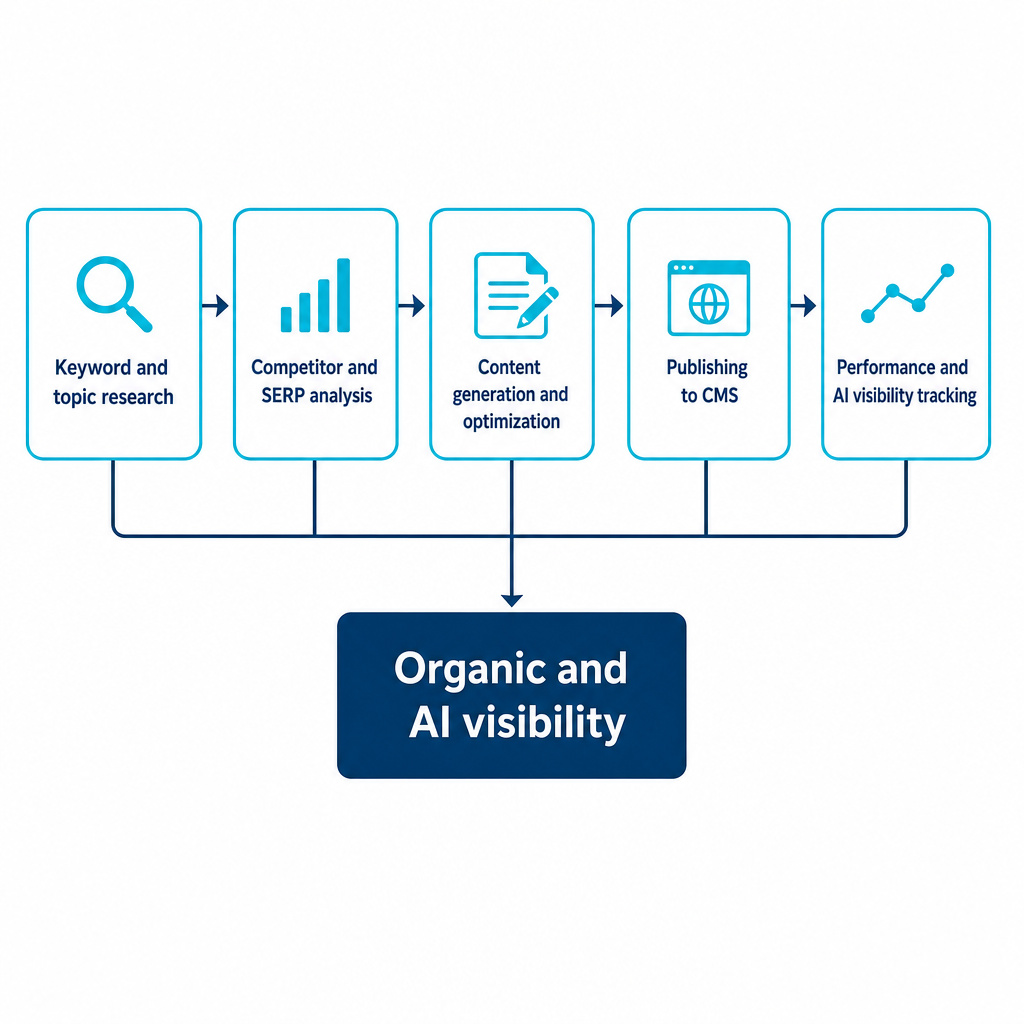
Most platforms cluster their features into a handful of jobs:
- Keyword research and topic discovery based on real search demand and competition.
- On-page optimization covering headings, structure, semantic coverage, and internal links.
- Content generation and rewriting aligned with SEO best practices and search intent.
- Competitor and SERP analysis, so you can see how top-ranking pages are built and what it takes to outrank them.
- Performance tracking across rankings, traffic, and visibility.
What's newer is that modern platforms are starting to track AI visibility — how often your brand or content appears inside AI assistants and chatbots — not just where you sit on a Google results page. As buyers increasingly ask ChatGPT, Perplexity, or Gemini instead of typing a query, being cited inside those answers becomes its own channel worth measuring.
Do you actually need one?
For most small businesses, SaaS founders, and marketing teams, the real question isn't "Should we use AI?" It's "Where does AI give us safe leverage?" You're usually choosing among three paths.
The first is continuing with manual workflows: keyword research in one tool, writers in another, uploads by hand, and publishing that slips whenever things get busy. The second is leaning on generic AI writers that produce fast copy but often drift off-brand, skip real research, and ignore the SEO data that decides whether a page ranks. The third is adopting a dedicated ai powered seo tool that connects research, writing, optimization, and publishing into one pipeline.
An AI SEO tool tends to pay off when a few things are true at once:
- You need consistent, frequent content but don't want to hire a full editorial team.
- You already know SEO matters, yet keeping up with keyword research, competitive analysis, and technical details keeps falling behind.
- You care about both Google rankings and how your brand shows up inside AI assistants, and you want to measure both.
A useful gut check: if your two biggest recurring bottlenecks are "What should we write next?" and "Who will actually publish it correctly every week?", a good tool converts that constant firefight into a system that simply runs.
How these tools work under the hood
Every platform is different, but most work through four connected mechanisms rather than a single magic step.
A data and research layer ingests SEO signals — keyword volumes, difficulty scores, SERP results, competitor pages, and sometimes your own analytics and Search Console data. AI models then surface opportunity clusters: topics and keywords where you can realistically rank and pull traffic rather than fighting for terms already owned by far larger sites.
AI-assisted planning and content creation takes those topics and generates outlines and drafts tuned to specific search intents, industries, and audiences. Large language models handle the drafting, but the stronger platforms don't just "write a blog post." They mirror the patterns of top-ranking pages — headings, FAQs, relevant entities — while keeping the piece unique and aligned to your brand.
Optimization and technical support layers on internal link suggestions, metadata, schema markup, and content adjustments that improve relevance and usability. Some platforms go further and automate structured-data enhancements that help visibility in both classic search and AI-driven search interfaces.
Publishing and measurement closes the loop. The tool saves content into your CMS, helps publish on a schedule, and tracks rankings, traffic, and sometimes mentions inside AI assistants. The more advanced platforms integrate directly with CMS APIs and search engine APIs, so content gets published and indexed quickly instead of sitting in a queue waiting for crawlers to notice it.
The difference between a helpful tool and a frustrating one usually lives at the seams between these four steps. A platform that researches well but dumps drafts into your inbox still leaves you doing the tedious publishing work by hand.
The main categories you'll compare
When you survey the market, tools tend to fall into three broad camps, each solving a different problem.
Content-focused AI SEO tools specialize in keyword-driven briefs, SERP analysis, and optimization recommendations for blog posts and landing pages. They shine when you already have writers but need sharper guidance on what to cover and how to match search intent.
All-in-one AI SEO platforms combine rank tracking, keyword research, site audits, and AI-generated insights or content in a single interface. Some now include AI visibility tracking, showing how content performs across both search results and AI-driven experiences like assistants and chatbots.
Technical and AI search visibility tools focus on technical SEO automation — schema, internal linking, speed — and on optimizing structured data for AI search and knowledge graphs. These matter most for larger sites, where technical gaps can materially affect both Google rankings and the answers AI assistants generate.
| Category | Best for | Core strength | You still handle |
|---|---|---|---|
| Content-focused | Teams with writers | Briefs and intent guidance | Writing and publishing |
| All-in-one platform | Broad SEO ownership | Research plus tracking in one place | Orchestrating outputs |
| Technical / AI visibility | Larger, complex sites | Structured data and automation | Content strategy |
| Content automation | Lean teams | End-to-end research-to-publish | Guardrails and approval |
That fourth row — content automation — is a newer segment that treats production, optimization, publishing, and indexing as one continuous pipeline rather than separate tools you have to wire together yourself. AymarTech sits in this segment.
Criteria that separate serious platforms from text generators
Once you're comparing shortlisted tools, a handful of practical criteria matter far more than feature-count marketing.
Content quality, originality, and fact-checking. Ask how a platform prevents generic or inaccurate output. The better tools combine SERP and topic analysis with editorial checks and constraints, rather than emitting unstructured AI text. We built AymarTech to write fact-checked SEO articles — not raw drafts — and to research low-competition, intent-matched topics so each piece stays relevant and defensible.
Brand voice and audience targeting. For small businesses and SaaS brands, "sounding like us" matters as much as ranking. Look for real controls over tone, style, reading level, and audience. In our platform you define your brand voice and target audience so drafts read like your own team wrote them, which keeps content feeling like a natural extension of your product and sales messaging.
Automation depth versus editorial control. Teams sit at different points on this spectrum. Some want AI to research and outline while humans write; others want end-to-end automation with approval checkpoints. We support both auto-publish and approval modes: finished articles can publish directly on a schedule, or land as drafts in your CMS for review first. That lets you start with human oversight and ease into more automation as trust builds.
Integrations and technical fit. Check which platforms a tool supports and how deeply it connects. Direct API or OAuth integrations are far more reliable than export-and-upload workflows. We integrate with WordPress.com via OAuth using the posts API, and also connect to WordPress.org, Webflow, Shopify, Wix, Notion, and generic API or webhook endpoints — so finished posts land in the system your team already uses.
Indexing, measurement, and AI visibility. Content only helps if it can be found and measured. Prioritize fast indexing, rank tracking, and insight into how your content surfaces inside AI assistants. After publishing, we can trigger the Google Indexing API, then monitor rankings and AI citations so you see which articles drive organic traffic and mentions in tools like ChatGPT, Claude, Perplexity, and Gemini.
Governance and risk. Understand how a tool handles source attribution, content duplication, and publishing permissions. Our workflow of connected accounts, approval mode, and CMS-level permissions — particularly OAuth with platforms like WordPress.com — gives you a governed path from AI draft to live article without sharing CMS passwords or bypassing existing roles.
If you're still building foundational understanding, our beginner guide to AI SEO platforms covers the concepts here at a slower pace, and our overview of the best AI SEO software for small businesses works through fit for lean teams specifically.
Where AymarTech fits
We built AymarTech to automate the full pipeline for businesses that want hands-off organic growth and visibility inside AI assistants. Rather than handing you another dashboard of suggestions, the platform is designed to research, write, fact-check, optimize, illustrate, and publish on autopilot while staying aligned with your brand voice and editorial standards.
In practice, that means we connect directly to your website and CMS and deliver finished, SEO-ready articles as real posts — not drafts you paste in yourself. We research low-competition, intent-matched keywords in your niche, write fact-checked articles in your brand voice with on-brand images and smart internal links, and auto-publish to WordPress, Webflow, Shopify, Wix, or Notion on the cadence you approve. Then we trigger the Google Indexing API and monitor rankings and AI citations so you can see what's driving both search and AI visibility. The mechanics of that last step are covered in detail in our guide on how to auto-publish blog posts to WordPress.
This approach makes the most sense when you want daily or weekly SEO content tailored to your products and audience without hiring a content team, when you need that content researched and internally linked so it drives rankings and conversions, and when you care about getting indexed quickly and cited by AI assistants rather than publishing posts and hoping. In short, if you want your blog to grow like a product — consistently, predictably, with clear feedback — an ai powered seo tool turns SEO content into a growth engine instead of an ad-hoc project.
Frequently asked questions
What is an ai powered seo tool in plain terms?
It's software that uses AI models to handle key SEO tasks — researching keywords, analyzing competitors, generating and optimizing content, and tracking performance — so you get more organic traffic with less manual work.
How is an AI-powered SEO tool different from a generic AI writer?
Generic AI writers produce text but usually ignore real SEO data like search volumes, SERP structure, and competition. AI SEO platforms combine that data with content generation and optimization, so the output is designed to rank and convert, not just fill a page.
Can AI-powered SEO tools really publish directly to my website?
Yes. Platforms like AymarTech integrate directly with content systems such as WordPress, Webflow, Shopify, and Wix, delivering finished articles as true posts and publishing automatically on a schedule or after your approval.
How do AI SEO tools help with AI assistants like ChatGPT or Perplexity?
Some platforms factor in AI search visibility: they optimize structured data and topical coverage, help content get indexed quickly, and monitor when your pages are cited or referenced inside AI-powered search tools.
Is it safe to let an AI-powered SEO tool auto-publish content?
Auto-publishing works best when you've set clear brand-voice rules, topics, and guardrails and trust the platform's research and fact-checking. We reduce risk by supporting both approval workflows and governed CMS integrations, so you control how and when AI-generated content goes live.